
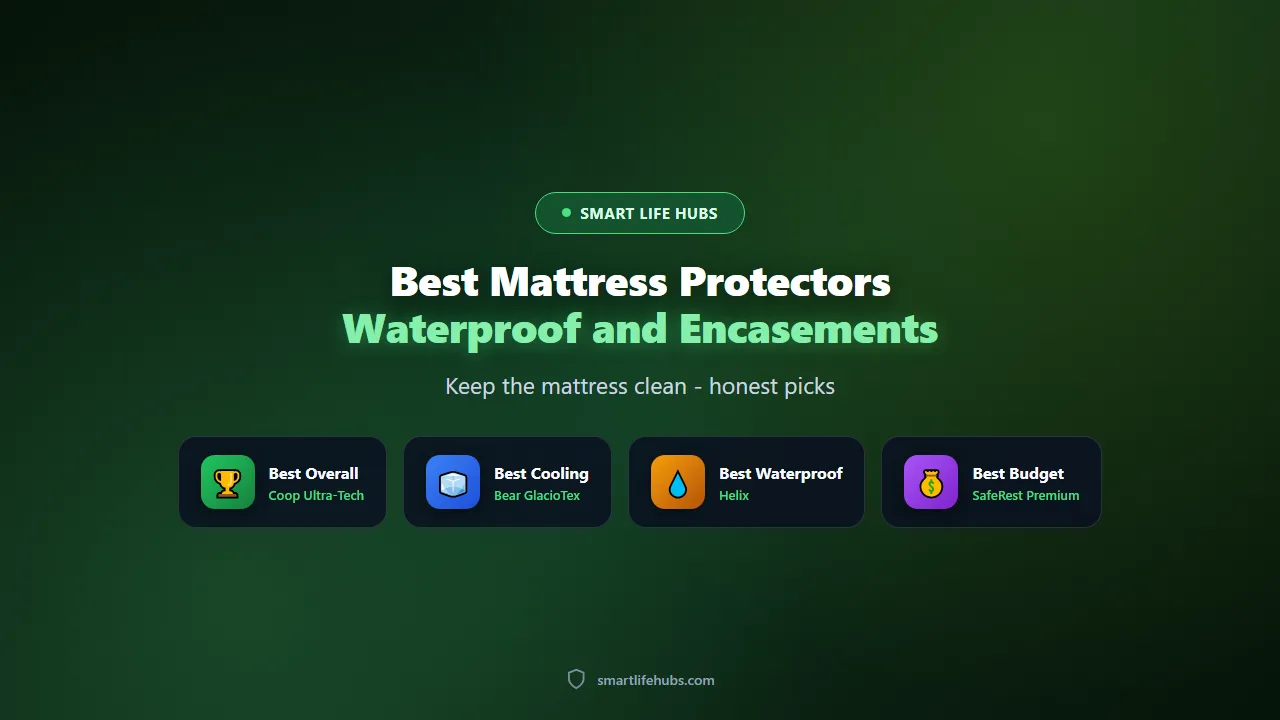
Best mattress protectors of 2026 are the thin layers that keep a spill, a sweat or a dust mite out of the mattress, and the honest finding after testing several is that the cheap ones fail in one of three ways: they crinkle loudly, they trap heat, or they leak at the seam. A good protector disappears under the sheet, and most buyers can find one for under 60 dollars.
The second thing to understand is that a protector and an encasement are different products. A protector sits on top and guards against spills and allergens, while an encasement zips around all six sides and is the one you need for bed bugs. If you have bed bugs or want the strongest protection, buy an encasement; for everyday protection, a protector is enough and more comfortable.
Prices below are US retail captured in November 2026 and they move with sales.
At a glance
| Product | Best for | Key specs | Price |
|---|---|---|---|
| Coop Ultra-Tech Waterproof | Best overall | Waterproof TPU, quiet, under 60 USD | About 50 to 60 USD |
| Bear GlacioTex Protector | Best cooling | GlacioTex cooling fibres, waterproof | About 80 to 120 USD |
| Helix Waterproof | Best cooling value | Cool, waterproof, anti-microbial | About 70 to 110 USD |
| SafeRest Premium | Best budget | Waterproof, hypoallergenic, cheap | About 25 to 40 USD |
| Utopia Bedding Encasement | Best bed bug protection | Six-sided zip, Velcro seal | About 28 USD |
The best mattress protectors of 2026
1. Coop Ultra-Tech Waterproof, best overall
The Coop is the pick because it solves the two problems that make people give up on a protector: it is quiet and it localises liquid without leaking, while staying under about 60 dollars. It uses a waterproof TPU backing with a breathable knit top, it fits a range of mattress depths and it has a soft feel rather than a plastic one. The honest trade-offs are a skirt that can be tight on very deep mattresses, a TPU layer that is less breathable than a cotton terry, and a protector rather than an encasement, so it is the pick for everyday protection.
Pros
- Quiet and waterproof, with liquid localised at the surface
- Soft knit top rather than a plastic feel
- About 50 to 60 dollars
Cons
- Skirt can be tight on very deep mattresses
- TPU backing is less breathable than cotton terry
Check today’s price on Amazon.
2. Bear GlacioTex Protector, best cooling
The GlacioTex is the pick if you sleep hot, because its cover uses a polyester-polyethylene blend that feels cool to the touch and wicks moisture, while the protector underneath stays waterproof and hypoallergenic. It costs about 80 to 120 dollars, and the honest trade-offs are a price above the budget options, a cooling layer that will saturate like any fabric, and a protector rather than a comfort layer, so it is the pick for a hot sleeper who wants the bed dry as well as cool.
Pros
- GlacioTex cover that feels cool and wicks moisture
- Waterproof, hypoallergenic and machine washable
- About 80 to 120 dollars
Cons
- Pricier than the basic protectors
- Cooling is a fabric treatment, not active
Check today’s price on Amazon.
3. Helix Waterproof, best cooling value
The Helix is the pick if you want a cool protector for less than the Bear, because it combines a breathable top with a waterproof, anti-microbial backing and a price around 70 to 110 dollars. The honest trade-offs are a brand that is better known for mattresses than protectors, a cooling performance that is good rather than exceptional, and a protector that is thinner than a terry option, so it is the pick for a hot sleeper on a mid budget.
Pros
- Breathable top with a waterproof anti-microbial backing
- About 70 to 110 dollars
- No shrinkage after washing
Cons
- Less cooling than the GlacioTex
- Thinner than a cotton terry protector
Check today’s price on Amazon.
4. SafeRest Premium, best budget
The SafeRest is the pick if you want a waterproof protector for the least money, because it offers a TPU-backed, hypoallergenic protector at about 25 to 40 dollars, which is enough for a guest room, a rental or a child’s bed. The honest trade-offs are a plastic feel that some people find noisy, a thinner construction that will not last as long, and a brand with a smaller review base, so it is the pick for a budget or a spare bed.
Pros
- About 25 to 40 USD, the cheapest here
- Waterproof and hypoallergenic
- Good for a guest room or a rental
Cons
- Plastic feel and a thinner build
- Less durable than the more expensive options
Check today’s price on Amazon.
5. Utopia Bedding Encasement, best bed bug protection
The Utopia is the pick if you need full protection rather than a top layer, because it zips around all six sides of the mattress with a heavy-duty zip and a Velcro flap over the pull, which is the detail that stops bed bugs slipping through the gap. It costs about 28 dollars, and the honest trade-offs are a protector that is harder to fit and remove, a fabric that is less breathable, and an encasement that will not stop an infestation starting, so it is the pick for containment.
Pros
- Six-sided zip with a Velcro guard over the pull
- About 28 dollars, cheap for an encasement
- Full protection against liquids, allergens and bed bugs
Cons
- Harder to fit and remove than a protector
- Less breathable and does not prevent infestations
Check today’s price on Amazon.
How to choose a mattress protector
Start with the job, because a protector and an encasement solve different problems. For spills, sweat, allergens and everyday protection, a protector is enough and more comfortable. For bed bugs, or for a mattress you want sealed completely, an encasement is the one that works, and it is worth the extra effort to fit.
Then check the waterproofing, because a protector that leaks at the seam is worse than none. Look for a TPU or vinyl backing that covers the top, a well-sewn seam and a brand that has been spill-tested. A protector that says water-resistant rather than waterproof will let a large spill through, so read the wording rather than the headline.
Check the breathability and the noise, because the two complaints that make people remove a protector are heat and crinkle. A cotton terry top is quiet and breathable, a knitted polyester is softer but warmer, and a vinyl-backed protector is the loudest and the hottest. If you sleep hot, look for a cooling fabric or a terry top rather than a bare TPU layer.
Think about the fit and the depth, because a protector that is too shallow will pop off the corner and one that is too deep will bunch. Measure the mattress depth and check the pocket, and look for a protector with a fitted skirt or elastic all round. A protector that moves in the night is one you will stop using.
Finally, be honest about the life, because a protector is a consumable rather than a buy-once item. A cheap protector that lasts two years is better value than an expensive one that delaminates in three, so check the warranty and the return policy, and plan to replace it when the backing cracks or the waterproofing fails. Tom’s Guide’s 2026 testing at tomsguide.com/best-picks/best-mattress-protector covers the waterproofing, the cooling and the fit of the current models.
Living with a mattress protector
Fitting and care
Fitting a protector is easier with two people, because the skirt has to go over all four corners and a protector that is half-on will ride up as soon as you lie down. Start at the top corners, work the skirt down one side, then the other, and smooth the top from the centre out so there is no pocket of air that will rustle in the night. A protector that is taut and flat is one you will not notice.
Care is the part that decides how long the waterproofing lasts, because the backing is a thin membrane and the wrong wash will destroy it. Use a mild detergent on a warm cycle, skip the bleach and the fabric softener, and dry on a low heat or a line. A protector that comes out of a hot dryer stiff and cracked has been ruined, and it will leak long before it wears out, so the care label is worth reading once before the first wash, and again before the first tumble dry.
Wash it before you first use it, because a new protector can have a stiff finish and a storage smell. Wash on a warm cycle with a mild detergent, avoid bleach and fabric softener, which damage the waterproofing, and tumble on a low heat or line dry. A protector washed harshly will lose its waterproofing before it wears out.
Put it on over a clean, dry mattress and smooth it out, because a protector that is bunched will rustle and will wear at the fold. Pull the skirt firmly over the corners, check that the seams sit flat, and tuck any excess under the mattress rather than leaving it loose, which is the usual cause of a protector riding up in the night.
Wash it every one to two weeks with the sheets, because a protector that is under a fitted sheet still collects sweat and skin. Use a gentle cycle, dry it fully before you put it back, and check the backing after a few months for any cracking or peeling, which is the sign it needs replacing.
Deal with spills immediately, because a protector buys you time rather than immunity. Strip the protector, rinse the spill with cold water, and wash it as soon as you can, since a dried stain is harder to remove and a sugary drink will degrade the backing. A protector that has absorbed a large spill should be checked for leaks through to the mattress.
Rotate the mattress and check the protector at the same time, because a protector hides the condition of the mattress underneath. Look for any sagging, any smell or any staining on the mattress itself, and check that the protector has not been the cause of a damp patch by trapping condensation against the mattress.
For the wider sleep range, our mattress guide covers the beds, and the mattress vacuum guide covers the cleaning.
Frequently asked questions
Frequently Asked Questions
6Do I need a mattress protector?
Yes. A mattress is a large, hard-to-clean investment, and a protector guards against spills, sweat, skin and dust mites for under 60 dollars. Most mattress warranties also require the mattress to be kept clean, and a stain can void the cover.
What is the difference between a protector and an encasement?
A protector sits on top and guards against spills and allergens, while an encasement zips around all six sides and is the one you need for bed bugs. For everyday protection a protector is more comfortable, and for containment an encasement is the stronger choice.
Will a waterproof protector make me hot?
A bare vinyl or TPU protector can be warm, so look for a cotton terry top or a cooling knit if you sleep hot. A protector with a breathable top and a waterproof backing will keep the bed dry without trapping as much heat.
How often should I wash a mattress protector?
Every one to two weeks with the sheets, and more often if you sweat heavily or have allergies. Wash on a warm gentle cycle, avoid bleach and softener, and dry it fully before it goes back on the bed.
Can a protector fix a mattress that already smells?
No. A protector stops a problem getting worse, but it will not remove an existing odour or stain. Clean and air the mattress first, and if the smell persists, the mattress may need replacing.
Do mattress protectors fit all mattress depths?
Not all. Check the pocket depth against your mattress, and look for a deep-pocket or extra-deep option if the mattress is thick or has a pillow top. A protector that is too shallow will pop off the corner.
The bottom line
Buy the Coop Ultra-Tech Waterproof at about 50 to 60 dollars if you want the best overall protector, because it is quiet, it localises liquid without leaking and it disappears under the sheet, which are the three things a protector has to do.
Buy the Bear GlacioTex at about 80 to 120 dollars if you sleep hot, the Helix Waterproof at about 70 to 110 dollars for cooling on a mid budget, the SafeRest Premium at about 25 to 40 dollars for the budget, and the Utopia Bedding Encasement at about 28 dollars if you need six-sided bed bug protection.
The honest point is that a protector is a consumable that protects an expensive object, so buy the one that fits your mattress depth, wash it gently and replace it when the backing cracks. A quiet, cool protector under a cotton sheet is the one you will keep on the bed.







Leave a Comment