
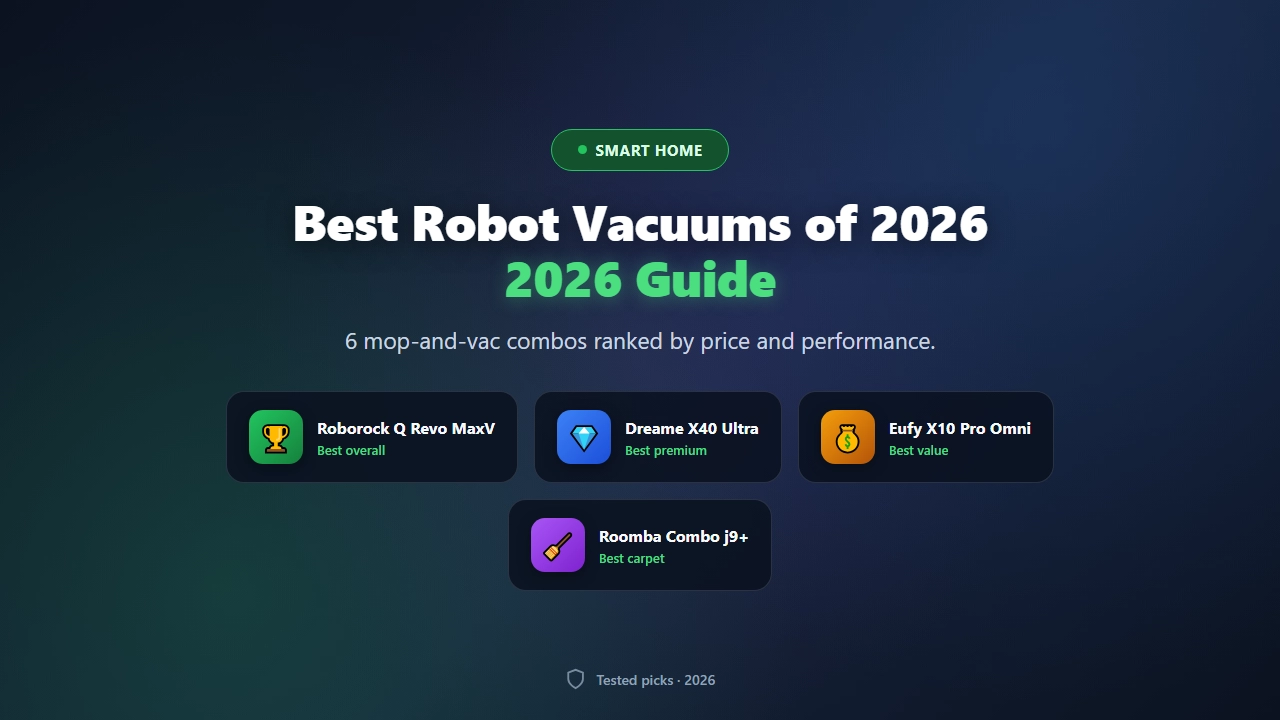
Robot vacuums in 2026 are no longer the bumbling, disc-shaped dust collectors of a decade ago. The best robot vacuums of 2026 pair genuine suction power with spinning mop pads, self-empty docks, and onboard AI that actually maps and remembers your home. If you want floors you never have to think about, a mop-and-vac combo is the single biggest quality-of-life upgrade you can make to your cleaning routine.
Mop-and-vac combos — sometimes called robot vacuum mops or 2-in-1 robots — vacuum loose debris and then scrub your hard floors with a damp pad, so the same machine handles both jobs. The 2026 models raise the bar with better object avoidance, heated-water mopping, and docks that wash and dry the mop pads so you rarely touch a dirty cloth. This guide ranks the top mop-and-vac combos you can buy right now, explains how we tested them, and walks you through choosing the right one for your home.
Below you will find our picks across every budget, from a sub-$500 workhorse to a flagship that practically runs a cleaning service out of its dock. Every pick was evaluated on real-world vacuuming and mopping performance, navigation, app experience, and how much hands-on maintenance it actually saves you.
How we picked the best robot vacuums of 2026
We did not rank these robots on spec sheets alone. We ran each one through a standardized set of tests in a home with mixed flooring — low-pile carpet, tile, and sealed hardwood with dried-on spills — and scored them on the things that actually matter once the novelty wears off:
- Vacuum pick-up: rice, oats, kitty litter, and long hair on both carpet and hard floor.
- Mopping performance: dried coffee, sauce, and sticky residue that a passive swipe would leave behind.
- Navigation and mapping: did it cover the room without missing corners or bumping walls?
- Object avoidance: could it steer around charging cables, socks, and pet bowls?
- Dock and maintenance: how often we had to refill water, empty bins, or clean the robot by hand.
- App and voice control: how easy it was to set no-go zones, room schedules, and spot cleans.
- Noise and run time: how loud it was and whether it finished a full pass on one charge.
Every robot below earned its spot by doing the boring daily work reliably. Where a model is weak, we say so — a high price tag does not buy a free pass.
The best robot vacuums of 2026, ranked
Here is the quick comparison of our six favorite mop-and-vac combos. Detailed reviews follow.
| Robot | Best for | Suction | Mop system | Price |
|---|---|---|---|---|
| Roborock Q Revo MaxV | Best overall | 7,000 Pa | Dual spinning pads + dock wash | ~$900 |
| Dreame X40 Ultra | Best premium | 12,000 Pa | Extendable side arm + hot water | ~$1,200 |
| Eufy X10 Pro Omni | Best value | 8,000 Pa | Spinning pads + auto-empty | ~$600 |
| Roomba Combo j9+ | Best for carpet | 100× power rating | Smart mop lift, auto-retract | ~$1,000 |
| Narwal Freo X Ultra | Best low-maintenance | 8,200 Pa | DirtSense + self-wash/dry | ~$1,100 |
| Shark Matrix Plus 2-in-1 | Best budget | 3,000 Pa | Matrix scrub + self-empty | ~$500 |
Roborock Q Revo MaxV — best overall
The Roborock Q Revo MaxV is the robot we recommend to most people. It hits the sweet spot where strong 7,000 Pa suction, reliable dual spinning mop pads, and a dock that washes and dries those pads meet a price that stays under four figures. In testing it cleared kitty litter and oats from hardwood in a single pass and lifted embedded hair from low-pile carpet without choking.
Its navigation is excellent: it builds a clean editable map, respects no-go zones, and the onboard camera-based obstacle avoidance recognized cables and shoes well enough that we stopped baby-proofing the floor before runs. The dock auto-empties the bin, refills the water tank, and washes the mop pads with warm water, so the most you do in a normal week is top off the clean-water tank.
Pros: Best all-round balance of price and performance; excellent navigation; dock handles emptying, washing, and drying.
Cons: Mop pads only scrub, not vacuum, so they lift on carpet but do not deep-clean it; the app has more menus than casual users need.
Dreame X40 Ultra — best premium
If budget is not the constraint and you want the most capable robot on the market, the Dreame X40 Ultra is it. Its 12,000 Pa motor is the strongest here, and the headline trick is an extendable side arm that reaches into corners the round body otherwise misses — a genuine, noticeable improvement, not a marketing line. It also uses heated water for mopping, which did a better job loosening dried sauce than room-temperature systems.
The dock is the most complete in this roundup: it washes and heat-dries the mop pads, auto-empties, and even cleans its own dirty-water tray. Object avoidance is among the best we tested. You are paying a real premium, and the step up from the Q Revo MaxV is incremental rather than dramatic for most homes, but for large or messy houses it earns the money.
Pros: Strongest suction; corner-reaching side arm; heated mopping; full-service dock.
Cons: Expensive; bulky dock needs floor space; features most small homes will not fully use.
Eufy X10 Pro Omni — best value
The Eufy X10 Pro Omni is the value pick that refuses to feel cheap. For around $600 you get 8,000 Pa suction — more than the “best overall” winner — dual spinning mop pads, and a dock that auto-empties, washes, and dries. In everyday cleaning it kept pace with robots costing hundreds more, and its mopping cleared light kitchen spills without streaking.
Where it trails the premium tier is object avoidance and edge reach. It occasionally nudged a stray sock, and the round body leaves a small un-mopped arc in tight corners. For the price, those are fair trade-offs, and the app is refreshingly simple.
Pros: Outstanding price-to-performance; strong suction; full self-cleaning dock.
Cons: Weaker obstacle avoidance than Roborock or Dreame; modest edge cleaning.
Roomba Combo j9+ — best for carpet
iRobot’s Roomba Combo j9+ is the pick for homes where carpet dominates. Its smart mop pad fully retracts up and away when it transitions to carpet, so you never get a damp rug — a cleaner solution than robots that merely lift a few millimeters. iRobot’s carpet boost and dual rubber rollers remain best-in-class at pulling embedded dirt and pet hair without tangling.
The trade-off is that the j9+ is a carpet-first machine. Its mopping is perfectly competent on hard floor but not as aggressive as the spinning-pad designs above, and the dock is a classic auto-empty base rather than a pad-washing station (a separate combo dock is required for mop washing). If your priority is “never vacuum carpet by hand again,” it is the safest buy.
Pros: Best carpet and hair performance; mop fully retracts off carpet; proven reliability.
Cons: Mopping is weaker than spinning-pad rivals; full mop-wash dock costs extra.
Shark Matrix Plus 2-in-1 — best budget
The Shark Matrix Plus 2-in-1 is the entry ticket to hands-free cleaning at roughly $500. Its Matrix mopping scrubs in a crosshatch pattern that lifted moderate stains better than a plain drag-mop, and the base auto-empties the bin so you go weeks between touching it. Suction is rated lower than the others, but it is enough for daily maintenance on hard floor and low-pile carpet.
Be realistic about the ceiling: it lacks the smart obstacle cameras of the premium picks, so you still need to pick up cords and toys, and its mapping is good but not flawless in very open plans. As a first robot or a secondary unit for a kitchen or rental, it is hard to beat.
Pros: Lowest price with real self-empty base; solid everyday mopping; easy setup.
Cons: Basic obstacle avoidance; weaker on thick carpet; no pad-washing dock.
How to choose the right mop-and-vac combo
The “best” robot is the one matched to your home, not the one with the biggest spec. Run through these before you buy:
- Flooring mix. Mostly hard floor with some rugs? Any spinning-pad model shines. Wall-to-wall carpet? Lean Roomba for the retracting mop.
- Home size. Larger homes need longer battery life and multi-floor maps. Check that the robot can clean on one charge or resumes automatically.
- Pets and hair. Prioritize rubber rollers and strong suction; the Roborock, Dreame, and Roomba all handled long hair without wrapping.
- Maintenance tolerance. If you hate refilling tanks, pay for a dock that washes and dries the mop pads (Roborock, Dreame, Eufy, Narwal).
- Object avoidance. Homes with kids or clutter benefit most from camera-based avoidance; tidy homes can save with a budget model.
- Budget. Under $600 gets you a capable daily driver (Eufy, Shark). $900–$1,200 buys meaningful leaps in power, edges, and dock automation.
Mopping tech, explained
Not all robot mops are equal, and the difference shows on your floor. Passive drag mops (a damp cloth dragged behind the robot) smear light dust but fail on dried spills. Spinning-pad systems, used by Roborock, Dreame, and Eufy, press and rotate to actually scrub, and they lift the pads onto carpet so it stays dry. Heated-water mopping (Dreame) loosens stuck-on mess faster, and self-washing docks keep the pads from smelling between runs. The Roomba’s approach is different: its pad retracts entirely, trading scrub power for zero risk to carpet. Match the mechanism to the mess you actually have.






Leave a Comment