
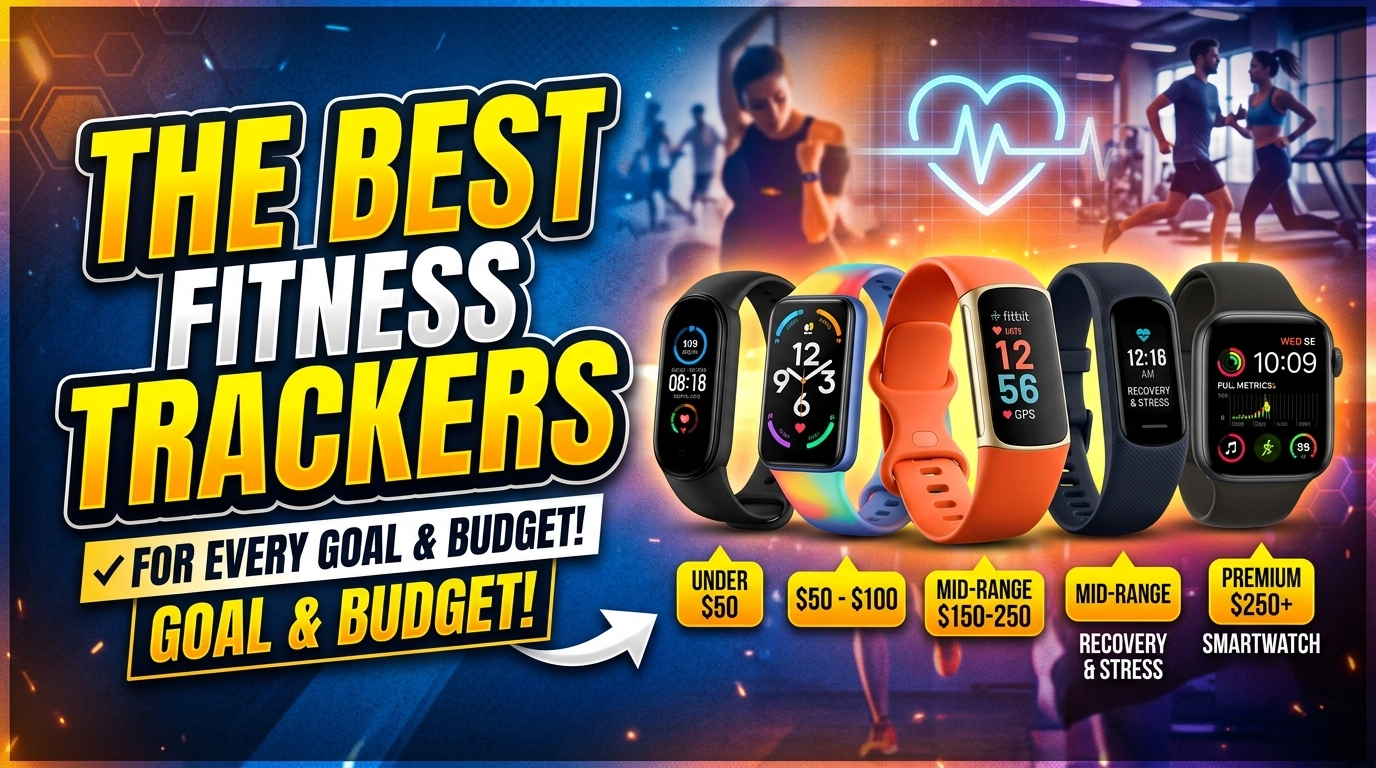
A good fitness tracker should do more than count steps. The right device can help you understand how much you move, how well you sleep, how your body responds to workouts, and whether your training is progressing.
But “best” depends on what you actually need. A lightweight fitness band may be perfect for tracking daily activity, while a runner could benefit much more from a dedicated GPS watch. Someone focused on sleep might prefer a smart ring, and an iPhone user may want a smartwatch that handles calls, notifications, workouts, and health data in one place.
We compared popular fitness bands, smartwatches, GPS watches, smart rings, and recovery wearables to find the best options for different goals and budgets.
Best fitness trackers at a glance
| Category | Best pick | Best for | Main advantage | Main drawback |
|---|---|---|---|---|
| Best overall | Fitbit Charge 6 | Most users | Strong core tracking in a slim design | Some advanced features require Fitbit Premium |
| Best budget tracker | Fitbit Inspire 3 | Beginners | Affordable and easy to use | No built-in GPS |
| Best for iPhone users | Apple Watch Series 10 | iPhone owners | Excellent health and smartwatch integration | Usually requires daily charging |
| Best for Android users | Samsung Galaxy Watch 7 | Android and Samsung users | Fitness, health, and smartwatch features | Some features work best with Samsung phones |
| Best for runners | Garmin Forerunner 265 | Dedicated runners | Detailed GPS and training tools | More fitness-focused than smartwatch-focused |
| Best battery life | Garmin Vivoactive 5 | Everyday users and travelers | Up to about 11 days of battery life | Less advanced than Garmin’s running watches |
| Best for sleep | Oura Ring 4 | Sleep and wellness tracking | Comfortable overnight wear and detailed sleep insights | Requires a membership for the full experience |
| Best for recovery | Whoop 5.0 | Serious athletes | Strain, sleep, and recovery coaching | Membership is required |
| Best no-subscription option | Garmin Vivoactive 5 | Value-conscious users | Core features do not require a monthly fee | Fewer lifestyle apps than Apple or Samsung watches |
Prices vary by retailer, storage configuration, cellular connectivity, and sales. Subscription terms can also change, so check the current cost before buying.
Best fitness tracker overall: Fitbit Charge 6
The Fitbit Charge 6 is the best choice for most people who want a fitness tracker rather than a full smartwatch. It is slim, comfortable, relatively easy to use, and includes the features most people care about: steps, heart rate, sleep, workouts, stress, and activity trends.
It also includes built-in GPS, which means you can record outdoor walks and runs without carrying your phone. That is a meaningful advantage over cheaper bands that rely on a phone’s GPS connection.
The Charge 6 is especially appealing to beginners because Fitbit’s app presents information in a friendly, approachable way. You do not need to understand advanced training terminology to make sense of your daily activity, sleep duration, or heart-rate trends.
Why it stands out:
- Slim, lightweight design
- Built-in GPS
- Heart-rate and sleep tracking
- Workout tracking
- Activity reminders
- Google Maps and Google Wallet support
- Generally lower cost than a premium smartwatch
What to consider: Some deeper sleep, wellness, and workout insights require Fitbit Premium. The basic tracking experience remains useful without it, but calculate the long-term cost if you want access to all the app’s features. Recent comparisons continue to list the Charge 6 among the strongest all-purpose fitness bands because it combines core tracking with a relatively accessible price. Digital Trends1
Best for: People who want reliable everyday tracking without wearing a large smartwatch.
Best budget fitness tracker: Fitbit Inspire 3
The Fitbit Inspire 3 is a sensible starting point for anyone new to fitness trackers. It focuses on the essentials: steps, heart rate, sleep, calories, activity reminders, and basic workout tracking.
Its small size makes it comfortable for overnight wear, and its battery can last longer than many full-featured smartwatches. It does not have built-in GPS, however, so you will need your phone nearby to map outdoor walks or runs.
That limitation will not matter to everyone. If your main goals are becoming more active, monitoring daily steps, and developing a consistent sleep routine, the Inspire 3 may provide everything you need.
Pros:
- Affordable
- Lightweight
- Simple to operate
- Comfortable for sleep
- Useful activity and sleep tracking
- Longer battery life than many smartwatches
Cons:
- No built-in GPS
- Smaller display
- Fewer smartwatch features
- Some advanced insights may require Fitbit Premium
Best for: Beginners, casual users, and anyone who wants basic health tracking without spending smartwatch money.
Best fitness tracker for iPhone users: Apple Watch Series 10
The Apple Watch Series 10 is the best choice for iPhone owners who want fitness tracking alongside a broad set of smartwatch features. It can track workouts, heart rate, sleep, activity rings, walking steadiness, and other health data while also handling notifications, calls, messages, music, maps, and payments.
Its biggest advantage is how naturally it works with the iPhone. Health and workout data are integrated into Apple’s ecosystem, and the watch supports a large selection of third-party fitness apps.
The Series 10 is also a strong option for people who want real-time information during exercise. Its bright display makes it easy to see pace, heart rate, elapsed time, and workout zones without reaching for a phone.
Why choose it:
- Excellent iPhone integration
- Large, bright display
- Extensive workout tracking
- Built-in GPS
- Strong app selection
- Notifications, calls, music, and payments
- Core health and fitness features do not require a separate data-analysis subscription
The main drawback: Battery life is much shorter than that of most fitness bands and sports watches. Depending on use, many owners will need to charge it every day. That can be inconvenient for people who want uninterrupted overnight tracking. Reviews of the Series 10 have praised its health and fitness tools while continuing to identify its roughly one-day battery life as a limitation. Digital Trends1
Best for: iPhone users who want one device for fitness, communication, and everyday smartwatch functions.
Best fitness tracker for Android users: Samsung Galaxy Watch 7
The Samsung Galaxy Watch 7 is a well-rounded option for Android users, particularly those who already own a Samsung phone. It combines fitness tracking with smartwatch features such as notifications, apps, payments, music controls, and calls.
It has a bright touchscreen, built-in GPS, heart-rate monitoring, sleep tracking, and a wide range of workout modes. It is a better fit than a basic fitness band for people who want to interact with their device throughout the day.
Some health features and integrations work best within the Samsung ecosystem. Android users with phones from other brands should check compatibility before buying.
Strengths:
- Full smartwatch experience
- Built-in GPS
- Large, readable display
- Workout and sleep tracking
- Strong Samsung phone integration
- Useful notifications and apps
Weaknesses:
- Battery life is typically shorter than that of a fitness band
- Some advanced features are limited on non-Samsung phones
- More expensive than a basic tracker
Best for: Android users who want a smartwatch with substantial fitness and health capabilities. The Galaxy Watch 7 is often recommended for Samsung owners, although battery performance can decline when GPS and continuous health monitoring are used heavily. Digital Trends
Best fitness tracker for runners: Garmin Forerunner 265
The Garmin Forerunner 265 is designed for runners who want more than a daily step count. It provides detailed workout data, GPS tracking, pace information, heart-rate zones, training guidance, recovery information, and support for structured workouts.
The watch is particularly useful if you are preparing for a race or following a training plan. You can view interval sessions, monitor your pace during a run, review your performance afterward, and use the data to plan future workouts.
Compared with a general-purpose smartwatch, the Forerunner 265 puts training first. It has fewer lifestyle features than an Apple Watch or Galaxy Watch, but that simplicity can be an advantage when you want your device to stay focused on exercise.
Best features for runners:
- Accurate route and distance tracking
- Pace and heart-rate data
- Interval workouts
- Training plans
- Recovery recommendations
- Running dynamics and performance metrics
- Strong battery life during regular use
- Support for multiple sports
Potential drawbacks:
- Higher price than a basic fitness band
- Interface may feel more technical to beginners
- Fewer everyday apps than a traditional smartwatch
Best for: Runners who train regularly, follow structured plans, or want detailed performance data.
Best fitness tracker for battery life: Garmin Vivoactive 5
The Garmin Vivoactive 5 is a strong middle ground between a fitness band and a sports watch. It offers a color display, built-in GPS, sleep tracking, heart-rate monitoring, workout modes, and a battery life that can reach about 11 days under suitable conditions.
That battery life makes it a good choice for travelers, people who dislike daily charging, and anyone who wants to wear a tracker overnight. It also gives Garmin users access to a large amount of health and fitness information without requiring a monthly subscription for core features.
The Vivoactive 5 is not as specialized as the Forerunner line, so serious runners may prefer a dedicated running watch. It is also less app-focused than an Apple Watch or Galaxy Watch.
Best for:
- General fitness
- Walking and gym workouts
- Sleep tracking
- Travel
- Users who want long battery life
- People who prefer not to pay a recurring membership
Best for: Anyone who wants a capable everyday fitness watch with unusually long battery life.
Best fitness tracker for sleep: Oura Ring 4
The Oura Ring 4 is one of the best choices for people who care more about sleep and recovery than real-time workout data. It has no screen, so it will not show notifications or pace during a run. Instead, it quietly records information throughout the day and presents it in the Oura app.
Its ring design is comfortable for many people to wear overnight, and the app focuses heavily on sleep duration, sleep consistency, readiness, recovery, heart-rate variability, resting heart rate, and temperature trends.
A ring can also be a good alternative for people who find wrist-worn devices uncomfortable at night or do not want another screen on their body.
Advantages:
- Discreet design
- Comfortable for overnight wear
- Strong sleep and recovery emphasis
- No distracting display
- Tracks long-term wellness trends
- Typically lasts several days per charge
Drawbacks:
- No screen for real-time workout feedback
- Less practical for checking pace during exercise
- Accurate sizing is important
- Full functionality requires a membership
Best for: Sleep-focused users, wellness enthusiasts, and people who prefer a minimalist wearable. Oura is frequently recognized for sleep and recovery tracking, but the membership should be included in the total cost before buying. Digital Trends2
Best fitness tracker for recovery: Whoop 5.0
Whoop is built around the idea that training is only one part of fitness. Sleep, stress, recovery, and accumulated strain also determine how ready you are for your next workout.
The Whoop 5.0 is a screen-free wearable that focuses on metrics such as sleep, strain, heart-rate variability, recovery, and training load. Rather than checking the time or reading notifications, you use the app to review how your recent behavior may be affecting your body.
This approach can be useful for athletes who train frequently and are willing to adjust their workouts based on recovery data. It is less compelling for someone who simply wants step counting or occasional exercise logging.
Why athletes choose it:
- Detailed strain and recovery analysis
- Sleep coaching
- Screen-free design
- Continuous wear
- Useful long-term trends
- Charging while wearing the device, depending on the model and charging system
The trade-off: Whoop uses a membership-based model. The ongoing cost is worthwhile only if you will regularly use its analysis to change training, sleep, or recovery habits. Current comparisons describe Whoop as a specialist tool for serious athletes, but identify the required membership as its biggest disadvantage. TechRadar2
Best for: Athletes who train several days a week and want coaching centered on recovery.
Best no-subscription fitness tracker: Garmin Vivoactive 5
The Garmin Vivoactive 5 earns a second mention because it is one of the better options for buyers who want to pay once and continue using the core fitness features without a monthly fee.
Garmin’s app provides workout records, health trends, sleep data, activity information, and training-related insights. The watch also offers GPS, a color display, and multiple exercise modes.
Garmin has introduced paid premium features in parts of its ecosystem, so it is still wise to check the current plan details. However, the Vivoactive 5 remains a strong choice for people who want access to everyday tracking without the subscription dependence associated with some recovery-focused wearables.
Another option for runners is the Coros Pace 3, which has been praised for its lightweight design, running tools, and battery life of up to 24 days in suitable use. It is more of a sports watch than a lifestyle smartwatch, but that is exactly why many runners like it.
Best for: Buyers who want useful fitness data, long battery life, and predictable ownership costs.
How to choose the right fitness tracker
Start with your main goal
Your primary use matters more than a long list of specifications.
- General activity: Fitbit Charge 6 or Inspire 3
- Sleep tracking: Oura Ring 4
- Running: Garmin Forerunner 265
- Android smartwatch features: Samsung Galaxy Watch 7
- iPhone integration: Apple Watch Series 10
- Recovery coaching: Whoop 5.0
- Long battery life: Garmin Vivoactive 5
- No recurring fee: Garmin Vivoactive 5 or a Garmin sports watch
Check compatibility before buying
A tracker may be excellent but still unsuitable for your phone.
Apple Watch models are designed for iPhone users. Samsung watches work best with Android phones, and certain features may be restricted when paired with another brand. Fitness bands and Garmin watches usually offer broader compatibility, but you should still check the required app and operating-system version.
Decide whether you need built-in GPS
There are three common arrangements:
- No GPS: The device records basic activity but does not map outdoor routes.
- Connected GPS: The tracker uses your phone’s GPS.
- Built-in GPS: The tracker maps runs, walks, and rides independently.
Built-in GPS is worth prioritizing if you regularly run, cycle, hike, or exercise without carrying your phone.
Consider battery life honestly
A smartwatch with a bright display and frequent GPS use may need charging every day or two. A basic band may last a week or longer, and some Garmin watches can last for weeks depending on the model and settings.
Think about when you are willing to charge:
- Daily charging may be fine for a smartwatch.
- Multi-day battery life is better for sleep tracking.
- Long battery life is especially useful for travel and hiking.
- GPS use usually reduces battery life substantially.
Calculate the real cost
The purchase price is not always the full price. For a subscription-based tracker, use this formula:
Two-year cost=Device price+(24×monthly membership fee)
For an annual plan:
Two-year cost=Device price+(2×annual membership fee)
A more expensive device without a subscription may cost less over time than a cheaper device that requires a monthly membership.
Are fitness trackers accurate?
Fitness trackers are useful for identifying patterns, but they are not perfect measuring instruments. Accuracy can vary according to the device, fit, skin contact, activity, movement, and software algorithms.
Step counts and heart-rate trends can be helpful for comparing your activity from day to day. GPS watches are generally more useful for distance and route tracking than basic bands. Sleep stages and recovery scores should be treated as estimates rather than definitive measurements.
A wearable should not replace medical testing or professional advice. If a device reports an unusual health reading or you have concerning symptoms, speak with a qualified healthcare professional.
Fitness tracker features that matter most
The most useful features are usually:
- Comfortable fit
- Reliable battery life
- Clear app design
- Built-in GPS, if you exercise outdoors
- Accurate-enough heart-rate tracking
- Sleep tracking
- Automatic workout detection
- Water resistance
- Compatibility with your phone
- No unwanted subscription surprises
A long sensor list is less important than whether the device turns its data into information you can understand and use.
The Fitbit Charge 6 is the best all-around choice for most people because it combines useful health and fitness tracking with a slim design and built-in GPS.
Choose the Fitbit Inspire 3 if you want an inexpensive, beginner-friendly tracker. Choose the Apple Watch Series 10 if you use an iPhone and want a complete smartwatch. Android and Samsung users should consider the Galaxy Watch 7, while dedicated runners will get more useful training data from the Garmin Forerunner 265.
For sleep and recovery, the Oura Ring 4 is a discreet option, while Whoop is better suited to athletes who want detailed strain and readiness coaching. If battery life and no recurring subscription are your priorities, the Garmin Vivoactive 5 is one of the most balanced choices available.
Ultimately, the best fitness tracker is not necessarily the one with the most sensors or the highest price. It is the one you will wear consistently, charge regularly, understand easily, and use to make realistic improvements to your daily habits.
Frequently Asked Questions
16What is the best fitness tracker overall?
The Fitbit Charge 6 is the best all-around choice for most people. It combines reliable health and fitness tracking, built-in GPS, a slim design, and an easy-to-use app. It strikes a good balance between features and price, making it suitable for beginners and experienced users alike.
Are fitness trackers accurate?
Fitness trackers provide useful estimates and trends rather than perfect measurements. Accuracy varies based on the device, how well it fits, skin contact, the type of activity, and the software algorithm. Step counts and heart-rate trends are generally reliable for comparing your activity day to day. GPS distance tracking is fairly accurate for outdoor activities. Sleep stages and recovery scores should be treated as estimates, not definitive measurements. Wearables should not replace professional medical testing or healthcare advice.
What is the difference between a fitness tracker and a smartwatch?
A fitness tracker prioritizes health and activity data, usually with a smaller display and longer battery life. A smartwatch adds smartphone features such as notifications, calls, messages, music, payments, and app support. If you mainly want to track steps, heart rate, sleep, and workouts, a fitness tracker is often sufficient and less expensive. If you want a device that also handles communication and everyday smartphone tasks, a smartwatch is better.
Do fitness trackers work without a phone?
It depends on the device. Most fitness trackers can record basic activity and workouts without a phone nearby. However, they usually need to connect to a smartphone app to set up, sync data, receive notifications, and view detailed insights. GPS watches with built-in GPS can map routes independently, but they still typically require a phone to upload and analyze the data later. Check the product specifications to confirm what features require a phone connection.
Do all fitness trackers require a subscription?
No. Many fitness trackers, including the Fitbit Charge 6, Fitbit Inspire 3, and Garmin Vivoactive 5, offer useful core features without a monthly membership. However, some brands like Whoop and Oura use subscription-based models where full functionality requires a paid plan. Always check whether a tracker requires a subscription before buying, and calculate the total two-year cost including membership fees.
Which fitness tracker is best for sleep tracking?
The Oura Ring 4 is one of the best choices for sleep tracking. Its ring design is comfortable to wear overnight, and it provides detailed insights into sleep duration, sleep stages, consistency, readiness, and recovery. Other good options include the Fitbit Charge 6 and Samsung Galaxy Watch 7, although the Oura Ring’s discreet form factor and sleep-focused analytics make it particularly popular with sleep-conscious users.
What is the best fitness tracker for runners?
The Garmin Forerunner 265 is purpose-built for runners. It provides accurate GPS tracking, detailed pace and heart-rate data, training plans, interval workouts, recovery recommendations, and running-specific metrics. If you want a less expensive option, the Garmin Vivoactive 5 offers solid GPS, sleep tracking, and battery life, though it is less specialized for running. The Coros Pace 3 is another lightweight option with excellent battery life and running tools.
How long do fitness tracker batteries last?
Battery life varies widely. Basic fitness bands like the Fitbit Inspire 3 can last 5–10 days. Mid-range trackers like the Fitbit Charge 6 typically last 5–7 days. Smartwatches like the Apple Watch usually need charging every 1–2 days. Garmin sports watches can last anywhere from several days to 2–3 weeks depending on GPS use and model. Built-in GPS use drains the battery faster than relying on connected GPS. Choose based on your willingness to charge: daily charging is typical for smartwatches, while trackers meant for sleep should last at least several days.
Can a fitness tracker replace a medical device?
No. Consumer fitness trackers are designed for wellness and fitness monitoring, not medical diagnosis or treatment. While features like ECG and blood oxygen monitoring can provide useful information, they should not replace professional medical testing or advice. If a wearable reports an unusual reading or you have health concerns, consult a qualified healthcare professional.
What is the best budget fitness tracker?
The Fitbit Inspire 3 is the best budget option. It costs significantly less than a smartwatch while still providing step counting, heart-rate monitoring, sleep tracking, calories, and basic workout logging. It has a longer battery life than many smartwatches. The main trade-off is that it does not have built-in GPS, so you will need your phone to map outdoor walks or runs.
Should I choose a fitness tracker with or without a subscription?
It depends on your priorities and budget. Trackers without subscriptions like the Garmin Vivoactive 5 have lower long-term costs and offer useful core features at no extra charge. Subscription-based trackers like Whoop and Oura may provide more specialized insights (recovery coaching, detailed sleep analysis) but add monthly expenses. Calculate the total two-year cost before deciding. A more expensive device without a subscription may cost less over time than a cheaper device with mandatory monthly fees.
Which fitness tracker should iPhone users buy?
The Apple Watch Series 10 is the best choice for iPhone users who want full integration with their phone, including notifications, calls, messages, music, maps, and payments. It also has strong fitness and health tracking. However, it requires daily or near-daily charging. If you want a longer-lasting device, the Fitbit Charge 6 or Garmin Vivoactive 5 work well with iPhones and have much better battery life, though they offer fewer smartwatch features.
Which fitness tracker should Android users buy?
The Samsung Galaxy Watch 7 is the best smartwatch option for Android users, especially those with Samsung phones. It combines fitness tracking with smartwatch features. For a basic fitness band that works with any Android phone, the Fitbit Charge 6 and Fitbit Inspire 3 are both solid choices. Garmin watches also work well with Android devices and offer excellent sports-tracking capabilities.
Do I need built-in GPS on a fitness tracker?
It depends on how you exercise. If you primarily walk around town, use a gym, or do activities indoors, you may not need built-in GPS. If you regularly run, cycle, hike, or swim outdoors and want to map your routes without carrying your phone, built-in GPS is worth the extra cost. Connected GPS (using your phone) is less accurate but is free and requires fewer battery resources. Many basic fitness bands rely on connected GPS or step counting alone.
What fitness tracker has the longest battery life?
Garmin sports watches and fitness bands generally have the longest battery life. The Garmin Vivoactive 5 can last around 11 days with typical use, and some Garmin running watches can last 2–3 weeks with light use. Garmin Epix and Fenix models also offer extended battery life. In contrast, smartwatches like the Apple Watch Series 10 and Samsung Galaxy Watch 7 typically last 1–3 days. If battery life is a priority, choose a dedicated fitness band or sports watch over a general-purpose smartwatch.
Is a fitness ring (like Oura) better than a wrist-worn tracker?
It depends on your preferences. A smart ring like the Oura Ring 4 is comfortable for overnight wear, discreet, and focuses on sleep and recovery data. However, it has no screen, so you cannot check your heart rate or pace during a workout. Wrist-worn trackers have displays, making them more practical for real-time workout feedback, notifications, and everyday use. Choose a ring if sleep and recovery are your priorities and you do not mind using an app to check data. Choose a wrist-worn tracker if you want real-time feedback during exercise or prefer a visible display.



Leave a Comment