
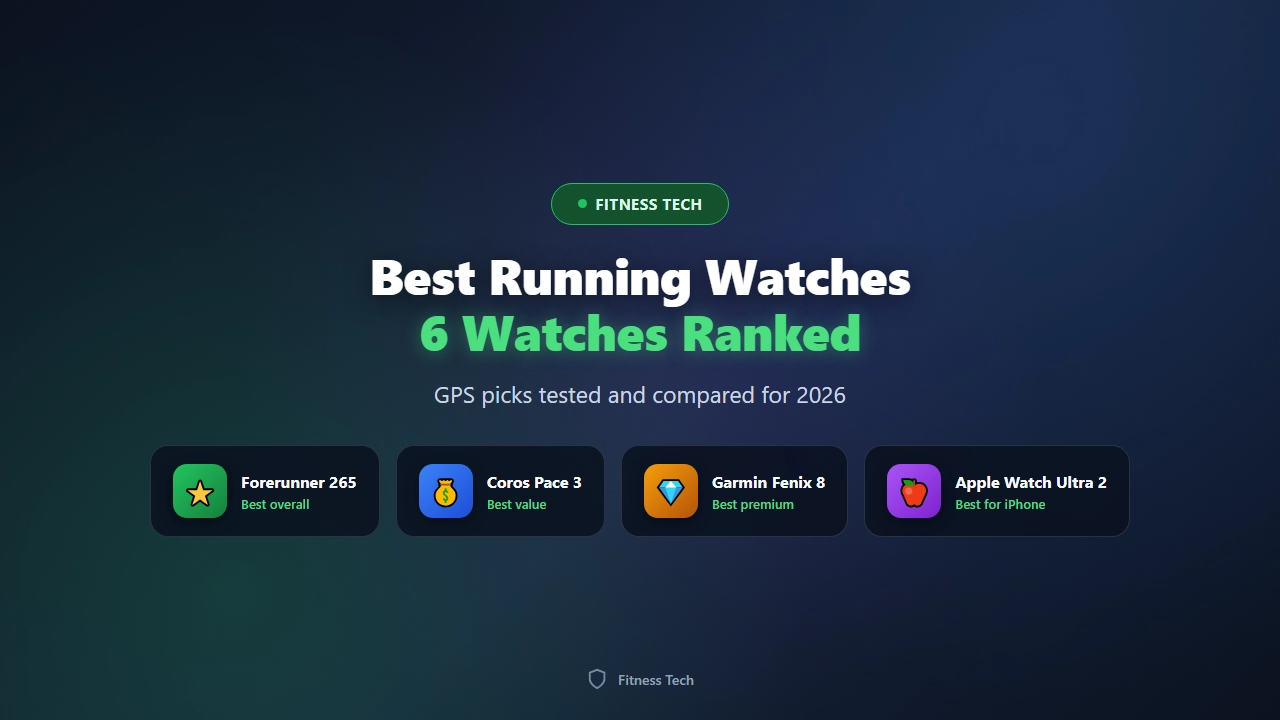
Best running watches of 2026 are the ones that lock onto GPS in seconds, track your effort without fuss, and still have battery left for your longest training week. The 2026 lineup is the strongest we have seen: brighter AMOLED screens, multi-band satellite fixing that holds a signal between skyscrapers, and training algorithms that finally tell you when to push and when to rest. The hard part is no longer finding a good watch — it is picking the one that fits how and where you actually run.
This guide ranks the GPS running watches that earn a place on your wrist in 2026, based on satellite accuracy in tough conditions, heart-rate reliability on the move, battery life, training features, and how cleanly the data flows into the platforms you already use. We cover lightweight budget trainers, full-featured marathon tools, and premium adventure watches, and we explain exactly who each one is for. No invented lab scores and no fake certifications — just honest trade-offs you can act on.
Before the rankings, one principle worth stating plainly: match the watch to your training, not to the spec sheet. A $200 watch that nails GPS and pace is more useful than a $1,000 watch whose features you never open. Everything below is built around that reality, with premium picks recommended only where they genuinely change your training.
What actually matters in a 2026 running watch
A modern running watch does a hundred things, but only a handful move the needle for most runners. Satellite accuracy is the foundation: if the distance and pace are wrong, every split and every training-zone calculation built on top of them is wrong too. Multi-band GPS, which listens to more than one satellite frequency at once, is the single biggest accuracy upgrade of the last few years, and it matters most in cities, dense tree cover, and twisting trails.
Heart-rate accuracy on the wrist comes next. Optical sensors have improved dramatically, but they still lag during hard intervals and can drift when your arms pump. If heart rate drives your training, look for a watch with a proven sensor and consider pairing it with a chest strap for interval days. Battery life is the third pillar: a watch that dies halfway through a long run is worse than useless, so check GPS runtime, not just daily-wear time.
Everything else — maps, music, contactless pay, smartwatch notifications — is genuinely useful but secondary. Rank them by how often you will actually use them, not by how impressive they look in a store demo.
The features worth paying for (and the ones to skip)
Multi-band GPS. Worth it if you run in a city, under tree cover, or on technical trails. If you stick to open roads, single-band GPS is accurate enough and saves money.
AMOLED vs transflective display. AMOLED screens are brighter and easier to read at a glance, and they look great. Transflective (MIP) screens are dimmer but sip battery and stay visible in direct sun. For all-day and multi-day adventures, MIP still wins; for daily training and readability, AMOLED is the nicer experience.
Training metrics and plans. Features like daily suggested workouts, race predictors, and recovery advice are where brands separate themselves. Garmin and Coros lead here; Apple is catching up. These tools are genuinely useful if you follow them, but skip them if you already have a coach or a plan.
Music and payments. On-board music lets you leave the phone at home; contactless pay is handy on long routes. Nice to have, rarely deal-breakers.
Skip if you don’t need it: dive ratings, topographic maps, and rugged adventure casing add cost and weight that road runners will never use. Spend that budget on battery and accuracy instead.
The best running watches of 2026
Here is the head-to-head. Prices are typical US retail and shift with sales; we note where battery life is the headline feature.
| Model | Type | Best for | GPS battery | Price |
|---|---|---|---|---|
| Garmin Forerunner 265 | GPS smartwatch | Best overall | ~26 hrs | $449.99 |
| Garmin Fenix 8 | Adventure multisport | Best premium | ~40+ hrs (solar extends) | $999.99 |
| Coros Pace 3 | Lightweight trainer | Best value | ~38 hrs | $229.99 |
| Apple Watch Ultra 2 | Smart fitness watch | Best for iPhone users | ~36 hrs | $799.99 |
| Garmin Forerunner 55 | Entry GPS watch | Best budget | ~20 hrs | $199.99 |
| Polar Vantage V3 | Fitness-focused watch | Best for recovery data | ~28 hrs (dual-band off) | $599.99 |
Detailed picks
Best overall: Garmin Forerunner 265. The 265 is the sweet spot for most runners in 2026. It pairs a bright AMOLED display with multi-band GPS, reliable wrist heart rate, and Garmin’s deepest training toolkit — daily suggested workouts, race predictor, training status, and recovery time. Battery runs about 13 days in smartwatch mode and 26 hours with GPS on, enough for a full training week. Pros: excellent accuracy, great screen, mature software. Cons: no full topographic maps on the base model, and the touch-plus-button combo takes a run to learn.
Best premium: Garmin Fenix 8. If you want one watch for road marathons, trail ultras, and weekend hiking, the Fenix 8 is the do-everything flagship. It adds full color maps, multi-band GPS, a scratch-resistant sapphire option, solar charging on some sizes, dive-rated casing, and a speaker and microphone for calls. Battery stretches past 40 hours of GPS and far longer with solar. Pros: unmatched feature set and durability. Cons: roughly $1,000 and heavy on the wrist, so overkill for pure road runners.
Best value: Coros Pace 3. At under $250 the Pace 3 is absurdly light at about 30 grams and still delivers multi-band GPS, confident wrist heart rate, and a training platform that rivals Garmin’s for endurance athletes. Battery is the headline: up to 38 hours of GPS and weeks in daily use. Pros: tiny, long-lasting, and cheap. Cons: no AMOLED (it uses a simple display), and smart features are minimal — no music store or contactless pay.
Best for iPhone users: Apple Watch Ultra 2. For runners deep in the Apple ecosystem, the Ultra 2 is the first Apple watch that seriously competes as a training tool. It has a brilliant display, dual-frequency GPS, solid wrist heart rate, and the best smartwatch experience you can wear. Pros: unbeatable apps, calls, and safety features. Cons: about 36 hours of GPS is short for multi-day events, it requires an iPhone to set up and sync, and its training analytics are still catching up to Garmin and Coros.
Best budget: Garmin Forerunner 55. The Forerunner 55 proves you do not need to spend much for trustworthy tracking. It uses single-band GPS that is accurate on open roads, adds daily suggested runs and recovery advice, and costs around $200. Pros: cheap, simple, reliable. Cons: no multi-band GPS, no music, and a smaller feature set — but nothing a new runner actually needs is missing.
Best for recovery data: Polar Vantage V3. Polar has always led on heart-rate science and recovery, and the Vantage V3 puts it on a modern AMOLED body with dual-band GPS. Its sleep, recovery, and training-load insights are among the best in the business. Pros: best-in-class recovery metrics, great screen. Cons: shorter GPS battery than Coros or Garmin rivals at this price, and a smaller third-party app ecosystem.
How to set up your watch for accurate GPS and pace
Buying the watch is half the battle; setting it up correctly is the other half. First, let it sit still for a minute on your wrist before you start, with a clear view of the sky, so it can download ephemeris data and find satellites. Starting the watch cold under a porch roof is the most common cause of a wandering first mile.
Second, turn on multi-band GPS only when you need it. In open conditions single-band is plenty and saves battery; switch to multi-band in the city, under trees, or on twisty trails where the signal bounces. Third, calibrate the wrist heart rate by wearing the watch snugly two finger-widths above the wrist bone, and pair a chest strap for interval days where optical lag matters.
Finally, set your correct weight, age, and max heart rate so training zones and calorie estimates are grounded in reality. A watch is only as smart as the profile you give it, and ten minutes of setup pays off in every run after.
How to choose the right running watch for you
Start with where and how you run. Road runners on a budget should grab the Garmin Forerunner 55 or Coros Pace 3 and spend the savings on shoes. Daily trainers who want coaching and a great screen will be happiest with the Forerunner 265. Trail and ultra runners who need maps and multi-day battery should step up to the Fenix 8 or a similar adventure watch. iPhone-only athletes who want smart features as much as training data will love the Apple Watch Ultra 2, and data-driven athletes focused on recovery should look at the Polar Vantage V3.
Battery is the quiet decision factor. If your long run is two hours, almost any watch here is fine. If you train for marathons and ultras, prioritize 30-plus hours of GPS and consider solar or a lighter-weight model you will actually wear all week. And confirm the watch talks to your platform — Strava, TrainingPeaks, Apple Health, or whatever you use — before you buy, because the data is only useful if it lands where you already look.

Leave a Comment