
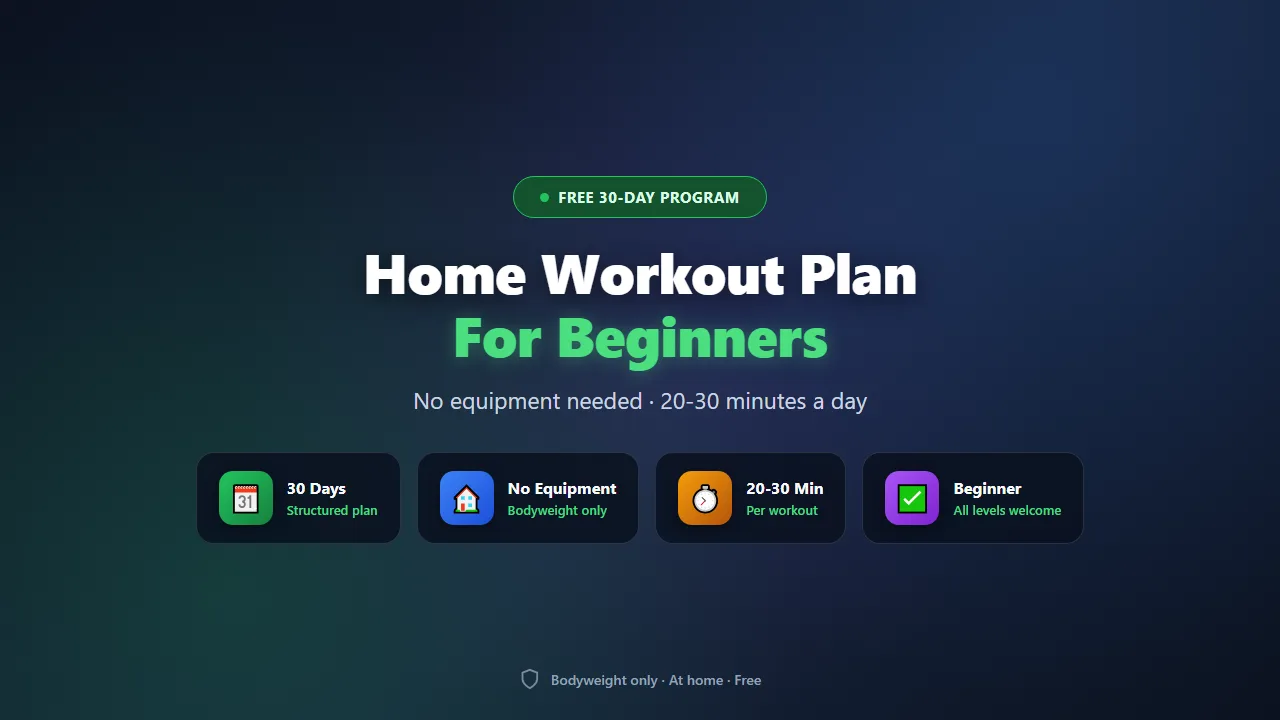
Most people do not fail at working out because the exercises are hard. They fail because they have no plan, no schedule, and no idea what to do tomorrow. A 30-day home workout plan fixes all three at once. You wake up, you check the day’s number, you do the work, and the decision-making is already done for you.
This is a complete 30-day home workout plan for beginners that requires zero equipment and zero gym membership. Every workout is bodyweight only, takes 20 to 30 minutes, and is designed to be done in a living room, bedroom, or hotel room. The plan is structured in four weekly phases, so you start gently and build strength, endurance, and habit at a pace your body can actually absorb.
Below you get the full week-by-week schedule, every exercise explained with proper form, the mistakes that quietly kill beginners’ progress, and the answers to the questions people ask most about starting a home workout routine. Print it, bookmark it, or keep it on your phone, and start on a Monday.
The 30-day home workout plan at a glance
The plan runs in four phases. Each week has a single focus, so your body adapts gradually instead of getting shocked, sore, and discouraged in the first three days.
| Phase | Days | Focus | Goal |
|---|---|---|---|
| Week 1 | Days 1-7 | Foundation | Learn the 12 core movements with perfect form |
| Week 2 | Days 8-14 | Strength | Add sets and reps, build muscular endurance |
| Week 3 | Days 15-21 | Volume | Push total work volume, add short cardio bursts |
| Week 4 | Days 22-30 | Peak | Full circuits, finisher challenges, test your progress |
Training days are Monday through Friday with rest on Saturday and Sunday. That gives you 20 workout days and 10 rest days across the month, which is the sweet spot for a beginner: enough stimulus to change your body, enough recovery to keep you healthy and motivated.
How the plan works: 4 simple rules
Rule 1: Consistency beats intensity. A so-so workout you actually do beats a perfect workout you skip. If you are exhausted, do the day’s workout at half effort rather than skipping it. Showing up is the exercise.
Rule 2: Rest is part of the plan. Muscle is built while you recover, not while you train. The two rest days are non-negotiable. Light walking on rest days is fine and actually helps recovery.
Rule 3: Progress by reps, not by weight. With no equipment, the way you make the workout harder is adding reps, slowing down the movement, or reducing rest time. Each week adds exactly that. If an exercise feels easy, slow it down to a 3-second count on the way down and feel it become hard again.
Rule 4: Form first, always. Ten ugly reps are worse than five clean ones. If you cannot do the full movement with good form, do the easier version listed with each exercise. There is no shame in the beginner version, that is how everyone starts.
Week 1: Foundation (days 1-7)
Week 1 teaches your body the movements and your brain the habit. Every exercise is done slowly and deliberately. Aim for full range of motion over speed.
| Day | Workout | Sets x Reps | Rest between sets |
|---|---|---|---|
| Day 1 | Squats, Glute bridges, Wall sits, Plank | 3 x 10 / 3 x 12 / 3 x 20s / 3 x 20s | 60s |
| Day 2 | Knee push-ups, Superman holds, Bird dogs, Standing calf raises | 3 x 8 / 3 x 15s / 3 x 8 per side / 3 x 15 | 60s |
| Day 3 | Rest or 20-minute walk | – | – |
| Day 4 | Lunges, Tricep dips (chair), Dead bugs, Plank | 3 x 8 per side / 3 x 8 / 3 x 10 per side / 3 x 25s | 60s |
| Day 5 | Full-body circuit: Squats, Knee push-ups, Glute bridges, Superman holds | 3 rounds, 10 reps each | 90s between rounds |
| Day 6 | Rest or 20-minute walk | – | – |
| Day 7 | Rest. Review the week, note what felt hard | – | – |
That is only about 20 minutes a day. If you feel sore on Day 2, that is normal and it will pass. Keep moving gently, drink water, and do not skip Day 4 because of it, the movement actually helps the soreness fade faster.
Week 2: Building strength (days 8-14)
Week 2 adds reps and introduces the first cardio bursts. Your body now knows the movements, so we start asking for more work in the same time.
| Day | Workout | Sets x Reps | Rest between sets |
|---|---|---|---|
| Day 8 | Squats, Glute bridges, Wall sits, Plank | 3 x 15 / 3 x 15 / 3 x 30s / 3 x 30s | 45s |
| Day 9 | Knee push-ups, Superman holds, Bird dogs, Calf raises | 3 x 10 / 3 x 20s / 3 x 10 per side / 3 x 20 | 45s |
| Day 10 | Rest or 25-minute walk | – | – |
| Day 11 | Lunges, Tricep dips, Dead bugs, Plank | 3 x 10 per side / 3 x 10 / 3 x 12 per side / 3 x 35s | 45s |
| Day 12 | Cardio circuit: Jumping jacks, High knees, Mountain climbers, Squats | 4 rounds, 30s each exercise | 60s between rounds |
| Day 13 | Rest or 25-minute walk | – | – |
| Day 14 | Rest. Test yourself: how many squats can you do in 60 seconds? | – | – |
Write down your Day 14 squat number. You will repeat that test on Day 30 and the difference will be visible proof the plan works.
Week 3: Adding volume (days 15-21)
Week 3 is where most people feel a real change. Clothes fit slightly differently, stairs feel easier, and the workouts start to feel like a normal part of the day.
| Day | Workout | Sets x Reps | Rest between sets |
|---|---|---|---|
| Day 15 | Squats, Glute bridges, Wall sits, Plank | 4 x 15 / 4 x 15 / 4 x 40s / 4 x 40s | 45s |
| Day 16 | Push-ups (knee or full), Superman holds, Bird dogs, Calf raises | 4 x 10 / 4 x 25s / 4 x 10 per side / 4 x 20 | 45s |
| Day 17 | Rest or 30-minute walk | – | – |
| Day 18 | Lunges, Tricep dips, Dead bugs, Plank | 4 x 10 per side / 4 x 12 / 4 x 12 per side / 4 x 45s | 45s |
| Day 19 | Cardio circuit: Jumping jacks, High knees, Mountain climbers, Bear crawls | 5 rounds, 30s each exercise | 45s between rounds |
| Day 20 | Rest or 30-minute walk | – | – |
| Day 21 | Rest. Eat well today, Day 22 is the biggest workout yet | – | – |
If full push-ups are still too hard by Week 3, stay on knee push-ups but lower yourself slowly for 3 seconds. Slow negatives build the chest and triceps strength you need to graduate to full push-ups.
Week 4: The finish (days 22-30)
Week 4 combines everything into longer circuits and a final challenge. This is the week that turns a 30-day experiment into a lasting habit.
| Day | Workout | Sets x Reps | Rest between sets |
|---|---|---|---|
| Day 22 | Full circuit: Squats, Push-ups, Lunges, Glute bridges, Plank | 4 rounds, 12 reps each (plank 40s) | 60s between rounds |
| Day 23 | Cardio circuit: Jumping jacks, High knees, Mountain climbers, Bear crawls, Squats | 5 rounds, 40s each exercise | 45s between rounds |
| Day 24 | Rest or 30-minute walk | – | – |
| Day 25 | Strength day: Squats, Push-ups, Lunges, Tricep dips, Dead bugs | 4 x 15 / 4 x max / 4 x 12 per side / 4 x 12 / 4 x 12 per side | 45s |
| Day 26 | Cardio circuit: full 6-exercise round | 5 rounds, 40s each exercise | 45s between rounds |
| Day 27 | Rest or light walk | – | – |
| Day 28 | Finisher challenge: 100 squats, 50 push-ups, 2-minute plank, broken into as many sets as needed | Time yourself | As needed |
| Day 29 | Rest. Stretch, hydrate, sleep well | – | – |
| Day 30 | Final test: repeat the 60-second squat test from Day 14, then the full Day 1 workout | Compare your numbers | – |
The Day 28 finisher is meant to be hard. Break it into as many sets as you need, just finish it. When you write down your Day 30 squat count next to your Day 14 count, you will have your answer about whether this plan works.
The 12 core exercises, explained
Every movement in this plan is a compound exercise, meaning it works several muscle groups at once. That is how a no-equipment plan still builds full-body strength. Here is each one with the form cue that matters most.
Squat. Feet shoulder-width apart, chest up, sit back and down like you are reaching for a chair, knees tracking over toes. Cue: push the floor away through your heels on the way up.
Push-up. Hands slightly wider than shoulders, body in one straight line, lower your chest to the floor. Beginner version: knees on the floor. Cue: squeeze your glutes to keep your hips from sagging.
Plank. Forearms on the floor, elbows under shoulders, body rigid like a board. Cue: brace your abs like you are about to be punched, and breathe.
Lunge. Step forward, lower until both knees are at 90 degrees, push back up. Cue: keep your front knee over your ankle, not past your toes.
Glute bridge. Lie on your back, knees bent, feet flat, push your hips up until your body forms a straight line from shoulders to knees. Cue: squeeze your glutes hard at the top for one second.
Superman hold. Lie face down, arms extended, lift arms and legs off the floor and hold. Cue: keep your gaze down to protect your neck.
Bird dog. On all fours, extend one arm and the opposite leg, hold, switch. Cue: keep your hips level, do not let them tilt or twist.
Dead bug. On your back, arms up, legs in tabletop, lower one arm and the opposite leg toward the floor without letting your lower back arch. Cue: press your lower back into the floor.
Tricep dip. Hands on the edge of a sturdy chair, slide your hips off, bend your elbows to lower yourself, push back up. Cue: keep your shoulders down, do not shrug.
Wall sit. Slide your back down a wall until thighs are parallel to the floor, hold. Cue: push your back flat into the wall.
Mountain climber. From a high plank, drive your knees to your chest one at a time, fast. Cue: keep your hips low and your core tight.
Bear crawl. From all fours with knees hovering an inch off the floor, crawl forward and backward. Cue: small steps, quiet feet, back flat.
Common mistakes beginners make
Doing too much on day one. The number one reason home workout plans die is a Day 1 that leaves you unable to walk for a week. This plan deliberately starts easy. Trust the ramp.
Rushing the reps. Fast, sloppy reps build sloppy habits and injure joints. Count three seconds down on every squat and push-up. You will feel the difference immediately.
Skipping rest days. Rest is not laziness, it is where the adaptation happens. Training sore muscle every single day leads to burnout and injury.
Comparing to YouTube athletes. You are not competing with anyone. Your only competition is the person you were yesterday, and specifically the number from Day 14.
Giving up after one bad day. Miss a workout? Do not quit the plan, just pick up on the next scheduled day. One missed session costs you nothing. Four missed sessions in a row costs you the habit, so never let one day become four.
What you actually need (and what you don’t)
The honest answer: nothing. Bare feet on carpet or a towel on a hard floor is enough for every exercise in this plan. But three cheap things make the month noticeably more comfortable.
A non-slip yoga mat protects your wrists, knees, and lower back during planks, push-ups, and glute bridges on hard floors. Any basic mat works, and it doubles as a reason to keep the floor spot you have claimed as your workout corner. If you want a thicker option for sensitive joints, our best yoga mats guide covers the full range.
Comfortable, flat-soled shoes for the cardio circuit days, especially if you train on hard floors. Running shoes work, barefoot-style training shoes work better for lateral movements.
A water bottle and a timer. Your phone’s stopwatch is the timer. Keep water next to your mat so you never have an excuse to wander off mid-workout.
That is the complete gear list. If you want to add equipment later, resistance bands are the best first purchase because they add progressive resistance without taking up space, but none of it is required for the next 30 days.
Tips to stay consistent for 30 days
Schedule it like an appointment. Pick a time, put it in your calendar, and treat it like a meeting you cannot cancel. Morning workouts fail least because nothing has a chance to get in the way yet.
Lay out your mat the night before. A two-second preparation removes the first excuse of the day. You will be amazed how much willpower this small ritual saves.
Track every day. A simple checkmark on a calendar is one of the most powerful habit tools that exists. Do not break the chain. When you see ten checkmarks in a row, you will not want to stop.
Announce your goal. Tell one person you are doing a 30-day plan. The tiny pressure of being asked “how is the workout thing going?” keeps you honest more than any app.
Pair it with something you enjoy. Play music, a podcast, or a show you only allow yourself during workouts. Your brain will start looking forward to training instead of dreading it.
A 30-day home workout plan does not need to be complicated to work. This one is deliberately boring in the best way: twelve basic exercises, four weekly phases, twenty minutes a day, and a clear finish line. No equipment, no gym, no excuses, just a calendar and the decision to start.
The plan works if you do the work. Week 1 will feel easy and that is on purpose. By Week 3 you will feel the change. By Day 30, when you look at your squat test number next to your Day 14 score, you will have the only proof that matters: your own numbers going up.
Start tomorrow morning. Lay out your mat tonight, do Day 1 before your brain can talk you out of it, and put a checkmark on the calendar. Thirty days from now, you will be glad you did. Which day are you starting on? Tell me in the comments and I will hold you to it.






Leave a Comment