7-Day Full-Body Workout Plan for Busy People (2026 Edition)
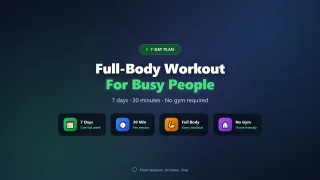
Busy people do not need longer workouts, they need smarter ones. If you have a job, a family, and a life, the problem is never motivation, it is time. A 7-day Full-Body Workout Plan solves that by doing three things at once: it trains every major muscle group in each session so you never have to juggle a split, keeps every workout under 30 minutes, and requires zero Equipment and zero commute.
This is a full 7-day workout plan for busy people that works around a packed schedule. There are three short circuits you rotate across the week, each one hitting your legs, chest, back, and core in under half an hour. You do between four and six sessions in seven days depending on how your week looks, and even a chaotic day only asks for 30 minutes of your time.
Below you get the full week laid out day by day, every workout written out in sets and reps, the mistakes that make busy people quit, and the answers to the questions people ask most about fitting training into a full life.
The 7-day plan at a glance
The week mixes three workouts and two rest days. If one day gets swallowed by work, swap it for a rest day and move on, nothing breaks.
| Day | Workout | Focus | Time |
|---|---|---|---|
| Monday | Workout A | Push & legs | ~30 min |
| Tuesday | Workout B | Pull & core | ~30 min |
| Wednesday | Workout C | Cardio & conditioning | ~25 min |
| Thursday | Workout A | Push & legs | ~30 min |
| Friday | Workout B | Pull & core | ~30 min |
| Saturday | Rest or easy walk | Recovery | 20-30 min |
| Sunday | Rest | Recovery | – |
That gives you five training sessions and two rest days. If your week is crazier than most, the minimum to still make progress is the three workouts A, B, and C once each. Two of them is enough to maintain, three is where you start improving.
Why full-body beats a split when you’re busy
Traditional bodybuilding splits divide the week into chest day, back day, leg day, and so on. That works when you have an hour a day and a gym to commute to. When you are busy, it fails for one reason: if you miss your chest day, you miss your whole week’s chest work.
Full-body training fixes that. Every workout hits every major muscle group, so no single missed session derails your week, and you never have to remember which body part gets trained today. It is also time-efficient. Research consistently shows that full-body sessions produce comparable strength gains to splits for beginners, in a fraction of the weekly time. For a busy person that trade is a no-brainer: one workout, whole body, done.
The 2-minute warm-up
Do not skip this. Two minutes of movement wakes up your joints and raises your core temperature, which makes the workout feel better and cuts injury risk. Do each for 30 seconds.
March in place: bring your knees up high and swing your arms, 30 seconds. Arm circles: both directions, 30 seconds. Hip circles: hands on hips, big slow circles, 30 seconds. Bodyweight squats: 10 slow reps to get your legs and hips ready.
That is it. For the cardio day you can swap the squats for a slow jog in place.
Workout A: Push & legs
Workout A stacks two pushing movements with two lower-body moves. It is the session that builds chest, shoulders, and triceps while keeping your legs strong.
| Exercise | Sets x Reps | Rest | Notes |
|---|---|---|---|
| Push-ups | 3 x 10-15 | 60s | Knees on floor if full push-ups are too hard |
| Pike push-ups | 3 x 8-12 | 60s | Hips high, targets shoulders |
| Bodyweight squats | 3 x 15-20 | 60s | Drive through heels |
| Walking lunges | 3 x 10 each leg | 60s | Keep front knee over ankle |
| Plank | 3 x 30-45s | 60s | Straight line, brace your abs |
Rest 60 seconds between exercises, and 90 seconds between rounds if you go through the list twice. The whole thing should take about 30 minutes including warm-up.
Workout B: Pull & core
Workout B trains your back and core, the areas most desk workers neglect. With no equipment, pulling is done bodyweight through rows and holds, and it makes a huge difference to posture.
| Exercise | Sets x Reps | Rest | Notes |
|---|---|---|---|
| Reverse snow angels | 3 x 12 | 60s | Face down, pull arms along floor |
| Superman holds | 3 x 20-30s | 60s | Lift arms and legs, gaze down |
| Bird dogs | 3 x 10 each side | 60s | Opposite arm and leg, hips level |
| Dead bugs | 3 x 10 each side | 60s | Lower back pressed to floor |
| Marching glute bridges | 3 x 8 each side | 60s | Bridge up, lift one foot, swap |
This is the sneaky-difficult one. The movements look gentle, but holding every rep for slow counts makes them burn. Take your time and you will feel it in your upper back, glutes, and deep core the next morning.
Workout C: Cardio & conditioning
Workout C is the shortest of the three and the most forgiving on a busy day. It is a circuit that boosts your heart rate, burns calories, and improves work capacity, and it doubles as the stress-relief session.
| Exercise | Time | Rest |
|---|---|---|
| Jumping jacks | 40s | 20s |
| High knees | 40s | 20s |
| Mountain climbers | 40s | 20s |
| Fast bodyweight squats | 40s | 20s |
| Bear crawls | 40s | 20s |
Run the five exercises in order, 40 seconds of work and 20 seconds of rest, and repeat the whole circuit three to four times. That is 15 to 20 minutes of conditioning plus your warm-up. Low-impact version: swap jumping jacks for step touches and skip the bear crawls if your wrists complain.
The cooldown
Two minutes at the end keeps you from feeling stiff for the rest of the day. Hold each position for 30 seconds.
Standing quad stretch: pull one heel toward your glute, hold, swap. Doorway chest stretch: forearm on a doorframe, lean through gently. Standing hamstring fold: hinge at the hips and let your upper body hang. Deep squat hold: sit into a deep squat and breathe, letting your hips open.
How to lay the week out
The Monday to Sunday layout above is the ideal. Real life does not always cooperate, so here is how to adapt it without losing the plan.
If a workday disappears: move the missed workout to your Saturday slot, or simply skip it and treat it as a second rest day. Two sessions a week still keeps you healthy; three is where real progress lives.
If you only have 15 minutes: do Workout C, the circuit, since it packs the most conditioning into the least time. Or do the two lower-body exercises from Workout A plus the plank.
If you feel sore: that is normal in the first week. Light walking, water, and a good night’s sleep fix most of it. Train through mild soreness, rest through sharp pain.
Common mistakes busy people make
Waiting for the perfect block of time. There is no perfect hour hiding in your day. When you find 30 minutes, take it. Half an hour is enough to do everything in this plan.
Treating a missed day as a failed week. One busy day does not undo a week of training. The people who succeed are the ones who miss a session and just pick up the next day. I always tell readers: it is only a problem if one day becomes four.
Overdoing the first workout. Starting with maximum effort leaves you too sore to train again for a week. Start at the lower end of the rep range and let the progression build.
Skipping the warm-up. When time is tight, the warm-up is the first thing to get cut. Two minutes is all it takes. Skipping it is how you get injured, and an injury is the one thing that really derails a schedule.
Trying to make it perfect. Consistency beats perfection every single time. A 20-minute workout is infinitely better than a skipped 60-minute one.
Gear you actually need
Nothing. Every movement in this plan is bodyweight, so you can train in bare feet on carpet, a towel, or a mat. But two cheap items make the week more comfortable and more consistent.
A non-slip mat saves your wrists and knees during the plank and push-up work on hard floors, and it doubles as a visual cue: roll it out and your brain knows it is time to train. Our best yoga mats guide rounds up solid, inexpensive options.
Comfortable flat shoes for the cardio day, especially if you train on hard floors. If you want to add tiny resistance later, a cheap set of resistance bands is the best first upgrade, but it is not needed for this week.
And a water bottle must sit right next to your mat. Fewer excuses, better workout.
How to make it stick when you’re busy
Anchor it to an existing habit. Train right after you wake up, right before your shower, or right after the kids are in bed. Hooking the workout onto something you already do every day removes the decision point entirely.
Set the clothes out the night before. One small action that takes ten seconds removes the first excuse of the morning. You will be surprised at how much discipline this little ritual saves.
Use a 30-minute timer. When the timer goes off, you are done, even mid-set. This prevents a “quick session” from dragging on and makes the workout predictable, so you never dread starting it.
Put it in the calendar. Treat it like a meeting with your future self. If a colleague books over it, you reschedule it exactly like any other appointment rather than cancelling it.
Track the sessions you finish. A simple tally of completed workouts is deeply motivating. After a few checkmarks in a row, the streak becomes the thing you protect.
Frequently asked questions
Frequently Asked Questions
Frequently Asked Questions
Is a 7-day workout plan too much for beginners?
How long should a full-body workout take?
Can you build muscle training 30 minutes a day?
Is full-body training better than a split?
What if I miss a day during the week?
Can I do cardio on rest days?
The bottom line
A 7-day workout plan for busy people does not need to be complicated, and it does not need to take an hour. Three short circuits, rotated across a week, with two rest days, will train your whole body and fit into a schedule that already has too much in it.
The plan is built around one principle: showing up matters more than the workout being perfect. If you have 30 minutes, you have enough. Start Monday, do Workout A, and let the week take care of the rest. When Friday’s Workout B is done, you will have trained every major muscle group three times with zero equipment and no commute.
Which day is your hardest to fit a workout into? Tell me in the comments, and I will help you build a workaround for exactly that day.
Related reading
20 Best Bodyweight Exercises for a Full-Body Workout · 30-Day Home Workout Plan for Beginners (No Equipment Needed) · Best Daily Mobility Routine: 10 Minutes for a Full Body

Daniel Okoro
Daniel Okoro is a strength and rehab coach and our senior fitness contributor. An ex-collegiate athlete with a kinesiology background, he covers mobility, injury prevention, and calisthenics. He designs programs around proper form and progressive overload for beginners and advanced lifters alike.





Leave a Comment