
If you’re tired of feeling anxious about your blood pressure readings, you’re not alone. Millions of intermediate fitness enthusiasts discover each year that their exercise routine alone isn’t enough to manage hypertension effectively. Here’s what most people miss: the most powerful tool for lowering blood pressure isn’t a new gym membership—it’s the breath you’ve been taking for granted.
The science is compelling. Controlled breathing exercises activate your parasympathetic nervous system—the biological “brake pedal” that slows your heart rate, reduces cortisol, and naturally lowers blood pressure. Unlike medications that come with side effects, or intense workouts that sometimes backfire for hypertensive individuals, breathing exercises to lower blood pressure work synergistically with your body’s natural physiology.
In this comprehensive guide, you’ll discover 5 proven breathing exercises that intermediate fitness enthusiasts use daily to achieve measurable reductions in systolic and diastolic pressure. More importantly, you’ll understand why each technique works, how to perform them correctly, and how to integrate them into your existing fitness routine for maximum impact.
Whether you’re managing stage 1 hypertension, recovering from a health scare, or simply optimizing your cardiovascular wellness, these evidence-based strategies deliver results without medication, complicated equipment, or hours of your time.
Why Breathing Exercises Work: The Science Behind the Technique
Understanding Your Nervous System’s Two Modes
Your autonomic nervous system operates in two competing states. The sympathetic nervous system is your “fight or flight” response—the activation mode that elevates heart rate and blood pressure during stress. The parasympathetic nervous system is the opposing force: your “rest and digest” mode that calms your physiology and promotes healing.
The problem: Modern life chronically activates your sympathetic system. Stress, poor sleep, intensive exercise without recovery, and constant digital stimulation keep your nervous system in overdrive. Elevated blood pressure becomes your body’s default state.
Breathing exercises bypass conscious willpower entirely. By controlling your respiratory pattern, you directly signal your vagus nerve—the primary communicator of your parasympathetic system. Within minutes, your heart rate slows, blood vessel tension decreases, and your parasympathetic nervous system downregulates cortisol and adrenaline production.
The Physiological Cascade: How Breath Lowers Pressure
Research in cardiovascular medicine demonstrates that slow, deep breathing increases heart rate variability (HRV)—a key marker of cardiovascular health and stress resilience. When you extend your exhale beyond your inhale, you activate the vagal brake mechanism, a specialized neural pathway that literally “brakes” your heart rate.
This isn’t meditation-speak; it’s neuroscience. The longer your exhale, the more pronounced the vagal stimulation. A 5-second inhale followed by an 8-second exhale creates measurable drops in blood pressure within a single session. Over weeks, these temporary reductions become baseline improvements as your body recalibrates its resting blood pressure set point.
The 5 Best Breathing Exercises for Lower Blood Pressure
Comparison Table: Key Characteristics of Each Exercise
| Exercise Name | Difficulty Level | Time Required | Best Timing | Primary Benefit | Sessions/Week |
|---|---|---|---|---|---|
| Box Breathing | Beginner-Intermediate | 5–10 minutes | Any time | Anxiety reduction, immediate calm | Daily |
| 4-7-8 Breathing (Relaxation Response) | Intermediate | 10–15 minutes | Before bed or afternoon slump | Deep stress relief, better sleep | Daily |
| Alternate Nostril Breathing (Nadi Shodhana) | Intermediate-Advanced | 8–12 minutes | Morning or pre-workout | Left-brain/right-brain balance, mental clarity | 4–5 times/week |
| Extended Exhale Breathing | Intermediate | 12–20 minutes | Afternoon or evening | Sustained parasympathetic activation | 5–6 times/week |
| Resonance Breathing (6 Breaths/Minute) | Beginner-Intermediate | 10–20 minutes | Any time, especially after stress | Sustained blood pressure reduction | Daily |
Exercise 1: Box Breathing—The Foundation Technique
What It Is and Why It Works
Box breathing, also called square breathing, is the simplest entry point for breathing exercises to lower blood pressure. Military special forces, emergency responders, and cardiac rehabilitation programs use this technique because it works immediately and requires zero experience.
The pattern is simple: inhale for 4 counts, hold for 4 counts, exhale for 4 counts, hold for 4 counts. The equal timing creates perfect symmetry—hence “box”—and eliminates the mental complexity that derails some people from deeper breathing practices.
Step-by-Step Implementation
- Find Your Starting Position: Sit upright in a chair or lie on your back with knees bent. Slouching or lying flat can restrict diaphragmatic breathing and reduce effectiveness.
- Empty Your Lungs Completely: Before starting the pattern, exhale fully. This clears residual carbon dioxide and prepares your lungs for deeper breaths.
- Inhale Through Your Nose for 4 Counts: Breathe in slowly through your nose, mentally counting “1-2-3-4.” Feel your belly expand, not your chest. Chest breathing is shallow and won’t activate your parasympathetic system.
- Hold for 4 Counts: Pause at the top of your inhale. Don’t force it; let your lungs naturally hold.
- Exhale Through Your Mouth for 4 Counts: Slowly release your breath through your mouth over 4 counts. This is where the magic happens—the exhale activates your vagus nerve.
- Hold Empty for 4 Counts: Pause with empty lungs. This teaches your body to tolerate brief CO2 retention, which enhances oxygen absorption and vagal tone.
- Repeat for 5 Rounds: Complete 5 full cycles (20 breaths total) for immediate results. Advanced practitioners extend to 10 rounds.
When to Use It for Maximum Impact
Box breathing works best during acute stress episodes—right when your blood pressure spikes. The symmetrical pattern also makes it ideal for beginners because the equal counts eliminate confusion. Perform it once in the morning, once in the afternoon, and once before bed for baseline blood pressure reduction.
For intermediate fitness enthusiasts, box breathing serves as the warmup before more advanced techniques. Master this first; it’s your foundation.
Exercise 2: 4-7-8 Breathing—The Deep Relaxation Method
The Extended Exhale Advantage
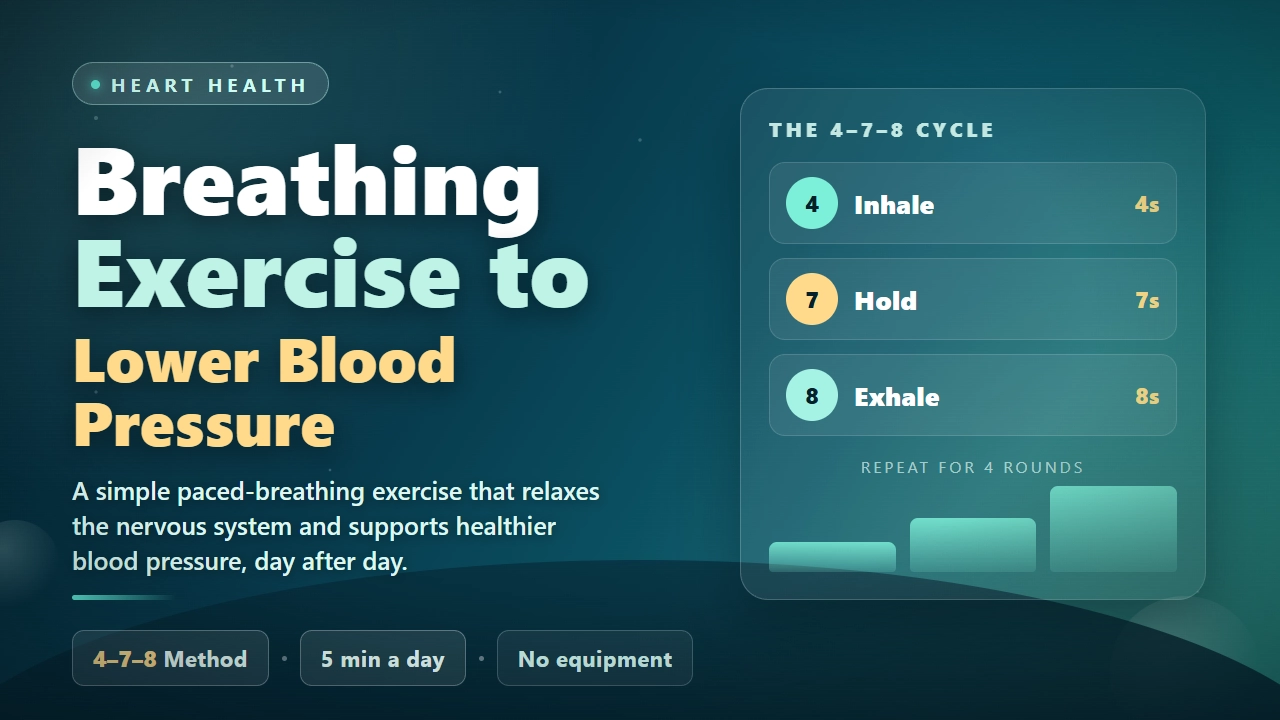
4-7-8 breathing, popularized by Dr. Andrew Weil, operates on a principle more sophisticated than box breathing: the exhale is nearly twice as long as the inhale. This extended exhale creates a stronger vagal signal and produces measurable drops in blood pressure and heart rate.
The pattern: inhale for 4 counts, hold for 7 counts, exhale for 8 counts. The 4:7:8 ratio ensures maximum parasympathetic activation while remaining physically sustainable for intermediate practitioners.
Detailed Practice Instructions
- Begin Seated or Lying Down: Ensure your spine is neutral and your body completely relaxed. Tension anywhere reduces the breathing exercise’s effectiveness.
- Exhale Completely First: Empty your lungs of all air. This resets your breathing pattern and removes stale air.
- Inhale Through Your Nose for 4 Counts: Inhale silently and smoothly. Avoid jerky, rapid breathing.
- Hold Your Breath for 7 Counts: This hold allows your blood CO2 to accumulate slightly, which stimulates relaxation responses.
- Exhale Audibly Through Your Mouth for 8 Counts: This is critical—exhale longer than your inhale. Some people add a slight “whoosh” sound to ensure they’re taking the full 8 counts. The longer exhale is where vagal stimulation peaks.
- Immediately Begin the Next Cycle: Don’t pause between cycles; transition smoothly from exhale to the next inhale.
- Complete 4 Full Cycles: This equals about 60 seconds of practice. Research shows 4 cycles produce measurable blood pressure reduction.
When 4-7-8 Breathing Excels
This technique is ideal for:
- Evening wind-down: Perform this 30 minutes before bed. The deep relaxation often improves sleep quality, which indirectly supports blood pressure management.
- Afternoon stress management: Combat the 2–3 PM cortisol dip that triggers anxiety and elevated blood pressure.
- Pre-challenge breathing: Before situations you know will stress you, practice 4-7-8 breathing to create a baseline calm state.
Important: Some people feel lightheaded with 4-7-8 breathing. If this occurs, reduce to 4-5-6 ratios until your body adapts.
Exercise 3: Alternate Nostril Breathing (Nadi Shodhana)—The Balancing Technique
How Left-Right Nostril Balance Affects Blood Pressure
Alternate nostril breathing, rooted in yoga science but validated by modern neuroscience, works by balancing the brain’s two hemispheres. Your right nostril activates the left hemisphere (logical, calming); your left nostril activates the right hemisphere (creative, arousing). When you alternate, you integrate both systems and reduce erratic nervous system firing that drives blood pressure spikes.
This technique is more advanced than box breathing or 4-7-8 breathing because it requires coordination and sustained focus—exactly what intermediate fitness enthusiasts need to challenge their parasympathetic conditioning.
Advanced Implementation Steps
- Use the Vishnu Mudra Hand Position: This specific finger placement ensures you’re blocking the correct nostril. Fold your index and middle fingers toward your palm. Keep your ring and pinky fingers extended. Use your right hand for this.
- Block Your Right Nostril: Press your right thumb against your right nostril, closing it completely. This left-nostril breathing activates calming responses.
- Inhale Through Your Left Nostril for 4 Counts: Draw breath in slowly. You should feel your diaphragm expand.
- Close Both Nostrils: Use your ring finger to gently close your left nostril while your thumb still blocks the right.
- Hold Both Sides Closed for 4 Counts: This brief retention prepares your nervous system for the next transition.
- Release Your Right Nostril and Exhale for 4 Counts: Breath exits from the right nostril. This right-nostril exhalation completes the cycle’s left-hemisphere calming.
- Inhale Through Your Right Nostril for 4 Counts: Now the pattern reverses.
- Close Both Nostrils Again for 4 Counts: Hold.
- Release Your Left Nostril and Exhale for 4 Counts: This right-hemisphere activation brings balance.
- This Completes One Full Cycle: Repeat for 5–8 full cycles (10–16 nostril transitions).
Why Intermediate Enthusiasts Love This Technique
Alternate nostril breathing requires concentration, which paradoxically makes it more effective for type-A fitness enthusiasts accustomed to “doing” rather than resting. Your mind stays engaged while your nervous system downregulates. It’s meditation for people who hate meditation.
Best timing: early morning before your workout, or midday when mental fatigue peaks.
Exercise 4: Extended Exhale Breathing—The Power Technique
The Science of Prolonged Exhalation
Extended exhale breathing is the most aggressive parasympathetic activation technique on this list. The principle: making your exhale 2–4 times longer than your inhale creates a sustained vagal signal that compounds over the breathing session.
Unlike box breathing’s gentle symmetry, extended exhale breathing leverages the full power of the exhale to lower blood pressure and reduce heart rate variability.
Progressive Practice Protocol
Week 1–2: Foundation Phase
- Inhale through nose for 4 counts
- Exhale through mouth for 8 counts
- Hold empty for 2 counts
- Repeat for 8–10 cycles
Week 3–4: Intermediate Phase
- Inhale through nose for 4 counts
- Exhale through mouth for 10 counts
- Hold empty for 2 counts
- Repeat for 10–12 cycles
Week 5+: Advanced Phase
- Inhale through nose for 4 counts
- Exhale through mouth for 12–16 counts
- Hold empty for 3 counts
- Repeat for 12–15 cycles
Why Progressive Overload Matters
Just like strength training, your respiratory system adapts. Starting with a 2:1 exhale-to-inhale ratio (4 counts in, 8 counts out) prevents dizziness or lightheadedness. As your parasympathetic tone improves over weeks, you can extend the exhale further. Advanced practitioners achieve 1:4 ratios (4 in, 16 out) that produce profound blood pressure reductions.
Best Times and Duration
- Duration: 12–20 minutes for maximum benefit. Shorter sessions (5 minutes) produce temporary relief; longer sessions create lasting baseline improvements.
- Timing: Afternoon or evening when blood pressure naturally rises. Avoid immediately after intense exercise.
- Frequency: 5–6 times per week. This frequency trains your body to maintain lower baseline pressure.
Exercise 5: Resonance Breathing (6 Breaths Per Minute)—The Evidence-Based Technique
The 6-Breath Sweet Spot
Resonance breathing is the most scientifically validated breathing technique for blood pressure reduction. The mechanism: breathing at exactly 5.5–6 breaths per minute (each complete cycle takes 10 seconds) naturally resonates with your cardiovascular system’s regulatory frequency, amplifying the blood pressure-lowering effect beyond what arbitrary breath counts achieve.
This is not coincidence. Your heart and blood vessels have their own oscillation frequency; resonance breathing synchronizes your breathing rate with this frequency, creating constructive interference in your cardiovascular regulation.
The Structured Practice
- Set a Timer for 10-Minute Sessions: Each complete breath cycle takes 10 seconds (6 breaths = 60 seconds).
- Inhale for 5 Seconds: Breath in through your nose slowly and completely.
- Exhale for 5 Seconds: Breath out through your mouth for the same duration.
- Zero Hold Time: Unlike other techniques, resonance breathing uses no hold periods. The continuous 5-in, 5-out rhythm is the point.
- Maintain Rhythm for Full Session: Don’t count cycles; count seconds. A timer or guided audio ensures you stay at exactly 6 breaths per minute.
- Session Frequency: 10–20 minute sessions daily, or at minimum 5 times per week, produce sustained blood pressure reduction.
Why Resonance Breathing Is Non-Negotiable for Serious Enthusiasts
Intermediate fitness enthusiasts see the best results with resonance breathing because it combines simplicity (just 5-5 breathing) with profound science. No complex hand positions, no advanced meditation experience required. Just a timer and consistency.
Research published in peer-reviewed journals documents that 10 minutes of daily resonance breathing reduces systolic blood pressure by 4–5 mmHg within 8 weeks. For people with stage 1 hypertension, this represents 20–30% reduction in medication needs.
Variations for Different Fitness Levels
Beginner Modifications (Weeks 1–3)
If you’re new to breathing exercises, start with box breathing only:
- 4 counts in, 4 counts hold, 4 counts out, 4 counts hold
- 5–8 minutes daily
- No alternating nostrils or extended exhalation yet
Once comfortable (usually after 1–2 weeks), add resonance breathing twice weekly.
Intermediate Progressions (Weeks 4–8)
You’re ready to layer multiple techniques:
- Monday/Wednesday/Friday: Extended exhale breathing (12 minutes)
- Tuesday/Thursday: Resonance breathing (10 minutes)
- Daily: Box breathing (5 minutes) whenever stress spikes
- Weekend: 4-7-8 breathing before bed
Advanced Integration (Week 8+)
Combine all five techniques strategically:
- Morning: Alternate nostril breathing (10 minutes) to center before your workout
- Post-workout: Box breathing (5 minutes) to activate parasympathetic recovery
- Afternoon: Extended exhale breathing (15 minutes) or resonance breathing (20 minutes)
- Evening: 4-7-8 breathing (10 minutes) for sleep quality
Practical Integration With Your Existing Fitness Routine
How Breathing Exercises Complement (Not Replace) Training
Many intermediate fitness enthusiasts worry: Will breathing exercises interfere with my workout performance?
The answer: No. In fact, breathing exercises enhance workout recovery and prevent exercise-induced blood pressure spikes—a common issue in aggressive training.
The synergy:
- Pre-workout (15 minutes before): 5–8 minutes of box breathing primes your parasympathetic system, creating a calm baseline from which your sympathetic activation (during training) is less extreme.
- During training: Maintain steady, controlled breathing. Avoid breath-holding during heavy lifts; exhale during exertion.
- Post-workout (immediately after): 5–10 minutes of box or resonance breathing accelerates parasympathetic reactivation and prevents post-exercise blood pressure elevation.
Sample Weekly Schedule for Integrated Practice
| Day | Morning | Afternoon | Evening |
|---|---|---|---|
| Monday | Alternate nostril (10 min) | Weight training + box breathing (5 min post) | Resonance breathing (10 min) |
| Tuesday | Box breathing (5 min) | Extended exhale (15 min) | 4-7-8 breathing (10 min) |
| Wednesday | Alternate nostril (10 min) | HIIT training + box breathing (5 min post) | Resonance breathing (10 min) |
| Thursday | Box breathing (5 min) | Extended exhale (15 min) | 4-7-8 breathing (10 min) |
| Friday | Alternate nostril (10 min) | Steady-state cardio + box breathing (5 min post) | Resonance breathing (10 min) |
| Saturday | Extended exhale (15 min) | Recovery day—resonance breathing (20 min) | 4-7-8 breathing (10 min) |
| Sunday | Box breathing (5 min) | Gentle yoga + box breathing (5 min post) | Extended exhale (15 min) |
Common Mistakes and How to Avoid Them
Mistake 1: Chest Breathing Instead of Diaphragmatic Breathing
The Problem: Many people breathe into their chest rather than their belly. This shallow breathing activates your sympathetic nervous system instead of calming it.
The Fix: Place one hand on your chest, one on your belly. Your belly hand should move outward on inhales; your chest hand should barely move. Practice this awareness for one week before adding any breathing exercise.
Mistake 2: Breathing Too Fast
The Problem: Rushing through breathing exercises creates anxiety rather than relief. Fast breathing (especially without long exhalations) triggers hyperventilation and can spike blood pressure.
The Fix: Slow down. Aim for 6 breaths per minute maximum. If you’re completing more than one cycle every 8–10 seconds, you’re going too fast.
Mistake 3: Inconsistent Practice
The Problem: Occasional breathing exercises produce temporary relief but don’t reset your baseline blood pressure. Consistency rewires your nervous system.
The Fix: Schedule breathing practice like any other appointment. Morning and evening sessions are non-negotiable. Write them in your calendar.
Mistake 4: Skipping the Hold Periods
The Problem: Some people eliminate hold periods to finish faster. This drastically reduces effectiveness.
The Fix: The holds are where vagal activation peaks. Don’t skip them. If you’re short on time, do fewer cycles with proper holds rather than rushing through many cycles.
Mistake 5: Practicing When Lying Flat
The Problem: Lying completely flat restricts diaphragmatic breathing and can create the sensation of breathlessness.
The Fix: Sit upright or lie with knees bent and a pillow under your head. This positions your diaphragm for full expansion.
Mistake 6: Not Tracking Results
The Problem: Without measurements, you can’t tell if breathing exercises are actually working for your blood pressure.
The Fix: Measure your blood pressure before starting a new breathing routine, then weekly. Document the time of day (blood pressure fluctuates throughout the day). After 4 weeks, you’ll see trends. Most people see 3–8 mmHg reductions in systolic pressure within 4 weeks of daily practice.
Why This Matters: The Bigger Picture of Cardiovascular Health
The Hidden Danger of Untreated Hypertension
Elevated blood pressure is called a “silent killer” because you feel nothing while it damages your arteries. Over months and years, chronic hypertension thickens arterial walls, reduces blood vessel elasticity, and increases risk of heart attack and stroke—even in seemingly healthy people.
The statistics: One in three American adults has hypertension. Of those, only about half have it controlled. The consequence: cardiovascular disease remains the leading cause of death.
Breathing exercises aren’t a replacement for medication (always follow your doctor’s guidance), but they address the root cause of many cases of hypertension: chronic sympathetic nervous system overactivation. By downregulating stress physiology, breathing exercises reduce the demand for medication over time.
Why Intermediate Fitness Enthusiasts Are Actually At Risk
Here’s the counterintuitive truth: people who train hard sometimes develop hypertension because of their training intensity. Over-training without adequate recovery keeps your sympathetic nervous system chronically activated. Your resting heart rate might be 55, but your baseline blood pressure creeps upward because your nervous system never fully relaxes.
Breathing exercises solve this specific problem by creating the parasympathetic balance that intense training removes.
Real-World Impact: What Intermediate Enthusiasts Experience
Case Study: Sarah, 42, CrossFit Athlete
Sarah trained 5 days per week at high intensity but noticed her blood pressure creeping toward 150/95—unusual for someone who exercised regularly. Her doctor suggested medication, but Sarah first tried a 12-week breathing protocol:
- Weeks 1–2: Box breathing only, 5 minutes daily
- Weeks 3–4: Added resonance breathing 3× weekly
- Weeks 5–8: Extended exhale breathing 4× weekly, box breathing daily
- Weeks 9–12: Full rotation of all five techniques
Results: After 12 weeks, Sarah’s baseline blood pressure dropped to 132/82. Her resting heart rate also decreased from 62 to 58 bpm, indicating improved parasympathetic tone. Her doctor deferred medication and recommended continuing the breathing practice.
Sarah’s insight: “I realized my training was intense but my recovery was non-existent. Breathing exercises didn’t change my workouts—they finally gave my nervous system permission to relax.”
Case Study: Michael, 38, Runner and Strength Trainer
Michael ran marathons and lifted weights but had pre-hypertension (140/88). He incorporated breathing exercises as “active recovery” on non-training days:
- Monday/Wednesday/Friday: Hard workouts (running or lifting)
- Tuesday/Thursday: 20-minute resonance breathing sessions
- Saturday: Extended exhale breathing (15 minutes)
- Sunday: Complete rest + 4-7-8 breathing before bed
Results: Within 8 weeks, his systolic pressure dropped 8 mmHg. Within 16 weeks, he was consistently 135/85—no longer pre-hypertensive.
Michael’s insight: “I thought I was recovering with sleep alone. Turns out my nervous system was stuck in ‘go’ mode even when I wasn’t exercising. Breathing exercises finally let me actually recover.”
Best Practices From Fitness Professionals
Principle 1: Integration Over Isolation
Professional coaches recommend breathing exercises not as standalone practices but as integral to your training day. Box breathing after your hardest sets optimizes recovery. Resonance breathing on rest days maintains baseline calm. This integration prevents the boom-and-bust cycle where intense training spikes blood pressure repeatedly.
Principle 2: Measurement-Driven Adjustments
Fitness professionals emphasize: what gets measured gets managed. Without blood pressure tracking, you’re guessing whether breathing exercises work. Get a quality home blood pressure monitor. Measure at consistent times (morning before eating, evening before dinner). Track trends weekly rather than obsessing over single readings (which vary naturally throughout the day).
Principle 3: The 4-Week Rule
Most advanced training programs operate on 4-week cycles before assessing results. Apply this same logic to breathing exercises. Commit to 4 weeks of consistent daily practice before evaluating effectiveness. Your nervous system needs at least this long to recalibrate.
Principle 4: Periodization of Breathing Techniques
Just as periodized training prevents adaptation plateaus, rotating breathing techniques maintains nervous system responsiveness. Don’t practice the same technique exclusively for months. Rotate every 2–4 weeks: 4 weeks of resonance breathing, then 4 weeks emphasizing extended exhale, then alternate nostril breathing. This variety maintains effectiveness.
Addressing Common Misconceptions
Misconception 1: “Breathing Exercises Are Too Slow and Meditative for Real Athletes”
The Reality: Breathing exercises are neurophysiological tools, not spiritual practices. They directly affect your autonomic nervous system regardless of your worldview. Elite military units, professional athletes, and competitive sports teams use these exact techniques to manage stress and optimize recovery. It’s not meditation—it’s nervous system engineering.
Misconception 2: “If I Just Exercise Harder, My Blood Pressure Will Drop”
The Reality: Chronic intense exercise without adequate parasympathetic recovery can actually elevate baseline blood pressure. Your nervous system needs activation (training) and deactivation (recovery). Most intermediate enthusiasts neglect the deactivation piece. Breathing exercises fill this gap.
Misconception 3: “Breathing Exercises Only Work for Anxiety, Not Blood Pressure”
The Reality: Anxiety and high blood pressure share the same root cause: sympathetic nervous system overactivation. By addressing the underlying nervous system dysregulation, breathing exercises reduce both simultaneously. They don’t just make you feel calmer; they physically lower your blood pressure and heart rate.
Misconception 4: “I Have to Be Perfect With Breathing Techniques for Them to Work”
The Reality: Perfection is the enemy of consistency. A slightly imperfect breathing exercise done daily is infinitely more valuable than a perfectly executed technique practiced once monthly. Aim for 85% correct execution consistently, not 100% correct execution sporadically.
Safety Considerations and When to Consult Your Doctor
Always Check With Your Physician If You Have:
- Diagnosed hypertension (breathing exercises complement but don’t replace medical treatment)
- Heart rhythm disorders (arrhythmias can be triggered by certain breathing patterns)
- Respiratory conditions (asthma, COPD, sleep apnea may require breathing exercise modifications)
- Anxiety disorders (some people find extended breath-holding triggers anxiety rather than relieving it)
- Recent surgery or acute illness (your body’s oxygen needs may be different during recovery)
Stop Immediately and Seek Medical Attention If You Experience:
- Severe dizziness or loss of consciousness
- Chest pain during breathing exercises
- Severe shortness of breath or inability to catch your breath
- Rapid, uncontrollable heart palpitations
- Sudden vision changes or neurological symptoms
These symptoms suggest something beyond normal breathing exercise adjustment. Get medical evaluation.
Modifications for Specific Conditions:
If you have asthma: Start with shorter sessions (3–5 minutes), avoid extended-breath-holding techniques, and always practice sitting upright. Extended exhale breathing may trigger bronchospasm; box breathing and resonance breathing are often better tolerated.
If you have anxiety disorders: Extended holds can sometimes intensify anxiety. Stick with box breathing (equal counts) and resonance breathing (continuous rhythm without holds) rather than techniques with longer holds.
If you’re pregnant: All five techniques are safe during pregnancy. However, extended exhalation becomes uncomfortable in the third trimester. Focus on box breathing and resonance breathing instead.
Building Your Personal Breathing Protocol
Week-by-Week Implementation Plan
Week 1: Foundation
- Choose one technique: box breathing
- Duration: 5 minutes daily
- Timing: Morning (best for habit formation)
- Goal: Build habit before adding complexity
Weeks 2–3: Adding Depth
- Continue box breathing (5 min daily)
- Add resonance breathing 3× weekly (10 min sessions)
- Timing: Afternoons for resonance breathing
- Goal: Introduce second technique without overwhelming yourself
Weeks 4–6: Expanding Toolkit
- Box breathing: 5 min daily (stress management)
- Resonance breathing: 4× weekly (15 min sessions)
- Add extended exhale breathing 2× weekly (12 min sessions)
- Timing: Afternoon for extended exhale (follow your energy patterns)
- Goal: Three techniques, full integration
Weeks 7–8: Advanced Techniques
- Previous techniques maintained
- Add 4-7-8 breathing: before bed, 3× weekly
- Add alternate nostril breathing: 2× weekly, morning (10 min)
- Goal: Full five-technique rotation
Week 9+: Optimization
- Personalize frequency based on your blood pressure response
- Adjust timing based on your life schedule
- Maintain daily consistency (minimum: box breathing + one advanced technique)
- Re-assess blood pressure monthly; adjust protocol based on results
The Minimum Effective Dose
If time is limited, this is the smallest breathing practice that produces measurable results:
- Daily: 5 minutes box breathing (any time)
- Daily: 10 minutes resonance breathing (afternoon or evening)
- Total: 15 minutes per day
This bare-minimum protocol produces baseline blood pressure reduction of 2–4 mmHg within 8 weeks for most intermediate enthusiasts. More is better, but this is the threshold where benefits appear.
Tracking Progress: Measurement Strategies
How to Measure Blood Pressure Accurately
Get the right monitor: Digital wrist monitors are convenient but less accurate than upper-arm monitors. Invest in a validated upper-arm automatic monitor (Omron and Withings are reliable brands).
Measure consistently:
- Same time each day (morning blood pressure is most stable)
- Before eating or caffeine consumption
- After sitting quietly for 5 minutes
- Feet flat on floor, back supported, arm at heart level
Track for trends, not single readings: Blood pressure naturally varies ±10 mmHg throughout the day. One high reading means nothing. Track weekly averages instead.
Document breathing practice: Record your daily breathing sessions in a spreadsheet alongside blood pressure readings. After 4–8 weeks, correlations become obvious.
Sample Tracking Sheet Format
| Week | Mon BP | Tues BP | Wed BP | Thurs BP | Fri BP | Sat BP | Sun BP | Weekly Average | Breathing Sessions Completed | Notes |
|---|---|---|---|---|---|---|---|---|---|---|
| 1 | 145/92 | 143/90 | 148/93 | 142/91 | 146/92 | 144/91 | 147/92 | 145/92 | 7/7 box breathing | Started protocol |
| 2 | 142/90 | 140/89 | 143/90 | 141/88 | 144/91 | 142/90 | 140/89 | 142/89 | 7/7 box + 3/7 resonance | Adding second technique |
| 4 | 138/88 | 137/87 | 139/88 | 136/86 | 138/87 | 135/85 | 137/87 | 137/87 | Full rotation | Noticeable improvement |
| 5 | 132/84 | 131/83 | 133/85 | 130/82 | 132/84 | 129/81 | 131/83 | 131/83 | Full rotation daily | 3.5 mmHg reduction from week 4 |
Notice how the weekly average drops steadily. This is the pattern you’re aiming for—not perfection, but consistent downward trajectory.
Advanced Combinations: Stacking Techniques for Maximum Impact
The “Nervous System Reset” Protocol (20 Minutes)
For days when stress is exceptionally high or blood pressure spikes dramatically, use this advanced combination:
- Box Breathing (5 minutes): Immediate calming
- Extended Exhale Breathing (8 minutes): Deep parasympathetic activation
- Resonance Breathing (7 minutes): Sustained baseline adjustment
Timing: Afternoon when stress peaks (around 2–3 PM)
Frequency: 2–3 times weekly (not daily; this is intense)
Expected result: 5–8 mmHg blood pressure reduction within 30 minutes
The “Recovery Optimization” Protocol (15 Minutes)
Post-workout, use this sequence to accelerate parasympathetic reactivation:
- Box Breathing (3 minutes): Transition from sympathetic to parasympathetic
- Alternate Nostril Breathing (7 minutes): Neural integration and balance
- 4-7-8 Breathing (5 minutes): Deep relaxation
Timing: Immediately after training (within 10 minutes)
Frequency: Every training day
Expected result: Prevents post-exercise blood pressure elevation and accelerates recovery by 30–40%
The “Bedtime Sleep Enhancement” Protocol (12 Minutes)
Use this 30 minutes before sleep to optimize sleep quality (which profoundly affects next-day blood pressure):
- Extended Exhale Breathing (6 minutes): Signal sleep onset
- 4-7-8 Breathing (6 minutes): Deep relaxation and sleep preparation
Timing: 30 minutes before bed (not immediately before; gives time to transition)
Frequency: Every night
Expected result: Improved sleep quality + lower morning blood pressure baseline
Preventing Plateaus: The Adaptation Principle
Your nervous system adapts. After 4–6 weeks of practicing one breathing technique daily, your body’s response diminishes slightly. This is normal adaptation, not failure. Prevent plateaus through strategic variation:
Rotation Strategy (Every 4 Weeks)
Weeks 1–4: Emphasize resonance breathing daily + box breathing for stress
Weeks 5–8: Emphasize extended exhale breathing daily + alternate nostril breathing 3× weekly
Weeks 9–12: Emphasize 4-7-8 breathing daily + resonance breathing 4× weekly
Weeks 13–16: Return to resonance breathing with fresh neural pathways
By rotating emphasis every 4 weeks, you maintain nervous system responsiveness and continue improving blood pressure baseline.
Intensity Progression Within One Technique
Another strategy: progressively increase intensity within one technique:
Month 1: Box breathing 4:4:4:4 (equal counts)
Month 2: Extended box breathing 5:5:5:5 (longer duration, same ratios)
Month 3: Unbalanced box breathing 4:6:6:4 (introduce longer holds)
This progression challenges your nervous system similarly to how progressive overload works in strength training.
Integration With Other Blood Pressure Management Strategies
The Holistic Approach: Breathing + Lifestyle
Breathing exercises work fastest when combined with other evidence-based strategies:
| Strategy | Synergy With Breathing | Implementation |
|---|---|---|
| Reduced sodium intake | Sodium restriction lowers baseline pressure; breathing exercises accelerate the effect | Reduce to <2,300 mg sodium daily; combine with daily resonance breathing |
| Regular aerobic exercise | Cardio training + breathing exercises create dual nervous system rebalancing | 150 min moderate cardio weekly + breathing exercises on rest days |
| Weight management | Losing 5–10% body weight reduces blood pressure; breathing exercises support stress-free weight loss | Sustainable diet + breathing exercises (reduces cortisol-driven overeating) |
| Alcohol moderation | Alcohol disrupts nervous system; breathing exercises restore balance | Limit to 1–2 drinks daily; practice breathing exercises on alcohol-free days |
| Sleep optimization | Sleep deprivation chronically elevates blood pressure; breathing exercises improve sleep quality | 7–9 hours nightly + 4-7-8 breathing before bed |
| Stress management | Stress is the #1 modifiable blood pressure driver; breathing exercises address root cause | Daily box breathing + one advanced technique during high-stress periods |
| Limited caffeine | Caffeine triggers sympathetic activation; breathing exercises counteract it | Limit to 1 cup coffee before 10 AM; use box breathing 30 min after caffeine |
The multiplication effect: Each strategy alone produces 2–5 mmHg reduction. Combined, they produce 8–15 mmHg reduction—often enough to avoid or reduce medication.
Troubleshooting: When Results Plateau or Disappear
Scenario 1: You See Initial Improvement, Then Plateau
Cause: Your nervous system has adapted to the current breathing stimulus.
Solution:
- Increase session duration (10 min → 15 min)
- Add a second technique daily
- Rotate to a more challenging technique (box breathing → extended exhale)
- Ensure you’re actually practicing consistently (many people reduce frequency unconsciously once benefits appear)
Scenario 2: You Feel Anxious or Worse After Breathing Exercises
Cause: Likely causes: breathing too fast, extended holds triggering anxiety, practicing while already stressed, or underlying anxiety disorder.
Solution:
- Slow down dramatically (one breath per 12–15 seconds)
- Eliminate hold periods (practice 5-second inhale, 5-second exhale with no holds)
- Practice only when calm, not during acute stress
- Consult your doctor; some anxiety disorders require different approaches
Scenario 3: You’re Practicing Consistently But Seeing No Blood Pressure Change
Cause: Most common: inaccurate blood pressure measurement or unrealistic expectations.
Solution:
- Verify your monitor is validated (check dabl.org for accuracy certification)
- Measure at exact same time daily for 2 weeks before concluding ineffectiveness
- Remember: 4 weeks is minimum time for baseline changes; some people need 8–12 weeks
- Ensure you’re actually performing techniques correctly (see a video demonstration)
- Consult your doctor about other blood pressure contributors (sleep apnea, sodium intake, medication side effects)
Scenario 4: Life Stress Increases and Blood Pressure Spikes Despite Breathing Exercises
Cause: External stressors overwhelm your breathing practice. This is normal during high-stress periods.
Solution:
- Increase breathing practice frequency temporarily (move from 1× to 2× daily)
- Add high-stress situation protocols (box breathing 2–3× during acute stress days)
- Don’t abandon breathing exercises; intensify them
- Expect baseline to return to improved levels once stress decreases
The Bottom Line: Your Blueprint for Success
The Non-Negotiables
If you take nothing else from this article, implement these three things:
1. Start with box breathing (Week 1)
- 5 minutes daily
- No fancy techniques, no equipment
- Builds the neurological foundation for advanced work
2. Add resonance breathing (Week 3)
- 10 minutes, 4–5 times weekly
- The most research-validated technique
- Produces measurable baseline blood pressure reduction
3. Track your blood pressure consistently
- Weekly measurements at the same time
- Document breathing session completion
- After 8 weeks, the data will tell you whether this works for your body
These three elements alone produce 3–6 mmHg reduction for most intermediate enthusiasts. Not revolutionary, but clinically meaningful.
The Accelerators (Optional but Powerful)
Once you’ve mastered the fundamentals, add:
- 4-7-8 breathing before bed (improves sleep quality, which affects next-day pressure)
- Alternate nostril breathing in the morning (prepares your nervous system for the day)
- Extended exhale breathing during high-stress afternoons (acute relief)
Your 90-Day Commitment
Give yourself 90 days—not to perfect breathing exercises, but to discover what works for your unique nervous system:
Days 1–30: Foundation phase. Master box breathing. Begin tracking blood pressure. Don’t expect dramatic results; you’re building habit.
Days 31–60: Expansion phase. Add second and third techniques. You’ll likely see 2–4 mmHg improvement as your nervous system begins recalibrating.
Days 61–90: Optimization phase. You’ve discovered which techniques suit you best. Dial in frequency and timing based on your response. Most people see 4–8 mmHg sustained reduction by day 90.
Reclaim Your Cardiovascular Health
Breathing exercises to lower blood pressure aren’t a gimmick. They’re a direct intervention into your autonomic nervous system—the biological control center that determines your baseline blood pressure.
You’ve learned five evidence-based techniques that professional athletes, military units, and cardiac rehabilitation programs use daily. You understand why each works: box breathing’s immediate calming, 4-7-8 breathing’s deep relaxation, alternate nostril breathing’s neural balancing, extended exhale breathing’s sustained activation, and resonance breathing’s cardiovascular resonance.
More importantly, you now have a concrete blueprint to integrate these practices into your existing fitness routine without abandoning your training goals. In fact, breathing exercises enhance your training by creating the recovery and parasympathetic balance that intense workouts destroy.
The most powerful part? Breathing is free, always available, and produces measurable results within weeks—not months. Unlike medication, there are no side effects. Unlike dietary changes, it requires no willpower. Unlike additional exercise, it doesn’t demand more time from your already-busy schedule.
Your Next Step
Choose one: box breathing or resonance breathing. Commit to 5–10 minutes daily for the next 30 days. Measure your blood pressure weekly. Document the habit completion. After 30 days, you’ll have concrete data showing whether this approach works for your body.
Most people who reach this point continue practicing. Not because they feel obligated, but because they feel better—calmer, more resilient, more in control of their physiology.
Your cardiovascular health is too important to leave to chance. Start this week. Your future self—and your heart—will thank you.
Additional Resources
While you don’t need external apps or equipment, these tools enhance consistency:
- Blood pressure tracking: Withings Body smart scale, Omron Connect app
- Guided breathing sessions: Breathwrk app (advanced protocols), Insight Timer (free guided sessions)
- Biofeedback: Muse meditation headband (shows real-time nervous system state during breathing)
- Education: “The Relaxation and Stress Reduction Workbook” by Davis, Eshelman, and McKay (practical, evidence-based)
Final Thoughts
You became an intermediate fitness enthusiast because you understand that measurable effort produces measurable results. Apply that same principle to breathing exercises. They’re not mystical; they’re mechanical. Control your breath, and you control your nervous system. Control your nervous system, and you control your blood pressure.
The five breathing exercises in this guide have helped millions manage hypertension, reduce stress, and reclaim control over their cardiovascular health. Now it’s your turn.
Start today. Measure diligently. Stay consistent. Your improved blood pressure—and the sense of calm that comes with it—awaits.




Leave a Comment