
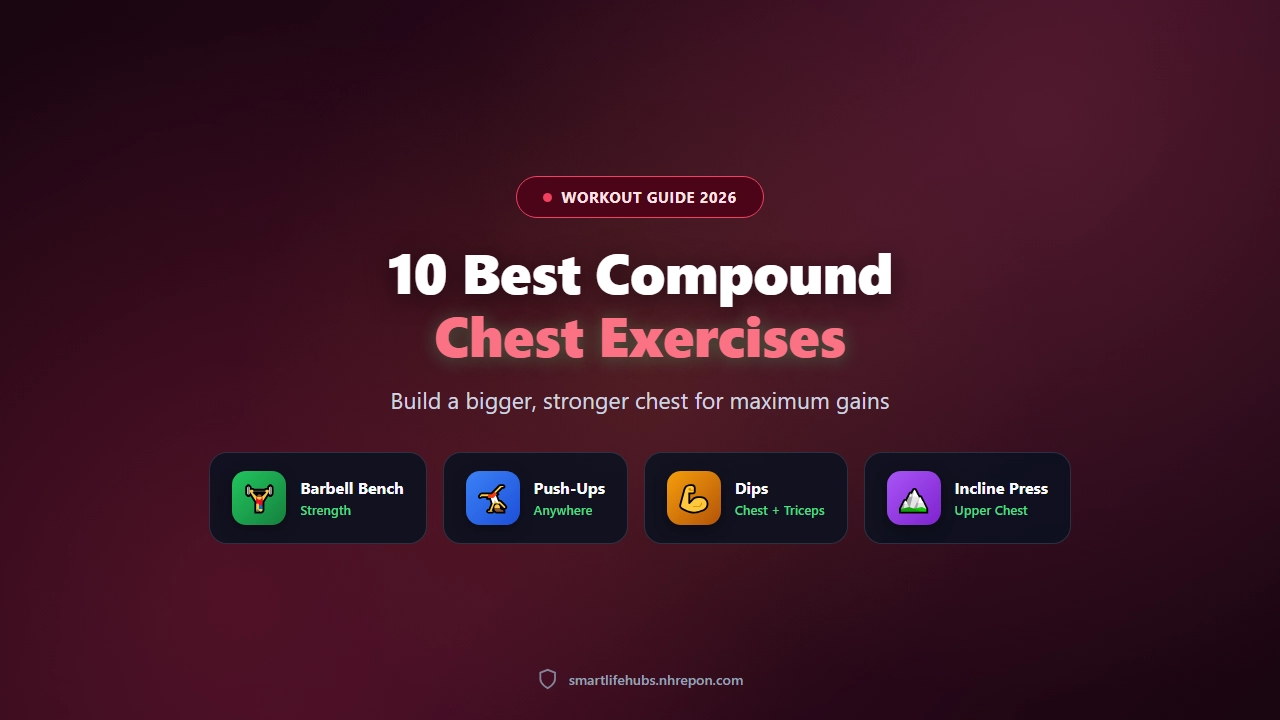
Building a strong, powerful chest starts with the right exercises. The 10 best compound chest exercises for maximum gains in 2026 hit multiple muscle groups at once — pectorals, triceps, and shoulders — so you get more strength and size per rep than isolation work alone.
Below you’ll find the full rundown: which exercises to prioritise, what each one actually targets, and a quick comparison table so you can build a smarter chest routine. Whether you train at a full gym or at home, there’s a proven movement here for you.
What makes a chest exercise “compound”?
A compound exercise is any movement that uses two or more joints at the same time, forcing multiple muscle groups to work together. For the chest, that means pressing and dip patterns that recruit the pecs, front delts, and triceps in one rep.
Why that matters: compound lifts let you load more weight, hold tension on more muscle, and build overall upper-body strength far faster than isolation moves like flyes alone. They are the foundation of every solid chest program.
Before you pick a barbell or jump to the machine rack, write down the one or two goals you have — raw pressing strength, upper-chest fullness, or lower-chest definition. A clear target makes the table below far easier to apply.
Compound chest exercises compared
| Exercise | Main muscles | Equipment | Difficulty | Best for |
|---|---|---|---|---|
| Barbell Bench Press | Chest, triceps, front delts | Barbell + bench | Intermediate | Overall strength and chest mass |
| Dumbbell Bench Press | Chest, triceps, stabilisers | Dumbbells + bench | Beginner | Balanced chest and symmetry |
| Push-Ups | Chest, triceps, shoulders, core | None | Beginner | Anywhere chest training and volume |
| Decline Dumbbell Press | Lower chest, triceps | Decline bench + dumbbells | Intermediate | Filling out the lower pec |
| Incline Bench Press | Upper chest, front delts | Incline bench + barbell/dumbbells | Intermediate | Upper-chest fullness |
| Dips | Lower chest, triceps, shoulders | Parallel bars | Advanced | Chest and triceps power |
| Cable Crossovers | Chest, shoulders | Cable machine | Beginner | Peak contraction and definition |
| Dumbbell Flyes | Chest, shoulder stabilisers | Dumbbells + bench | Beginner | Chest stretch and width |
| Dumbbell Pullovers | Chest, lats, triceps | Dumbbell + bench | Intermediate | Chest expansion and lats |
| Machine Chest Press | Chest, triceps | Machine | Beginner | Safe pressing and injury recovery |
The 10 best compound chest exercises for maximum gains
1. Barbell Bench Press: the king of chest exercises
No movement builds upper-body pressing strength like the barbell bench press. It’s the classic compound lift for chest mass, and for good reason — it lets you load more weight than any other chest exercise while hammering the pecs, triceps, and front delts together.
Because a barbell demands balance on both sides, you also recruit stabiliser muscles through your shoulders and upper back. That translates to real-world strength in any pushing or pressing motion.
Form tip: keep your shoulder blades pinched back, feet planted, and lower the bar to mid-chest before driving it up. Progress the weight over time and it stays the most productive lift you’ll ever do for your chest.
2. Dumbbell Bench Press: correct imbalances and build symmetry
The dumbbell bench press gives you the same pressing stimulus as the barbell but trains each side independently. That makes it a brilliant tool for fixing strength or size imbalances between your left and right pecs.
Free weights also force your shoulder stabilisers to work harder, improving coordination and control. The result is a more even, balanced chest over time.
Form tip: keep the dumbbells over your chest without letting them drift, and control the descent so you feel the stretch through the pecs before pressing back up.
3. Push-Ups: the classic bodyweight builder
Push-ups are the most accessible compound chest exercise there is — no equipment, no bench, no gym. They reliably hit the pecs, triceps, shoulders, and core, which makes them a staple for beginners and advanced lifters alike.
Their real strength is volume and versatility. You can do them anywhere, add tempo or a small pause to increase difficulty, or elevate your feet to shift more load onto the upper chest.
Form tip: keep a straight line from head to heels, lower until your chest nearly touches the floor, and press up without letting your hips sag.
4. Decline Dumbbell Bench Press: target the lower chest
The decline press shifts the emphasis to the lower portion of your pecs, helping you build the fuller, more sculpted look many lifters want. It’s one of the few compound presses that really load the lower pec heavily.
It also engages the triceps and shoulders as helpers, which means it keeps your whole pressing pattern strong while rounding out the chest.
Form tip: set the bench to a slight decline, control the dumbbells down toward the lower chest, and don’t let them bounce off the bottom.
5. Incline Bench Press: focus on the upper chest
If your chest looks flat from the front, the incline bench press is the fix. Raising the angle of the bench shifts the workload onto the upper pectoral fibres, giving you that full, square look at the top of the chest.
The incline also places your shoulders in a safer, more stable position, reducing joint strain while strengthening the stabilisers around the shoulder girdle.
Form tip: use a 30–45 degree incline, keep the bar or dumbbells tracking just above the upper chest, and avoid flaring your elbows too wide.
6. Dips: the bodyweight chest and triceps power movement
Dips are a demanding compound movement that works the lower chest, triceps, and shoulders through a big range of motion. They build serious pressing strength and a thick, defined lower chest.
Leaning forward during the dip shifts more emphasis onto the chest; staying more upright keeps it on the triceps. That makes dips a flexible tool you can tweak to hit different goals.
Form tip: keep your shoulders down and away from your ears, lower under control, and press back up without locking out aggressively.
7. Cable Crossovers: finisher for peak contraction
Cable crossovers aren’t a heavy strength builder, but they’re unbeatable as a finisher. Because the cable machine keeps constant tension on the pecs, you get a strong squeeze at the top of the movement that free weights can’t match.
They also give you a huge range of motion and easy variation — change the cable height or your grip to hit different parts of the chest and shoulders.
Form tip: keep a slight bend in your elbows, squeeze the pecs together at the centre, and stop the return before the weight stacks pull your shoulders forward.
8. Dumbbell Flyes: build chest stretch and width
Dumbbell flyes are an isolation-style compound that opens up the chest with a deep stretch. While they won’t hold as much weight as a press, they’re excellent for improving the mind-muscle connection and adding width and definition.
Because your shoulders and arms work as stabilisers, they also contribute to overall upper-body stability rather than just the pecs.
Form tip: keep a soft bend in the elbows, lower the dumbbells in a wide arc until you feel the stretch, then hug them back together without letting them crash.
9. Dumbbell Pullovers: expand the chest and hit the lats
The dumbbell pullover is an underrated compound that works the chest, lats, and triceps together. Lying across a bench with a single dumbbell overhead, you get a long stretch through the ribcage that many lifters use to build chest depth.
It’s also a great pull-like movement to balance all the pressing in a typical chest day, keeping the shoulder joints healthy.
Form tip: keep the arms mostly straight, lower the weight behind your head in a controlled arc, and pull it back over your chest using your lats and chest, not just your arms.
10. Machine Chest Press: safe, guided overload
The machine chest press is the most beginner-friendly compound here. A guided range of motion removes the balance and stability demands of free weights, so you can focus on safely pushing heavy weight and building the chest and triceps.
That makes it ideal for beginners learning the groove, or for anyone returning from injury who wants controlled overload without joint stress.
Form tip: set the seat so the handles line up with mid-chest, plant your feet, and press with a controlled tempo rather than flinging the weight.
The best compound chest routine pairs one heavy press for strength, one incline or decline movement for the area you want to target, and a bodyweight or isolation finisher for volume. Rotate the selection every few weeks so your chest keeps adapting.
Pick the exercises that fit your equipment and level, keep the weight heavy enough to challenge you, and prioritise clean form over ego lifting. Considered these 10 compound chest exercises and built consistently, you’ll see real gains in strength and size.






Leave a Comment