

Want stronger looking, more defined shoulders? The lateral raise is a simple exercise with a specific job: lifting your arms out to your sides to train the shoulder’s middle deltoid. But small changes in load, posture, and arm path can make the movement feel very different—and often less effective.
This guide explains how to do lateral raises safely, which muscles they work, how to choose a variation, and how to adjust sets and reps to your experience level. You’ll also find practical cues to help you train your shoulders without turning every rep into a shrug or a swing.
Why lateral raises matter
The shoulder is made up of several muscles that contribute to different movements. The deltoid—the rounded muscle that caps the shoulder—has three main portions: anterior (front), medial or lateral (middle), and posterior (rear). The middle deltoid helps lift the arm out to the side, so a lateral raise is a direct way to train that action.
That matters if you want to build balanced shoulders, improve your capacity for side-reaching movements, or add targeted work alongside presses and other upper-body exercises. A lateral raise is an isolation exercise: it focuses more directly on shoulder abduction than a press, which also involves the triceps and other muscles. It complements compound lifts rather than replacing them.
No exercise can guarantee a particular appearance or prevent injury on its own. Consistent training, sensible progression, recovery, and a comfortable range of motion all contribute to results.
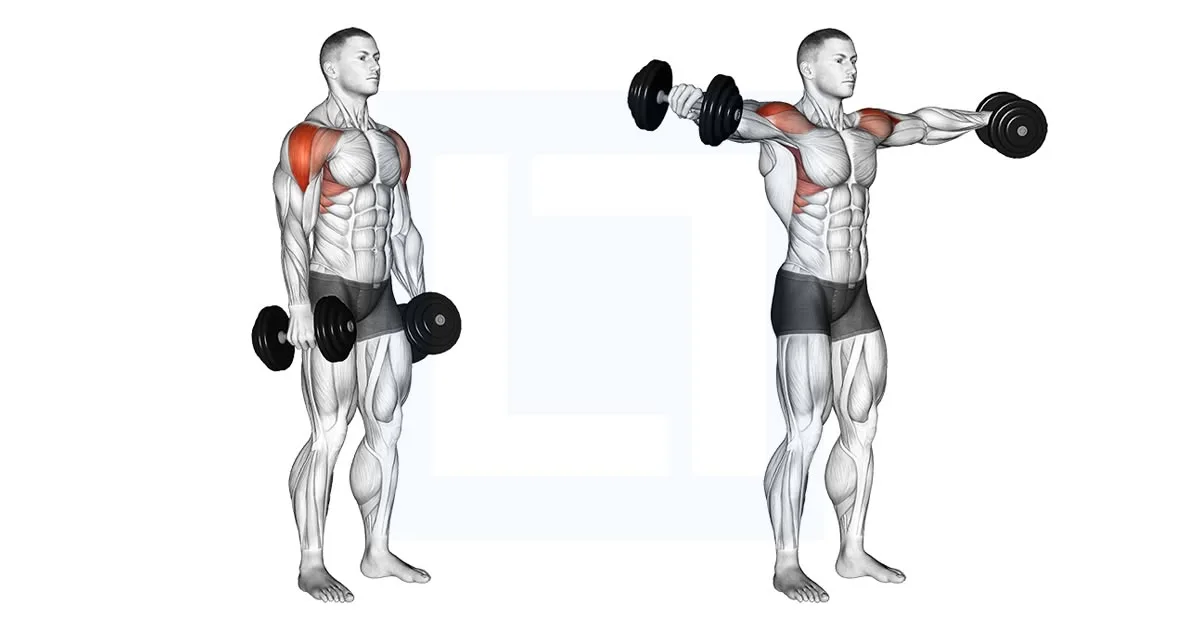
Lateral raises muscles worked
The main muscle worked in a lateral raise is the middle deltoid. Other muscles help control and support the movement:
| Muscle | Role in the exercise |
|---|---|
| Middle deltoid | Primary muscle lifting the upper arm out to the side |
| Anterior deltoid | May assist, especially depending on your arm path |
| Upper trapezius | Helps coordinate and stabilize the shoulder blades; can take over if you shrug excessively |
| Rotator cuff | Helps stabilize the shoulder joint as the arm moves |
| Core and forearm muscles | Help steady your torso and grip the weights |
The exact contribution of each muscle varies with the movement, equipment, arm position, and individual anatomy. A small study of competitive bodybuilders found that changing the arm’s rotation during lateral raise variations affected measured activity in several shoulder muscles. That’s useful context, but EMG readings measure electrical activity during a particular test—not long-term muscle growth or the “best” technique for every person.
How to do a dumbbell lateral raise
Use a weight you can control without rocking your body. If you’re new to the exercise, start with very light dumbbells—or practise the motion without weights.
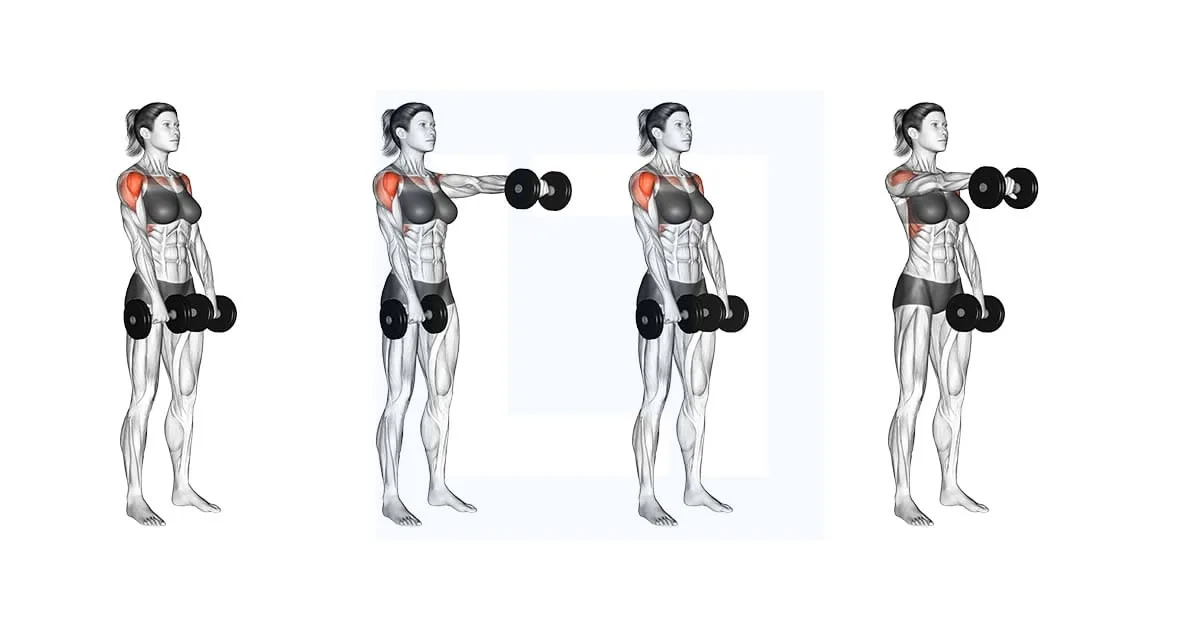
- Set your stance. Stand with feet about hip-width apart. Hold a dumbbell in each hand beside your thighs, arms relaxed and elbows slightly bent.
- Brace gently. Keep your ribs stacked over your pelvis. Use a relaxed, stable posture rather than arching your lower back.
- Choose a comfortable arm path. Lift your arms out and slightly forward from your sides, rather than forcing them into a perfectly straight line.
- Raise with control. Lead with your elbows and bring your upper arms toward shoulder height—or stop earlier if that is the most comfortable range for you.
- Keep the shoulders relaxed. Let your shoulder blades move naturally, but avoid deliberately hiking your shoulders toward your ears.
- Pause briefly. Keep your wrists neutral and your elbows softly bent. Your hands don’t need to rise higher than your elbows.
- Lower slowly. Bring the weights back to your sides under control. Don’t let gravity pull them down.
- Repeat with the same form. End the set when you can no longer maintain a controlled path without swinging, shrugging, or changing your posture.
A useful starting tempo is to raise smoothly, pause briefly near the top, and lower more slowly than you lift. There’s no need to count an exact number of seconds; the goal is to keep the movement deliberate.
Technique tips that make each rep count
Use a manageable load. Lateral raises are often more effective with lighter weights than people expect. If you need a big body swing to get the dumbbells moving, reduce the weight.
Keep a soft bend in your elbows. Locked elbows can make the lever feel unnecessarily long. A small, consistent bend makes it easier to control the motion.
Stop at a comfortable height. Shoulder height is a useful reference, not a mandatory target. Raising higher is not automatically better, especially if it causes discomfort or a shrug.
Move through a range you can control. Don’t force your arms down into a stretch or push them up through a painful position. Comfortable range can differ between people.
Avoid turning the movement into a front raise. A small forward angle is common and often comfortable, but bringing your hands far in front shifts the exercise’s emphasis.
Think “lift the elbows,” not “throw the hands.” This cue can help keep the movement smooth. Your wrists should stay in line with your forearms rather than bending to lift the weights.
Common lateral raise mistakes and how to fix them
Going too heavy
Heavy dumbbells can encourage momentum, body rocking, and shortened reps. Try lowering the load and seeing whether you can lift and lower each rep without changing your posture.
Shrugging hard at the top
Some upward movement of the shoulder blades is part of normal arm elevation. The problem is deliberately pulling the shoulders toward your ears to finish every rep. Reduce the weight, stop at a comfortable height, and keep your neck relaxed.
Swinging the torso
A small amount of natural body movement may happen near the end of a hard set, but repeated swinging can make it harder to control the exercise. Stand tall, brace lightly, and stop the set when your torso starts driving the weights.
Locking the elbows
Straightening the elbows completely increases the distance between the shoulder and the weight, which may make the lift harder to control. Keep a slight bend and maintain it throughout the rep.
Forcing a “thumbs down” position
Some lifters rotate their arms so the thumbs point down, believing it guarantees better shoulder targeting. You don’t need to force that position. A neutral or slightly thumb-up hand position is a practical starting point; choose a rotation that feels comfortable.
Chasing a burn instead of good reps
A burning sensation can happen during a challenging set, but it isn’t a reliable measure of muscle growth or exercise quality. Use repeatable technique and gradual progression as your main guides.
Lateral raise variations: which one should you choose?
Different variations change the resistance profile and how much support you get. No single version is best for everyone.
| Variation | What it offers | A good fit for |
|---|---|---|
| Dumbbell lateral raise | Simple, widely available; resistance is greatest as the weights move farther from your sides | Most lifters |
| Seated dumbbell lateral raise | Makes it harder to use a large body swing | Anyone practising strict control |
| Cable lateral raise | The cable pulls from the side, creating a different resistance feel through the movement | Lifters who want a cable option |
| Lean-away cable raise | Increases the range of motion on the working side | Experienced lifters who can control it comfortably |
| Machine lateral raise | Provides a supported path and makes setup straightforward | Beginners or those who prefer machine training |
| Bent-elbow lateral raise | Shortens the lever and may feel easier to control | Beginners or people adjusting to a lighter-feeling variation |
Choose a variation you can perform comfortably and consistently. It’s fine to use more than one over time, but you don’t need to rotate through every option to make progress.
Sets, reps, and progression
Lateral raises typically work well with moderate-to-higher repetitions because the exercise is easier to control with lighter loads. A practical starting point for many people is 2–4 sets of 10–20 repetitions, performed with consistent form. This is a general programming suggestion, not a required formula.
Start with a load that leaves you able to complete the set without swinging. When you can perform the top end of your chosen rep range with clean, controlled technique, try a small weight increase and build your reps back up. If the next dumbbell jump is too large, keep the same load and add reps gradually.
Avoid adding sets simply because the exercise feels light at the beginning. Instead, assess your whole training week, recovery, and whether your shoulders are progressing. If you already do several pressing exercises, you may need less additional shoulder volume than someone whose routine includes little direct shoulder work.
Lateral raises by experience level
Beginner: Start with bodyweight practice, very light dumbbells, or a lateral raise machine. Do 2 sets of 10–15 controlled repetitions once or twice a week, leaving a few good reps in reserve. Focus on a smooth lift and slow return.
Intermediate: Try 2–4 sets of 12–20 repetitions with dumbbells or cables. Add reps before increasing the load, and keep the movement consistent from one workout to the next.
Advanced: Use a challenging but controlled load, and consider changing the equipment or stance to suit your program. Techniques such as partial repetitions or drop sets can make a set more demanding, but they’re optional—not a substitute for good technique or recovery.
Common misconceptions
“Heavier weights always build bigger shoulders.” Heavier weights help only when you can control them and use them within a suitable program. If the load causes swinging or discomfort, it may not be the right load for that set.
“The upper trapezius should do no work.” Shoulder movement involves coordinated muscle activity. The goal is not to eliminate the trapezius, but to avoid excessive shrugging that takes over the movement.
“Lateral raises train every part of the deltoid equally.” The middle deltoid is the main target, while the front and rear portions are involved to varying degrees. A single movement is not a complete shoulder program. A small EMG study comparing several shoulder exercises similarly concluded that a variety of movements may be useful for training different deltoid portions. University of Wisconsin-Madison1
“EMG proves which exercise builds the most muscle.” EMG research can describe electrical activity in a particular testing setup. It does not by itself prove which exercise produces the most muscle growth over time. Results also depend on factors such as training effort, progression, and the way a study is designed. MDPI
Important safety notes
Stop if you feel sharp pain, sudden weakness, numbness, or a painful pinching sensation. Muscle effort and mild fatigue are different from joint pain. Don’t push through pain to reach a particular height or complete a planned number of repetitions.
If you have a shoulder injury, recent surgery, ongoing pain, or a medical condition that affects exercise, get individualized advice from a qualified healthcare professional or physical therapist before adding or changing shoulder exercises. Exercise instructions in an article cannot assess your symptoms or replace a professional evaluation.
Frequently Asked Questions
7What muscles do lateral raises work?
Lateral raises primarily work the middle deltoid, the muscle on the outer side of the shoulder. The front deltoid, upper trapezius, rotator cuff, forearms, and core may also contribute to the movement or help stabilize your body.
How do you do lateral raises with proper form?
Stand tall with light dumbbells at your sides, elbows slightly bent, and wrists neutral. Raise your arms out and slightly forward with control, stopping around shoulder height or sooner if that is more comfortable. Lower slowly without swinging or shrugging.
Should I raise dumbbells above shoulder height?
You generally do not need to raise them higher than shoulder height. Use a comfortable range that you can control, and stop sooner if lifting higher causes pain or makes you shrug.
How many sets and reps of lateral raises should I do?
A practical starting point is 2–4 sets of 10–20 repetitions, adjusted to your experience, training program, and recovery. Choose a weight that allows consistent technique and increase reps or load gradually.
Are dumbbell or cable lateral raises better?
Neither is universally better. Dumbbells are convenient and simple; cables provide resistance from a different direction. Choose the variation that feels comfortable, is easy to set up, and lets you perform controlled repetitions.
Can beginners do lateral raises?
Yes. Beginners can start with very light dumbbells, bodyweight practice, or a machine. Use a comfortable range of motion and stop the set if you cannot control the movement.
Why do my shoulders or neck hurt during lateral raises?
Pain can have different causes, and an article cannot diagnose them. Stop if you feel sharp or persistent pain, reduce the range or load if appropriate, and seek advice from a qualified healthcare professional if symptoms continue.
Lateral raises are a practical way to train the middle deltoid and add direct shoulder work to a broader strength program. The basics are simple: choose a manageable load, lift with control, keep a soft bend in your elbows, and use a pain-free range that suits you. Progress gradually, and don’t let heavier weights or extra repetitions come at the expense of technique.
Start with the variation that feels best, track how your sets go, and adjust one thing at a time. For more approachable training guides, explore the other strength and fitness articles on Smart Life Hubs.






Leave a Comment