
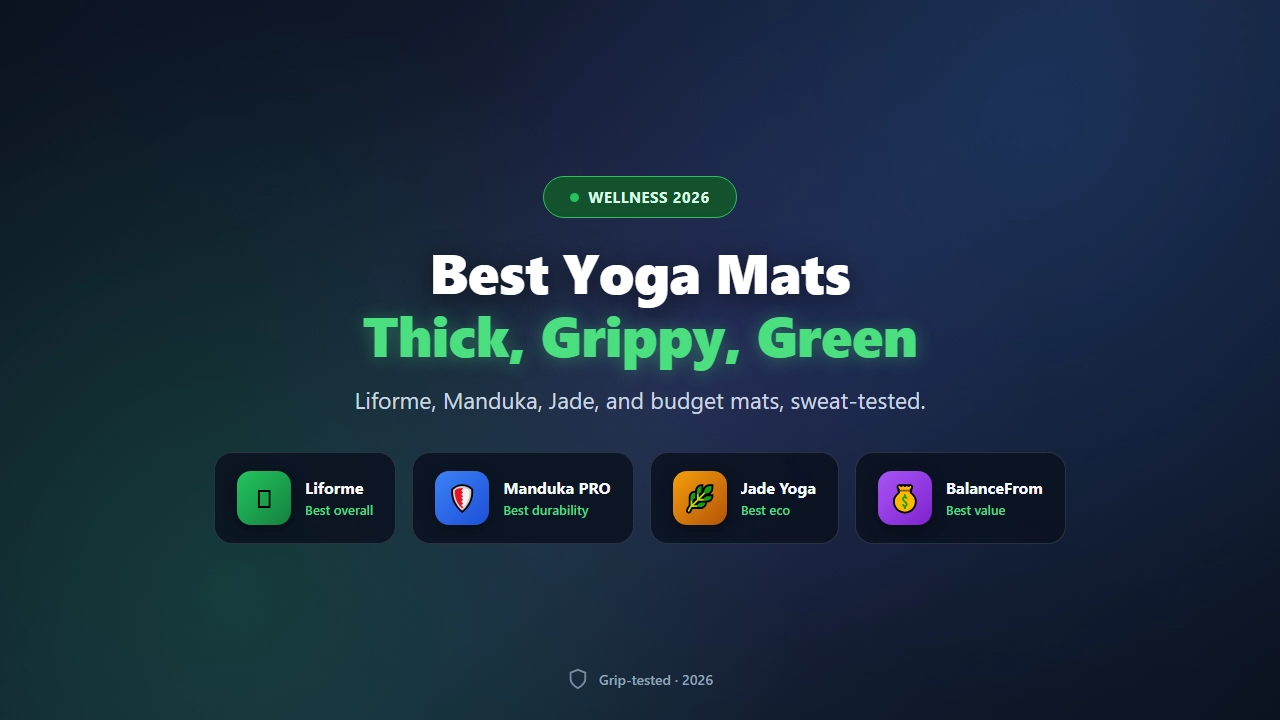
A yoga mat is the most personal piece of gear in fitness, and also the easiest to get wrong. Too thin and your knees punish you in low lunges. Too thick and you wobble in every standing balance. Slippery when sweaty is the worst sin of all. After a decade of practicing on gym floors, hotel carpets, and my own living room, I have strong opinions about what separates a great mat from a towel with a logo. Finding the best yoga mat 2026 has to offer means matching the surface to how you actually practice.
We tested five mats across a full range of prices, from the $25 budget PVC option to the $130 Manduka flagship. We practiced hot flows, held long balances, and tried to slide through downward dog on every single one. We also checked the eco credentials, because a thick yoga mat that sits in a landfill for 500 years is not a win for anyone. Whether you want a thick yoga mat for joint comfort, a non slip yoga mat for sweaty sessions, or an eco friendly yoga mat you can feel good about, there is a clear answer below.
Here is the roadmap: the at-a-glance table, five full reviews, a buying guide that settles the thickness question, and the FAQs we hear most.
The 5 best yoga mats of 2026 at a glance
Every mat here held up through a month of practice without falling apart. The real differences are grip under sweat, cushioning, weight, and how the materials were sourced.
| Product | Best for | Key specs | Price |
|---|---|---|---|
| Liforme Yoga Mat | Best overall premium mat | Natural rubber, 4.2 mm, alignment markers, 2.3 kg | ~$120 |
| Manduka PRO Yoga Mat | Best durability | 6 mm dense PVC, lifetime warranty, 3.2 kg | ~$130 |
| Jade Yoga Harmony Mat | Best eco-friendly mat | Natural rubber, 5 mm, open-cell grip | ~$90 |
| Gaiam Premium Print Yoga Mat | Best budget mat | 6 mm PVC, non-slip texture, many designs | ~$25 |
| BalanceFrom GoYoga Mat | Best value thick mat | 7 mm TPE, double-sided non-slip, carrying strap | ~$28 |
The 5 best yoga mats of 2026: full reviews
1. Liforme Yoga Mat — Best overall premium mat
The Liforme is the mat I reach for on days I want the practice to feel effortless. It is made from natural rubber, sits at 4.2 mm thick, and weighs 2.3 kg, which puts it firmly in the do-not-travel-with category. The grip is exceptional even when your hands are slick with sweat, and the printed alignment markers are not a gimmick; they genuinely help with hand and foot placement in standing poses. At around $120 it is a serious investment, and the rubber needs airing out when new. But for home practice and studio work, this is the best yoga mat 2026 testers will keep coming back to.
| Pros | Cons |
|---|---|
|
|
Check today’s price on Amazon.
2. Manduka PRO Yoga Mat — Best durability
The Manduka PRO is the buy-once mat. It is 6 mm of dense PVC with a lifetime warranty, and at 3.2 kg it feels like a yoga mat that plans to outlive your practice. The density is the star here: it is firm enough for balance poses while still cushioning your joints in kneeling work. The catch is the break-in period. New Mandukas are famously slippery for the first few sessions, sometimes more, until the surface grips up. You can accelerate it with a salt scrub, but it takes patience. If you want a thick yoga mat that will still look new in five years, this is the one.
| Pros | Cons |
|---|---|
|
|
Check today’s price on Amazon.
3. Jade Yoga Harmony Mat — Best eco-friendly mat
If sustainability matters to you, the Jade Harmony is the answer. It is made from natural rubber with an open-cell surface that grips aggressively, even in hot yoga, and the company plants a tree for every mat sold. At 5 mm thick and roughly $90, it sits in the premium middle ground, and the grip is the grippiest of anything we tested. The open-cell surface has a flip side: it absorbs sweat, so it needs regular cleaning, and the rubber smell is noticeable for the first week or two. Natural rubber also degrades faster than PVC. Those are fair trade-offs for a mat that does not poison the planet.
| Pros | Cons |
|---|---|
|
|
Check today’s price on Amazon.
4. Gaiam Premium Print Yoga Mat — Best budget mat
The Gaiam Premium Print is what I tell new practitioners to start with. It is 6 mm of PVC with a textured top surface, costs around $25, and comes in more patterns than you can count. For the price, the cushioning is genuinely good, and the texture helps with grip far better than the glossy mats of a decade ago. Two honest caveats: PVC is the least eco-friendly material in this roundup, and the grip does fade after heavy use, so expect to replace it after a year or two of regular practice. As a first mat, that is a fine trade. As a forever mat, no.
| Pros | Cons |
|---|---|
|
|
Check today’s price on Amazon.
5. BalanceFrom GoYoga Mat — Best value thick mat
The BalanceFrom GoYoga is the best yoga mat for beginners on a budget who want serious cushioning. At 7 mm of TPE, it is the thickest mat here, which makes kneeling poses and savasana noticeably more comfortable on hard floors. It is double-sided non-slip, and a carrying strap is included, which is a nice touch at roughly $28. The TPE material is more eco-friendly than PVC and cleans up well. The trade-offs: it shows wear after about a year, and the surface gets a little slick when wet, so hot yoga is not its home. For gentle practice and stretching, it is absurd value.
| Pros | Cons |
|---|---|
|
|
Check today’s price on Amazon.
How to choose the best yoga mat (2026 buying guide)
Five good mats, five different personalities. Here is how to match one to your practice.
Thickness is the first decision. Beginners and joint-sensitive people should pick 6 to 8 mm, because comfort keeps you coming back. If you spend most of your time in standing and balance poses, 4 to 5 mm gives you a more stable base. Travel mats at 1.5 to 3 mm exist for a reason, but they are compromises you feel on every knee.
Grip beats everything in hot classes. If you sweat, look for natural rubber open-cell surfaces like the Jade Harmony, or the Liforme’s proprietary coating. PVC mats get slippery when wet. A non slip yoga mat is not a luxury in hot yoga, it is a safety feature.
Think about where you practice. Hardwood floors ask for more cushioning. Carpet asks for less. If you practice at home only, weight does not matter. If you carry a mat to a studio, 2.3 to 3.2 kg adds up fast, and a strap or bag becomes essential.
Check the materials. Natural rubber is the eco friendly yoga mat choice but degrades faster and smells at first. PVC lasts longer and costs less but is worse for the planet. TPE splits the difference. There is no perfect answer, just the trade-off you are willing to live with.
Budget tiers in plain terms. Under $30 gets you a solid starter mat that will last a year or two. $90 to $130 gets you the grip and durability that serious practitioners want. The jump from $30 to $90 is the one that actually changes your practice.
Yoga pairs beautifully with other low-impact tools. If you want to add a little cardio before your practice, the best jump ropes of 2026 warm up the shoulders and calves in five minutes flat. And if you are curious about why yoga works beyond the mat, Harvard Health has a solid summary of the health benefits of yoga worth reading.






Leave a Comment