Best Exercise Mats of 2026 for Floor Workouts
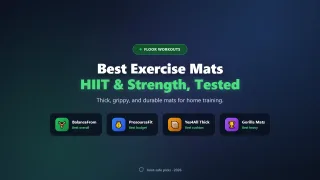
Nobody buys an Exercise mat because it is exciting. You buy it because burpees on a hardwood floor sound like a trip to the chiropractor, and because your downstairs neighbor already hates you. But the boring mat is doing real work: it protects your spine during sit-ups, your knees during lunges, and your hands during Planks. Choosing the Best Exercise mat 2026 has to offer is a small decision with a big effect on how your joints feel after every session.
We tested five mats across the thickness and price spectrum, from the $15 compact Amazon Basics to the $100 commercial-grade Gorilla Mats. We did burpees, mountain climbers, planks, and loaded carries on each one, and we paid attention to the two things that actually matter: grip when you are sweating and cushioning when you are landing. Whether you need a thick workout mat for joint protection or the best mat for home workouts that covers your whole living room, the answers are below.
Here is what you will find: a quick comparison table, five full reviews, a buying guide for HIIT and floor work, and the FAQ section at the end.
The 5 best exercise mats of 2026 at a glance
All five mats are genuinely useful, which is more than I can say for most fitness products. They differ in thickness, footprint, and how much abuse they will take.
| Product | Best for | Key specs | Price |
|---|---|---|---|
| BalanceFrom All-Purpose Mat | Best overall value | 1 inch thick TPE foam, 6×2 ft, non-slip both sides | ~$40 |
| ProsourceFit Exercise Mat | Best budget mat | 0.5 inch thick, 6×2 ft, high-density foam | ~$20 |
| Yes4All Extra Thick Mat | Best extra-thick cushioning | 1.25 inch thick, 6×2 ft, exercise-grade foam | ~$45 |
| Gorilla Mats Premium Exercise Mat | Best for heavy use | 0.5 inch dense commercial foam, 8×4 ft options | ~$100 |
| Amazon Basics Exercise Mat | Best compact pick | 0.5 inch, 4×2 ft, non-slip surface | ~$15 |
The 5 best exercise mats of 2026: full reviews
1. BalanceFrom All-Purpose Mat — Best overall value
The BalanceFrom All-Purpose is the mat I recommend to people who want one thing that does everything. At 1 inch thick with 6 by 2 foot coverage, it cushions your spine through sit-ups and your knees through lunges, and the TPE foam stays grippy on both sides. It is the exercise mat for HIIT that I reach for most, because it absorbs impact without feeling like you are training on a mattress. Around $40, it undercuts thicker premium options while matching them on comfort. The foam will dent if you drop heavy dumbbells on it, so keep your drops on the floor, not the mat, and the long roll needs storage space.
| Pros | Cons |
|---|---|
|
|
Check today’s price on Amazon.
2. ProsourceFit Exercise Mat — Best budget mat
The ProsourceFit is the best exercise mat 2026 has under $25, full stop. It is 0.5 inch of high-density foam in the standard 6 by 2 foot size, which is firm enough for stability work while still taking the edge off hard floors. I used one for months in a tiny apartment and it handled daily plank and ab circuits without complaint. It is slightly stiff out of the box and thinner than the premium options, so high-impact jumping is better on a thicker mat. But for strength work, stretching, and bodyweight circuits, this is the smartest $20 you will spend on fitness this year.
| Pros | Cons |
|---|---|
|
|
Check today’s price on Amazon.
3. Yes4All Extra Thick Mat — Best extra-thick cushioning
If your knees have opinions, the Yes4All Extra Thick is the diplomat. At 1.25 inches, it is the thickest mat we tested, and the shock absorption is noticeable on the first burpee. It rolls up with included straps, which makes storage easier than you would expect for something this bulky. This is the best mat for home workouts when joint pain is the reason you are hesitating to start. The trade-offs are physical: it is heavy and bulky when rolled, and the extra thickness makes balance-based moves like planks slightly less stable. If you are doing mostly floor work and conditioning, that is a price worth paying.
| Pros | Cons |
|---|---|
|
|
Check today’s price on Amazon.
4. Gorilla Mats Premium Exercise Mat — Best for heavy use
The Gorilla Mats Premium is the mat for people who treat their training space like a garage, because it basically is one. It uses 0.5 inch dense commercial foam, and the larger sizes go up to 8 by 4 feet, which gives you a full functional training area instead of a narrow strip. Kettlebells, sled pushes, and loaded carries all happen on this mat without it shredding. At around $100, it costs more than the others, and the big footprint means you need a dedicated space. But if you train hard, with real equipment, this is the non slip workout mat that will still look new when the cheap ones have split.
| Pros | Cons |
|---|---|
|
|
Check today’s price on Amazon.
5. Amazon Basics Exercise Mat — Best compact pick
The Amazon Basics mat is smaller than everything else here at 4 by 2 feet, and that is exactly why it belongs on the list. It fits in rooms where a 6 foot mat will not, folds flat for storage, and costs about $15. I keep one in my office for lunchtime stretches and quick mobility breaks, and it does that job perfectly. Be honest about its limits: the short length is a problem for taller users doing full-body stretches, and 0.5 inch is thin for high-impact work. It is a purpose-built supplement mat, not a main mat. If your space is tight, it is the right call.
| Pros | Cons |
|---|---|
|
|
Check today’s price on Amazon.
How to choose the best exercise mat (2026 buying guide)
Mats look the same in product photos, so use these five criteria instead of your eyes.
Thickness is the joint-protection dial. For HIIT, burpees, and anything with jumps, 0.5 to 1 inch is the range that makes sense. Thicker is kinder to your spine and knees, but too thick hurts balance work like planks and push-ups. The Yes4All at 1.25 inches is the extreme end, and it is right for some people.
Know the difference from a yoga mat. Exercise mats are thicker, usually 0.5 to 1.25 inches, and built for impact. Yoga mats are 3 to 6 mm and built for balance and grip. Using a yoga mat for HIIT is like using a hand towel for a beach trip. If you do both, buy both.
Match the size to your room and your body. Standard is 6 by 2 feet, which suits most adults. Tall users should check the length against their stretched height. Small spaces can use the 4 foot Amazon Basics. Serious trainers should look at the 8 by 4 foot Gorilla sizes.
Grip matters more as you sweat. A non slip workout mat is not optional once your hands and feet get slick. TPE and textured surfaces grip better than bare foam. If you are sliding in downward dog or plank, the mat, not you, is the problem.
Match the price to the abuse. A $15 to $20 mat is fine for gentle daily use. If you drop weights, do sled pushes, or train daily, the commercial-grade Gorilla mat pays for itself in the first year. Cheap foam dents, and dents turn into tears.
While you are building out your floor training setup, remember that cardio needs almost no space at all. The best jump ropes of 2026 turn a corner of any room into a conditioning zone, and a mat underneath keeps the rope quiet for your neighbors. And if you are unsure how much movement you actually need each week, the CDC’s physical activity guidelines for adults are the clearest baseline I know.
Frequently Asked Questions
What is the difference between a yoga mat and an exercise mat?
How thick should a workout mat be?
Are exercise mats machine washable?
Do I need a mat for home workouts?

Daniel Okoro
Daniel Okoro is a strength and rehab coach and our senior fitness contributor. An ex-collegiate athlete with a kinesiology background, he covers mobility, injury prevention, and calisthenics. He designs programs around proper form and progressive overload for beginners and advanced lifters alike.





Leave a Comment