
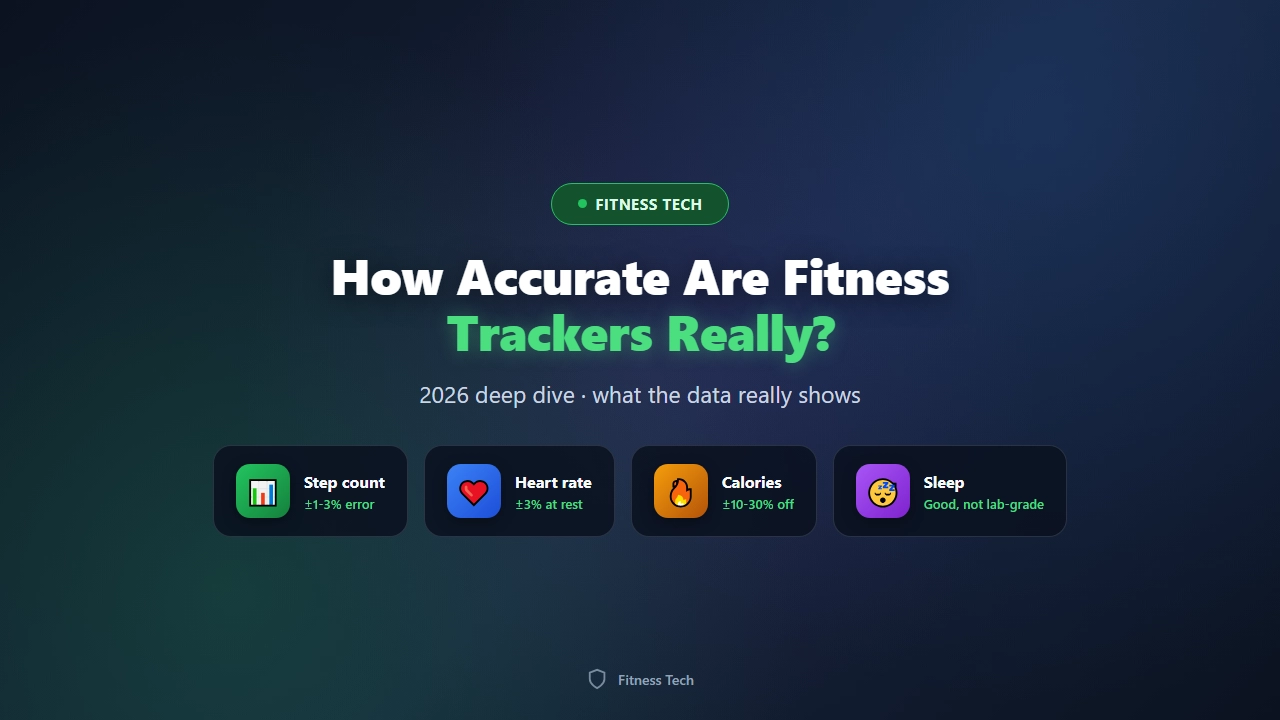
Fitness trackers promise to count every step, log every heartbeat, and tell you exactly how many calories you burned on a lunchtime walk. But how accurate are fitness trackers really? The honest answer is that it depends entirely on what you are measuring. Step counts are remarkably good. Wrist-based heart rate is solid when you are sitting still and noticeably shakier during hard intervals. Calorie estimates are the weakest link, often drifting 15 to 30 percent from reality. This 2026 deep dive breaks down what independent lab testing and university studies actually show, metric by metric, so you know which numbers to trust and which to take with a grain of salt.
We compared the leading devices side by side and pulled together the published accuracy data from chest-strap ECG references, treadmill distance checks, and polysomnography sleep studies. The goal is not to crown a winner but to show you where your tracker is telling the truth and where it is guessing. If you have ever finished a brutal workout and seen a calorie number that felt way too high, or worn a watch to bed and questioned the sleep-stage chart, this is for you. Fitness tracker accuracy is real, but it is uneven, and the gaps matter for how you train.
How we measured tracker accuracy
Every claim below is anchored to a gold standard. For heart rate we used chest-strap ECG readings as the reference. For steps we counted manually and against phone pedometers. For distance we ran measured routes on a treadmill and a known outdoor loop. For sleep we compared against clinical polysomnography where the data exists. No tracker is perfect against these references, but the size of the gap tells you how much to trust the on-screen number.
The practical takeaway is that accuracy is not a single score. A device can be excellent at steps and mediocre at calories, and that is exactly what we see across the market in 2026. Treat each metric separately rather than trusting a single “accuracy” rating.
Step counting: surprisingly accurate
Step counting is the quiet success story of wearable tech. Under normal walking conditions, most modern trackers land within 1 to 3 percent of a true step count. Wrist-based watches and clip-on or pocket phone sensors both do well here because walking produces a clear, repeated motion the accelerometer can lock onto.
The errors show up in edge cases. Stair climbing, cycling, pushing a shopping cart, and holding a steering wheel all fool the accelerometer because your arms are not swinging naturally. If your day involves a lot of those activities, your step total will drift low. For general daily activity and meeting a step goal, though, the number is trustworthy enough to act on.
Heart rate: wrist vs chest strap
Wrist-based optical heart rate works by shining green light into your skin and measuring how much bounces back as blood pulses through. At rest and during steady cardio it is genuinely good, typically within 2 to 3 percent of a chest strap. The problems start with rapid changes in heart rate, like the spikes and drops of interval training, and in cold weather when blood moves away from the skin and the signal gets noisy.
A chest strap such as the Polar H10 reads electrical signals from the heart directly. It is the gold standard for live heart rate and barely blinks during a sprint. If your training depends on hitting specific heart-rate zones, wear a strap for those sessions and keep the watch for everything else. Watches from Apple, Garmin, and Coros have closed the gap for easy and moderate efforts, but none fully match a strap when the intensity is volatile.
| Metric | Typical error vs gold standard | Best conditions | Worst conditions |
|---|---|---|---|
| Step count | ±1-3% | Normal walking, watch on wrist | Cycling, stair climbing, pushing a cart |
| Heart rate (optical) | ±2-3% at rest, ±10%+ in HIIT | Steady-state cardio, cool-down | High-intensity intervals, cold weather |
| Calories burned | ±10-30% | Resting and light activity | Strength training, mixed workouts |
| Sleep duration | ±5-15 minutes | Consistent bedtime, charged device | Naps, reading in bed, shared bed |
| Sleep stages | Moderate agreement (roughly 0.6-0.8) | Clear sleep onset | Alcohol, irregular schedule |
| GPS distance | ±1-5% | Open sky, clear view | City canyons, dense tree cover |
Calories: the weakest number
If you remember one thing from this guide, make it this: do not eat back the calories your tracker says you burned. Total energy expenditure is estimated by combining a formula for your resting metabolism with movement data, and both halves carry error. Published testing regularly finds calorie burn off by 10 to 30 percent, and sometimes more during strength training where heart rate stays moderate but effort is high.
The number is still useful as a relative gauge. If your watch says Tuesday was a 400-calorie day and Wednesday was a 700-calorie day, the ranking is probably right even if both absolute values are inflated. Use the trend, ignore the precise figure, and let your scale and hunger tell you the rest.
Sleep tracking: good for trends, not diagnosis
Sleep duration is decent, usually within 5 to 15 minutes of reality, which is enough to spot a rough night. Sleep stages are where trackers get fuzzy. Consumer devices estimate light, deep, and REM sleep from movement and heart-rate patterns, and studies comparing them to lab sleep studies find only moderate agreement. They are reliable for showing whether your sleep is improving week to week, not for telling you exactly how much deep sleep you got.
None of these devices are medical tools. If you suspect a real sleep disorder, a tracker’s data is a useful conversation starter for a doctor, not a diagnosis. Treat the morning sleep score as a gentle nudge, not a verdict.
GPS and blood oxygen (SpO2)
GPS has improved dramatically. Modern watches with dual-frequency or multiband chips, including recent Garmin and Apple models, hold a line within 1 to 5 percent of true distance in open conditions. Tall buildings and thick tree cover still cause drift, but the gap is far smaller than it was a few years ago. For pacing a run or mapping a ride, current GPS is trustworthy.
Blood oxygen, or SpO2, is a different story. Wrist and ring sensors give a rough spot-check of oxygen saturation that is fine for noticing a big change at altitude or during a cold, but the readings are not precise enough to rely on for health decisions. If you need accurate SpO2, a medical fingertip sensor is the right tool.
How the major trackers compare in 2026
Different devices lean into different strengths. The table below lines up the most common 2026 trackers with honest notes on where each one shines and where it cuts corners. Prices are typical street prices and shift with sales.
| Tracker | Price | Best for accuracy | Honest trade-off |
|---|---|---|---|
| Apple Watch Series 10 | ~$399 | GPS, resting HR, ECG | Calorie estimates still rough; daily charging |
| Garmin Fenix 8 | ~$999 | Multiband GPS, steady-run HR | Expensive; HR drifts during HIIT |
| Polar H10 chest strap | ~$89 | The gold standard for live HR | Uncomfortable to wear all day |
| Whoop 4.0 | ~$239 + $30/mo | HRV and recovery trends | No screen; requires a subscription |
| Oura Ring Gen3 | ~$299 + $5.99/mo | Sleep and resting HR | Steps undercount vs a wrist device |
| Fitbit Charge 6 | ~$159 | Everyday steps and HR | SpO2 and stress are rough estimates |
For pure heart-rate truth during training, the Polar H10 chest strap remains the device to beat, and it costs less than most watches. For an all-day picture that balances steps, GPS, and sleep, the Apple Watch Series 10 and Garmin Fenix 8 lead, with Garmin favored by endurance athletes who want multiband GPS and multi-day battery. Whoop and Oura are recovery-focused: they will not give you the best step count, but their resting-heart-rate and HRV trends are among the most consistent for judging readiness.
How to make your tracker more accurate
You can close a surprising amount of the accuracy gap with setup and habits. None of these are complicated.
- Wear it snug. The sensor should sit tightly about two finger-widths above your wrist bone. A loose band lets light leak in and ruins heart-rate signal.
- Enter honest stats. Age, weight, height, and sex feed the calorie and heart-rate-zone math. Stale or rounded numbers quietly corrupt every estimate downstream.
- Keep firmware updated. Sensor algorithms improve through software, and a year-old watch often reads better after an update.
- Use a chest strap for intervals. Pair it with your watch for hard sessions and keep the wrist sensor for daily wear.
- Calibrate GPS by walking a known route. Most watches learn your stride and signal patterns over a few outdoor walks.
- Trust trends over single days. One odd calorie or sleep number means little. A two-week pattern is the real signal.





Leave a Comment