
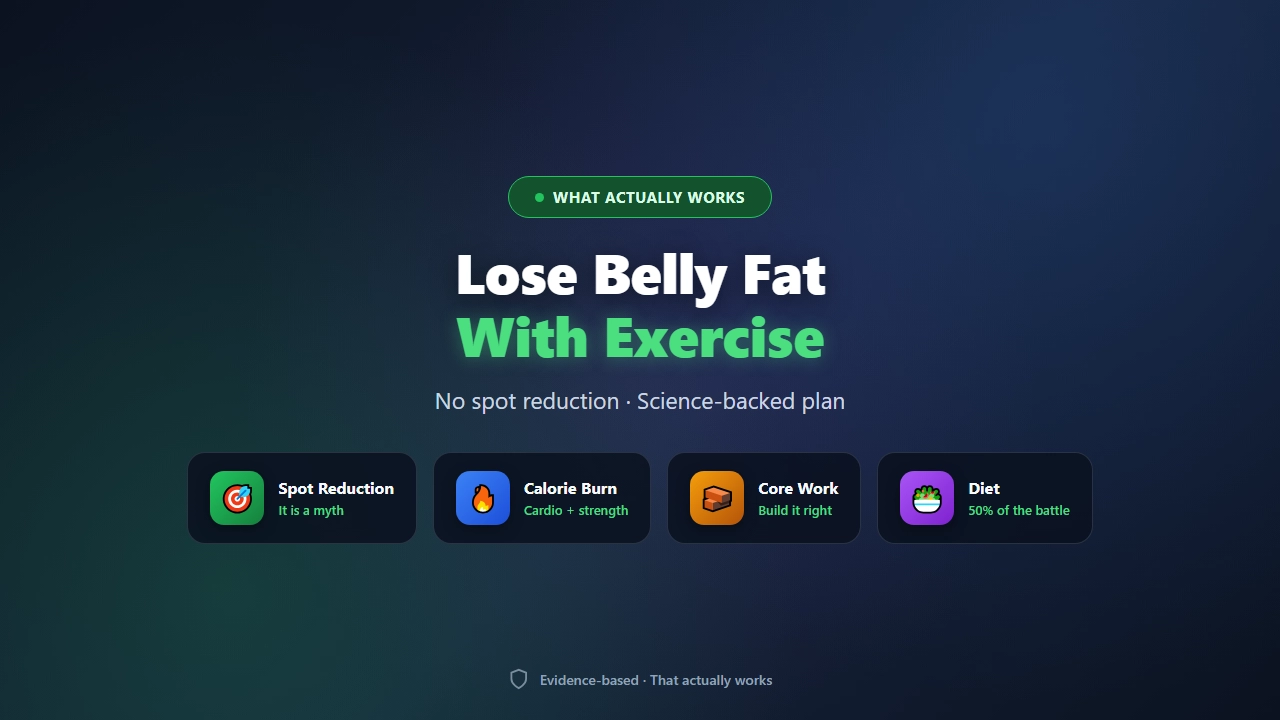
If there is one thing every fitness article, every trainer, and every influencer agrees on, it is this: you cannot spot reduce fat. Doing a thousand crunches will not burn fat off your stomach specifically, and anyone who tells you otherwise is selling something. But that does not mean exercise is useless for belly fat. Far from it, the right kind of exercise combined with the right diet is the most reliable way to slim your midsection.
This guide separates the bull from the science. Below you get the exercises and training methods that genuinely reduce belly fat, how ab training fits into the equation (it does, just not the way you think), and the daily habits that make the biggest difference to the fat around your waist.
The spot reduction myth, busted
Spot reduction is the idea that you can burn fat from a specific body part by exercising that part. The research is unanimous: it does not work. A landmark study showed that people who did only ab exercises for six weeks got stronger abs but lost no belly fat compared to a control group. Fat loss happens systemically, through a calorie deficit, not locally, through targeted muscle work.
What ab exercises do is build the muscle underneath the fat. So when the fat does come off through diet and overall exercise, you have a defined stomach underneath rather than a flabby one. That is a real benefit, it just is not spot reduction.
Why belly fat is different and more stubborn
Belly fat comes in two types. Subcutaneous fat sits just under the skin and is what you can pinch. Visceral fat wraps around your internal organs and is the more dangerous type, linked to heart disease and type 2 diabetes. Visceral fat is also more hormonally active, which makes it especially responsive to stress and poor sleep.
This matters because visceral fat responds best to a combination of diet, exercise, and stress management, more than any single magic workout. The good news is that visceral fat is often the first fat to go when you start losing weight, because it is more metabolically active. The stubborn lower-belly fat in men, and the fat around the hips and thighs in women, tends to be the last to leave, and that is normal and biologically driven.
What actually works: the 3 pillars
Belly fat loss, like all fat loss, comes down to three things. Get these right and your waist will shrink, get them wrong and no workout routine can save you.
| Pillar | Why it matters | How to apply it |
|---|---|---|
| Calorie deficit | Fat only leaves when you burn more than you eat | Eat 300-500 calories below maintenance |
| Protein intake | Preserves muscle, keeps you full, burns more to digest | 0.7-1g per pound of bodyweight daily |
| Training | Burns calories, builds muscle, raises metabolism | Strength + cardio, 3-5 days a week |
The calorie deficit is non-negotiable. No exercise burns enough to outrun a bad diet. If you eat back everything you burn in a workout, your waist will not change no matter how much you train.
The best exercises for burning belly fat
The best belly-fat-burning exercises are the ones that burn the most total calories and build the most muscle, because muscle raises your resting metabolism. Here is what ranks highest.
| Exercise type | Why it works | How often |
|---|---|---|
| Compound strength (squats, lunges, push-ups, deadlifts) | Builds the most muscle, burns the most per minute | 3x a week |
| High-intensity interval training (HIIT) | Burns lots of calories in little time, boosts metabolism | 2-3x a week |
| Steady-state cardio (walking, running, cycling) | Easy to sustain, adds to total calorie burn | 3-4x a week |
| Walking | Underrated, low impact, builds daily burn, reduces stress | 7,000-10,000 steps daily |
A mix of strength and cardio beats either alone. Strength training keeps and builds the muscle that keeps your metabolism high, while the cardio daily activity adds the extra calorie burn that tips you into a deficit. Walking is the most underrated tool here, it is low-impact, reduces cortisol, and quietly adds up to hundreds of calories across a week.
Does core work help at all?
Yes, but not for burning fat. Dedicated core and ab work does two genuinely useful things. First, it builds the muscle that shows through once the fat is gone, giving you a defined, strong midsection rather than a soft one. Second, a strong core improves your posture, protects your lower back, and makes every other exercise better, which is a big deal when you are training consistently.
The catch is that ab exercises burn very few calories. A 10-minute ab workout burns maybe 30 calories, while a 10-minute brisk walk burns about the same and 10 minutes of HIIT burns far more. So treat core work as building the muscle, and treat cardio and strength as burning the fat.
For core, stick to the movements that actually load the abs well: planks, dead bugs, bird dogs, hanging leg raises, and reasonable rep ranges. Skip the endless crunches, they have a limited range of motion and put avoidable strain on your lower back.
Daily habits that melt belly fat faster
Exercise is only half the equation. These habits push your belly fat down faster than any single workout.
Eat protein first. Starting each meal with protein keeps you full longer, stops overeating, and raises the thermic effect of food. Cut liquid calories. Soda, juice, and alcohol add hundreds of empty calories a day with zero fullness. Walk after meals. A 10-minute walk within an hour of eating flattens the post-meal blood sugar spike, which directly relates to fat storage around the belly.
Sleep 7 to 8 hours. Poor sleep raises cortisol and the hunger hormone ghrelin, both of which push fat toward the belly. Manage stress. Chronic stress keeps cortisol elevated, and cortisol is strongly linked to visceral fat. Cut refined sugar. High-sugar diets spike insulin, which encourages fat storage around the midsection more than dietary fat does.
A simple 4-week plan
Here is a realistic plan you can start this week. It combines the three pillars without requiring dramatic changes.
| Day | Activity |
|---|---|
| Monday | Full-body strength (30 min) + 10-min walk |
| Tuesday | HIIT (20 min) or steady-state cardio (30-40 min) |
| Wednesday | Full-body strength (30 min) |
| Thursday | Walk (30-45 min) + core circuit (10 min) |
| Friday | Full-body strength (30 min) |
| Saturday | Long walk or hike (45-60 min) |
| Sunday | Rest |
Pair that with a 300-500 calorie deficit and protein at every meal, and you will see meaningful changes in your waistline within a month, with the biggest visible progress coming around the 6 to 8 week mark.






Leave a Comment