
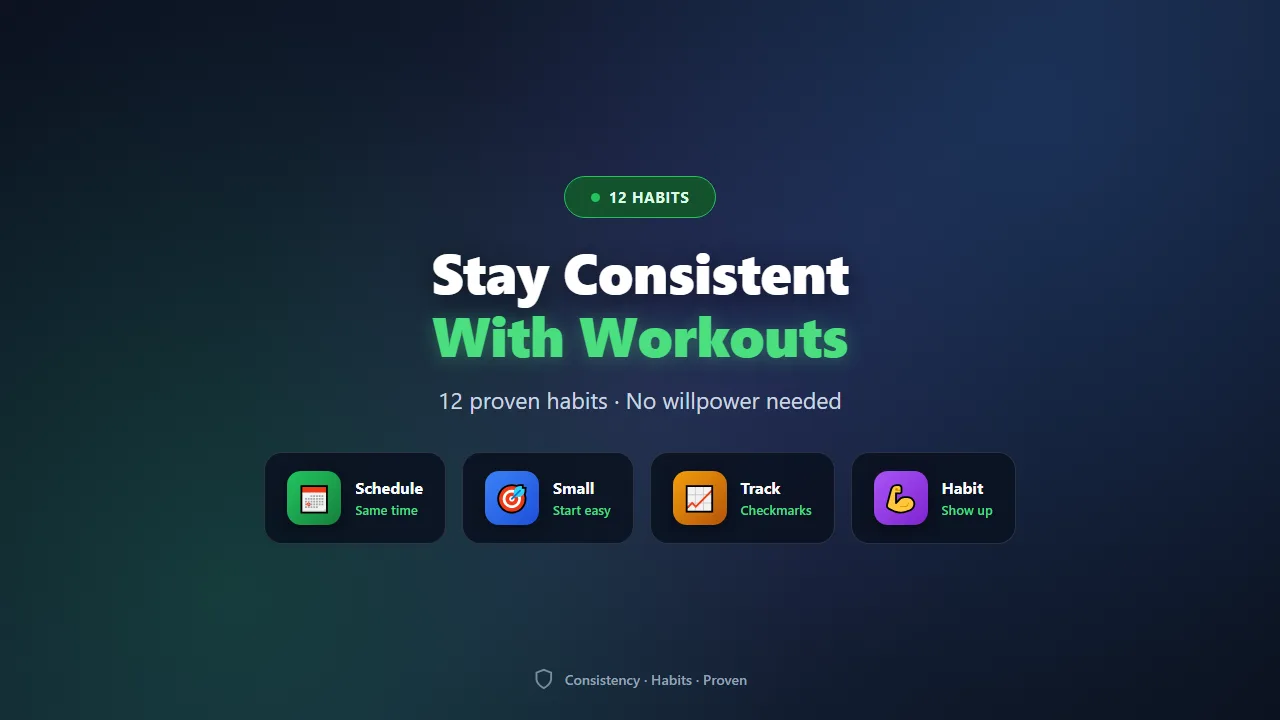
Ask any fitness expert what separates people who get results from people who do not, and the answer is never the program. It is consistency. The best workout in the world does nothing if you skip it after two weeks, and a mediocre workout done for a year transforms your body. The problem is that most people rely on motivation to stay consistent, and motivation is a mood, it disappears on the first bad day.
The solution is habits. Here are 12 proven habits that make workout consistency automatic, so you train even on the days you do not feel like it.
The 12 habits that build consistency
1. Schedule your workouts like appointments. Put them in your calendar with a fixed day and time, and treat them as non-negotiable meetings. If you would not skip a dentist appointment, do not skip your workout.
2. Start smaller than you think you need. A 20-minute workout you actually do beats a 60-minute plan you abandon. Once the habit is solid, you can add time. Starting small is not a compromise, it is strategy.
3. Anchor it to an existing habit. Train right after something you already do every day, like waking up, dropping the kids at school, or finishing work. The anchor reminds you, and the workout becomes part of the routine.
4. Lay everything out the night before. Clothes, mat, shoes, water bottle. Removing the morning decision removes the morning excuse. This one habit saves more workouts than almost anything else.
5. Track every session. A calendar with a checkmark per workout, or any simple tracker. The streak becomes something you protect, and a visible run of checkmarks is deeply motivating.
6. Never miss twice. Missing one workout is nothing, missing two is the beginning of a pattern. The rule is simple: a missed session is followed by the very next scheduled one, no exceptions, no guilt.
7. Make it easy to start. On low-motivation days, tell yourself you will just do 5 minutes. Starting is the hard part, and once you start, you almost always finish. The 5-minute rule saves workouts constantly.
8. Have a minimum viable workout. Define your “bad day” workout, a 10-minute version you can do anywhere. When life is chaos, you still get the win, and the habit survives the hard weeks.
9. Prepare for the excuses. Write down your three most common excuses, tired, busy, no energy, and a planned response for each. When the excuse arrives, you already have your answer.
10. Train at your best time. Are you a morning person or an evening person? Training when your energy naturally peaks makes every session feel easier and more sustainable.
11. Find a form you enjoy. If you hate running, do not run. Cycling, swimming, lifting, dance, sports, there is a version of exercise you enjoy, and enjoyment is the ultimate consistency tool.
12. Forgive yourself fast. Guilt is the killer of habits. You missed a week? Fine, start again today. One bad stretch does not erase your progress, and beating yourself up only makes you quit longer.
Why habits beat motivation
Motivation is a feeling, and feelings fluctuate. Some days you wake up ready to train, other days you would rather stay in bed. Habits remove the decision entirely: you train because it is scheduled, anchored, and tracked, not because you feel like it. Research on habit formation shows that repeated behavior in a consistent context becomes automatic in roughly two months. That means your first two months are the hard part, and every day after gets easier.






Leave a Comment