
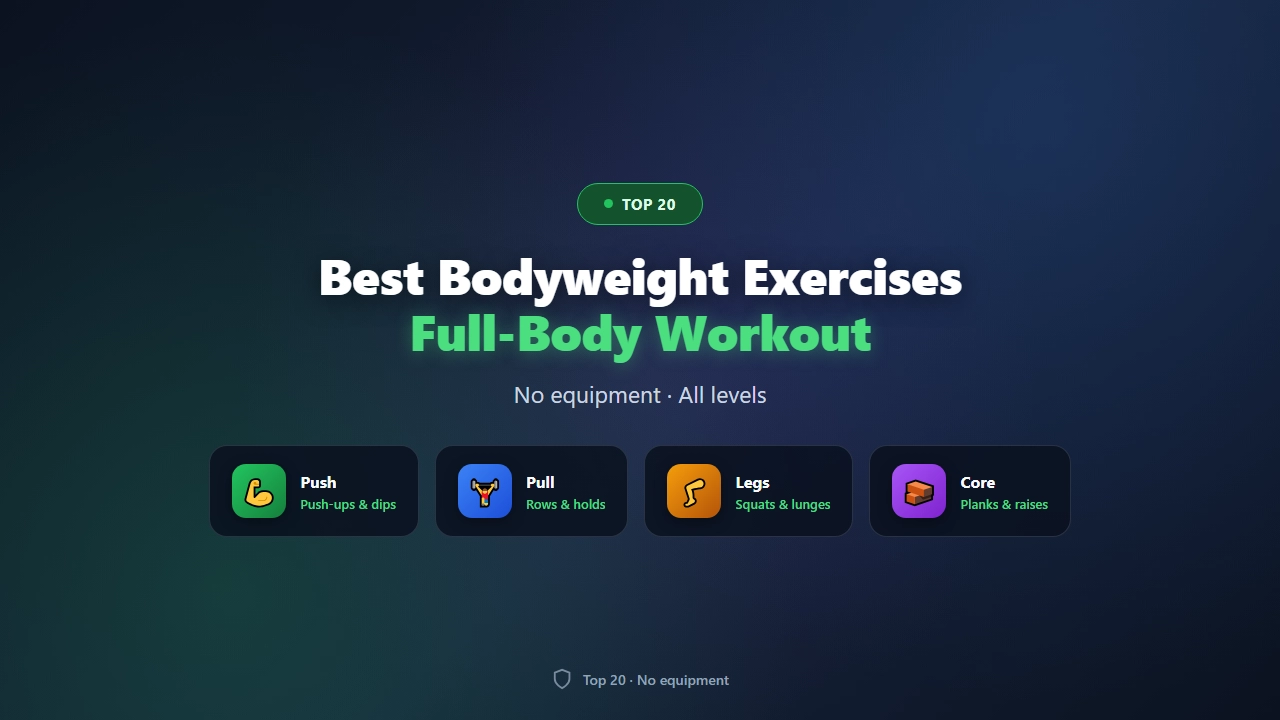
You do not need a single piece of equipment to train your entire body. The 20 best bodyweight exercises cover every muscle group, every movement pattern, and every fitness level, from absolute beginner to advanced athlete. This is the complete list, and it is all you need to build a strong, functional, good-looking physique at home.
Below you get the exercises organized by movement pattern, how to do each one correctly, and a sample full-body workout that combines them into a routine you can follow three times a week.
How to use this list
The 20 exercises are grouped into four patterns: push, pull, legs, and core. A balanced routine picks exercises from every group, because your body needs both pushing and pulling, both squatting and hinging, and a strong core to hold it all together. Each exercise lists a target rep range and an easier and harder variation, so you can find the level that challenges you.
The push exercises (chest, shoulders, triceps)
1. Push-ups. The king of bodyweight exercises. Hands slightly wider than shoulders, body in a straight line, lower your chest to the floor. Beginner: knee push-ups. Advanced: one-arm push-ups.
2. Pike push-ups. Hips high, hands on the floor, lower your head toward the ground. This shifts the load to your shoulders. Beginner: feet on the floor. Advanced: feet elevated.
3. Dips. Hands on a sturdy chair behind you, lower your body, push back up. Builds chest and triceps. Beginner: bent knees. Advanced: straight legs with feet elevated.
4. Diamond push-ups. Hands close together under your chest, forming a diamond with your thumbs and index fingers. This variation hammers the triceps.
5. Wall handstand holds. Kick up against a wall and hold. This builds shoulder strength and balance, and it is the gateway to handstand push-ups.
The pull exercises (back, biceps, rear delts)
6. Bodyweight rows. Lie under a sturdy table or use a towel over a door, grab the edge, and pull your chest toward it. This is the closest you get to a barbell row at home.
7. Towel rows. A towel looped over a door handle, pull your body toward the door with an underhand grip. Great for the biceps.
8. Reverse snow angels. Lie face down, arms out, sweep your arms from above your head down to your hips along the floor, engaging the back muscles.
9. Superman holds. Lie face down, lift your arms, chest, and legs off the floor, and hold. Builds the lower back and glutes, the foundation of a healthy spine.
The leg exercises (quads, hamstrings, glutes)
10. Squats. The foundation of leg training. Feet shoulder-width, sit back and down, drive through your heels. Beginner: chair squats. Advanced: pistol squats.
11. Lunges. Step forward and lower until both knees are at 90 degrees. Works the quads, hamstrings, and glutes, plus your balance. Beginner: reverse lunges. Advanced: jumping lunges.
12. Glute bridges. Lie on your back, knees bent, drive your hips up and squeeze. Beginner: two legs. Advanced: single leg with a pause.
13. Calf raises. Stand on the edge of a step, lower your heels, rise onto your toes. Simple, but the calves need their own work.
14. Wall sits. Slide down a wall until your thighs are parallel to the floor and hold. It burns like nothing else and builds real endurance in the quads.
15. Step-ups. Use a sturdy chair or step, step up and down. Works the legs with a natural pattern and is gentle on the knees.
The core exercises (abs, obliques, lower back)
16. Planks. Forearms on the floor, body in a straight line, hold. The most reliable core exercise there is. Beginner: knee planks. Advanced: long-lever planks.
17. Dead bugs. Lie on your back, arms up, legs in tabletop, lower one arm and the opposite leg without arching your back. Trains the deep core with zero spine strain.
18. Bird dogs. On all fours, extend one arm and the opposite leg, hold, switch. Builds core stability and balance.
19. Mountain climbers. From a high plank, drive your knees to your chest fast. Core plus cardio in one movement.
20. Bicycle crunches. Lie on your back, hands behind your head, and bring opposite elbow to opposite knee. The most effective of the crunch family for the obliques.
A sample full-body workout
Here is how to combine the 20 into a complete three-times-a-week routine. It covers every pattern in about 30 minutes.
| Order | Exercise | Sets x Reps |
|---|---|---|
| 1 | Push-ups | 3 x 10-15 |
| 2 | Bodyweight rows | 3 x 8-12 |
| 3 | Squats | 3 x 15-20 |
| 4 | Dips | 3 x 8-12 |
| 5 | Glute bridges | 3 x 15 |
| 6 | Planks | 3 x 30-45s |
| 7 | Mountain climbers | 3 x 30s |
Rest 60 seconds between exercises. Rotate the harder variations as you get stronger, and swap in any of the other exercises from the list to keep it interesting. This one routine, done consistently, covers your whole body.





Leave a Comment