
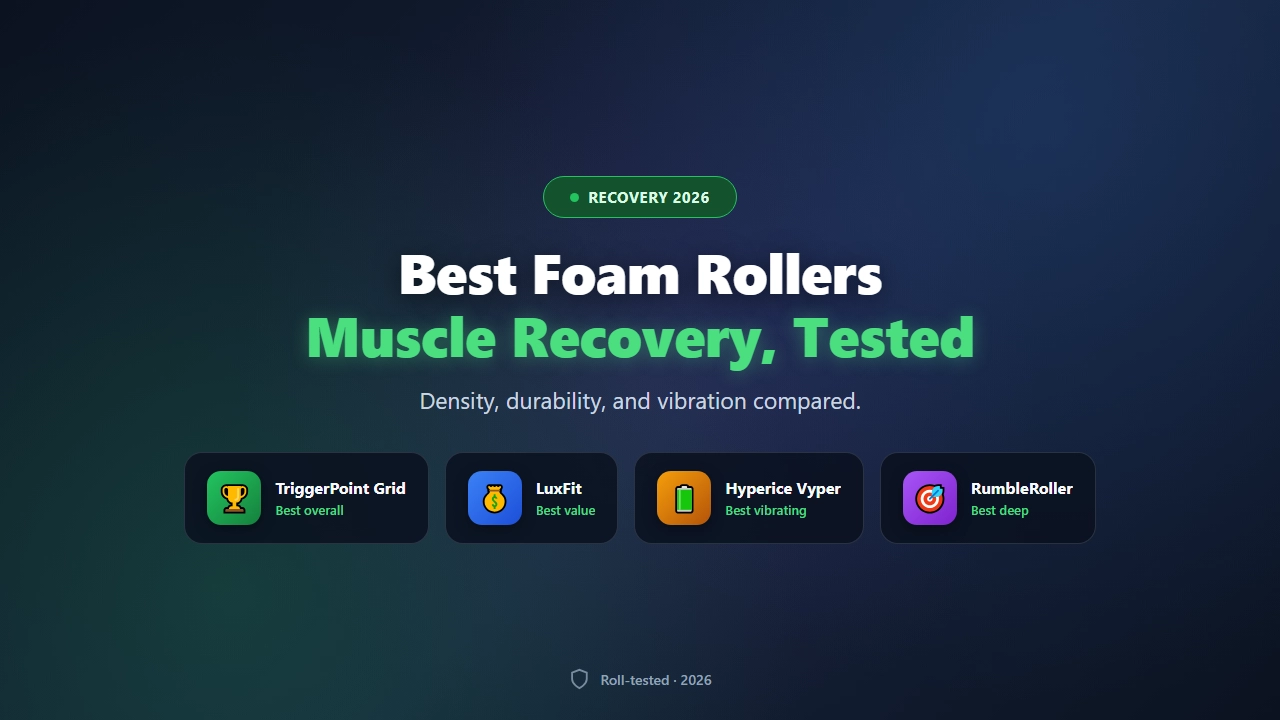
Skip the $100 sports massage and buy a $25 cylinder of foam instead. That is not hyperbole, it is the math of recovery. A foam roller is always available, always the right temperature, and it works on exactly the spot that hurts without you having to explain it to anyone. The catch is that rollers come in wildly different densities, and the wrong one for your level feels like either nothing or a punishment. Finding the best foam roller 2026 has to offer means matching firmness to your pain tolerance and your goals.
We tested five rollers across the density spectrum, from the smooth high-density basics to the knobby RumbleRoller and the $200 vibrating Hyperice. We rolled quads, backs, and IT bands, timed the sessions, and noted which ones made us wince and which ones did nothing at all. Whether you need a foam roller for back pain relief, a high density foam roller for deep work, or you are wondering if a vibrating foam roller is worth the money, this guide has the answers.
Here is what follows: the comparison table, five full reviews, a practical buying guide, and the FAQ section at the end.
The 5 best foam rollers of 2026 at a glance
Every roller here is a legitimate tool, not a toy. The differences are density, surface texture, and whether you want vibration doing part of the work.
| Product | Best for | Key specs | Price |
|---|---|---|---|
| TriggerPoint Grid Foam Roller | Best overall foam roller | Multi-density grid, hollow core, 13 inches | ~$45 |
| LuxFit High-Density Foam Roller | Best value high-density roller | High-density EPP foam, 6×36 inch options | ~$25 |
| TheraBand High-Density Roller | Best firm roller | High-density EVA, 6×18 inch, smooth surface | ~$40 |
| Hyperice Vyper 3.0 Vibrating Roller | Best vibrating roller | 3 vibration speeds, 6×17 inch, USB rechargeable | ~$200 |
| RumbleRoller | Best for deep tissue work | Knobby surface, dense core, 6×18 inch | ~$50 |
The 5 best foam rollers of 2026: full reviews
1. TriggerPoint Grid Foam Roller — Best overall foam roller
The TriggerPoint Grid is the roller I recommend when someone wants one tool that does everything. The multi-density grid surface provides a mix of firm and softer zones, so you can roll a sensitive hamstring gently and a dense quad with more pressure, all on the same roller. The hollow core keeps it light and easy to control, and the 13 inch length covers most muscle groups. At about $45, it is priced right in the middle. The grid is firm enough to make beginners wince, and the grip ridges will show wear after a few years. It is still the best foam roller 2026 has to offer for most people.
| Pros | Cons |
|---|---|
|
|
Check today’s price on Amazon.
2. LuxFit High-Density Foam Roller — Best value high-density roller
The LuxFit is the best high density foam roller under $30, and it does not compromise on firmness to get there. It is made from high-density EPP foam that holds its shape through heavy use, and the 36 inch length options are a genuine advantage if you want to roll your entire back with your spine supported. At about $25, it costs half of the premium options. The design is basic, no texture, no channels, and the foam can dent under years of very heavy use. But for daily rolling of backs, quads, and hamstrings, this is the value champion of the category.
| Pros | Cons |
|---|---|
|
|
Check today’s price on Amazon.
3. TheraBand High-Density Roller — Best firm roller
The TheraBand roller is the physical-therapist answer to recovery, which means it is very firm and very consistent. It is high-density EVA with a smooth surface, sized 6 by 18 inches, and the firmness is exactly what you want when you have a knot that needs real pressure rather than gentle coaxing. At about $40, it is priced fairly for a brand trusted in clinical settings. The smooth surface is the trade-off: it can slip on some floors, so use it on a mat, and the firmness is too intense for sensitive areas like the IT band when you are new. It pairs well with lighter work.
| Pros | Cons |
|---|---|
|
|
Check today’s price on Amazon.
4. Hyperice Vyper 3.0 Vibrating Roller — Best vibrating roller
The Vyper 3.0 is the premium answer to the question of whether a vibrating foam roller is worth it. It combines a firm foam roller with three vibration speeds, and the vibration does real work: it loosens tissue faster than static rolling, which shortens your recovery session noticeably. It is USB rechargeable, the battery lasts through weeks of use, and the 6 by 17 inch size is practical. At about $200, it costs as much as a rack of plates, and the motor is audible in a quiet room. If you roll daily and value your time, it earns its price. If you roll once a week, it does not.
| Pros | Cons |
|---|---|
|
|
Check today’s price on Amazon.
5. RumbleRoller — Best for deep tissue work
The RumbleRoller is not a first roller, it is a finish roller. The knobby surface replicates the feel of a therapist’s thumbs, and on quads, glutes, and IT bands it is the closest thing to a deep tissue massage you can buy for $50. The dense core keeps the knobs pressing into the tissue rather than sinking into soft foam. It is genuinely painful for beginners, so do not start here, and it is not a pre-workout tool because it relaxes tissue so thoroughly. For post-workout recovery on overworked legs, nothing in this roundup digs deeper.
| Pros | Cons |
|---|---|
|
|
Check today’s price on Amazon.
How to choose the best foam roller (2026 buying guide)
Density, texture, and length. Those three decisions determine whether you use the roller or it becomes a doorstop.
Start smoother and denser, not knobbier. Beginners should start with a high-density smooth roller like the LuxFit or TheraBand. The knobby RumbleRoller and the firm TriggerPoint grid are for tissue that has adapted to rolling. Jumping straight to the most aggressive surface is how people quit rolling after one session.
Length matters for back work. Short rollers, 13 inches, are easier to control on legs and arms. Long rollers, 36 inches, support your spine while you roll your back, which is why the LuxFit long version is the one I suggest for a foam roller for back pain. If back rolling is your main use, buy the long one.
Match firmness to your pain tolerance. High-density EVA and EPP foam is the standard middle ground. Multi-density grids give you options on one surface. Knobby surfaces are the deep-tissue end. There is no correct answer, there is only the firmness that you will actually use.
Know how to use a foam roller properly. Two to five minutes per muscle group is plenty. Move slowly, pause on tight spots, and breathe. Pre-workout, roll lightly. Post-workout, roll deeper and slower. Rolling is a complement to stretching, not a replacement for it, and it is not a treatment for injuries.
Consider the price tiers honestly. A $25 roller covers about 80 percent of the benefit for most people. The jump to $45 to $50 buys texture and durability. The $200 vibrating roller buys speed and convenience, and only makes sense if you roll daily. Do not buy the Vyper to impress anyone, buy it because you roll every day.
Recovery is only half the picture, and active work is the other half. If you want to add some movement between recovery sessions, the best jump ropes of 2026 are a light, joint-friendly way to keep blood flowing. And for a broader view of how exercise and recovery fit into your week, Harvard Health’s exercise and fitness section is one of the more sensible resources on the internet.






Leave a Comment