
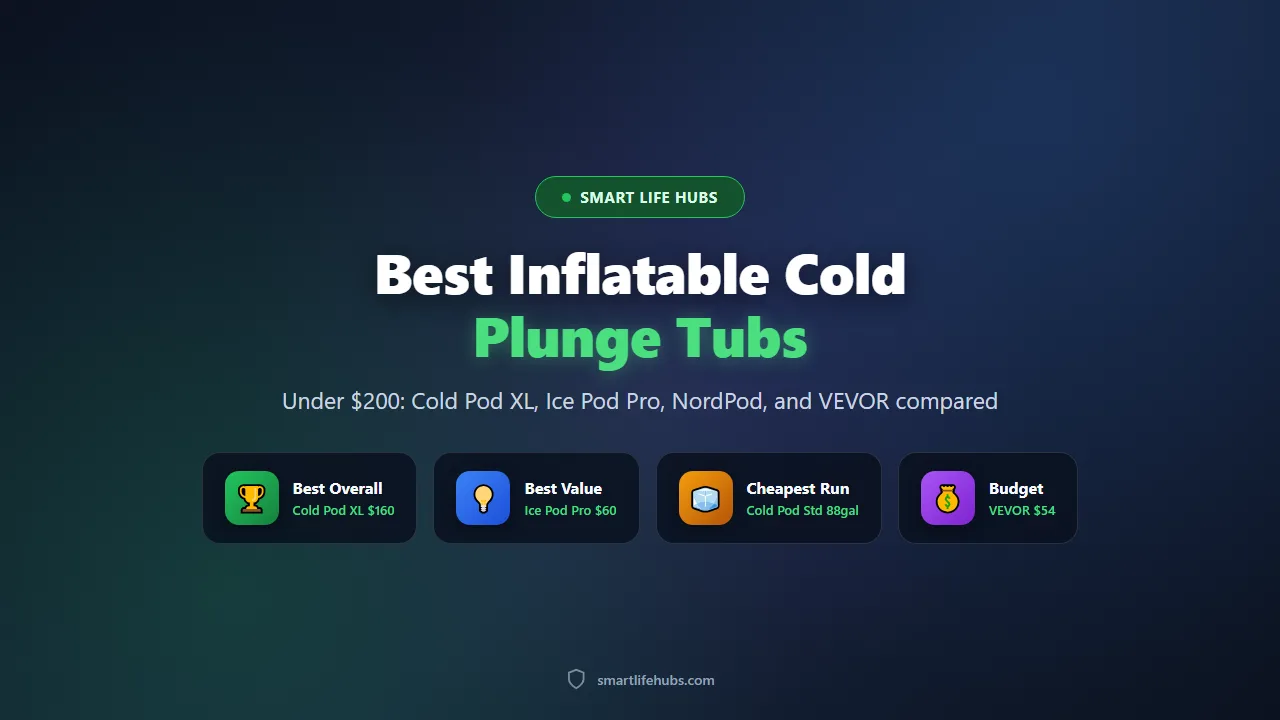
An inflatable cold plunge tub under $200 is the cheapest way to find out whether cold water is for you. It is a heavy-duty plastic barrel with insulated walls, a drain and usually a cover, and it cools with bagged ice rather than a compressor. That means the tub is cheap and the ice is the running cost, which is why the smartest buying decision at this price is the tub with the smallest volume and the best insulation.
Prices run from about $40 for a basic 88 gallon pod to about $160 for a well-insulated 116 gallon tub with a cover. The Cold Pod XL at about $160 is the best all-round pick, the Pod Company Ice Pod Pro at about $60 is the best value with chiller ports, the VEVOR at about $54 is the cheapest upright, and the Lifepro NordPod at about $100 to $150 is the most rigid.
I pulled Ice and Cedar’s and Cool Inflatables’ sub-$200 comparisons, Ice Plunge HQ’s and BankrollZen’s inflatable rankings, and Knowledgelib’s roundup of 29 sources including Garage Gym Reviews and BarBend. Where a figure is a claim rather than a measurement, I say so. Prices are US street prices as of November 2026.
At a glance
| Product | Best for | Key specs | Price |
|---|---|---|---|
| The Cold Pod XL | Best overall | 116 gal, 4-layer insulation, thermal cover, fits up to 6 foot 7 | About $160 |
| Pod Company Ice Pod Pro | Best value | 110 gal, insulated, chiller ports, lid included | About $60 |
| The Cold Pod Standard | Cheapest to run | 88 gal, multi-layer walls, least water to chill | About $41 to $120 |
| Lifepro NordPod | Most rigid | Drop-stitch walls, all-weather lid, pump, legs, bag | About $100 to $150 |
| VEVOR Upright Ice Bath | Best budget | 90 to 98 gal, inflatable walls, published temperature range | About $54 |
The best inflatable cold plunge tubs under $200 of 2026
1. The Cold Pod XL, best overall
The Cold Pod XL costs about $160 and it is the most popular portable cold plunge on Amazon, with a 4.2 rating from more than 500 reviews. It holds 116 gallons, uses four-layer insulation, comes with a thermal cover, fits people up to 6 foot 7 and sets up in under five minutes, folding flat for storage. Ice Plunge HQ names it the best portable option under $200, and BankrollZen calls it the best inflatable tub for most people.
The trade-offs are the usual inflatable ones. Garage Gym Reviews scored The Cold Pod 3.62 out of 5, with 5 out of 5 for portability and draining but only 2 for durability and ergonomics, and its tester concluded that if you are on a budget and really want a cold tub, sure, get it. The walls are softer than a hard barrel and the vinyl will eventually wear.
- Pros: About $160; 116 gal; four-layer insulation; cover included; folds flat
- Cons: Vinyl durability; soft walls; ice only
Check today’s price on Amazon.
2. Pod Company Ice Pod Pro, best value
The Pod Company Ice Pod Pro costs about $60 and Cool Inflatables names it the best cold plunge under $200 because it combines insulation, 110 gallons, a fit for people up to 6 foot 7 and chiller ports, with an adapter kit sold separately. No other tub at this price combines all four. It also includes a lid.
The trade-offs are thinner walls than the Cold Pod XL and a shorter review history. The chiller adapter is an extra purchase, so if you plan to add a chiller, factor that in. As a first tub for testing the habit, it is the best value here.
- Pros: About $60; 110 gal; insulated; chiller ports; lid included
- Cons: Thinner walls; adapter sold separately; limited review history
Check today’s price on Amazon.
3. The Cold Pod Standard, cheapest to run
The Cold Pod Standard costs about $41 on Amazon or about $120 direct, and Ice and Cedar names it the cheapest tub to actually run because 88 gallons is the least water to chill of any tub in its roundup. It is ice-only, so plan on two to three large bags of ice per fill, and Knowledgelib lists it as the pick if your budget is under $200.
The trade-offs are less insulation and a smaller capacity than the XL, so it will not hold temperature as long. If you only plunge in cool weather or have cheap ice, the running cost is the number that matters, and this tub wins it.
- Pros: About $41 to $120; 88 gal; least water to chill; cheapest running cost
- Cons: Less insulation; holds cold for less time; ice only
Check today’s price on Amazon.
4. Lifepro NordPod, most rigid
The Lifepro NordPod costs about $100 to $150 and it is the tub that feels closest to a hard barrel. It uses drop-stitch walls rather than a bare inflatable ring, and it comes with an all-weather lid, a pump, legs and a storage bag, so it holds cold longer than an uninsulated inflatable while still packing away. GymScored gives it 73 and rates it the insulated middle step between an inflatable and a hard-shell barrel.
The trade-offs are the price, which sits at the top of this list, and the fact that it is still soft-sided rather than a permanent fixture. BankrollZen lists the NordPod at about $100 for the base model and about $400 to $500 for the Plus and Elite versions.
- Pros: About $100 to $150; drop-stitch walls; lid, pump, legs and bag included
- Cons: Most expensive here; still soft-sided; no chiller
Check today’s price on Amazon.
5. VEVOR Upright Ice Bath, best budget
The VEVOR upright ice bath tub costs about $54 and it is the cheapest upright tub that names its wall layers individually and the only one in Ice and Cedar’s roundup that publishes a usable water-temperature range. It holds 90 to 98 gallons with inflatable walls, and Cool Inflatables calls it the lowest-price option sold and shipped by Amazon.
The trade-offs are basic insulation and no chiller ports, so it is a pure ice tub. It is the pick if you want to spend as little as possible to test whether you will use a cold plunge at all.
- Pros: About $54; 90 to 98 gal; cheapest upright; published temp range
- Cons: Basic insulation; no chiller ports; least refined build
Check today’s price on Amazon.
Living with an inflatable tub
The first thing you learn is that capacity is a cost, not a luxury. Every extra gallon is water you have to chill, so an 88 gallon tub needs noticeably less ice than a 116 gallon one. If ice is expensive where you live, buy the smaller tub.
The second thing is that the cover matters more than the spec sheet suggests. A tub with a thermal cover holds its temperature for hours, and one without loses it fast, which is why the Cold Pod XL’s included cover is a real feature rather than a freebie.
The third thing is stability. Climbing into a soft-walled barrel is awkward the first few times, and the drop-stitch NordPod is noticeably more reassuring than a thin inflatable ring. Put the tub on a flat, level surface and keep something solid to hold as you get in.
The fourth is the ice logistics. Two to three large bags per fill is the realistic number for a standard tub, and you need somewhere to store them and a plan for the meltwater. If that sounds like a chore, this is the point where most people give up.
Finally, the tub is the cheap part. If you discover you love cold plunging, the upgrade path is a hard barrel and a chiller, and the inflatable becomes the spare. Buying the inflatable first is the right order.
Which tub for which buyer
If you are six foot or under and want the simplest thing that works, the Pod Company Ice Pod Pro at about $60 is the answer, because it gives you insulation, 110 gallons, a lid and chiller ports for less than the cost of two months of gym membership.
If you are tall or want full shoulder immersion, go for the larger Cold Pod XL at about $160, which fits people up to 6 foot 7 and comes with a cover that the cheaper tubs do not include.
If ice is expensive where you live, buy the smallest tub you can comfortably use, because every gallon is a gallon you chill. The Cold Pod Standard at 88 gallons is the cheapest to run for exactly that reason.
If you want the tub to feel solid rather than floppy, the Lifepro NordPod’s drop-stitch walls are the upgrade, and the difference when you climb in is immediately obvious.
And if you are not sure you will stick with it, buy the VEVOR at about $54, use it for a month, and let the result tell you whether to spend more.
How to choose an inflatable cold plunge tub
Match the capacity to your ice budget. Smaller tubs cost less to fill with ice and are easier to store, and the Cold Pod Standard at 88 gallons is the cheapest to run. Bigger tubs suit taller people and full shoulder immersion.
Check the insulation layers. Four-layer walls and a thermal cover make a real difference to how long the water stays cold, and drop-stitch walls make the tub feel solid. A single-layer inflatable will fight you all the way.
Think about chiller ports. If you may add a chiller later, buy a tub with ports such as the Ice Pod Pro rather than retrofitting a sealed tub, which usually means drilling and leaks.
Measure your height. The cheap pods fit people up to about 6 foot 7, but taller people should check the listing, because an upright tub that is too short means a shoulder-freezing, knee-bent session.
Plan for draining. A drain near the bottom is essential, and a pump or a tilt-and-pour routine is not. Check the tub has a proper drain before you buy, because Garage Gym Reviews gave the Cold Pod top marks for draining and that is not universal.
Expect to replace it. Vinyl and inflatable walls are the durability weak point, and a tub that lasts two to three seasons is a reasonable expectation at this price. Keep it out of direct sun when not in use.
Start with the habit, not the hardware. A $54 tub that gets used four times a week is worth far more than a $1,200 barrel that stays in the garage. Buy the inflatable, test for a month, then upgrade if you are still doing it.
Think about the rest of the kit. Our cold plunge chiller guide covers the upgrade path, and our portable sauna guide covers the hot side of contrast therapy.
Frequently asked questions
Frequently Asked Questions
6What is the best inflatable cold plunge tub under $200?
The Cold Pod XL at about $160 for most people, with 116 gallons, four-layer insulation and a thermal cover. The Pod Company Ice Pod Pro at about $60 if you want chiller ports, and the VEVOR at about $54 if the budget is fixed.
How much ice does an inflatable cold plunge need?
Two to three large bags per fill for a standard tub, and more for larger capacities. Smaller tubs need less, which is why the 88 gallon Cold Pod Standard is the cheapest to run.
Can you add a chiller to an inflatable tub?
Only if the tub has chiller ports. The Pod Company Ice Pod Pro includes them, with an adapter kit sold separately. Retrofitting a sealed inflatable usually means drilling and risks leaks.
How long does an inflatable cold plunge last?
Expect two to three seasons of regular use from vinyl and inflatable walls. Keep it out of direct sun and empty it between sessions to extend its life.
Are inflatable cold plunge tubs worth it?
Yes, as a way to test the habit for under $200. They are less durable and less insulating than hard barrels, but they cost a fraction of the price and fold away.
How cold will an inflatable tub get?
It depends on the ice. GymScored found a three-bag ice dump in an insulated tub holds 45 degrees Fahrenheit for 24 hours, and the water will drift upward as the ice melts.
The bottom line
Buy the Cold Pod XL if you want the best inflatable tub under $200: about $160, 116 gallons, four-layer insulation and a thermal cover. Buy the Pod Company Ice Pod Pro at about $60 if you want chiller ports and the best value. Buy the Cold Pod Standard at about $41 to $120 if the running cost is the priority, the Lifepro NordPod at about $100 to $150 if you want the most rigid walls, and the VEVOR at about $54 if you want to spend as little as possible. Cool Inflatables’ sub-$200 cold plunge comparison reached the same conclusion on the Ice Pod Pro. The honest summary is that an inflatable tub is a test, not a destination, and the cheapest well-insulated one you will actually use is the right buy. Which size fits your space? Tell us in the comments.






Leave a Comment