
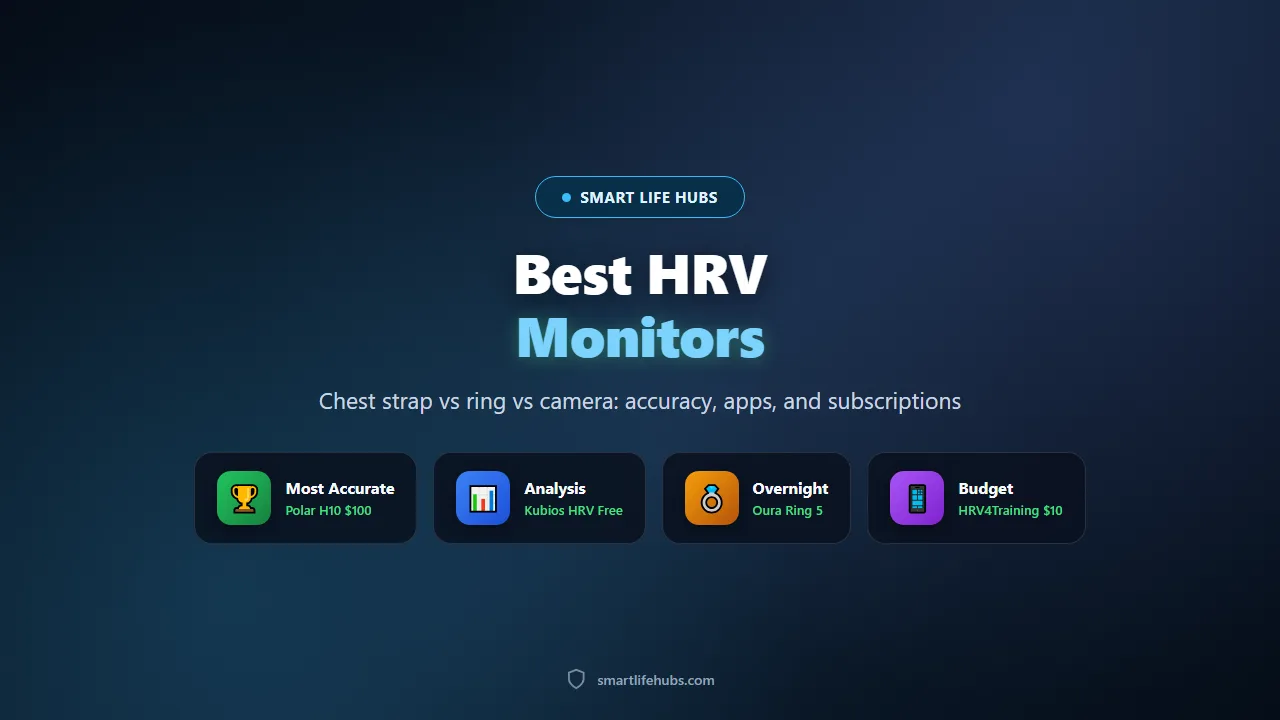
Heart rate variability is the variation in time between your heartbeats, and it is one of the most useful numbers in consumer fitness, because it reflects how your nervous system is coping with training, sleep and stress. A higher HRV generally means you are recovered and adaptable, and a sustained drop usually means you are not. The catch is that HRV is highly individual, so the number only means something compared with your own baseline.
The tools fall into three tiers. A chest strap with an app is the most accurate and costs about $100 plus a free app. A ring or band measures automatically while you sleep and costs more with a subscription. A phone camera app costs about $10 and is surprisingly good for a daily reading.
I pulled HRV Expert’s app-by-app validation review, USA Longevity’s wearable comparison, Bodly’s 2026 app guide and Welltory’s app breakdown, including a 2025 study of 536 nights against ECG. Where a figure is a claim rather than a measurement, I say so. Prices are US street prices as of November 2026.
At a glance
| Product | Best for | Key specs | Price |
|---|---|---|---|
| Polar H10 with Elite HRV | Best accuracy | ECG chest strap, about 1 ms precision, free app, morning readiness score | About $100 plus free app |
| Kubios HRV | Best analysis | Time, frequency and non-linear analysis, research-grade, works with a chest strap | Freemium |
| Oura Ring 5 | Best overnight HRV | Finger sensor, automatic nocturnal HRV, 6.0 percent error against ECG | $399 to $499 plus $5.99 a month |
| Whoop 5.0 | Best for athletes | Wrist band, continuous HRV, strain and recovery coaching | $239 a year membership |
| HRV4Training | Best budget | Phone camera PPG, no hardware, validated against ECG | About $10 one-time |
The best HRV monitors of 2026
1. Polar H10 with Elite HRV, best accuracy
The Polar H10 chest strap costs about $100 and it is the reference against which every wearable is measured. It records the heart’s electrical signal rather than guessing from light, and recent wearable studies used it as their reference standard. Paired with the free Elite HRV app, it gives you a daily morning readiness reading using either the strap or the CorSense finger sensor. Elite HRV has the most independent validation of any app here, including a study of 26 professional cyclists where it showed no difference from ECG.
The trade-offs are the strap and the routine. A chest strap is uncomfortable for some people and the reading only happens when you do it, so it is a habit rather than a background measurement. If you want accuracy and are willing to measure each morning, nothing here beats it.
- Pros: About $100 strap; ECG-grade accuracy; free app; most independently validated
- Cons: Chest strap is uncomfortable for some; requires a daily routine; no overnight tracking
Check today’s price on Amazon.
2. Kubios HRV, best analysis
Kubios HRV is free at its core and it is the tool researchers use, offering time-domain, frequency-domain and non-linear analysis including SD1, SD2, sample entropy and detrended fluctuation analysis. It works best with a Polar H10, and HRV Expert recommends it if you want a readiness score built from more than one measure, a strap-free reading, data stored in the EU or a path into research-grade analysis on a computer.
The trade-offs are the interface, which intimidates beginners, and the fact that it is an analysis tool rather than a coaching product. If you want a simple 0 to 100 score and guided breathing, Elite HRV is friendlier. If you want to understand your own data properly, Kubios is the one.
- Pros: Freemium; research-grade analysis; works with a chest strap; strap-free options
- Cons: Steep learning curve; not a coaching app; best paired with hardware
Check today’s price on Amazon.
3. Oura Ring 5, best overnight HRV
The Oura Ring 5 costs $399 to $499 plus a $5.99 monthly membership, and it had the highest agreement with ECG for nocturnal HRV among consumer wearables in a 2025 study of 13 adults over 536 nights, at a concordance of 0.99 and an average error of 6.0 percent. USA Longevity’s comparison puts the Gen 4 at 6.0 percent error and the Gen 3 at 7.2 percent, both ahead of every wrist device tested.
The trade-offs are the price, the subscription and the fact that it measures at night rather than on demand. Because it captures HRV while you sleep, it removes the daily routine entirely, which for most people is the reason they actually get a usable trend.
- Pros: Best validated overnight HRV; no daily routine; 6 to 9 day battery
- Cons: $399 to $499 plus $5.99 a month; ring sizing; no on-demand reading
Check today’s price on Amazon.
4. Whoop 5.0, best for athletes
The Whoop 5.0 costs $239 a year with the hardware included, and it is the choice for athletes who want HRV turned into a decision. It tracks continuously, gives a daily recovery score and strain guidance, and in the 2025 overnight study it recorded a concordance of 0.94 with an average error of 8.2 percent against ECG, behind the Oura but ahead of the watches. USA Longevity notes the difference between Oura and Whoop was not statistically significant in that study.
The trade-offs are the subscription, which never ends, and the fact that you cannot buy the hardware outright. If you stop paying, the band stops delivering data. For a serious athlete who will use the coaching daily, that is acceptable, and Whoop includes hardware upgrades.
- Pros: $239 a year includes hardware; continuous tracking; recovery and strain coaching
- Cons: Subscription required; no owned hardware; 8.2 percent error against ECG
Check today’s price on Amazon.
5. HRV4Training, best budget
HRV4Training costs about $10 as a one-time iOS purchase and it turns your phone camera into an HRV monitor. You hold a fingertip over the camera for one to five minutes and it measures pulse variation, and a 2017 validation study of 29 people at rest found trivial differences against ECG with a correlation of 1.00. Bodly lists it among the methods validated against the clinical reference.
The trade-offs are that it requires a daily routine and good technique, and it depends on a phone camera rather than a dedicated sensor. It is the cheapest serious entry into HRV tracking and a good way to test whether you care about the number before spending on hardware.
- Pros: About $10 one-time; no hardware; validated against ECG; simple
- Cons: Daily routine required; camera technique matters; iOS focused
Check today’s price on Amazon.
Living with HRV tracking
The first thing you learn is that the absolute number is nearly useless. HRV varies enormously between people, and a value that looks low for one person is normal for another. What matters is your own baseline and whether today is above or below it, so the first two weeks of data are for establishing that baseline rather than for judging anything.
The second is that measurement conditions decide the reading. HRV is sensitive to alcohol, illness, late nights, hard training, caffeine and even a late meal, so a morning reading taken in the same position at the same time is the only comparable one. Elite HRV asks you to measure in the same position every time for exactly this reason.
The third is that overnight and morning readings measure different things. Nocturnal HRV averaged across the night is stable and reproducible, which is why the Oura and Whoop comparisons use it, while a morning spot reading reflects your readiness at that moment. Do not compare the two as if they were the same number.
The fourth is how to use the information. A single low reading means nothing, but three or four low readings in a row during a heavy training block is a reasonable signal to ease off, and a rising trend while training stays constant is a good sign of adaptation.
Finally, do not let the number own your mood. HRV is a guide to training, not a verdict on your health, and obsessing over daily fluctuations is the fastest way to make a useful tool into a source of anxiety.
If you find yourself checking the score before you have got out of bed and letting it decide your day, switch to a weekly review instead, which is what most coaches recommend for exactly this reason.
The short answer is that the chest strap is the most accurate, the ring is the easiest to sustain, and the app you will actually open each morning without being reminded is the one that matters most.
How to choose an HRV monitor
Decide whether you want accuracy or convenience. A chest strap with Elite HRV or Kubios is the most accurate and needs a daily routine. A ring or band measures automatically while you sleep and costs more. Most people who stick with HRV long term choose the automatic option.
Check what the subscription covers. Whoop requires a membership to function at all, and Oura requires one for the detailed insights. The Polar H10 with Elite HRV or Kubios has no ongoing fee for the core analysis, which makes it the cheapest over several years.
Pick the measurement moment. A morning spot reading suits someone who wants a readiness number before training. Overnight tracking suits someone who will never remember a morning routine. Both are valid, and they are not interchangeable.
Use one device consistently. A trend within one device means more than a comparison between two, because each device measures at its own times and reports its own metric. Switching devices resets your baseline.
Match the app to your temperament. Elite HRV gives a simple 0 to 100 score and guided breathing, Kubios gives research-grade analysis and a steeper learning curve, and Whoop gives coaching. If you want to understand the physiology, Kubios; if you want a decision, Whoop or Elite HRV.
Pair the app with the right sensor. Kubios and Elite HRV are at their best with a Polar H10. Using them with a wrist optical sensor introduces the beat-detection error that Kubios warns can lead to errors up to 10 percent in HRV parameters.
Do not use HRV alone to judge health. HRV is one input alongside sleep, soreness, mood and performance. If you feel unwell, that matters more than any number, and persistent symptoms belong with a doctor.
Think about the rest of the kit. Our fitness tracker roundup covers the wearables that report HRV, and our no-subscription smart ring guide covers the rings that do not charge a monthly fee.
Frequently asked questions
Frequently Asked Questions
6What is the most accurate way to measure HRV?
An ECG chest strap such as the Polar H10, which recent wearable studies used as their reference standard. Independent research puts chest straps ahead of wrist optical sensors, with coefficients of variation under 3 percent against 5 to 15 percent for wrist devices.
Are rings accurate for HRV?
Oura is the best validated consumer wearable for overnight HRV, with a 2025 study of 536 nights finding a concordance of 0.99 against ECG and an average error of 6.0 percent. Whoop was close behind at 0.94 and 8.2 percent, and the difference was not statistically significant.
Is a chest strap or a watch better for HRV?
A chest strap is more accurate because it records the heart’s electrical signal. A watch or ring is more convenient because it measures automatically. For training decisions most people are better served by a device they will actually wear.
Do I need a subscription for HRV tracking?
No. Elite HRV and Kubios HRV are free for core analysis and work with a one-off chest strap purchase. Whoop requires a membership from $239 a year and Oura requires one from $5.99 a month.
What is a good HRV number?
There is no universal good number. HRV is highly individual, and a value that is low for one person is normal for another. Compare each reading with your own baseline rather than with anyone else’s.
Should I measure HRV in the morning or overnight?
Both work, and they measure different things. A morning spot reading reflects readiness at that moment and suits a pre-training check. Overnight tracking averages the whole night and needs no routine, which makes it easier to sustain.
The bottom line
Buy the Polar H10 with Elite HRV if you want the most accurate HRV for about $100 plus a free app, and Kubios HRV if you want research-grade analysis. Buy the Oura Ring 5 at $399 to $499 if you want the best validated overnight HRV and will pay $5.99 a month. Buy the Whoop 5.0 at $239 a year if you want coaching turned into daily decisions, and HRV4Training at about $10 if you want the cheapest way to start. HRV Expert’s HRV app comparison reached the same conclusion on Elite HRV having the most independent testing. The honest summary is that the chest strap is the most accurate, the ring is the easiest to sustain, and the number only means anything measured against your own baseline with one device. Which matters more to you, accuracy or convenience? Tell us in the comments.

Leave a Comment