
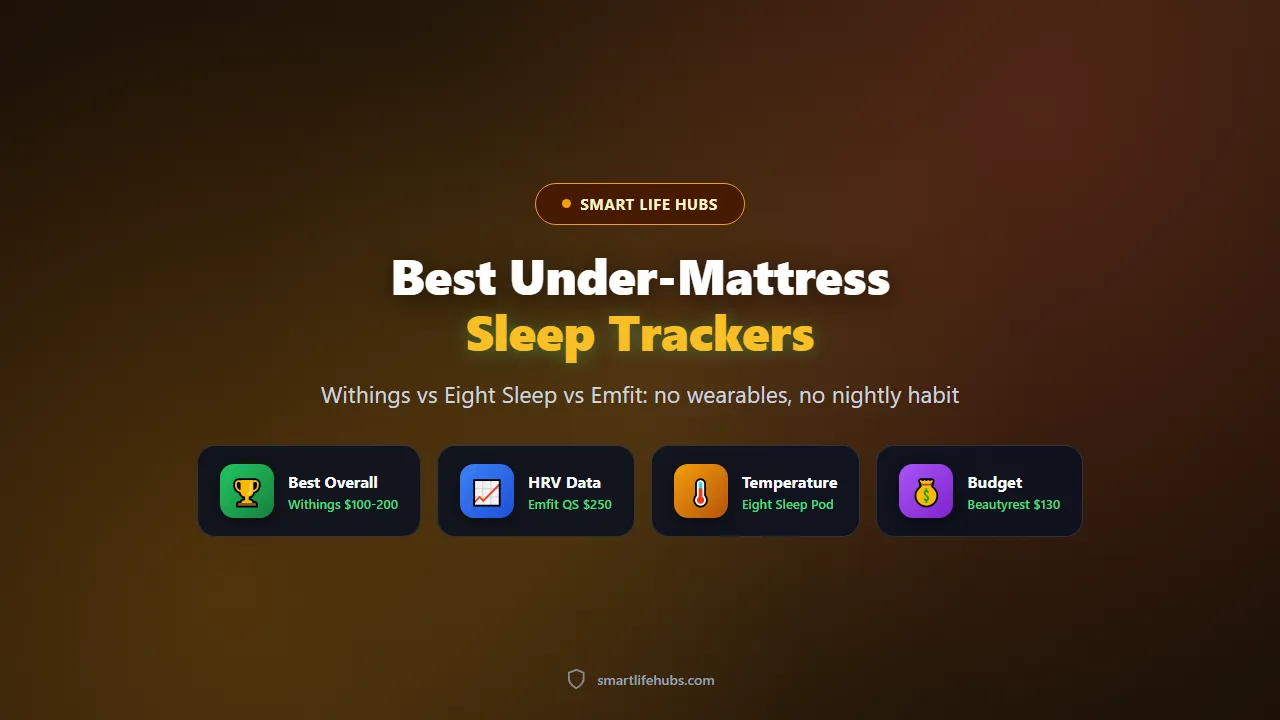
An under-mattress sleep tracker is a pad or strip that slides under your mattress and reads your heart rate, breathing and movement through the bed, so you get a sleep record without wearing anything. It suits people who hate sleeping with a watch or ring, couples where only one person wants tracking, and anyone who wants a device they set up once and never think about.
The category splits into two very different products. A passive pad such as the Withings Sleep Analyzer costs about $100 to $200, needs no subscription and tracks sleep stages, heart rate, breathing and snoring. An active cover such as the Eight Sleep Pod costs from about $1,995, requires a membership and is really a dual-zone heating and cooling system that also tracks sleep.
I pulled SleepLab’s and Komori Care’s under-mattress rankings, Asidehouse’s category analysis, Ring and Rest’s Withings versus Eight Sleep comparison, and Great Health Gear’s non-wearable roundup. Where a figure is a claim rather than a measurement, I say so. Prices are US street prices as of November 2026.
At a glance
| Product | Best for | Key specs | Price |
|---|---|---|---|
| Withings Sleep Analyzer | Best overall | Under-mattress pad, 4-stage sleep, heart rate, breathing, snoring, apnea detection | About $100 to $200 |
| Emfit QS | Best for HRV data | Under-mattress strip, HRV and recovery metrics, raw data export | About $199 to $250 |
| Eight Sleep Pod 4 | Best for temperature | Smart mattress cover, dual-zone heating and cooling, sleep tracking | From about $1,995 plus membership |
| Beautyrest Sleeptracker Monitor | Best budget | Under-mattress pad, basic sleep metrics, optional subscription | About $130 |
The best under-mattress sleep trackers of 2026
1. Withings Sleep Analyzer, best overall
The Withings Sleep Analyzer costs about $100 to $200 depending on the retailer and it is the clearest recommendation in the category. It is a thin inflatable pad that slides under the mattress, connects to Wi-Fi and delivers four-stage sleep tracking, heart rate, respiratory rate, snoring detection and a respiratory disturbance indicator. SleepLab calls it one of the only consumer devices with an FDA-cleared feature for detecting signs of moderate to severe sleep apnea, and Komori Care and SleepLab both name it the best under-mattress tracker overall.
The trade-offs are that it tracks one sleeper per pad, so couples need two, and it relies on ballistocardiography through the mattress, which means a very soft or adjustable mattress can reduce accuracy. There is no subscription, which is the main reason it beats the alternatives on value.
- Pros: About $100 to $200; no subscription; 4-stage sleep; apnea detection; snoring
- Cons: One sleeper per pad; accuracy depends on the mattress; no temperature control
Check today’s price on Amazon.
2. Emfit QS, best for HRV data
The Emfit QS costs about $199 to $250 and it is the strip for people who want the raw physiology rather than a sleep score. It sits under the mattress, measures heart rate variability and recovery in unusual detail for a non-wearable, exports raw data more readily than most rivals and needs no subscription for core tracking. It has a long record among sleep researchers and carers, and SleepLab calls it the best for HRV and recovery data.
The trade-offs are the app, which is more spreadsheet than storybook, and the lack of apnea detection. Ring and Rest notes a euro-denominated yearly fee applies after the first three years, which is worth checking before you buy. For an athlete or a quantified-self user who wants the numbers, it is the pick.
- Pros: About $199 to $250; detailed HRV and recovery; raw export; no core subscription
- Cons: Unpolished app; no apnea detection; yearly fee after year three
Check today’s price on Amazon.
3. Eight Sleep Pod 4, best for temperature
The Eight Sleep Pod 4 costs from about $1,995 depending on mattress size and it is a different product from the other three: a fitted mattress cover with active dual-zone heating and cooling that also tracks sleep stages and heart rate. It adjusts each side of the bed in real time based on your sleep stage and heart rate, which is a genuine solution to the hot-sleeper problem, and Great Health Gear praises the temperature control while noting the price and required membership.
The trade-offs are the cost and the subscription. A membership from about $19 a month unlocks the full data and automation, and Ring and Rest argues you should buy the Pod only if temperature control is the actual problem you are solving, because it is a climate product first and a tracker second. The Pod 6 adds an Autopilot plan at $299 a year.
- Pros: Dual-zone heating and cooling; tracks stages and heart rate; strong coaching
- Cons: From about $1,995; required membership from about $19 a month; tracker is secondary
Check today’s price on Amazon.
4. Beautyrest Sleeptracker Monitor, best budget
The Beautyrest Sleeptracker Monitor costs about $130 and it is the cheapest under-mattress pad worth considering. SleepLab lists it as the budget-friendly basics option, tracking the core sleep metrics with an optional subscription rather than a required one. It is the pick if you want to test whether under-mattress tracking suits you before spending more.
The trade-offs are the thinner feature set and the weaker app and validation record than the Withings. If you are going to spend $130, the Withings at a similar price is usually the better buy, so treat the Beautyrest as the fallback when the Withings is unavailable.
- Pros: About $130; no required subscription; simple setup
- Cons: Fewer features; weaker validation; app less polished
Check today’s price on Amazon.
How accurate are under-mattress trackers?
The honest answer is that they are good at the things that are easy to measure through a mattress and weaker at the things that are not. Total sleep time and the rough shape of your night are usually close to what a wearable or a sleep study would show, because movement and stillness are large signals. Heart rate and breathing rate are also reliable, since the pulse and the rise and fall of your chest are strong mechanical events.
Sleep stages are where the uncertainty lives. Separating light, deep and REM sleep from movement and heart rate alone is an inference, and a 2024 hospital study of wearables against polysomnography found stage sensitivity between 50 and 86 percent. Under-mattress devices have the same problem with less input data, so treat the stage breakdown as a guide and the duration, heart rate and breathing as the numbers to trust.
The practical consequence is that you should use these devices for trends rather than verdicts. If your deep sleep looks lower than last month, that may be real or it may be a different mattress topper, a warmer room or a partner who was away. Look for a pattern over a fortnight before drawing any conclusion about your sleep.
Living with an under-mattress tracker
The first thing you notice is the absence of a routine. There is no device to put on, no charger by the bed and nothing to remember, which is the whole appeal. After the first night the pad becomes invisible, and that is why people who could never keep up with a watch or ring stick with these.
The second thing is the mattress effect. A firm, flat mattress gives the sensor a clean signal, and a very soft, thick pillow-top or an adjustable base can blur it. If your mattress is plush, expect the sleep stages to be less reliable than the heart rate and breathing, which survive a soft mattress better.
The third is the couple problem. Most pads track one sleeper, so if your partner moves around, the reading can be muddied. Two pads solve it, and some covers handle both sides natively. Decide this before you buy, because retrofitting a second pad under the same mattress can be fiddly.
The fourth is what you do with the data. A nightly sleep score is motivating for a few weeks and then becomes background noise, so the useful habit is checking the weekly trend rather than the nightly number. If the data does not change anything you do, a cheaper option is the honest choice.
Finally, be clear about the medical limit. A disturbance indicator is not a diagnosis, and if the data suggests sleep apnea you should take it to a doctor rather than treating it as a result.
The bottom line is that the pad is the better tracker and the cover is the better climate device, and most people should buy the pad first rather than the much more expensive cover with its ongoing membership.
How to choose an under-mattress sleep tracker
Decide whether you want tracking or temperature. This is the fork in the category. A pad tracks sleep for $100 to $250 with no subscription. A cover controls temperature and tracks sleep from about $1,995 with a membership. Buying a cover for the data alone is the most expensive mistake here.
Check the subscription before you buy. Withings includes the app, trends and apnea detection in the purchase price, while Eight Sleep requires a membership from about $19 a month for the full feature set. Over three years that is $684 on top of the hardware.
Consider your mattress. Ballistocardiography works best on a firm, flat surface. If you have a soft pillow-top, a very thick hybrid or an adjustable base, check the manufacturer’s compatibility list rather than assuming it will work.
Think about how many people sleep in the bed. Most pads track one sleeper. If your partner is a restless sleeper or you both want data, budget for two pads or look at a cover that handles both sides.
Decide how much you care about the raw numbers. If you want HRV, readiness and raw export for training, the Emfit QS is the specialist. If you want a sleep score and a trend, the Withings does it for less.
Do not expect medical diagnosis. Sleep apnea detection on a consumer pad is a screening signal, not a test. Persistent snoring, gasping or daytime sleepiness belongs with a doctor and a proper sleep study.
Remember the cheaper alternatives. If all you want is a sleep score, a basic fitness band costs less and works well. The under-mattress pad earns its place when wearing something at night is the problem.
Think about the rest of the kit. Our sleep tracker roundup covers the wearables, and our smart pillow guide covers the other end of the bed.
Frequently asked questions
Frequently Asked Questions
6What is the best under-mattress sleep tracker?
The Withings Sleep Analyzer for most people, at about $100 to $200 with four-stage sleep tracking, heart rate, breathing, snoring and apnea detection, and no subscription. The Emfit QS if you want detailed HRV and recovery data, and the Eight Sleep Pod if temperature control is the real goal.
Do under-mattress sleep trackers work?
Yes, for sleep duration, sleep stages, heart rate and breathing. They use ballistocardiography to read the tiny mechanical vibrations of your heartbeat and breathing through the mattress, and accuracy depends on how firm and flat the mattress is.
Do you need a subscription for an under-mattress tracker?
Usually not. Withings includes the app, trends and apnea detection in the purchase price, and Emfit QS needs no subscription for core tracking. Eight Sleep requires a membership from about $19 a month for the full feature set.
Can an under-mattress tracker detect sleep apnea?
Withings has an FDA-cleared feature for detecting signs of moderate to severe sleep apnea, delivered as a breathing disturbance score. It is a screening signal to take to a doctor, not a diagnosis.
Will an under-mattress tracker work with my mattress?
It works best on a firm, flat mattress. Very soft pillow-tops and adjustable bases can reduce accuracy, so check the manufacturer’s compatibility list before buying.
Can two people use one under-mattress tracker?
Most pads track one sleeper, so couples usually need two pads. Eight Sleep’s cover handles both sides natively, and some covers and higher-end systems support two users.
The bottom line
Buy the Withings Sleep Analyzer if you want the best under-mattress tracker: about $100 to $200, four-stage sleep, heart rate, breathing, snoring and FDA-cleared apnea detection, with no subscription. Buy the Emfit QS at about $199 to $250 if you want detailed HRV and recovery data and raw export. Buy the Eight Sleep Pod from about $1,995 if temperature control is the actual problem, and the Beautyrest Sleeptracker at about $130 if the budget is tight. Asidehouse’s non-wearable sleep tracker analysis reached the same conclusion on the Withings as the category’s clearest option. The honest summary is that the pad is the better tracker and the cover is the better climate device, and the subscription is the number that decides the long-term cost. Which problem are you actually solving? Tell us in the comments.

Leave a Comment