
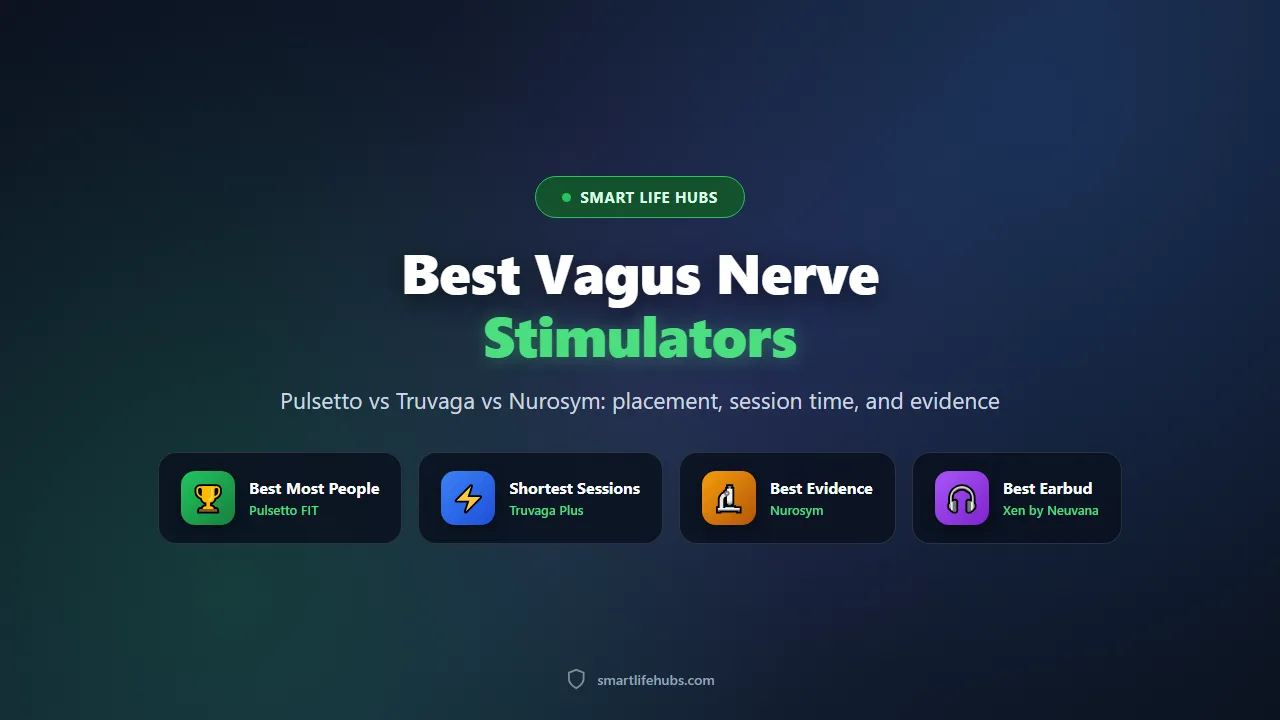
A vagus nerve stimulator is a small device that delivers a mild electrical signal to the vagus nerve, usually through the neck or the ear, with the aim of shifting your nervous system toward rest and digestion. The prescription versions are well established for epilepsy and depression, and a handheld prescription device is cleared for migraine and cluster headache. The consumer versions cost $200 to $900, are sold as general wellness products, and make softer claims about stress, sleep, and recovery. The evidence is promising but thin, and the devices are not medical treatments.
The category splits by placement. Neck devices from Pulsetto and Truvaga stimulate the cervical branch through the skin and run short sessions of two to ten minutes. Ear devices from Nurosym and Xen target the tragus and run longer sessions of 15 to 60 minutes. A third group, including Apollo Neuro and Sensate, uses vibration rather than electricity and makes still softer claims. Choosing one means picking an anatomy, a session length, and a tolerance for ongoing gel and subscription costs.
I compared manufacturer specifications, independent roundups from ONDA Life and Medical News Bulletin, and the published trial record. Where a figure is a claim rather than a measurement, I say so. Prices are as of November 2026 and promotions move them around.
At a glance
| Product | Best for | Key specs | Price |
|---|---|---|---|
| Pulsetto FIT | Best for most people | Neck collar, bilateral, 4-10 min sessions, hands-free | $296 |
| Truvaga Plus | Best short sessions | Handheld neck, 2 min sessions, gammaCore technology | $499 |
| Nurosym / Nuropod | Best evidence base | Ear clip on tragus, 15-60 min sessions, no gel | About $820 |
| Xen by Neuvana | Best earbud design | Earbuds, auricular, 15-30 min, music synced | $399 |
| Apollo Neuro | Best non-electrical | Wrist or ankle haptic vibration, 15-60 min | $448 |
The best vagus nerve stimulators of 2026
1. Pulsetto FIT, best for most people
The Pulsetto FIT costs $296 on sale, with a Lite at $269 and a FIT X at $350, and it is the most popular consumer option for a reason. It is a neck collar with electrodes on the back of the neck that target the cervical vagus nerve trunk through the skin, and it runs sessions of about 4 to 10 minutes from a phone app, with an offline mode added after early complaints. It is hands-free, so you can use it while working or watching television, and it is comfortable enough that independent comparisons score it around 8 out of 10 for comfort and session consistency. The costs stack up: it needs conductive gel, the app has an optional Premium tier at $45 a quarter after a trial, and the gel needs replacing. The evidence behind it is thinner than the marketing suggests, with little independent trial data, and it is sold as a general wellness device with CE and FCC marks rather than a medical clearance. If you want the cheapest credible entry point and a hands-free habit, it is the default pick.
- Pros: $296 with a Lite at $269; hands-free neck collar; 4-10 minute sessions; comfortable for daily use
- Cons: Needs gel; optional subscription; thin independent evidence; not a medical device
Check today’s price on Amazon.
2. Truvaga Plus, best short sessions
The Truvaga Plus costs $499, or $325 for the Truvaga 350, and it comes from electroCore, the company behind gammaCore, which is FDA cleared as a prescription device for migraine and cluster headache. The Truvaga line uses the same stimulation parameters as that platform and sells them over the counter as a wellness device. It is handheld and pressed against one side of the neck for about 2 minutes, which is the shortest session here, and the Plus adds an app while the 350 works without one. It needs conductive gel, with refills at $45 for a six-pack, and the app is required for the Plus. The trade-off is that you must hold it in place for the whole session, so it is not hands-free, and the unilateral approach covers one side of the neck rather than both. If you want the shortest routine and a device with a credible technology lineage, it is the better choice.
- Pros: 2 minute sessions; technology licensed from an FDA-cleared platform; 350 works without an app
- Cons: Handheld, not hands-free; gel required; Plus needs the app; $45 gel refills
Check today’s price on Amazon.
3. Nurosym / Nuropod, best evidence base
Nurosym, sold in the United States as Nuropod, costs about $820, and it is the consumer ear device with the largest independent trial record. It clips to the tragus of the ear and delivers auricular transcutaneous vagus nerve stimulation through a wired handheld controller, with sessions running 15 to 60 minutes. It needs no gel, has no subscription, and is CE certified as a medical device in the European Union, though it is not currently sold in the United States. The company cites trial partnerships with Harvard, UCLA, Barts NHS Trust, and Charite Berlin, which is more independent research than any other device here. The downsides are the price, the wire, and the long session, which is harder to keep up than a 4 minute neck session, and the fact that US buyers cannot buy it directly. If you want the most researched option and you do not mind the routine, it is the serious pick.
- Pros: Strongest independent trial record; no gel and no subscription; CE medical device in the EU
- Cons: About $820; wired ear clip; 15-60 minute sessions; not sold directly in the US
Check today’s price on Amazon.
4. Xen by Neuvana, best earbud design
Xen by Neuvana costs about $399 to $449 and it is the most consumer-friendly ear option. It looks like a pair of earbuds and delivers auricular stimulation through the ear canal, with sessions of 15 to 30 minutes and a free companion app that can sync the stimulation to music. It is hands-free and discreet enough to wear in public, which is the main advantage over a neck collar or a wired ear clip. The evidence base is thinner than Nurosym’s, and it is sold as a general wellness device rather than a medical product. If you want something that feels like normal consumer electronics and you will use it daily, it is the easiest ear option to live with.
- Pros: Earbud form factor; hands-free; free app with music sync; $399
- Cons: Limited independent evidence; 15-30 minute sessions; general wellness status
Check today’s price on Amazon.
5. Apollo Neuro, best non-electrical option
The Apollo Neuro costs $448 with a year of membership included, and it is different from everything else here because it uses vibration rather than electricity. It is a band worn on the wrist or ankle that delivers patterned haptic pulses, and it runs programmes from 15 to 60 minutes or all day. It has no gel, no electrodes, and nothing to insert, and owners rate it the most comfortable device in independent comparisons. The claim is that the vibration trains your nervous system to downshift, and the evidence is weaker than for the electrical devices, though the company has published some research. If you want a gentle, non-invasive habit and you dislike the idea of electrical stimulation on your neck, it is the safest place to start.
- Pros: No electricity, gel, or inserts; comfortable for all-day wear; touchscreen-free simple use
- Cons: $448 plus membership; vibration rather than VNS; weaker evidence for stress and sleep
Check today’s price on Amazon.
How to choose a vagus nerve stimulator
Start with the evidence and keep your expectations modest. Prescription vagus nerve stimulation is well established for epilepsy and depression, and gammaCore is cleared for migraine and cluster headache. Consumer wellness devices have far less support, and Medical News Bulletin reviews the evidence and the safety limits in detail. Treat these as relaxation tools that may help with stress and sleep, not as treatments.
Pick an anatomy you will actually use. Neck collars are hands-free and quick but need gel and can feel strange against the throat. Ear clips are discreet and well studied but wired and longer. Earbuds are the most normal to wear. If you cannot keep a 30 minute session, buy the neck device with a 4 minute routine.
Count the ongoing costs. Pulsetto needs gel and has an optional $45 quarterly subscription. Truvaga needs gel at $45 for a six-pack. Nurosym has none. Apollo includes a year of membership and then renews. A $300 device with $180 a year of gel is a different decision from a $820 device with no running costs.
Check the regulatory status. Nurosym is a CE medical device in the EU. Truvaga uses technology from an FDA-cleared prescription platform but is sold as wellness. Pulsetto, Xen, and Apollo are general wellness devices. None of the consumer models here is a substitute for medical care.
Think about the habit, not the hardware. The device that gets used daily is the one that works. A cheap, comfortable, hands-free collar beats an expensive wired ear clip that stays in a drawer. If you are unsure, the Pulsetto Lite at $269 or the Apollo at $448 are the easiest habits to start, and both have reasonable return windows.
Do not ignore the non-device options. Slow breathing, cold exposure, singing, and humming all stimulate the vagus nerve for free, and the effect on heart rate variability is measurable. Our recovery tech guide and our sleep gadget roundup cover the adjacent tools.
Place it properly, every session. For a neck device, the electrodes need clean, dry skin over the side of the neck, roughly level with the Adam’s apple and just under the jaw. I wiped the area with an alcohol wipe, let it dry, and spread a thin layer of gel, about the size of a small coin, across each pad. Too much gel lets the device slide and the intensity feels uneven; too little stings. Start on the lowest setting for the first week. You want a mild tingling or a flutter in the throat, never pain, and if it hurts you are pressing too hard or the gel has dried out.
Give it four to six weeks. The trial record is built on daily use, not occasional sessions, so a proper trial is a month of showing up. I kept a note on my phone with the date, the setting, and a one to ten score for how I slept. Most owners who say a device works describe a difference after three to four weeks, and the effect they notice is easier relaxation and falling asleep sooner rather than anything dramatic. If you have used one daily for a month and noticed nothing, stopping is a reasonable result, not a failure.
Know who should skip it. Anyone with a pacemaker, an implanted defibrillator, or a fitted vagus nerve stimulator should not use one of these without a cardiologist’s sign-off, and the same goes for a diagnosed arrhythmia, uncontrolled epilepsy, or a recent neck injury or surgery. The devices are not studied in pregnancy, so treat that as a question for your doctor. None of these products treats anxiety, depression, or insomnia, and using one instead of care is the most expensive mistake in this category.
Look after the gel and the pads. Gel dries out and loses conductivity, so cap it tightly and replace it when it turns watery or gritty. A tube typically lasts two to three months at daily use, which is the number to build into your running cost. Wipe the electrodes after each session with a damp cloth and let them air dry, and check the contact pads for cracks or flaking. A worn pad concentrates the current in one spot and makes the sensation sharp. Store the device in its case rather than loose in a gym bag, where lint builds up on the electrodes and reduces contact.
A few mistakes I see often. The first is buying on the strength of one review and using the device twice. The second is chasing intensity: turning the level up until it feels strong does not make it work better, and it irritates the skin. The third is falling asleep with a neck device on, which leaves a red mark and a sore throat. The fourth is comparing a two minute Truvaga session with a 30 minute Nurosym session and calling one better, when the protocols are simply different. Match the session length to your device and judge it on how you feel after a month.
Frequently asked questions
Frequently Asked Questions
6Do consumer vagus nerve stimulators work?
The evidence is mixed and limited. Prescription VNS is well established for epilepsy and depression, and gammaCore is cleared for migraine and cluster headache, but consumer wellness devices have far less independent support. Most users report feeling calmer and sleeping better, which may be partly expectation, and the devices are not treatments.
Which vagus nerve stimulator is best?
The Pulsetto FIT for most people at $296, because it is hands-free, cheap, and quick. The Truvaga Plus if you want the shortest sessions and a credible technology lineage. Nurosym if you want the largest independent trial record and you do not mind paying about $820.
Where do you place a vagus nerve stimulator?
Two common targets. Neck devices press electrodes against the side or back of the neck to reach the cervical branch. Ear devices clip the tragus, the small flap in front of the ear canal, to reach the auricular branch. Both are non-invasive.
Are vagus nerve stimulators safe?
Consumer devices are generally well tolerated, and side effects are usually mild, including tingling, redness where the gel sits, and occasional light-headedness. People with pacemakers, implanted devices, or a history of arrhythmia should check a doctor first, and anyone with a neurological condition should seek medical advice.
How long should a session last?
It depends on the device. Pulsetto sessions run about 4 to 10 minutes, Truvaga about 2, Xen 15 to 30, and Nurosym 15 to 60. Consistency over weeks matters more than session length.
Is Apollo Neuro a real vagus nerve stimulator?
No. It uses patterned vibration on the wrist or ankle rather than electrical stimulation, so it is a nervous system training tool rather than a VNS device. It is comfortable and has some published research, but it works by a different mechanism.
The bottom line
Buy the Pulsetto FIT if you want the cheapest credible, hands-free option: $296, 4 to 10 minute neck sessions, and a large user base. Buy the Truvaga Plus if you want the shortest routine and technology from an FDA-cleared platform. Buy Nurosym if you want the strongest independent trial record and you accept the price and the wire. Buy Xen by Neuvana if you want an earbud design. Buy Apollo Neuro if you prefer vibration over electricity. The honest summary is that none of these is a medical treatment, the best evidence sits with Nurosym, and the best value for a daily habit is the Pulsetto. Which one fits your routine? Tell us in the comments.


Leave a Comment