
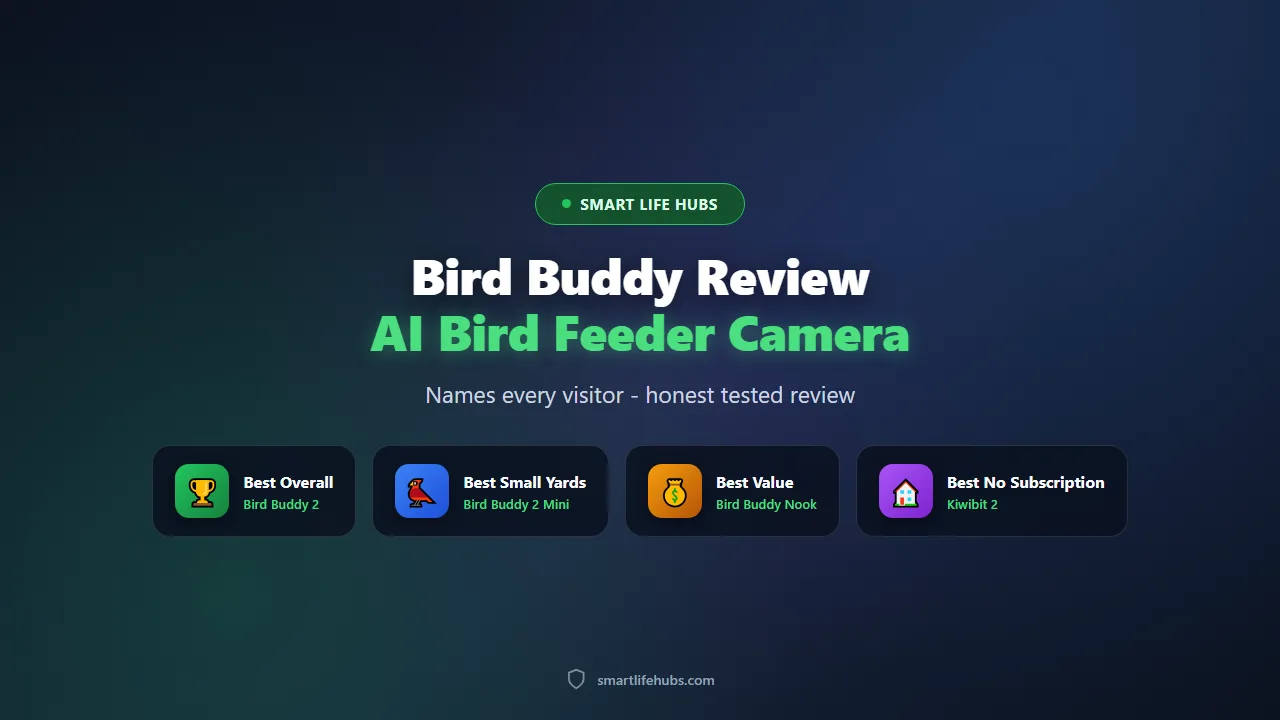
The Bird Buddy is a hopper-style bird feeder with a camera in the roof that photographs a visiting bird, identifies the species with AI and pushes a “postcard” to your phone, and after a season of use the honest verdict is that it is the most fun smart device I own and the most expensive feeder in its category. The current model is the Bird Buddy 2 at about 199 dollars, with a Mini at about 129 dollars, and the original Pro has been discontinued, so if you are comparing prices on a used or clearance Pro you should know you are buying the previous generation.
The second thing to understand is that Bird Buddy is a camera that happens to feed birds, not a bird feeder that happens to have a camera. The seed hopper holds about 1.5 pounds, which needs a refill every week or two, and the camera is the reason to buy it. If you only want to feed birds, a plain feeder costs a few dollars and does the same job better.
Prices below are US retail captured in November 2026 and they move with sales and bundles.
At a glance
| Product | Best for | Key specs | Price |
|---|---|---|---|
| Bird Buddy 2 | Best overall | 2K HDR, dual solar, AI species ID, 1,000+ species | About 199 USD |
| Bird Buddy 2 Mini | Best small yards | 2K camera, optional solar, AI ID, smaller shell | About 129 USD |
| Bird Buddy Nook | Best value | New camera, simpler body, AI ID | About 99 to 159 USD |
| Bird Buddy Home | Best large birds | Larger tray, solar, AI ID | About 219 USD |
| Kiwibit Bird Feeder 2 | Best no subscription | 2K, lifetime AI ID, solar roof | About 180 USD |
The Bird Buddy and its closest rivals
1. Bird Buddy 2, best overall
The Bird Buddy 2 is the pick if you want the sharpest photos and the most polished app, because it shoots 2K HDR, it has a microphone for birdsong identification, and it builds the dual solar panels into the hull rather than selling them as an add-on. The AI identified over a thousand species accurately in testing on the common backyard birds, the app turns every visit into a shareable postcard and a collection, and the free tier gives you AI identification, live streaming and daily postcards with no subscription. It costs about 199 dollars, and the honest trade-offs are a price at the premium end, a tray that larger birds find tight, and the fact that the top AI features sit behind an optional Premium plan at about 69.99 dollars a year.
Pros
- 2K HDR photos and video with sharp close-ups
- AI identification of 1,000+ species, free tier included
- Dual solar built in and a genuinely fun app
Cons
- About 199 USD, the most expensive feeder here
- Premium plan needed for 2K Ultra and some AI features
Check today’s price on Amazon.
2. Bird Buddy 2 Mini, best small yards
The Mini is the pick if you have a balcony or a small garden and you want the same camera in a smaller shell. It shares the 2K sensor and the AI identification with the full-size 2, it costs about 129 dollars, and the honest trade-offs are a smaller seed capacity, an optional rather than built-in solar panel, and a tray that suits small birds rather than a fox or a large corvid. It is the pick for a flat or a narrow space.
Pros
- About 129 USD, the cheapest Bird Buddy
- Same 2K camera and AI identification as the full model
- Compact shell for a balcony or a small post
Cons
- Smaller seed capacity and tray
- Solar is an optional add-on rather than built in
Check today’s price on Amazon.
3. Bird Buddy Nook, best value
The Nook is the pick if you want the Bird Buddy app for the least money, because it uses a simpler body with the newer camera and the same AI identification, at about 99 to 159 dollars depending on the solar configuration. The honest trade-offs are a camera that reviewers found slightly weaker on small, fast birds than the Pro, a plastic body that is less characterful than the original, and a perch that suits small birds, so it is the pick for a first smart feeder.
Pros
- About 99 to 159 USD, the cheapest way into the app
- Same AI identification and postcard system
- Simple body that is easy to fill and clean
Cons
- Camera is a step below the Pro on small birds
- Plainer design than the original Bird Buddy
Check today’s price on Amazon.
4. Bird Buddy Home, best large birds
The Home is the pick if you want a larger tray for bigger birds, because it has a wider feeding area and the same AI and solar approach in a bigger body, at about 219 dollars. The honest trade-offs are a higher price, a larger footprint on the wall or the post, and the same subscription question as the rest of the range, so it is the pick for a garden with blackbirds, thrushes or doves rather than finches.
Pros
- Larger tray for bigger birds
- AI identification and solar power
- About 219 USD
Cons
- About 219 USD and a larger footprint
- Same optional Premium plan for the top features
Check today’s price on Amazon.
5. Kiwibit Bird Feeder 2, best no subscription
The Kiwibit is the pick if you want AI identification without a subscription, because it offers lifetime AI species identification, a 2K camera and a solar roof at about 180 dollars with no ongoing fee. The honest trade-offs are a smaller app community, a design that is less polished than the Bird Buddy, and a brand with less recognition, so it is the pick for a buyer who wants the features without the membership.
Pros
- Lifetime AI identification with no subscription
- 2K camera and a solar roof option
- About 180 USD
Cons
- Smaller app community and less polish
- Less recognised brand than Bird Buddy
Check today’s price on Amazon.
How to choose a smart bird feeder
Start with what you want from it, because a smart feeder is a camera first. If you want sharp close-ups and a fun app, buy the Bird Buddy 2. If you want the same idea without a subscription, buy the Kiwibit. If you only want to feed birds, buy a plain feeder and spend the difference on a better seed, which the birds will notice more than the camera.
Then check the power, because a feeder with a camera needs energy. A built-in solar panel like the Bird Buddy 2’s is the most convenient, while an optional panel means you will be recharging the battery through the winter. Check the battery life the manufacturer claims and assume a third less in cold weather.
Check the seed capacity and the tray, because a small hopper means a weekly refill and a small tray means only small birds. A hopper of about 1.5 pounds is a week or two for a busy feeder, and a wider tray suits larger birds. Match the feeder to the birds you actually get rather than the ones in the marketing photos.
Think about the subscription, because the free tier and the premium tier are different products. The Bird Buddy gives AI identification and daily postcards free, and charges for longer clips, 2K Ultra and advanced filtering. A feeder with lifetime AI included avoids the decision, so compare the total three-year cost rather than the sticker price.
Finally, be honest about the placement, because a camera feeder needs a Wi-Fi signal where you hang it and a clear view of the feeding area. A feeder in the middle of a lawn with no cover gets fewer visits than one near a hedge, and a feeder beyond your Wi-Fi range will not send postcards. Bird Feeder Lab’s 2026 review at birdfeederlab.com/reviews/bird-buddy-review covers the current lineup and the subscription tiers.
Living with a smart bird feeder
Position and seed
Position is everything with a camera feeder, because the birds will not perform for a lens. Hang it a little back from the cover rather than right against a hedge, angle the camera so the tray is lit rather than backlit, and keep the perch clear of a branch that a squirrel can use as a bridge. A feeder in full sun will overheat the battery and wash out the photos, so a little shade is better than a flat, bright lawn.
Choose the seed for the birds you want, because the camera is only as interesting as the visitors. A sunflower heart mix brings tits and finches, a ground tray of millet brings doves and sparrows, and a fat ball brings starlings and woodpeckers. Change the mix and you change the cast, which is the cheapest way to keep the feed interesting.
Hang it where the birds already feed, because a feeder moved to a bare lawn will be ignored for weeks. Watch where the birds perch and feed now, then put the smart feeder in that flight path, a little back from the busiest branch so the camera has a clear view of the tray.
Keep the seed dry and the tray clean, because a hopper feeder that is damp will clog and a dirty tray will spread disease. Use a quality seed rather than a cheap mix full of filler, empty the old seed before you refill, and scrub the tray every few weeks, which matters more than any app feature.
Manage the notifications, because a smart feeder will alert you for every visit and the alert fatigue is real. Turn off the motion alerts for the common species if the app allows it, keep the daily postcard digest, and check the feed once a day rather than every time a sparrow lands.
Check the solar panel and the battery through the winter, because a panel that is angled away from the sun or covered in dust will not keep the battery up. Clean the panel monthly, angle it towards the sun, and bring the feeder in before a hard freeze if the manual says to.
Watch the visitors rather than the screen, because the point of the device is the birds. Use the collection to notice which species visit and when, and change the seed if you want to attract something different. For the wider bird range, our bird cage guide covers keeping birds indoors, and the outdoor camera guide covers keeping a camera weatherproof in the garden.
Frequently asked questions
Frequently Asked Questions
6Does Bird Buddy need a subscription?
No. The free tier includes AI species identification, live streaming and daily postcards. A Premium plan at about 69.99 dollars a year unlocks longer clips, 2K Ultra video and advanced species filtering.
How many species can it identify?
Bird Buddy says its AI recognises over 1,000 species, and it is reliable on the common backyard birds in good light. A bird too close to the lens or a small fast species can be missed, and you can edit the identification manually.
Is the Bird Buddy Pro still worth buying?
The Pro has been discontinued and is now sold as remaining stock, so at a discount it is still a good camera, but the Bird Buddy 2 is the current model and the one to buy new. Check the price gap before buying old stock.
How long does the battery last?
With the solar panel fitted, the Bird Buddy 2 is designed for near-continuous use. Without it, expect days to a couple of weeks depending on how many visits it records, and cold weather reduces that.
Will squirrels wreck it?
A hopper feeder with a plastic body is vulnerable to a determined squirrel, and a squirrel will also scare off the birds. Use a baffle or a squirrel-resistant feeder if they are a problem, and avoid hanging it from a thin branch.
Does it need Wi-Fi?
Yes, for the app and the postcards. The camera needs a 2.4GHz signal where you hang it, so check the coverage with your phone before you commit to a position.
The bottom line
Buy the Bird Buddy 2 at about 199 dollars if you want the best smart bird feeder, because the 2K HDR camera, the built-in dual solar, the birdsong identification and the genuinely fun app make it the most polished option, and the free tier covers the everyday use.
The honest limitations are the price, the tray that larger birds find tight, and the fact that a handful of the top AI features sit behind the optional Premium plan. The Bird Buddy 2 Mini at about 129 dollars is the pick for a balcony, the Nook at about 99 to 159 dollars for the cheapest way in, and the Kiwibit at about 180 dollars if you want AI identification with no subscription.
Buy a plain feeder if you only want to feed birds, because the birds care about the seed and not the camera, and a few dollars of good seed beats a hundred and ninety dollars of lens. Buy the Bird Buddy if you want the close-ups, the species log and the daily postcard, because that is what the money buys.

Leave a Comment