
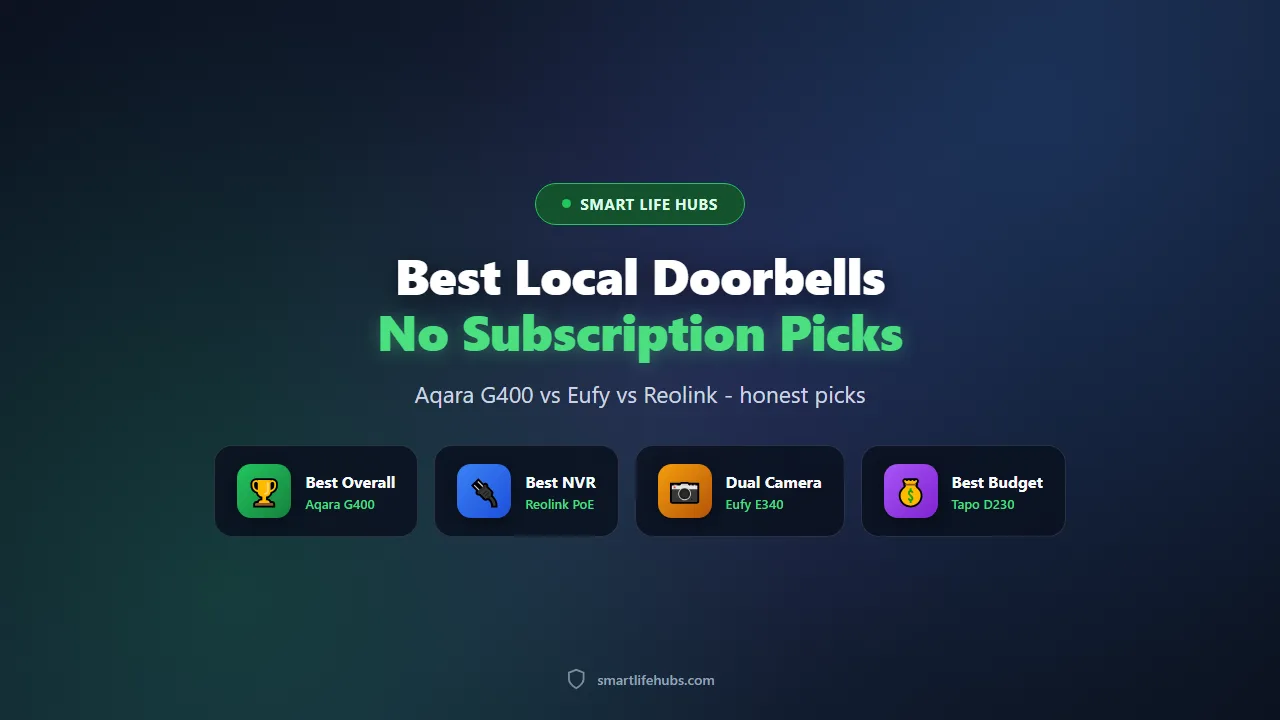
Best smart doorbells with local storage of 2026 record to a card, a hub or an NVR in your own house rather than to a subscription service, and the category has matured enough that you no longer need to accept a monthly fee to get good video. I have run a PoE doorbell and a battery doorbell side by side for a year and followed the category closely, and the honest finding is that the local-storage models are now better than the subscription ones on the two things that matter, picture quality and running cost, while the subscription models still win on polish and on the easiest setup.
The second thing to understand is where the footage actually goes, because “local storage” covers three different designs. Some doorbells record to a microSD card in the doorbell itself, some record to a hub or an NVR on your network, and some do both. A card in the doorbell is the simplest but the most vulnerable, because a thief can take the doorbell. A hub or an NVR keeps the footage out of reach and is the better choice for a front door that matters.
Prices below are US retail captured in November 2026 and they move with bundles, because several of these are sold with a hub.
At a glance
| Product | Best for | Key specs | Price |
|---|---|---|---|
| Aqara Doorbell Camera G400 | Best overall | 2K 3:4, PoE or wired, microSD to 512GB, local AI | About 100 USD |
| Reolink Video Doorbell PoE | Best for local NVR | 2K, microSD and NVR, RTSP, no subscription | About 100 USD |
| Eufy Video Doorbell E340 | Best dual camera | Two cameras, 8GB built in, HomeBase expandable | About 159 USD |
| TP-Link Tapo D230 | Best budget | Battery, 2K, microSD in the hub, no subscription | About 80 USD |
| Amcrest AD410 | Best for existing NVR | Wired, microSD, RTSP, works with an NVR | About 100 USD |
The best smart doorbells with local storage of 2026
1. Aqara Doorbell Camera G400, best overall
The G400 is the doorbell that reset the value of the category. It shoots 2K at a 3:4 vertical aspect ratio with a 165 degree field of view, so you see a visitor from head to the package at their feet, which a conventional 16:9 doorbell crops away. It can be powered by Power over Ethernet or by existing 8 to 24 volt doorbell wiring, it records 24/7 to a microSD card up to 512GB, and its person and package detection runs on the camera itself rather than in the cloud. It supports HomeKit Secure Video, Alexa, Google Home and SmartThings, and it exposes a local RTSP stream for Home Assistant and Frigate. At about 100 USD it is the pick unless you need a battery model or an NVR. The honest trade-offs are a quiet chime and some AI features, like face recognition, that sit behind a subscription.
Pros
- 2K 3:4 vertical view with a 165 degree field of view
- PoE or existing doorbell wiring, no battery to charge
- Local AI detection and 24/7 microSD recording up to 512GB
Cons
- Chime volume is quiet out of the box
- Some AI features require a subscription
Check today’s price on Amazon.
2. Reolink Video Doorbell PoE, best for local NVR
Reolink is the engineer’s choice and the one to buy if you want the footage on your own recorder. The PoE model runs on a single Ethernet cable for power and data, records to a microSD card or to a Reolink NVR, and exposes an RTSP stream that works with Frigate, Blue Iris and Home Assistant. It shoots 2K, detects people, vehicles and packages, and there is no subscription in Reolink’s published feature set. At about 100 USD it is the same money as the Aqara with a more open ecosystem, and the trade-off is a less polished app and a slightly more involved setup.
Pros
- PoE power and data on one cable, very stable
- microSD and NVR recording with RTSP and no subscription
- Person, vehicle and package detection
Cons
- App is less polished than Eufy or Aqara
- Setup is more involved, especially with an NVR
Check today’s price on Amazon.
3. Eufy Video Doorbell E340, best dual camera
The E340 is the most polished local doorbell and the one to buy if you want a package view without a second device. It has two cameras, one for the visitor and one angled at the doorstep, 8GB of built-in storage, and the option to expand to a Eufy HomeBase with a hard drive. Person and package detection run locally, there is no monthly fee for the core recording, and the app is the best in the category. At about 159 USD it costs more than the Aqara and the Reolink, and the trade-offs are that some models need a HomeBase for the full feature set and the RTSP support is inconsistent across the range.
Pros
- Dual cameras cover the visitor and the package
- 8GB built-in storage with no monthly fee
- Polished app and strong local detection
Cons
- About 159 USD, more than the Aqara and Reolink
- RTSP support varies by model and firmware
Check today’s price on Amazon.
4. TP-Link Tapo D230, best budget
The D230 is the cheapest doorbell here that genuinely works without a subscription. It is a battery model with 2K video and a vertical view, and it records to a microSD card that sits in the included chime hub rather than in the exposed doorbell, which is a smarter design than a card in the unit. Person detection runs on the device, there is no monthly fee, and the app is simple and reliable. At about 80 USD it is the pick for a rental or a first doorbell. The honest trade-offs are a plasticky build, no RTSP, weaker Home Assistant integration and a battery that needs charging every few months.
Pros
- About 80 USD with no subscription
- Storage in the chime hub, not the exposed doorbell
- Battery powered, so no wiring needed
Cons
- No RTSP and limited smart home integration
- Battery needs charging every few months
Check today’s price on Amazon.
5. Amcrest AD410, best for existing NVR
The AD410 is the pick if you already run an NVR or you want the most open local integration. It is a wired doorbell with a microSD card, RTSP and ONVIF support, two-way audio and person detection, at about 100 USD, and it slots into an existing Amcrest or third-party recorder without a subscription. The trade-off is an app and a design that feel older than the Eufy or the Aqara, and a vertical view that is less refined, so it is the practical choice for a system you already own rather than the best standalone doorbell.
Pros
- microSD plus RTSP and ONVIF for an existing NVR
- About 100 USD with no subscription
- Two-way audio and local person detection
Cons
- App and design feel dated
- Less polished than the Aqara or the Eufy
Check today’s price on Amazon.
How to choose a local-storage doorbell
Start with the power situation, because it decides the model class. If you have existing doorbell wiring or a convenient place to run Ethernet, a wired or PoE model is better, because there is no battery to charge and the video is more reliable. If you have no wiring and cannot run it, a battery model like the Tapo is the honest choice, and you accept the charging routine and the slower wake-up.
Then decide where the footage should live, because that is the real security difference. A microSD card in the doorbell is the simplest, but a thief can take the doorbell and the evidence with it. A hub or an NVR in a cupboard keeps the footage out of reach and lets you keep weeks of history, so it is the better choice for a door you care about. If you already own an NVR, buy a doorbell that speaks RTSP or ONVIF.
Check the field of view and the aspect ratio, because a vertical 3:4 view is the practical advantage of the newer doorbells. A conventional 16:9 image crops the top of a tall visitor and the package at their feet, while a vertical image shows both. If packages are your concern, the Aqara G400 and the Eufy E340 both handle it well.
Be clear about what the subscription actually buys, because it is usually not the recording. Most of these doorbells record locally for free and charge for cloud backup, extended history and advanced AI like face recognition. If you are happy with local recording and a notification, you can skip the plan, and the doorbell will still do the important job.
Finally, check the integration with the rest of your home, because a doorbell that cannot talk to your hub is a camera you check separately. The Aqara and the Reolink both work well with Home Assistant, the Eufy works best in its own app, and the Amcrest suits an existing NVR. A detailed 2026 roundup of the no-subscription models at easygoingnerd.com/blog/best-video-doorbells-no-subscription compares the storage and subscription position of the current range.
Living with a local-storage doorbell
Fit it with the wiring you have, and test the chime before you finish. A wired doorbell needs the right transformer voltage, usually 8 to 24 volts, and an underpowered transformer causes the chime to buzz or the doorbell to restart. A PoE model needs a PoE switch or injector, which is one more box but a very stable connection.
Set the detection zones and the sensitivity carefully, because a doorbell that alerts on every passing car becomes one you mute. Draw the zones to cover the path and the doorstep, exclude the road and the neighbour’s gate, and start with person detection only. Tune it over a fortnight rather than on the first day.
Mind the storage, because a card in a doorbell has a finite life. Use a high-endurance card rated for continuous writing, format it in the app rather than on a computer, and check the recording after a week to confirm it is looping correctly. A card that fails silently is the most common failure in a local doorbell.
Keep the firmware updated and the app current, because the local models still receive security fixes. A doorbell is a camera pointed at your street, so treat its software the way you would a router, and change the default password if the model has one.
Pair it with the rest of the home, because the alert is more useful when it does something. A notification that pops the live view on a smart display, or turns on a porch light at night, is worth more than a clip you watch later. For the wider camera range, our security cameras without subscription guide covers the indoor and outdoor options, and the outdoor camera guide covers the weatherproofing.
Frequently asked questions
Frequently Asked Questions
6Do local-storage doorbells need a subscription?
No. All of the models here record to a card, a hub or an NVR without a monthly fee. Some offer optional cloud backup or advanced AI for a subscription, but the core recording is free.
Can a thief steal the footage with the doorbell?
Yes, if the footage is on a card inside the doorbell. That is the argument for a hub or an NVR, which keeps the recording inside the house, or for a model that backs up to a hub automatically.
What is the difference between a card in the doorbell and a card in a hub?
A card in the doorbell is simpler and cheaper, but it is exposed and holds less history. A card in a hub or an NVR is out of reach, holds far more and survives the doorbell being removed, so it is the safer design.
Can I use a local doorbell with Home Assistant?
Yes. The Aqara G400 and the Reolink both expose a local RTSP stream, and the Reolink and Amcrest work with Frigate for on-device detection. The Eufy and Tapo are more closed, so check the current integration before you buy.
Do battery doorbells work as well as wired ones?
Mostly, but not quite. A battery model needs charging every few months, can be slower to wake and miss the first moments of a visitor, and is easier to remove. A wired or PoE model is more reliable and has no battery to maintain.
How much storage do I need?
It depends on the resolution and the recording mode. Motion-triggered recording on a 2K doorbell typically needs 32 to 128GB for a few weeks of history, while continuous recording fills a card much faster, so size up if you want a long archive.
The bottom line
Buy the Aqara Doorbell Camera G400 at about 100 USD if you want the best all-round local doorbell. The 2K vertical view, the PoE or wired power, the local AI detection and the microSD recording up to 512GB make it the most capable option here, and the HomeKit, Alexa, Google and RTSP support means it will fit almost any home.
The Reolink Video Doorbell PoE at about 100 USD is the pick if you want the footage on your own recorder, because the microSD plus NVR design and the RTSP stream give you the most control and the most security. The Eufy E340 at about 159 USD is the best dual-camera option, and the Tapo D230 at about 80 USD is the budget choice for a rental or a first doorbell.
Whichever you choose, put the storage somewhere a thief cannot reach it, tune the detection zones rather than accepting the defaults, and use a high-endurance card. A local doorbell is one of the few security upgrades that pays for itself in the first year, and it works without a monthly fee for as long as you own it.




Leave a Comment