
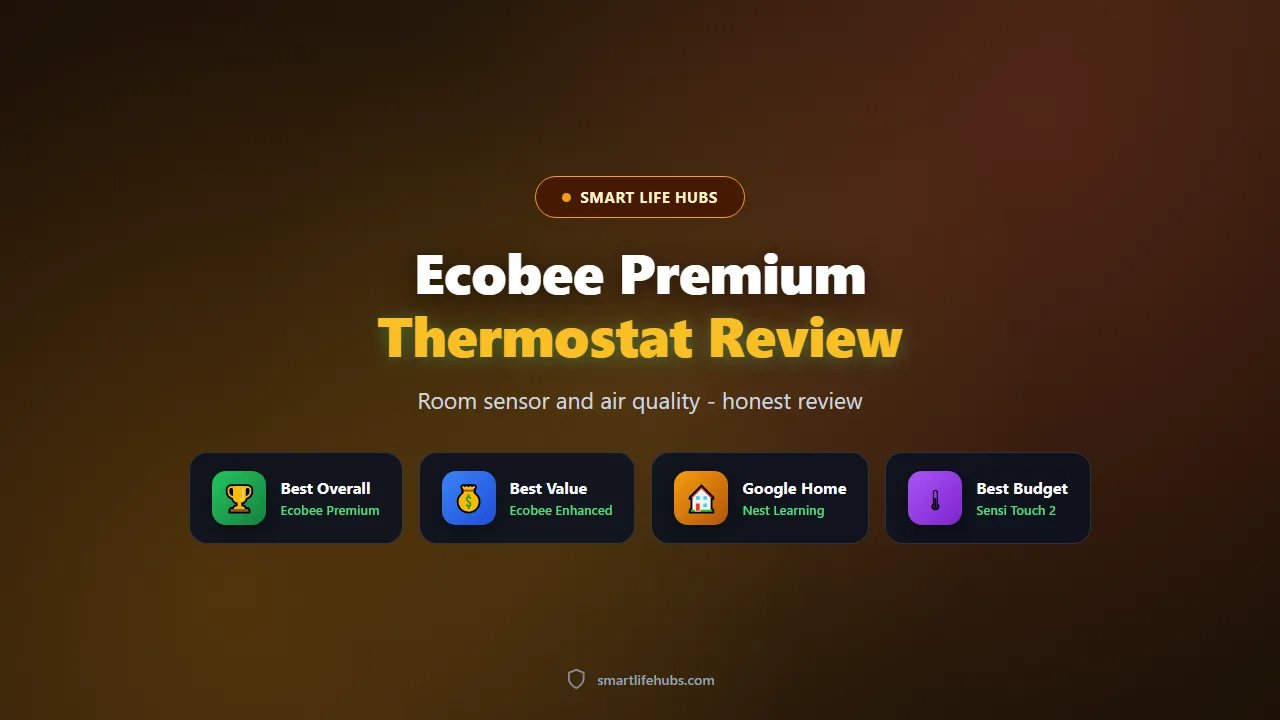
The Ecobee Smart Thermostat Premium is a 249.99 dollar smart thermostat with a metal finish, a colour touchscreen, a built-in air quality sensor and a wireless room sensor in the box, and it is the most complete thermostat Ecobee has made. I have used one for a heating season in a two-bedroom house with uneven rooms, and the honest finding is that the room sensor is the feature that justifies it, while the air quality sensor is interesting rather than essential.
The second thing to understand is what the Premium adds over the cheaper Ecobee models, because the range is confusing. The Premium includes a SmartSensor for a second room and an air quality monitor that measures volatile organic compounds, estimates carbon dioxide and reports temperature and humidity. The Enhanced is the same thermostat without the air quality sensor and usually without the room sensor. If your problem is a cold bedroom, the Premium is the one to buy; if your problem is a single uncomfortable room, the Enhanced plus a sensor may be enough.
Prices below are US retail captured in November 2026.
At a glance
| Product | Best for | Key specs | Price |
|---|---|---|---|
| Ecobee Smart Thermostat Premium | Best overall | Room sensor included, air quality monitor, metal body | About 249.99 USD |
| Ecobee Smart Thermostat Enhanced | Best value | Same core, no air quality sensor, often no sensor | About 189.99 USD |
| Google Nest Learning Thermostat | Best for Google Home | Learning schedule, 4th gen, no room sensor in the box | About 279 USD |
| Emerson Sensi Touch 2 | Best budget | Touchscreen, flexible scheduling, no sensor | About 140 to 170 USD |
The Ecobee Smart Thermostat Premium and its closest rivals
1. Ecobee Smart Thermostat Premium, best overall
The Premium is the pick if your house has rooms that never feel the same temperature, because the included SmartSensor sits in the room you actually use and the thermostat can average the two readings or follow the sensor alone. In my house that meant the bedroom stopped being the cold room at night, which was the whole point of buying it. The thermostat has a metal finish, a colour touchscreen, a built-in speaker with Alexa, and the air quality sensor reports VOCs, an estimated CO2 level, temperature and humidity. It works with Apple Home, Alexa, Google and SmartThings, and it supports Matter through a software update. At about 249.99 USD it is the most expensive mainstream thermostat here, and the honest trade-offs are that the air quality sensor is more interesting than useful and the app is busier than the Nest’s.
Pros
- Includes a SmartSensor for a second room, the feature that fixes uneven heating
- Air quality monitor with VOC, estimated CO2, temperature and humidity
- Metal body, Alexa built in and broad ecosystem support
Cons
- About 249.99 USD, the priciest here
- Air quality sensor is not as useful as the room sensor
Check today’s price on Amazon.
2. Ecobee Smart Thermostat Enhanced, best value
The Enhanced is the same thermostat without the air quality sensor and usually without the room sensor, at about 189.99 USD. It still has the colour touchscreen, the remote sensor support if you add one, and the same scheduling and ecosystem support, so it is the better buy if you only need one room controlled and you do not care about the air quality readout. The honest limitation is that you lose the feature that makes the Premium distinctive, so if uneven rooms are your problem, the extra sixty dollars is well spent on the Premium.
Pros
- About 189.99 USD, sixty less than the Premium
- Same core thermostat with remote sensor support
- Works with all the major ecosystems
Cons
- Usually sold without a room sensor
- No air quality monitor
Check today’s price on Amazon.
3. Google Nest Learning Thermostat, best for Google Home
The Nest Learning Thermostat is the pick if you live in Google Home and you want a thermostat that learns your routine rather than one you program. The fourth generation has a polished metal ring, a bright display and a schedule that adapts, and it works with the Nest Temperature Sensor sold separately for a second room. At about 279 USD it costs more than the Ecobee Premium and it does not include a room sensor, so you add one separately. The honest trade-off is a more closed ecosystem, so if you are not a Google household the Ecobee is the more flexible choice.
Pros
- Learns your schedule and adapts automatically
- Polished design and the simplest Google Home integration
- Optional Nest Temperature Sensor for a second room
Cons
- About 279 USD, and the room sensor is extra
- Best features are tied to Google Home
Check today’s price on Amazon.
4. Emerson Sensi Touch 2, best budget
The Sensi Touch 2 is the honest budget option. It has a touchscreen, flexible scheduling, remote access and a flexible C-wire policy, at about 140 to 170 USD, and it works with Alexa, Apple Home and Google. It has no room sensor and no air quality monitor, so it controls the temperature where the thermostat sits, which is fine for a small or a well-balanced home and a problem for a house with a cold bedroom. At this price it is the pick if you want a good thermostat without paying for the premium features.
Pros
- About 140 to 170 USD, well below the Ecobee and Nest
- Flexible C-wire requirements and a clear app
- Works with all the major ecosystems
Cons
- No room sensor, so it only knows the hallway temperature
- Build and display are less premium
Check today’s price on Amazon.
How to choose between the Ecobee Premium and its rivals
Start with the problem you are solving, because that decides the features. If you have one room that is always cold or hot, buy a thermostat that supports a remote sensor, and the Ecobee Premium is the only one here with a sensor in the box. If you want a thermostat that learns your routine, the Nest is the pick. If you want a good thermostat for a well-balanced home on a budget, the Sensi is the honest choice.
Then check the C-wire, because the wiring decides which models will work. Many smart thermostats need a common wire, and if you do not have one you either need a model that can steal power, an adapter, or an electrician. Our guide to thermostats without a C-wire covers the options in detail, and the Ecobee range is one of the better choices if you are short of a wire.
Installation and the power extender
Ecobee includes a power extender kit that connects to the furnace control board, so most homes without a C-wire can still install one without calling an electrician. The extender is a small module that fits in the furnace or air handler rather than at the thermostat, and it takes a few extra minutes to wire. If your system is a millivolt, a high-voltage or a certain heat pump configuration, check the compatibility list first, because a small number of systems need a proper C-wire run or an add-a-wire adapter.
Turn the power off at the breaker before you start, label the old thermostat wires, and take a photograph of the existing connections. Most thermostat wiring is straightforward, but a mislabelled wire can cause a blown fuse in the furnace control board, and the ten minutes spent labelling saves an expensive callout.
Check the ecosystem, because the app is what you will use daily. Ecobee works with Apple Home, Alexa, Google and SmartThings and supports Matter, which makes it the most flexible. The Nest is best in Google Home, the Sensi works with the major assistants but has a smaller feature set. Buy the thermostat that matches the assistant you already use.
Decide whether the air quality sensor is worth the money, because it is the Premium’s main premium. It reports VOCs, an estimated CO2 level and humidity, which is useful if you want to track a stuffy room or a damp house, but it is not a substitute for a proper carbon monoxide alarm and it will not change your heating much. If you want the sensor, buy the Premium; if you want the room sensor, buy the Premium; if you want neither, buy the Enhanced.
Finally, be honest about the savings claim, because a smart thermostat saves money by heating the rooms you use rather than the whole house, not by magic. The room sensor is where the real saving is, because it lets the system ignore the empty rooms. A detailed roundup at ecobee.com/en-us/products/smart-thermostat-premium covers the official specification if you want the manufacturer’s numbers.
Living with the Ecobee Premium
Put the room sensor where you actually live, not where the thermostat is. The sensor should sit in the room you want comfortable, at about chest height, away from a radiator, a window, a television or a direct sun patch. A sensor in the hallway tells you about the hallway, which is why a house with uneven rooms needs one in the bedroom.
Choose the occupancy mode deliberately, because Ecobee can follow the sensor, average the sensor and the thermostat, or ignore the sensor. For a house where one room matters at night, follow the sensor at night and average during the day. The default is rarely the best setting for the first week, so expect to adjust it.
Use the air quality reading as a prompt to ventilate, not as a medical device. A rising CO2 estimate or a VOC spike after cooking is a signal to open a window, and the humidity reading is useful for spotting a damp room. It is not a replacement for a carbon monoxide alarm or a proper air quality monitor.
Let the scheduling settle before you judge the savings. A smart thermostat needs a few weeks to learn your routine and for you to tune the setpoints, so compare your bill against the same months last year rather than against the first month. The real saving comes from not heating empty rooms, which is invisible week to week.
Keep the firmware updated and the sensor batteries fresh, because a thermostat that loses its sensor is a thermostat that controls the wrong room. Replace the sensor batteries on a schedule, and check the app monthly to confirm the sensor is reporting. For the wider range, our smart thermostat roundup compares the alternatives.
Frequently asked questions
Frequently Asked Questions
6What is the difference between the Ecobee Premium and the Enhanced?
The Premium includes an air quality monitor and a SmartSensor for a second room. The Enhanced is the same core thermostat without the air quality sensor and usually without the sensor, and it supports adding a sensor later.
Do I need a C-wire for the Ecobee Premium?
Ecobee includes a power extender kit for homes without a common wire, so it works in most installations. Some older systems and certain HVAC configurations need an adapter or an electrician, so check your wiring before you buy.
Is the Ecobee Premium worth the extra money?
Worth it if you have a room that is always too hot or too cold, because the included SmartSensor is the feature that fixes it. If your home is already balanced and you do not care about air quality, the Enhanced is the better value.
Does the Ecobee Premium work with Apple Home?
Yes. Ecobee supports Apple Home, Alexa, Google and SmartThings, and it added Matter support, which makes it one of the most flexible thermostats in this roundup.
What does the air quality sensor actually measure?
It reports volatile organic compounds, an estimated carbon dioxide level, temperature and humidity. It is a guide for ventilation rather than a medical or safety device, and it does not replace a carbon monoxide alarm.
Can I add more than one room sensor?
Yes, Ecobee supports multiple SmartSensors, so you can cover several rooms and let the thermostat average them or follow the one that matters. Extra sensors are sold separately.
The bottom line
Buy the Ecobee Smart Thermostat Premium at about 249.99 USD if your house has rooms that never feel the same temperature. The included SmartSensor is the feature that fixes it, the metal body and the colour touchscreen are pleasant to live with, and the broad ecosystem support means it will work with whatever assistant you already use.
The Ecobee Smart Thermostat Enhanced at about 189.99 USD is the better value if your home is already balanced and you only want a good smart thermostat, and the Emerson Sensi Touch 2 at about 140 to 170 USD is the honest budget choice. The Google Nest Learning Thermostat at about 279 USD is the pick if you live in Google Home and you want a thermostat that learns your routine.
The air quality sensor is the one feature I would not buy the Premium for, because the room sensor is what actually changes how a house feels. If you want both, the Premium is the right box; if you only want one, put the money into the sensor rather than the air quality readout.

Leave a Comment