
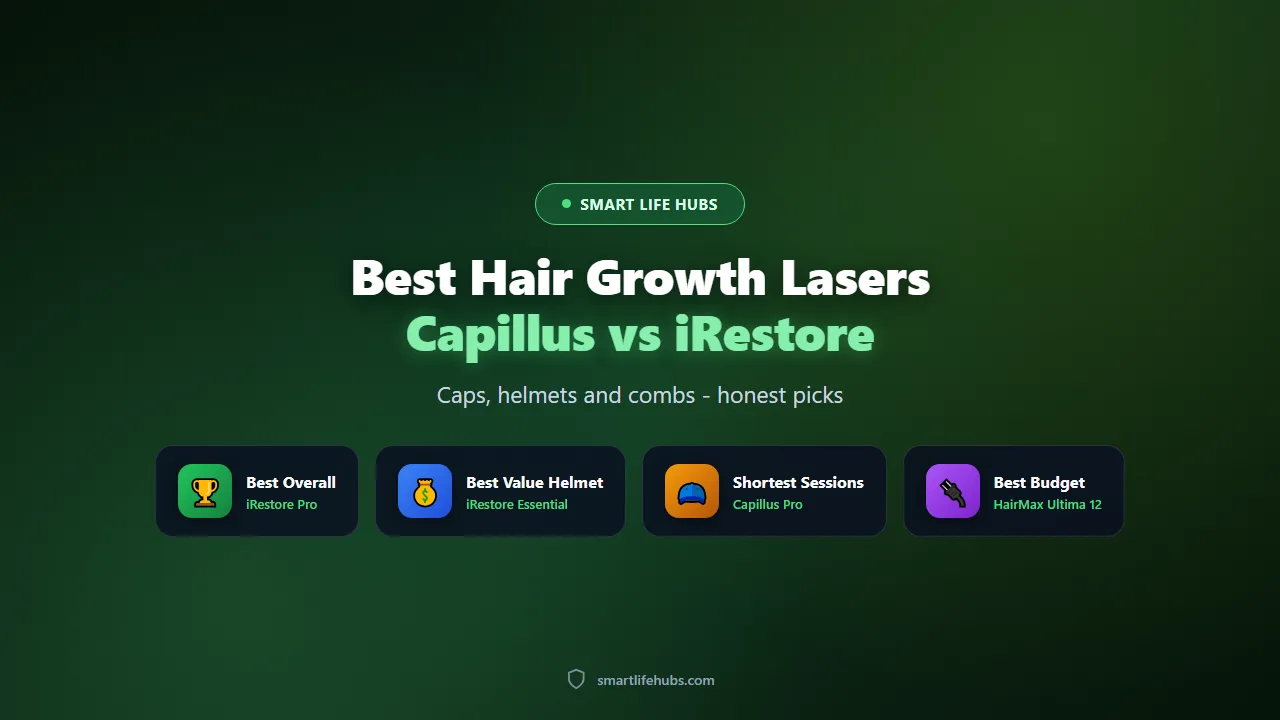
Best hair growth laser devices of 2026 are the caps, helmets and combs that use low-level laser therapy to stimulate the follicles, and the honest finding after comparing the range is that the iRestore Professional is the best overall while the Capillus is the pick if you want the shortest session. The category is expensive, the results take four to six months and the evidence is real but modest, so it is worth buying only if you will stick with the routine.
The second thing to understand is that low-level laser therapy is not a transplant and not a cure. It can thicken existing hair and slow loss in the early stages, and it works best on a scalp that still has hair rather than a bald one. If you have a clearly bald crown, a device will not bring it back, and you would be better off looking at a clinic or accepting the loss.
Prices below are US retail captured in November 2026 and they move with sales.
At a glance
| Product | Best for | Key specs | Price |
|---|---|---|---|
| iRestore Professional | Best overall | 282 lasers and LEDs, helmet, 25 min every other day | About 799 USD |
| iRestore Essential | Best value helmet | 120 light sources, helmet, 25 min every other day | About 499 USD |
| Capillus Pro | Best short sessions | 272 lasers, cap, 6 min a day, cordless | About 899 to 2,299 USD |
| Theradome PRO LH80 | Best laser-only | 80 medical-grade lasers, helmet, 20 min | About 895 to 995 USD |
| HairMax Ultima 12 | Best budget | 12 lasers, comb, 8 min three times a week | About 299 USD |
The best hair growth laser devices of 2026
1. iRestore Professional, best overall
The Professional is the pick because it has the most light sources and the broadest scalp coverage of the helmets at a mid-range price. It uses 282 lasers and LEDs in a hands-free helmet, it covers the top, back and sides, and the routine is 25 minutes every other day. iRestore says a double-blind study run by a board-certified dermatologist found an average 43.2 percent increase in hair growth over 16 weeks of every-other-day use. It costs about 799 dollars, and the honest trade-offs are a helmet that looks like a bicycle hat, a 25-minute session that is longer than the Capillus, and a result that is thickening rather than regrowth on a bald area.
Pros
- 282 lasers and LEDs with full top, back and side coverage
- Backed by a double-blind study reporting a 43.2 percent increase
- About 799 dollars
Cons
- Helmet design that is visible and a 25-minute session
- Thickens existing hair rather than regrowing a bald area
Check today’s price on Amazon.
2. iRestore Essential, best value helmet
The Essential is the pick if you want the same hands-free helmet for less money, because it uses 120 light sources at about 499 dollars, which is roughly half the Professional. The honest trade-offs are fewer diodes, a coverage area that is narrower, and a device that is a step below the Professional on the density that matters, so it is the pick for a first try or a smaller area.
Pros
- About 499 USD, the cheapest helmet here
- Hands-free with the same every-other-day routine
- Good for a first try on a small budget
Cons
- Fewer light sources than the Professional
- Narrower coverage and a smaller evidence base
Check today’s price on Amazon.
3. Capillus Pro, best short sessions
The Capillus is the pick if you want the shortest routine, because its 272 lasers sit in a cap you wear under a hat for six minutes a day, which is the easiest protocol in the category to keep. It is cordless with a rechargeable battery, it has a three-year warranty and it costs about 899 to 2,299 dollars depending on the configuration. The honest trade-offs are a price that reaches the top of the range, a cap that is less sturdy than a helmet, no timer display on the Pro, and a money-back window with conditions, so it is the pick for someone who values the routine above all.
Pros
- Six minutes a day, the shortest session here
- Cordless cap that fits under a hat, 272 lasers
- About 899 to 2,299 dollars
Cons
- Price reaches the top of the range
- Fabric cap is less sturdy and has no timer display
Check today’s price on Amazon.
4. Theradome PRO LH80, best laser-only
The Theradome is the pick if you want medical-grade laser diodes rather than a mix of lasers and LEDs, because its helmet uses 80 laser-only diodes with a 20-minute session several times a week. It is FDA-cleared and it costs about 895 to 995 dollars. The honest trade-offs are fewer light sources than the iRestore, a helmet that is bulky, and a brand with a smaller user base, so it is the pick for a buyer who wants laser-only and is comfortable with the evidence.
Pros
- 80 medical-grade laser diodes with no LEDs
- FDA-cleared with a 20-minute session
- About 895 to 995 dollars
Cons
- Fewer light sources than the iRestore
- Bulky helmet and a smaller user base
Check today’s price on Amazon.
5. HairMax Ultima 12, best budget
The Ultima is the pick if you want to try the technology for the least money, because it is a comb with 12 lasers that you draw through the hair for eight minutes three times a week, at about 299 dollars. The honest trade-offs are a device that only treats the parts you comb, a result that is modest compared with a full helmet, and a design that needs both hands, so it is the pick for a receding hairline or a small area rather than a whole scalp.
Pros
- About 299 USD, the cheapest here
- Eight minutes three times a week
- Good for a hairline or a small area
Cons
- Treats only what you comb, so coverage is limited
- Needs both hands and gives modest results
Check today’s price on Amazon.
How to choose a hair growth laser device
Start with the stage of the loss, because the devices work best where there is still hair to thicken. A receding hairline or a thinning crown responds better than a bald area, and a comb is enough for a hairline while a helmet suits a wider area. If the scalp is visibly bald, a device is unlikely to give you what you want.
Then check the session and the routine, because the protocol is the real cost. A six-minute daily cap is the easiest to keep, a 25-minute every-other-day helmet needs a slot in the evening, and a comb needs eight minutes three times a week with both hands. Buy for the routine you will still be doing in six months.
Check the light sources, because more diodes generally means better coverage, and the split between lasers and LEDs matters less than the total energy delivered. A helmet with 282 sources will treat a whole scalp faster than a comb with 12, and a device that mixes lasers and LEDs is a reasonable compromise.
Think about the evidence and the guarantee, because this category has a wide range of claims. Look for a device with a published study, a clear money-back window and a warranty, and read the conditions of the guarantee, because some brands charge a restocking fee. A device with a study and a fair return policy is the safer bet.
Finally, be honest about the result, because low-level laser therapy thickens and slows rather than regrows. Vogue’s 2026 roundup at vogue.com/article/best-red-light-therapy-for-hair-growth covers the helmets, caps and combs and the dermatology view of the evidence.
Living with a laser hair growth device
Expectations and tracking
Set the expectation before the first session, because the studies measure at 16 weeks and the first change most people notice is less hair on the brush rather than new growth. Take a baseline photograph of the hairline, the crown and the part in the same light and from the same distance, and repeat it every four weeks. Without the photos, the change is too slow to see and most people quit at the two-month mark believing it has failed.
Expect a maintenance phase rather than a cure, because the follicles need repeated stimulation. Most protocols move to once a week or fortnightly after the start phase, and a device that is used for the start phase and then stored will lose whatever it gained, so decide whether you will keep the routine before you spend the money.
Scalp care and combining treatments
Keep the scalp in good condition, because the light works better on healthy skin. Wash away styling product before a session, treat any dandruff or inflammation, and avoid tight hats that rub the area immediately afterwards. A scalp that is sore or flaky will make the routine uncomfortable and you will skip it.
Do not mix the device with an irritating topical on the same day, and tell a clinician what you are using if you start a prescription treatment. Minoxidil and a laser device are commonly used together, but the combination should be a decision made with a professional rather than an experiment, particularly if you have a scalp condition or are on medication.
Start before the loss is advanced, because the device thickens what is there rather than reviving a bald area. Take photographs of the hairline and the crown in the same light before you begin, and repeat them every four weeks, because the change is slow enough that you will not notice it week to week.
Keep the scalp clean and dry for each session, because oil and product block the light and reduce the dose. Wash the hair the day you treat, avoid styling products on the session days, and comb the hair back so the light reaches the scalp rather than the hair shaft.
Follow the routine rather than the results, because the protocol is every other day or several times a week for months and the visible change comes at four to six months. Put the device somewhere you will see it, set a reminder, and treat the sessions as a fixed appointment rather than something you fit in when you remember.
Be patient and take the photos, because the first change is a reduction in shedding rather than new growth, and it is easy to conclude the device is not working. Compare the four-week photos at three months, and only decide at six months, which is when the studies measure the result.
Combine it with the basics rather than expecting the device to do everything, because the evidence for minoxidil and a good diet is stronger than for light alone. Use the device as one part of a plan, keep the scalp healthy, and see a dermatologist if the loss is sudden or patchy, because that is a medical question rather than a device question. For the wider range, our hair loss guide covers the causes and the other treatments, and the silk pillowcase comparison covers the hair and skin angle.
Frequently asked questions
Frequently Asked Questions
6Do laser hair growth devices work?
The evidence supports a modest thickening and a slowing of loss in the early stages, and iRestore reports a 43.2 percent increase in hair growth over 16 weeks in a double-blind study. The results are gradual and they need a consistent routine over months.
How long before you see results?
Most people notice less shedding at about three months and visible thickening at four to six months, which is when the studies measure the outcome. A device used for a month and stopped will not show anything.
Which is better, a cap or a helmet?
A cap is shorter to use and fits under a hat, while a helmet covers the whole scalp with more diodes and treats faster. A cap suits a busy routine, and a helmet suits the broadest coverage.
Can a laser device regrow hair on a bald scalp?
Not reliably. The devices thicken existing hair and slow further loss, so they work best where there is still hair. A visibly bald area is better discussed with a dermatologist or a clinic.
Do I need to use minoxidil as well?
No, but the evidence for minoxidil is stronger than for light alone, and many people use both. Ask a clinician before combining treatments, and do not stop a prescribed treatment without advice.
Are there side effects?
Low-level laser therapy is generally well tolerated, with occasional scalp dryness or mild itching. Stop if the scalp becomes sore or burned, and check the manual for the contraindications, which include some skin conditions and photosensitising medication.
The bottom line
Buy the iRestore Professional at about 799 dollars if you want the best overall laser device, because the 282 lasers and LEDs, the full scalp coverage and the double-blind study make it the most convincing option, and the every-other-day routine is manageable.
Buy the iRestore Essential at about 499 dollars if you want the cheapest helmet, the Capillus Pro at about 899 to 2,299 dollars if you want the shortest daily session, the Theradome PRO at about 895 to 995 dollars for laser-only diodes, and the HairMax Ultima 12 at about 299 dollars for a hairline or a small area.
The honest point is that this is a slow treatment for a early problem rather than a fix for a bald one. Start while there is still hair, follow the routine for six months, take the photos and combine it with the basics, because a device used consistently on the right scalp will thicken it and a device bought in hope will not.


Leave a Comment