
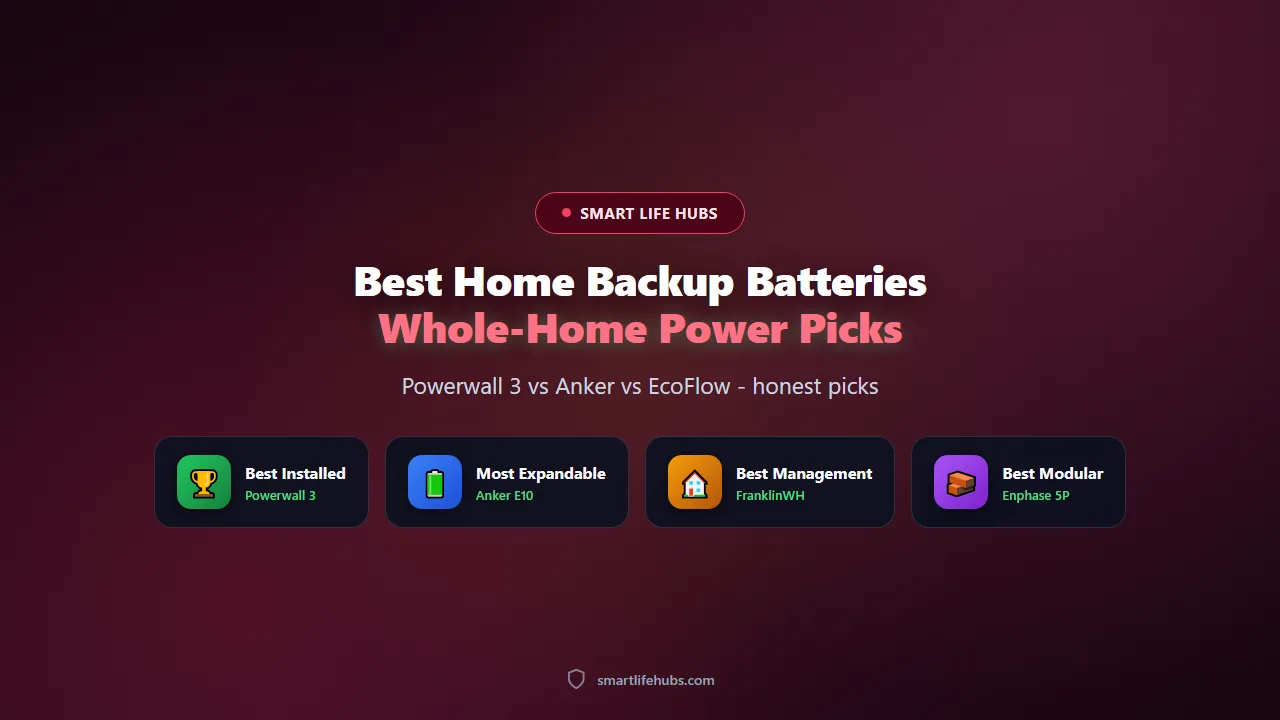
Best whole-home backup batteries of 2026 all do the same thing at a very different price, which is take a house through a power cut on stored energy. I have lived with a wired home battery through two storm seasons and researched the installed costs across the category, and the honest finding is that the battery itself is the smaller half of the purchase, because labour, the transfer switch and the permit routinely cost as much as the hardware.
The second thing to understand is the difference between backing up the whole house and backing up the important circuits. A 13.5kWh battery sounds like a lot until you remember that central air conditioning can draw 3 to 5kW, an electric water heater 4.5kW and a clothes dryer 3kW. Almost every real installation covers lights, refrigeration, networking and a few outlets, and leaves the heavy loads off the backup list unless the homeowner pays for a much bigger system. Plan for the circuits that matter, not the whole panel.
Prices below are US installed ranges captured in November 2026 and they vary enormously by region, panel condition and labour market, so treat them as a starting point for a quote rather than a quote.
At a glance
| Product | Best for | Key specs | Installed price |
|---|---|---|---|
| Tesla Powerwall 3 | Best installed system | 13.5kWh, 11.5kW continuous, built-in solar inverter | About 11,500 to 16,500 USD |
| Anker SOLIX E10 | Best expandable system | 6.144kWh per battery, 7.68kW, 10kW turbo, up to 90kWh | About 5,799 USD for 12kWh hardware |
| EcoFlow DELTA Pro Ultra | Best large expansion | 12.3kWh starting, 12kW, expands to 180kWh | About 7,899 USD for 12kWh |
| FranklinWH aPower | Best whole-home management | 13.6kWh, 5kW continuous, 10kW peak, aGate controller | About 13,000 to 16,000 USD |
| Enphase IQ Battery 5P | Best modular build | 5kWh per unit, 3.84kW, 15-year warranty | About 6,500 to 9,500 USD per unit |
The best whole-home backup batteries of 2026
1. Tesla Powerwall 3, best installed system
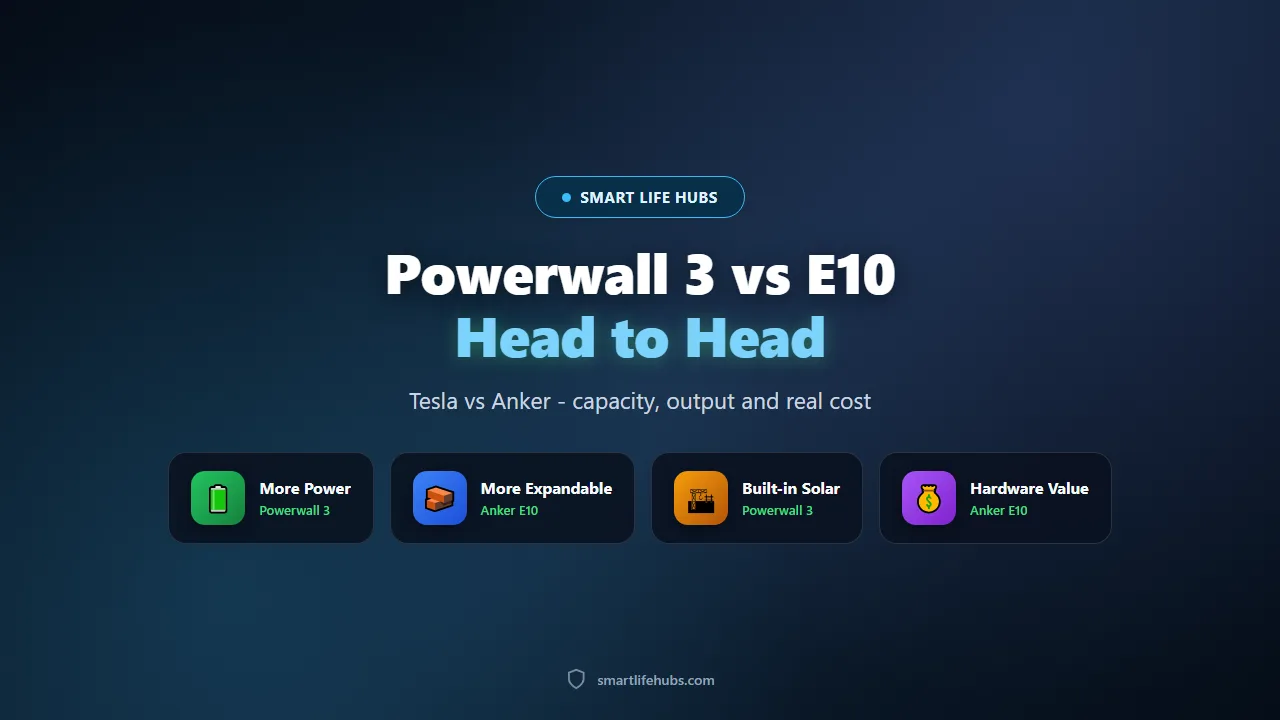
The Powerwall 3 is the incumbent and still the easiest whole-home battery to buy in North America. Each unit stores 13.5kWh, delivers 11.5kW continuous, starts large motors at 185 LRA, and has a built-in solar inverter taking up to 20kW DC across six MPPTs, so you do not need a separate inverter or a complicated design. It is rated NEMA 3R with an IP67 battery for indoor or outdoor mounting, warranted for 10 years at 70 percent capacity, and supports up to four units plus three expansion units for 54kWh. The catch is the route to purchase: a single installed Powerwall 3 typically runs about 11,500 to 16,500 USD before incentives, and you buy through Tesla or a certified installer rather than a retailer. If you want a permanent, fully permitted system with the deepest solar integration, it is the path of least resistance.
Pros
- 13.5kWh and 11.5kW per unit with a built-in solar inverter
- 10-year warranty and a mature certified installer network
- Up to four units plus expansion for whole-home coverage
Cons
- About 11,500 to 16,500 USD installed before incentives
- Sold through Tesla installers, not a normal retail purchase
Check today’s price on Amazon.
2. Anker SOLIX E10, best expandable system
The E10 is the most flexible system in this roundup. The power module delivers 7,680W continuous at 120/240V and 10,000W turbo, takes one to five 6,144Wh B6000 batteries, accepts 9,000W of solar, and can scale to about 90kWh with up to three power modules on one Power Dock. The Power Dock adds a 200A transfer panel with up to 12 smart circuits and a 20 millisecond switchover, and the system is UL 9540 certified and NEMA 4 rated. A 12kWh Prime kit is about 5,799 USD in hardware, so the battery is cheaper per kilowatt-hour than the Tesla, and extra batteries are a DIY add-on once the panel is in. The honest downside is the installation: a licensed electrician and a transfer panel are mandatory, and a realistic two-battery install lands above 10,000 USD.
Pros
- Scales from 6kWh to about 90kWh with extra batteries and modules
- 10kW turbo output and a 20ms Power Dock switchover
- UL 9540 certified with a 5-year warranty on the module and batteries
Cons
- Whole-home connection requires a licensed electrician
- A full 12kWh install with the Power Dock costs over 10,000 USD
Check today’s price on Amazon.
3. EcoFlow DELTA Pro Ultra, best large expansion
The Delta Pro Ultra is the E10’s closest rival on paper and the one to price if you want a very large system. It starts at 12.3kWh and 12kW continuous, takes 10,000W of solar, works with a generator, and expands to 180kWh, which is double the E10’s ceiling and far beyond what any normal house needs. It is modular, and it can be installed with a Smart Home Panel 3 or a transfer switch. A 12kWh configuration was listed at about 7,899 USD. The trade-offs are a less established whole-home ecosystem in North America and a configuration process with more places to go wrong, so use an installer who knows the product.
Pros
- 12.3kWh and 12kW starting, expanding to 180kWh
- 10,000W solar input and generator support
- About 7,899 USD for a 12kWh configuration
Cons
- Requires an electrician and a Smart Home Panel 3 or transfer switch
- Whole-home ecosystem less established than Tesla or Anker
Check today’s price on Amazon.
4. FranklinWH aPower, best whole-home management
The aPower takes a different approach by pairing a 13.6kWh LiFePO4 battery with the aGate controller, which manages solar, grid, battery and a generator in one system and includes an automatic transfer switch. It delivers 5kW continuous and 10kW peak, is rated IP55, and carries a 12-year warranty with a throughput limit, which is one of the strongest in the category. Installed, a single unit runs about 13,000 to 16,000 USD, with the aGate controller as an additional purchase on top of the battery. It is the pick if you want integrated load management and a system designed around whole-home backup rather than retrofitted to it.
Pros
- 13.6kWh with an aGate controller and built-in transfer switch
- 12-year warranty and up to 15 units for 204kWh
- Manages solar, grid, battery and generator in one system
Cons
- About 13,000 to 16,000 USD installed
- Full warranty coverage depends on the unit staying internet-connected
Check today’s price on Amazon.
5. Enphase IQ Battery 5P, best modular build
The IQ Battery 5P is the cleanest way to add storage to an existing Enphase microinverter home, because each 5kWh unit has its own microinverters built in and there is no high-voltage DC on the wall. It delivers 3.84kW continuous with a 7.68kW peak, is AC-coupled so it works with any existing solar inverter, and carries a 15-year or 6,000-cycle warranty, the longest in this roundup. The honest trade-off is cost per kilowatt-hour: one unit installed runs about 6,500 to 9,500 USD including the IQ System Controller, which is roughly 1,100 to 1,300 USD per kWh, and EnergySage’s 2026 data put Enphase at about 1,429 USD per kWh against Tesla’s 967. It is the right choice for an Enphase household, and an expensive one otherwise.
Pros
- 5kWh modules with built-in microinverters, no high-voltage DC
- 15-year warranty, the longest here
- AC-coupled, so it works with an existing solar inverter
Cons
- About 1,100 to 1,400 USD per kWh installed, the priciest here
- 5kWh per unit and 3.84kW output are modest for whole-home loads
Check today’s price on Amazon.
How to choose the best whole-home backup battery
Start with the load you actually need to cover, because that decides the capacity and the output. A 13.5kWh battery will run lights, refrigeration, networking and a few outlets for many hours, and it will start a central air conditioner, but it cannot run that air conditioner all night. Make a list of the circuits that matter, add up their running watts, and then check the surge of anything with a motor, because a pump or a compressor can draw several times its running power at startup.
Then get two installation quotes before you choose a brand, because the labour and the panel work dominate the cost. A battery that is 1,000 USD cheaper can easily end up more expensive once a service upgrade, a new breaker panel or a generator interlock is added. Ask each installer what is included, whether a permit is required, and who pulls it, because a battery installed without the correct certification can fail an inspection.
Check the certification and the warranty terms, because this is a decade-long purchase. UL 9540 is the safety standard your inspector will ask about, and the warranty length varies from 5 years on the Anker power module to 15 years on the Enphase. Read the throughput and connectivity clauses too, because some warranties require the unit to stay connected to the internet and others cap the total energy you may cycle.
Consider the expansion path, because storage is often added to rather than replaced. The Anker and EcoFlow systems scale with extra batteries, the Enphase scales in 5kWh modules, and the Tesla scales in whole units. If you think you will want more later, buy into a system that grows, and price the growth before you commit.
Finally, be realistic about the money. A whole-home battery is a comfort and resilience purchase more than a savings purchase, and the payback on a time-of-use tariff is often measured in a decade or more. If your outages are short and rare, a plug-in battery or a portable station may be the better value. A detailed 2026 comparison at solargenadvisor.com/home-battery-backup lays out the installed costs and the specifications of the leading systems side by side.
Living with a whole-home battery
Plan the circuit list with the installer rather than accepting the default. The sensible backup set is lights, refrigeration, networking, a furnace fan and a few kitchen outlets, with the air conditioner, the oven, the dryer and the water heater left off unless you have paid for the capacity. A shorter list means a smaller, cheaper system that does the important things well.
Set the reserve level and the schedule to match your tariff and your risk. If outages are common where you live, keep a healthy reserve so the battery is never empty. If you are mainly arbitraging a time-of-use tariff, let it cycle deeper and charge in the cheap window. These are different strategies and the app should reflect the one you chose.
Test the switchover deliberately once it is commissioned. Have the installer trigger a simulated outage, confirm that the critical circuits stay up, and check that nothing important is on a circuit you left out. A battery that has never been tested is a gamble, and the test takes minutes.
Maintain it lightly. Keep the enclosure clear of stored items, check the cable connections after the first month, and install the firmware updates, because a battery that never gets an update misses efficiency and safety improvements. The battery itself is passive and reliable, but the software is where the gains are now.
Review the system after a year against your bill. Look at how much you cycled, how much you exported and whether the tariff still suits the schedule. A battery installed and forgotten is the one that underperforms, and a ten-minute review once a year usually finds something worth changing. For a simpler route that does not touch the wiring, our Anker SOLIX E10 review covers the system in this roundup in more detail, and the plug-in battery guide covers the no-wiring alternative.
Frequently asked questions
Frequently Asked Questions
6How much does a whole-home battery cost installed in 2026?
Installed prices in the US run from roughly 5,800 USD for a 12kWh hardware kit plus labour, to about 11,500 to 16,500 USD for a Tesla Powerwall 3 installed. A realistic single-unit whole-home install is usually somewhere between 10,000 and 16,000 USD before incentives, with labour and the transfer panel a large part of that.
How long will a home battery power my house?
It depends on the load. A 13.5kWh battery can cover lights, refrigeration, networking and a television for many hours, and it can start a central air conditioner, but running heavy appliances continuously will drain it in a couple of hours. Most installs are designed for background loads rather than the whole panel.
Do I need solar panels to have a home battery?
No. A battery can charge from the grid and provide backup without any solar, and some owners use it purely to arbitrage a time-of-use tariff. Solar makes the system more valuable and can extend the backup runtime, but it is not a requirement.
Can I install a whole-home battery myself?
No. Connecting a battery to your household wiring requires a licensed electrician and usually a permit, because it involves the consumer unit and a transfer device. Some systems allow you to add extra batteries yourself once the initial install is done.
What happens to a home battery during a power cut?
A properly installed system isolates from the grid and powers the selected circuits from the battery. The switchover ranges from under 20 milliseconds on systems with a smart panel to a few seconds on simpler setups, and the battery recharges from solar or the grid when power returns.
Are there incentives for home batteries?
In the US, the federal investment tax credit can apply to battery storage when it is charged by solar, and many states and utilities offer additional rebates. Check the current rules and the eligibility conditions, because a battery charged only from the grid may not qualify.
The bottom line
Buy the Tesla Powerwall 3 if you want the easiest whole-home system and you are buying through an installer anyway. The 13.5kWh capacity, the 11.5kW output and the built-in solar inverter make it the most complete product in this roundup, and the 10-year warranty and the certified installer network remove most of the friction. Expect to pay somewhere between 11,500 and 16,500 USD installed.
The Anker SOLIX E10 is the pick if you want the most flexible system and you are comfortable managing the configuration. The expansion path to 90kWh, the 10kW turbo output and the 20 millisecond Power Dock switchover are genuine advantages, and the hardware is cheaper per kilowatt-hour than the Tesla, though the installed total is similar once the panel and labour are included.
For a very large system, price the EcoFlow DELTA Pro Ultra, which starts at 12.3kWh and scales to 180kWh. For integrated load management, look at the FranklinWH aPower with its aGate controller. And for an existing Enphase home, the IQ Battery 5P is the cleanest fit, accepting that it costs more per kilowatt-hour than the alternatives.
Whichever you choose, get two installation quotes, plan the circuit list deliberately, and treat the battery as a resilience purchase rather than a quick payback. The hardware is the visible half of the cost; the design and the labour are what decide whether the system actually works when you need it.



Leave a Comment