
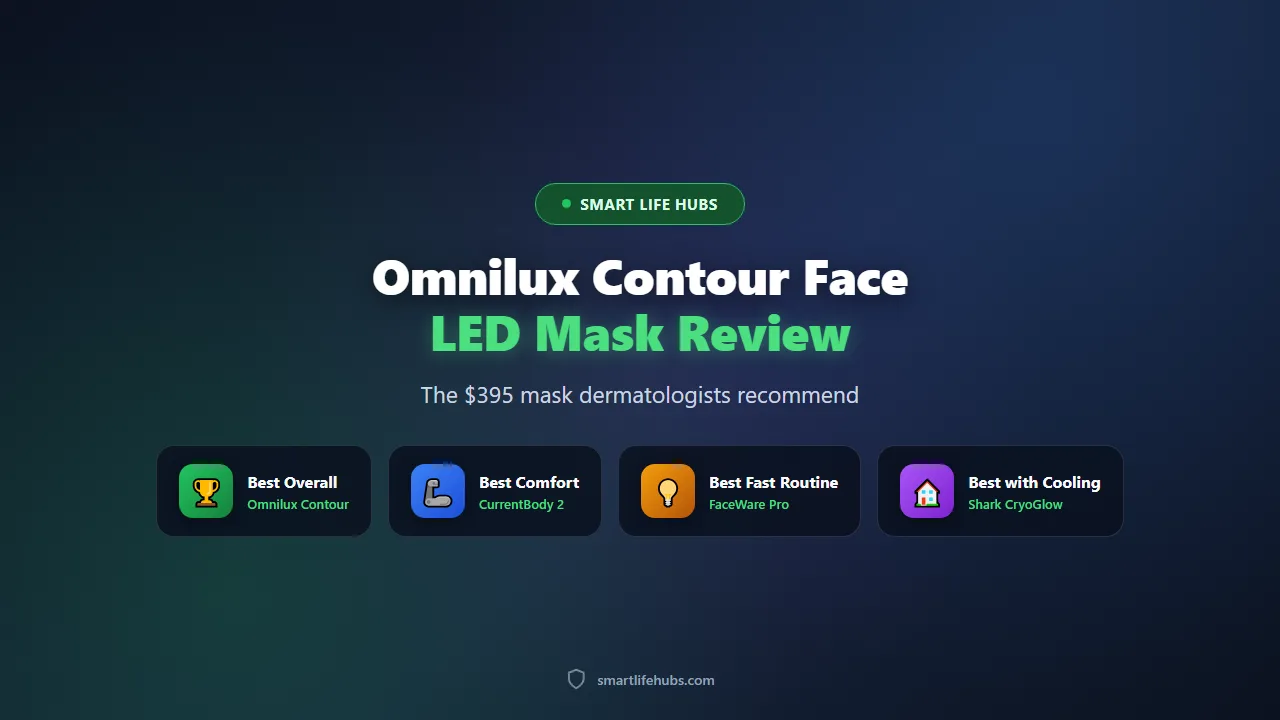
The Omnilux Contour Face is a flexible silicone LED mask that uses red and near-infrared light to target fine lines, texture and tone, and at about 395 dollars it is the mask most often handed out by dermatology practices for home maintenance. After three months of use the honest verdict is that it is the most comfortable and best-evidenced consumer LED mask you can buy, while it treats the face rather than the neck and the battery has been a real problem for a minority of owners.
The second thing to understand is that LED and microcurrent solve different problems, and the mistake is buying both. LED works on the surface: lines, texture, tone and redness, and it takes six to twelve weeks to show. Microcurrent works on the muscle: lift, jawline and definition, and it shows within days but fades when you stop. If you want a sharper jawline, buy microcurrent; if you want smoother skin, buy LED.
Prices below are US retail captured in November 2026 and they move with sales.
At a glance
| Product | Best for | Key specs | Price |
|---|---|---|---|
| Omnilux Contour Face | Best overall | Red and near-infrared LED, flexible silicone, 10 min | About 395 USD |
| CurrentBody Skin LED Mask Series 2 | Best comfort | Red and near-infrared, flexible body, app | About 469 USD |
| Dr. Dennis Gross FaceWare Pro | Best fast routine | Red and blue LED, 3 minute sessions | About 435 USD |
| Shark CryoGlow | Best with cooling | LED plus under-eye cooling, hands-free | About 350 USD |
| Therabody TheraFace Pro | Best multi-tool | Microcurrent plus LED, massage and masks | About 399 USD |
The Omnilux Contour Face and its closest rivals
1. Omnilux Contour Face, best overall
The Contour Face is the pick because it combines the deepest published evidence base of any consumer mask with a flexible silicone shell that actually fits a real face. It uses red and near-infrared LEDs, it needs no gel and no consumables, and the sessions are short enough that you will do them. Omnilux reports that 93 percent of participants saw firmer, smoother skin after a month of three-times-weekly use, and the company’s underlying technology is referenced across a large body of peer-reviewed light-therapy literature. The honest trade-offs are coverage, because it treats the face and not the neck or chest, a bare-bones listing, and a small but real share of owners reporting batteries that fail outright or a fit that gapes at the chin on smaller faces.
Pros
- Flexible silicone that contours to the face and no gel needed
- Red and near-infrared LED with a strong published evidence base
- About 395 dollars with no ongoing consumables
Cons
- Treats the face only, not the neck or chest
- Some owners report battery failures and a gaping fit
Check today’s price on Amazon.
2. CurrentBody Skin LED Mask Series 2, best comfort
The CurrentBody is the pick if comfort is the deciding factor, because its flexible silicone body is soft against the skin, it uses red and near-infrared light, and it has a simple app for the routine. It costs about 469 dollars, and the honest trade-offs are a higher price than the Omnilux, a design that is less structured so it can feel loose, and a brand whose evidence base is good rather than as deep. It is the pick for a buyer who finds rigid masks uncomfortable.
Pros
- Soft flexible silicone that is comfortable for the full session
- Red and near-infrared with a simple app
- About 469 dollars
Cons
- More expensive than the Omnilux
- Less structured fit and a thinner evidence base
Check today’s price on Amazon.
3. Dr. Dennis Gross FaceWare Pro, best fast routine
The FaceWare Pro is the pick if you want the shortest session, because it combines red and blue LED in a three-minute treatment that fits into a morning routine without a slot of its own. It is a dermatologist-founded brand, it is FDA-cleared, and it costs about 435 dollars. The honest trade-offs are a rigid shell that some people find uncomfortable, a price at the top of the range, and a treatment that covers less area than a flexible mask, so it is the pick for a quick daily habit rather than full-face coverage.
Pros
- Three-minute sessions with red and blue LED
- Dermatologist-founded and FDA-cleared
- About 435 dollars
Cons
- Rigid shell that can be uncomfortable
- Less coverage than a flexible mask
Check today’s price on Amazon.
4. Shark CryoGlow, best with cooling
The CryoGlow is the pick if you want LED plus a cooling extra, because it pairs a hands-free LED mask with under-eye cooling, which is the combination that makes it feel like a treatment rather than a chore. It costs about 350 dollars, and the honest trade-offs are a mask that is less proven than the Omnilux, a design that is bulkier, and a brand whose strength is value rather than clinical depth, so it is the pick for a buyer who wants the cooling and the LED in one device.
Pros
- Hands-free LED with under-eye cooling
- About 350 USD, cheaper than the clinical masks
- Simple set-and-forget routine
Cons
- Less clinical evidence than the Omnilux
- Bulkier design
Check today’s price on Amazon.
5. Therabody TheraFace Pro, best multi-tool
The TheraFace Pro is the pick if you want one device that does several jobs, because it combines microcurrent, LED, massage and masking in a single handheld, so you can work on the jawline and the skin in one routine. It costs about 399 dollars, and the honest trade-offs are a handheld rather than a hands-free mask, a learning curve across the different attachments, and a microcurrent that is less powerful than a dedicated device, so it is the pick for a buyer who values flexibility over the best single result.
Pros
- Microcurrent, LED, massage and masking in one
- About 399 dollars
- Good for travel and for a mixed routine
Cons
- Handheld rather than hands-free
- Less powerful microcurrent than a dedicated device
Check today’s price on Amazon.
How to choose an LED mask
Start with the problem, because LED and microcurrent are different tools. If your concern is lines, texture, tone or redness, buy an LED mask and expect results in six to twelve weeks. If your concern is a jawline that has lost its edge, buy a microcurrent device and expect a temporary lift within days. If it is both, buy one of each rather than a hybrid that does neither perfectly.
Then check the fit, because a mask that does not sit flat will not deliver an even dose. A flexible silicone shell like the Omnilux contours to the face and is the most forgiving, while a rigid shell can leave gaps at the cheek or the chin. Try the mask on before you commit, and check the return policy, because fit is the most common reason people stop using a mask.
Check the wavelengths, because the evidence is strongest for red light around 633 nanometres and near-infrared around 830 nanometres. A mask that lists both is the one to buy, and a mask that only gives a brand name for its light is one to be cautious about. Blue light is useful for acne, but it is a secondary feature rather than the reason to buy.
Think about the routine, because the best mask is the one you will use three times a week for three months. A three-minute session is easier to keep than a ten-minute one, and a mask that needs gel or a wired power supply is one more reason to skip a session. Check the session length, the power source and the cleaning before you buy.
Finally, be honest about the expectation, because LED is a slow surface treatment rather than a lift. It improves texture and tone over weeks, and it does not replace a retinoid, a sunscreen or a good moisturiser. Wirecutter’s 2026 LED mask testing at nytimes.com/wirecutter/reviews/best-led-face-masks covers the wavelengths, the fit and the session times in more detail.
Living with an LED mask
Skin prep and storage
Preparation matters more than the mask itself, because a layer of sunscreen or foundation will block a meaningful share of the light. Wash with a gentle cleanser, pat dry and wait a minute for the skin to be fully dry before you put the mask on. If you use a serum, choose one that is water-based and let it absorb rather than applying a thick cream, which scatters the light and reduces the dose.
Store the mask flat and out of direct sun, because the LEDs and the silicone degrade with heat. Keep the cable and any spare heads in the same case, and check the charge before a session rather than halfway through, because an interrupted session is one you will not repeat.
Clean the skin before every session, because sunscreen, moisturiser and makeup block light and reduce the dose the skin receives. Wash the face, pat it dry, and use the mask on bare skin rather than over a serum, which can also scatter the light. A clean face is the difference between a mask that works and one that does nothing.
Keep the sessions on a schedule rather than when you remember, because LED is cumulative and a missed week shows. Three times a week is the usual protocol, and a calendar reminder or an app routine is the easiest way to hold it. Expect the first visible change at about six weeks and the full result at three months.
Clean the mask after each use, because the silicone picks up oil and residue that will irritate the skin and block light. Wipe it with a gentle cleanser or the wipe the brand supplies, let it dry fully before you store it, and avoid alcohol on the LED window, which can cloud the plastic.
Store it flat and out of the sun, because heat and direct sunlight degrade the LEDs and the silicone. Keep the charger and the cable with the mask rather than in a drawer across the room, so the routine stays simple, and check the battery occasionally because a mask that will not hold a charge is a mask you will stop using.
Use it with a retinoid and a sunscreen rather than instead of them, because LED is an add-on rather than a replacement. Apply the retinoid on the nights you do not use the mask, wear sunscreen every morning, and keep the moisturiser simple. For the wider range, our LED face mask guide covers the alternatives, and the CurrentBody mask review covers the closest rival.
Frequently asked questions
Frequently Asked Questions
6Does the Omnilux Contour Face really work?
It has the deepest published evidence base of any consumer LED mask, and Omnilux reports that 93 percent of participants saw firmer, smoother skin after a month of three-times-weekly use. Results are gradual and cumulative, so expect the first change at about six weeks.
LED or microcurrent, which should I buy?
LED for lines, texture and tone; microcurrent for lift and jawline definition. They do different jobs, and buying one of each covers both rather than choosing a hybrid that does neither as well.
How often should I use an LED mask?
Most brands recommend three times a week for ten to fifteen minutes, and the results are cumulative. A mask you use three times a week for three months will outperform an expensive one that lives in a drawer.
Can I use an LED mask with retinol or vitamin C?
Use them at different times rather than together. Clean the skin before the mask, apply your retinoid or vitamin C on the nights you are not using it, and wear sunscreen every morning, because LED makes a consistent routine more important rather than replacing one.
Do I need to wear eye protection?
Most masks are designed to be used with the eyes closed, and many come with a shield. Follow the instructions, avoid staring at the LEDs, and use the eye protection if the brand supplies it.
Why did my mask stop holding a charge?
A small share of owners report battery failures, and a mask that will not hold a charge is usually a fault rather than wear. Contact the brand under warranty, and if it is out of warranty, a mask with a replaceable battery or a mains option is the better buy next time.
The bottom line
Buy the Omnilux Contour Face at about 395 dollars if you want the best overall LED mask, because the flexible silicone fit, the red and near-infrared wavelengths and the depth of published evidence make it the one most likely to still be in use in six months.
The honest limitations are the face-only coverage, the bare-bones listing and the battery reports, and the fit can gape on smaller faces. The CurrentBody Skin LED Mask Series 2 at about 469 dollars is the pick for comfort, the Dr. Dennis Gross FaceWare Pro at about 435 dollars for the shortest routine, and the Shark CryoGlow at about 350 dollars if you want the cooling.
The mistake to avoid is buying LED for a sagging jawline or microcurrent for rough texture. They are different tools, and the buyer who matches the device to the problem gets a result while the buyer who buys the wrong one gets an expensive drawer ornament.





Leave a Comment