
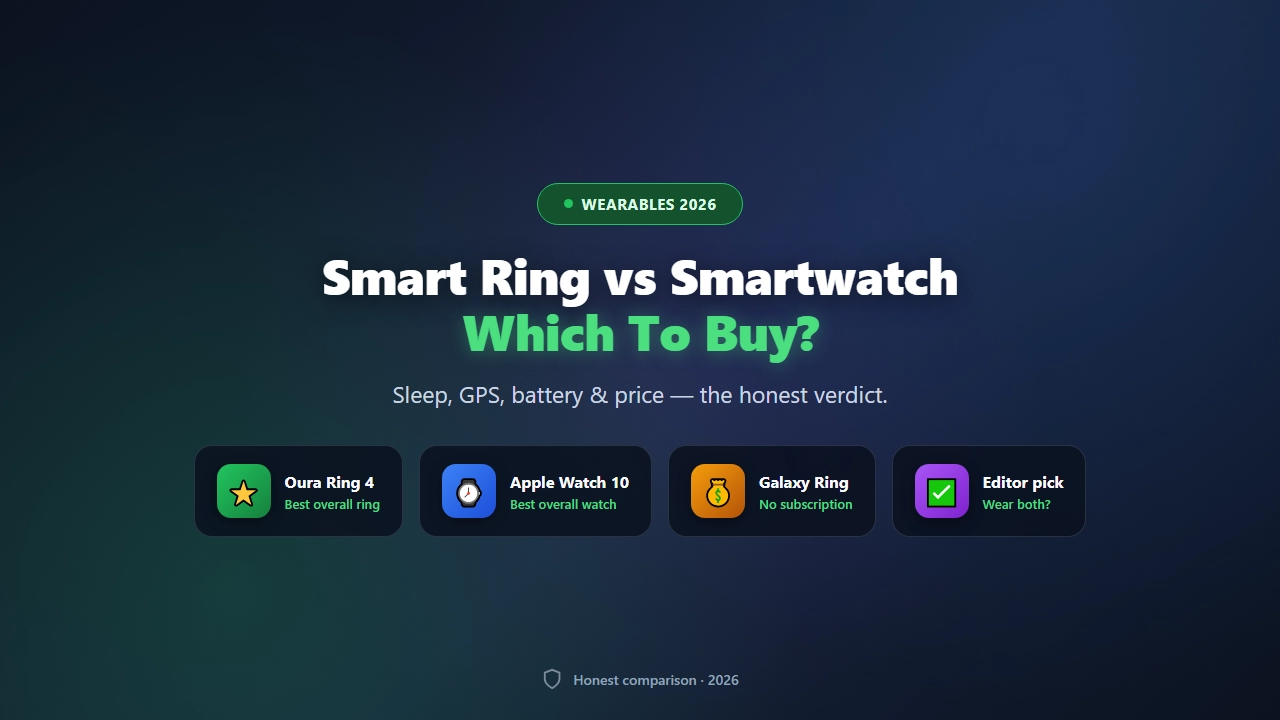
Smart ring vs smartwatch is the question almost every fitness-tracker shopper faces in 2026. Both promise to log your steps, heart rate, sleep, and workouts, but they do it in completely different ways — and the right pick depends on your habits, your budget, and how much you actually want a screen strapped to your wrist all day.
After several years of both categories maturing, the gap has closed in some places and widened in others. Smart rings are now accurate enough for meaningful sleep and recovery tracking, and they are nearly invisible to wear. Smartwatches, meanwhile, have grown into full mini-computers with built-in GPS, apps, notifications, calls, and deep workout metrics. This guide breaks down exactly how the two compare, where each one wins, and which device you should buy this year.
Below we cover how each device tracks your body, head-to-head accuracy, battery life, the best models you can actually buy right now, and a simple five-point buying guide so you can stop second-guessing and choose with confidence.
Smart ring vs smartwatch: the 10-second answer
If you want one sentence: buy a smart ring if your priority is effortless, discreet health and sleep tracking and you never want to think about charging or a screen, and buy a smartwatch if you want GPS, notifications, apps, on-wrist calls, and serious workout data. They are not really rivals so much as different tools — but for a lot of people, only one of them ends up getting worn every single day, and that device is the one worth buying.
The honest reality is that a smart ring will not replace a smartwatch for runners, cyclists, or anyone who wants to leave their phone at home. And a smartwatch is overkill (and annoying) for someone whose only goal is “tell me how well I slept and whether I’m recovered.” Pick based on the job, not on which gadget looks cooler in a product photo.
How each device actually tracks you
A smart ring uses a cluster of optical heart-rate sensors pressed against the inside of your finger. Because your finger skin is thin and the ring sits flush, it gets a clean, steady pulse signal. From that continuous reading it derives resting heart rate, heart-rate variability (HRV), blood-oxygen (SpO2), skin temperature trends, and detailed sleep staging. There are no screens, no speakers, and usually no GPS — the ring is a pure sensor.
A smartwatch carries the same family of optical sensors on the wrist, plus a much larger sensor suite: a multi-axis accelerometer and gyroscope for motion, a built-in GPS chip for location, an altimeter for elevation, and on many models an electrical heart sensor for on-demand ECG and irregular-rhythm alerts. The wrist placement is convenient but moves around more during exercise, which is the main reason wrist-based heart rate can lag during hard intervals.
In short, the ring is a focused health instrument, while the watch is a general-purpose wearable computer that also happens to track health. That single design difference explains almost every trade-off that follows.
Key differences at a glance
Here is the head-to-head on the factors people care about most:
| Factor | Smart ring | Smartwatch |
|---|---|---|
| Form factor | Tiny, jewelry-like, worn on any finger | Larger, worn on wrist, always visible |
| Battery life | 4–8 days per charge | 1–2 days (some Garmin 5–14 days) |
| Screen & notifications | None — silent tracking only | Full display, calls, texts, apps |
| GPS & workouts | No GPS; basic activity only | Built-in GPS, rep counting, sport modes |
| Sleep tracking | Excellent — comfortable all night | Good, but bulkier to sleep in |
| Typical price | $299–$399 + possible subscription | $159–$449, no subscription |
Health and fitness accuracy: who wins?
Accuracy is where the “smart ring vs smartwatch” debate gets nuanced, because it depends entirely on the metric:
Resting heart rate and HRV. The ring often edges out the watch here. A snug finger sensor produces a cleaner signal than a wrist that flexes and shifts, so overnight HRV and resting-HR readings from a good ring are genuinely useful for recovery scoring.
Sleep staging. This is the ring’s home turf. Because it is small and comfortable, people actually wear it every night, and combo data (movement + HR + temperature) lines up well with consumer-grade sleep tracking. A watch can do the same job but is chunkier to sleep in, so compliance drops.
Heart rate during exercise. The watch wins. Wrist-based optical sensors have improved dramatically, and tight watch bands plus motion filtering handle intervals and lifts better than a ring that was never designed for high-intensity HR. For serious training, the watch (or a chest strap) is the safer bet.
Steps and SpO2. Both are close enough for daily trends. Neither should be treated as medical-grade, but for spotting patterns over weeks, both are perfectly adequate.
The takeaway: for passive health and recovery insight, the ring is excellent; for active workout data, the watch is better.
Battery life and charging
Battery is the silent dealbreaker. Most smart rings run 4 to 8 days on a single charge and top up in a small dock in about 20 to 60 minutes. Many people charge while showering and never notice the gap. Smartwatches with bright always-on displays and GPS chew through power fast — a typical Apple or Samsung watch needs a nightly charge, and if you forget, your sleep data is missing.
The exception is Garmin and a few fitness-first watches, which stretch to 5 to 14 days by sacrificing some smart features. If “charge every day” sounds like a dealbreaker, lean ring — or pick a long-battery watch and accept fewer apps.
Best smart rings and smartwatches of 2026
These are the models worth your money this year, with honest positioning rather than hype:
| Device | Price | Best for |
|---|---|---|
| Oura Ring Gen 4 | $349 + $5.99/mo | Best overall ring; best-in-class sleep & recovery |
| Samsung Galaxy Ring | $399 | Best no-subscription ring; great for Galaxy phones |
| Ultrahuman Ring AIR | $349 | Best for biohackers; deep metabolic insights, no sub |
| Apple Watch Series 10 | $399 | Best overall watch; best iPhone integration |
| Garmin Venu 3 | $449 | Best battery life; serious training + 14-day life |
| Samsung Galaxy Watch 7 | $299 | Best Android watch; full smart features, good value |
Oura Ring Gen 4 remains the default recommendation for sleep and recovery, but note the ongoing membership fee — over two years that adds roughly $144 on top of the hardware. Samsung Galaxy Ring removes the subscription and pairs beautifully with Android, though its app ecosystem is younger. Ultrahuman Ring AIR appeals to data nerds who want glucose-adjacent and circadian insights without a paywall.
On the watch side, the Apple Watch Series 10 is the safe pick for iPhone owners, with the deepest app and health ecosystem. The Garmin Venu 3 is the choice if you hate charging and train seriously. The Samsung Galaxy Watch 7 is the strongest Android alternative at a friendlier price, though it still needs a daily top-up.
Who should buy a smart ring (and who should buy a smartwatch)
Buy a smart ring if your main goal is understanding sleep, stress, and recovery without changing your routine. It is ideal for minimalists, people who find watches distracting, and anyone who wants a device they will actually wear 24/7 without thinking about it. It also slips under gloves and looks like normal jewelry.
Buy a smartwatch if you run, ride, lift, or want to leave your phone behind on a workout. You need GPS, turn-by-turn directions, notifications, contactless pay, and the ability to answer a call from your wrist. It is also the better pick for safety features like fall detection and emergency SOS.
A surprising number of people end up with both: a ring for nightly recovery and a watch for daytime training. That is the “no compromise” setup, but it doubles the spend, so most buyers are better served picking the one that matches their dominant use case.
How to choose: a 5-point buying guide
Use this checklist before you spend a dollar:
1. Name your primary goal. Sleep and recovery? Ring. Workouts and connectivity? Watch. Be honest about what you will actually use.
2. Check your battery tolerance. If a nightly charge sounds like a chore, a ring (or a Garmin) spares you. If you already charge earbuds nightly, a watch is no big deal.
3. Do the subscription math. Some rings charge a monthly fee. Multiply it by the years you will keep the device and add it to the sticker price before comparing.
4. Match your phone. Apple Watch is iPhone-only. Galaxy Ring and Galaxy Watch favor Android. Pick the ecosystem you already live in or you will fight the software.
5. Verify fit and comfort. Rings come in specific sizes — most brands ship a free sizing kit first, and you should use it. A loose ring gives bad data; a tight watch band chafes. Comfort is the single biggest predictor of whether you will keep wearing it.





Leave a Comment