
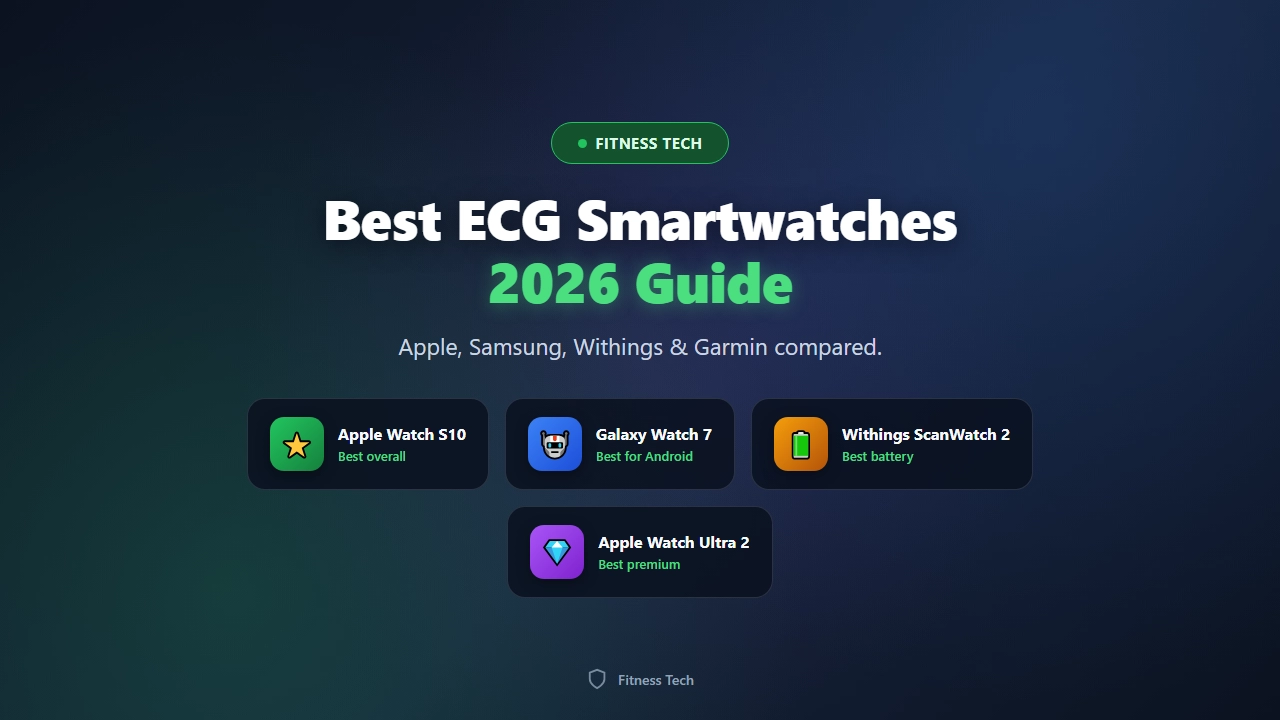
The best ECG smartwatches of 2026 put a medical-grade single-lead electrocardiogram on your wrist for the price of a normal fitness tracker. If you want to catch an irregular heartbeat like atrial fibrillation (AFib) early, an ECG-capable smartwatch is now the most practical tool you can buy, and the 2026 lineup is faster, more accurate, and more comfortable than anything released before it. This guide compares the leading ECG smartwatches side by side so you can choose the right one for your phone, your budget, and your health goals.
An ECG watch is not a replacement for a cardiologist, but it is an genuinely useful early-warning system. The standout models below can record a 30-second rhythm strip on demand, flag possible AFib, and store shareable PDFs you can hand to your doctor. Below we break down the top picks, how the technology works, how accurate it really is, and exactly what to look for before you buy.
The best ECG smartwatches of 2026
We compared the most capable ECG-enabled wearables available this year across accuracy, ease of use, battery life, phone compatibility, and price. These are the six we would actually recommend, each with a clear “best for” use case so you can match the watch to your situation rather than buying on spec sheets alone.
Apple Watch Series 10 — best overall
The Apple Watch Series 10 remains the default recommendation for iPhone users. Its ECG app is FDA-cleared, the electrode is built into the digital crown so you just hold it with a finger, and the rhythm strip is ready in 30 seconds. It also adds AFib History, which estimates how often your heart is in AFib over time, plus a bright, thinner display and faster charging than the Series 9.
Specs: Single-lead ECG, 18-hour battery (up to 36 with low-power mode), watchOS, 42/46mm sizes, water resistant to 50m.
Price: ~$399
Best for: iPhone owners who want the most polished, well-supported ECG experience.
Pros: Fast, reliable ECG; deepest third-party health app ecosystem; excellent display and build.
Cons: Daily charging; locked to iPhone; premium price for the larger size.
Samsung Galaxy Watch 7 — best for Android
For Android users, the Galaxy Watch 7 is the strongest ECG pick. Samsung Health’s ECG and BP monitoring is cleared in many regions, the watch runs Wear OS so it plays nicely with Google services, and the dual-band GPS is excellent for runners. The irregular-heart-rhythm notification works quietly in the background, then prompts an on-demand ECG when it detects something worth checking.
Specs: Single-lead ECG via Samsung Health, ~40-hour battery, Wear OS, 40/44mm sizes, BioActive sensor array.
Price: ~$299
Best for: Android users who want ECG without leaving the Google ecosystem.
Pros: Great value; strong sleep and stress tracking; works with non-Samsung Android phones.
Cons: ECG/BP still region-locked in some countries; still needs near-daily charging.
Withings ScanWatch 2 — best battery life
If daily charging is a dealbreaker, the Withings ScanWatch 2 is the hybrid smartwatch to beat. It looks like a classic analog watch, runs for up to 30 days on a charge, and still packs a medical-grade ECG plus SpO2 and an on-demand rhythm check. Withings has a track record of FDA-cleared health devices, which matters if you care about clinical credibility over flashy features.
Specs: Single-lead ECG, up to 30-day battery, analog + small OLED display, stainless steel case.
Price: ~$349
Best for: People who want heart monitoring without a screen-dominated smartwatch.
Pros: Weeks of battery; discreet, premium design; medical-device heritage.
Cons: Tiny display limits notifications; fewer apps than Apple/Samsung; slower UI.
Fitbit Sense 2 — best for all-day stress and heart health
The Fitbit Sense 2 pairs its ECG app with the best stress-tracking toolkit in the consumer wearables space, including an EDA (electrodermal activity) sensor and continuous skin-temperature tracking. If your goal is understanding the lifestyle factors that affect your heart — sleep, stress, and recovery — it is hard to beat, and the Fitbit app’s trends are genuinely readable.
Specs: Single-lead ECG, ~6-day battery, EDA sensor, SpO2, Google integration.
Price: ~$249
Best for: Users focused on stress, sleep, and holistic heart-health trends.
Pros: Long battery; excellent stress and sleep insights; lower price.
Cons: Some advanced features sit behind a Fitbit Premium subscription; ECG rollout varies by region.
Garmin Venu 3 — best for serious fitness fans
Garmin’s Venu 3 brings ECG support (where cleared) to a watch built for training, not just notifications. You get excellent GPS, advanced running and recovery metrics, and a bright AMOLED screen, plus on-demand ECG and irregular-rhythm alerts. It is the pick for people who run, ride, or lift and want heart screening as one feature among many.
Specs: Single-lead ECG (select regions), up to 14-day battery (AMOLED), full GPS + training metrics.
Price: ~$449
Best for: Athletes and data lovers who want ECG plus deep fitness tracking.
Pros: Multi-day battery; best-in-class fitness analytics; bright display.
Cons: ECG not available in every country; pricier than casual-use watches.
Apple Watch Ultra 2 — best premium and rugged
The Apple Watch Ultra 2 is the same ECG capability as the Series models wrapped in a bigger, brighter, more rugged titanium body with multi-day battery in low-power mode. It is overkill for most people, but if you dive, hike, or simply hate charging, it is the most capable ECG watch Apple makes.
Specs: Single-lead ECG, up to 36-hour battery (72 with low-power), 49mm titanium, 100m water resistance, diving certified.
Price: ~$799
Best for: Outdoor and adventure users who want ECG and extreme durability.
Pros: Longest Apple battery; brightest screen; toughest build.
Cons: Very expensive; large on smaller wrists; iPhone only.
Quick comparison table
| Smartwatch | Best for | Battery | Works with | Price |
|---|---|---|---|---|
| Apple Watch Series 10 | Overall (iPhone) | ~18 hrs | iPhone | ~$399 |
| Samsung Galaxy Watch 7 | Android users | ~40 hrs | Android | ~$299 |
| Withings ScanWatch 2 | Battery life | ~30 days | iPhone & Android | ~$349 |
| Fitbit Sense 2 | Stress & sleep | ~6 days | iPhone & Android | ~$249 |
| Garmin Venu 3 | Fitness tracking | ~14 days | iPhone & Android | ~$449 |
| Apple Watch Ultra 2 | Rugged / premium | ~36 hrs | iPhone | ~$799 |
How an ECG smartwatch actually works
A consumer ECG smartwatch records a single-lead electrocardiogram, meaning it measures the electrical activity of your heart from one angle rather than the 12 angles a hospital machine uses. You open the ECG app, rest your arm, and touch the opposite electrode (usually the watch crown) with a finger. The circuit runs through your body, capturing the timing and strength of each heartbeat. The watch’s algorithm then classifies the rhythm as normal sinus rhythm or possible atrial fibrillation, and lets you export the result as a PDF.
This is genuinely the same kind of signal a clinic uses to screen for AFib, just simplified to one lead. It is excellent at catching a sustained irregular rhythm, and far less useful for rare, fleeting events or for diagnosing structural heart disease.
How accurate are ECG smartwatches, really?
The leading watches are cleared by regulators (FDA in the US, CE/MDR in Europe) for detecting AFib, and several large studies have shown sensitivity above 95% for sustained AFib when used as directed. The bigger limitation is false positives from movement, poor contact, or a naturally variable heart rate, and false negatives for short or intermittent episodes. An “inconclusive” reading is common and usually just means the signal was noisy, not that something is wrong.
The honest takeaway: an ECG watch is a screening tool, not a diagnosis. If it flags AFib more than once, or you have symptoms like palpitations, chest discomfort, or unexplained fatigue, take the PDF to a doctor. If it says normal, that is reassuring but not a free pass to ignore symptoms.
How to choose the right ECG smartwatch
Pick by phone first, then by battery and feature priorities. The single most important rule is compatibility: Apple Watches only pair with iPhones, while Galaxy, Fitbit, Withings, and Garmin work across both platforms. After that, weigh these factors:
Battery life. If you hate charging, the Withings ScanWatch 2 (weeks) or Garmin Venu 3 (days) will suit you far better than an Apple or Samsung watch you plug in nightly.
Region availability. ECG and blood-pressure features are cleared in different countries at different times. Check the manufacturer’s supported-country list for your model before buying, because an “ECG smartwatch” may not have the feature active where you live.
What else you want. Pure heart monitoring favors Withings. Stress and sleep favor Fitbit. Training data favors Garmin. Ecosystem polish favors Apple. There is no single winner, only the best match for you.
Budget. You do not need to spend $800. The Galaxy Watch 7 and Fitbit Sense 2 deliver real, cleared ECG for under $300, and the Apple Watch Series 10 covers most iPhone users at $399.

Leave a Comment