
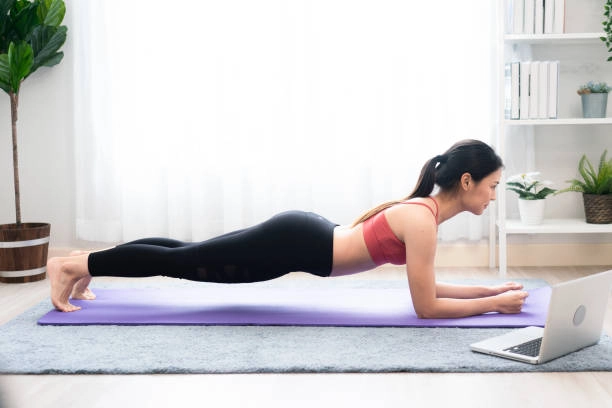
A plank exercise is a popular core-strengthening exercise that requires maintaining a static position similar to a push-up position. The plank exercise will be discussed in detail in this article, along with its history, origins, many advantages, correct forms and variations, common mistakes to avoid, and how to include it in your fitness regimen.
Due to its effectiveness in enhancing overall stability and strengthening the core muscles, the plank exercise has grown in popularity recently. It is an easy-to-do but difficult workout that can be incorporated into any fitness regimen because it can be done anywhere.
What is a Plank Exercise?
A plank exercise is essentially a static hold of the body in a push-up position with the core muscles engaged. The primary goal of this exercise is to engage and strengthen the abdominal muscles (rectus abdominis), oblique muscles, lower back muscles (erector spinae), and other stabilizing muscles such as the glutes and shoulders.
Your core muscles, including your back, abs, and stabilizing muscles, are worked out during the straightforward yet powerful plank exercise.
The History and Origins of the Plank Exercise
Now, let’s take a little trip down memory lane to explore the fascinating history and origins of the plank exercise. Believe it or not, this exercise has been around for centuries, tracing its roots back to ancient civilizations. It was popularized in modern times by Joseph Pilates and has since become a staple in fitness routines around the world. Talk about standing the test of time!
Benefits of the Plank Exercise
There is lot of benefits of plank exercises. Some of the benefits are discussing in the below list.
- Core Strength: One of the most significant benefits of a plank exercise is its ability to strengthen the core muscles, including the abdominal muscles, obliques, and lower back.
- Stability and Balance: Planks improve overall body stability by engaging the core muscles that help maintain balance during various movements and activities.
- Endurance and Stamina: Regular planking can enhance endurance and stamina, particularly in upper-body strength, shoulder stabilization, and core endurance.
- Posture Improvement: By strengthening the core and stabilizing muscles, planks can improve posture and reduce the risk of lower back pain.
- Increased Muscle Tone: Plank exercises can help tone and firm up the abdominal muscles, making them more visible with regular practice.
How to Perform a Proper Plank Exercise?
Performing a plank correctly is crucial for maximizing its benefits while minimizing the risk of injury or improper muscle engagement. Here are the steps to perform a standard plank exercise. Detailed instructions on how to perform a fundamental plank exercise, as well as variations of the exercise for various fitness levels.
- Start in Push-Up Position:
- Begin by getting into a push-up position with your hands shoulder-width apart and your feet hip-width apart.
- Keep your body straight from head to heels, forming a straight line from shoulders to ankles.
- Support Your Weight on Forearms and Toes:
- Place your forearms directly under your shoulders at about a 45-degree angle with your elbows aligned beneath your wrists.
- Position your toes underneath you so that they are spread shoulder-width apart, allowing your body to rest in a stable position.
- Engage Your Core Muscles:
- Keep your core muscles engaged throughout the exercise by drawing your navel towards your spine and maintaining tension in your abdominal muscles.
- Avoid letting your hips sag down or rise up during the hold; keep them level with your shoulders aligned directly above your elbows.
- Hold for a Set Duration:
- Hold this position steadily for a predetermined duration, typically ranging from 10 to 60 seconds. The longer you hold the plank, the greater the intensity and benefits.
- Start with shorter durations and gradually increase as you build up strength and endurance.
Exercises like the plank can aid with posture, stability, and core strength. Along with the glutes, the shoulders, back, and other muscles are also worked by them.
Better overall strength and body control can be achieved by regularly including planks in your training regimen. Never begin a new exercise program without first talking to a fitness expert.
Variations of Plank Exercise
To make planks more challenging or to target specific muscle groups, there are several variations that you can incorporate into your routine:
- Side Plank:
- Begin in a plank position and rotate onto one forearm while keeping the other hand under your hips for support.
- Extend the opposite leg behind you as much as possible, maintaining stability with both arms and legs.
- Elevated Plank:
- Place your hands on a stable surface such as a bench or chair, positioning your body between them at chest level.
- Keep your feet elevated off the ground, engaging more upper-body muscles like shoulders and triceps.
- Plank with Arm Swings:
- Perform standard plank hold while swinging one arm back and forth in front of you, alternating sides every few seconds.
- This variation adds a cardiovascular component to the exercise and engages different muscle groups for increased challenge.
- Plank With Leg Lifts:
- Begin in a standard plank position.
- Lift one leg off the ground while keeping your core engaged, holding it steady for several seconds before lowering back down.
- Perform this movement with alternating legs to target specific muscles and improve balance.
Proper Techniques for the Plank Exercise
Some of proper technique are discussed in below. If you follow them properly, i can get a robust fitness growing.
Basic Plank Technique
Now that you understand the benefits, it’s time to master the proper technique for the basic plank. Start by getting into a push-up position, but instead of resting on your hands, lower down onto your forearms. Keep your body in a straight line from head to toe, engage your core, and hold this position for as long as you can. Easy peasy!
Side Plank Variation
If you’re looking to spice things up, the side plank variation is for you. Lie on your side, stack your feet on top of each other, and prop yourself up on one forearm.
Lift your hips off the ground, maintaining a straight line from head to toe. You’re now working those oblique muscles and feeling like a plank superstar.
Reverse Plank Variation
For a twist on the traditional plank, give the reverse plank variation a try. Sit on the ground with your legs extended in front of you and your hands resting on the ground behind you, fingers pointing toward your feet.
Lift your hips off the ground, creating a straight line from head to heels. Prepare to feel the burn in your glutes, hamstrings, and core!
Common Mistakes to Avoid While Doing
Sagging Hips and Lower Back
Oh, the dreaded sagging hips and lower back! Avoid this common mistake by actively engaging your core and squeezing your glutes. This will let you keep your body in a straight line from your head to your heels, making your plank efficient and injury-free.
Placing Too Much Pressure on the Wrists
Placing too much pressure on them during planks can lead to discomfort and potential injury. Instead, distribute your weight evenly between your forearms and palms, or try using push-up handles or a yoga mat for some extra support.
Not Engaging the Core Muscles
Remember, the core is the star of the show when it comes to planks. Failing to engage those muscles is like going to a party and forgetting to bring the snacks.
To avoid this blunder, focus on pulling your belly button towards your spine and squeezing your abs throughout the entire plank. It’s time to show your core muscles some appreciation!
Now that you’re armed with knowledge about the plank exercise, it’s time to get down on the floor and start planking your way to a stronger, more stable you.
Tips for Incorporating Planks into Your Routine
- Frequency:
- Aim to include planks in your routine 2-3 times per week to allow sufficient recovery time between sessions.
- Consistency is key; regular practice leads to better results and muscle development.
- Progression:
- As you get stronger, gradually increase the duration of each plank set or decrease the frequency if needed.
- Incorporate variations like side planks, elevated planks, or arm swings as you progress.
- Rest and Recovery:
- Ensure proper rest between workouts to prevent overtraining and reduce the risk of injury.
- Include low-intensity activities such as yoga or stretching to aid in recovery.
- Proper Form is Paramount:
- Maintain good form throughout each plank exercise to maximize benefits and minimize the risk of strain or injury.
- If you experience any discomfort, consider adjusting your position or seeking advice from a fitness professional.
Tips for a Successful Plank Exercise
Fitness enthusiasts adore the plank exercise for good reason; it is a cornerstone of core strength and stability.
It’s a quick and easy technique that works for several muscle groups at once to give you a stable core and increase your overall strength.
- Perfect Your Plank Form
- Breath Control
- Gradual Progression
- Consistency and Progress Tracking
- Listen to Your Body
- Cool Down and Stretch
Tips for Progressing and Decreasing Difficulty in Plank Exercises
Once you have mastered the basic plank, it’s time to take it up a notch. Here are some tips to progress and increase the difficulty of your plank exercises:
Increasing Plank Hold Time
To improve your plank hold time, gradually increase the duration of your holds. Start by adding 5-second increments every week or two. Consistency is the key, so don’t rush the process. Before you know it, you’ll be planking like a pro!
Adding Variations and Challenges
To keep things interesting and continue challenging your core muscles, try incorporating different plank variations. Side planks, plank jacks, and planks with leg lifts are just a few examples
The plank exercise is a very efficient and convenient workout that may significantly improve your core strength, stability, and general fitness.
You may consistently push yourself and produce amazing outcomes by implementing the right approaches, variations, and progression tactics.
Remember to focus on maintaining proper form, listen to your body, and gradually increase the difficulty level to avoid injury.
Make the plank exercise a regular part of your regimen and take advantage of the many advantages it provides whether you are a novice or an experienced fitness lover. Start planking today and take your fitness journey to new heights.






Leave a Comment