
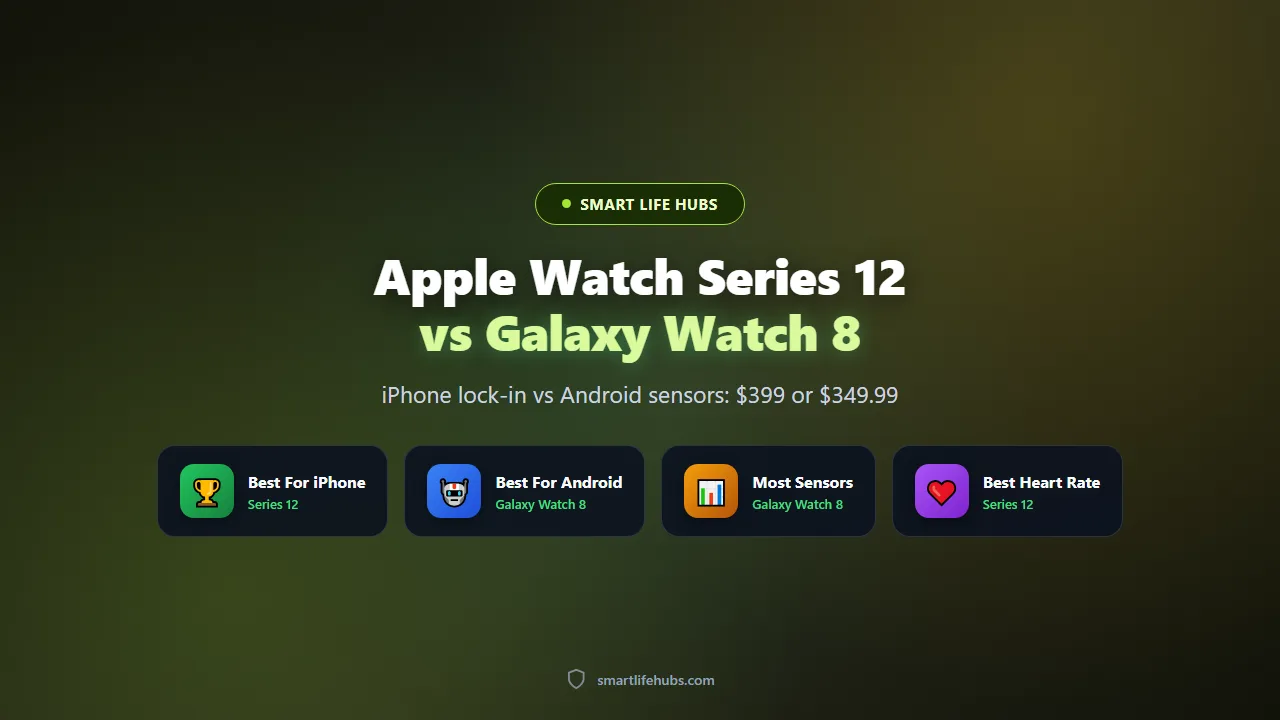
The Apple Watch Series 12 and the Samsung Galaxy Watch 8 are the two best smartwatches you can buy, and they are not really competing with each other. The Series 12 works only with an iPhone. The Galaxy Watch 8 works only with Android, and it works best with a Samsung phone. Both are excellent, both track health well, and both will frustrate you in ways the other does not. This is a comparison about which phone you carry, and only then about the watches.
Apple’s watch costs $399 for the 42 millimetre case and $429 for the 46, and the upgrades this year are concentrated in health sensing. The new Health Sensing System reads heart rate every five seconds instead of every five minutes, and it powers a Readiness score from 0 to 10 that tells you whether to train or rest. Samsung’s watch starts at $349.99 for the 40 millimetre case and $379.99 for the 44, with a sapphire crystal display, dual-frequency GPS, ECG, blood pressure, and body composition, all running Wear OS with Galaxy AI and Gemini on the wrist.
I compared manufacturer specifications, PCMag’s and TechRadar’s testing of the Galaxy Watch 8, PCMag’s and Macworld’s Series 12 testing, and owner reports from both ecosystems. Where a figure is a claim rather than a measurement, I say so. Prices are US street prices as of November 2026, and both watches are discounted during sales.
At a glance
| Criteria | Apple Watch Series 12 | Samsung Galaxy Watch 8 |
|---|---|---|
| Price | $399 (42mm) or $429 (46mm) | $349.99 (40mm) or $379.99 (44mm) |
| Phone compatibility | iPhone only | Android only, best with Samsung |
| Display | Always-on LTPO3 OLED, up to 2,000 nits | 1.34 or 1.47in Super AMOLED sapphire, 3,000 nits |
| Case | Aluminium, titanium, or ceramic | Armor aluminium, 5ATM plus IP68 and MIL-STD-810H |
| Battery | 24 hours rated, 40 to 54.5 hours tested | 30 hours with always-on, 40 without; 26 to 39 tested |
| GPS | L1 GPS, GLONASS, Galileo, QZSS, BeiDou | Dual-frequency L1 plus L5, four systems |
| Health sensors | ECG, blood oxygen, temperature, heart rate, HRV | ECG, blood pressure, body composition, temperature, heart rate |
| Coaching | Readiness score, sleep score, workout views | Galaxy AI, Gemini, energy score, sleep coaching |
| Best for | iPhone owners who want the best integration | Android and Galaxy owners who want the most sensors |
Apple Watch Series 12 vs Samsung Galaxy Watch 8: how they compare
Compatibility and lock-in
This decides everything. The Series 12 pairs only with an iPhone and will not set up with an Android phone at all. The Galaxy Watch 8 pairs with Android phones, but Samsung reserves its best health features for its own devices, and some functions including blood pressure and ECG have historically required a Galaxy phone. If you own an iPhone, the Samsung is not an option. If you own a Galaxy phone, the Apple is not an option. Only if you carry a non-Samsung Android phone does this become a real choice, and in that case the Galaxy Watch 8 still has the edge in sensors while the Apple ecosystem is simply unavailable.
Health sensors
The Series 12 has the better heart rate tracking and the more useful coaching. Its Health Sensing System samples heart rate every five seconds in the background, which Apple says makes it the most accurate heart rate sensing of any wearable, and the Readiness score turns sleep, HRV, vitals, and training load into a 0 to 10 number with four labels that updates through the day. It also has ECG, blood oxygen, wrist temperature, cycle tracking, hypertension notifications, hearing health, and fall and crash detection. The Galaxy Watch 8 has a wider sensor list: ECG, blood pressure, body composition through a bioelectrical impedance sensor, skin temperature, heart rate, blood oxygen, and sleep apnea detection, plus Galaxy AI coaching. The Samsung measures more things. The Apple measures the things you act on more often, and its Readiness score is the more practical daily feature.
Display and build
The Galaxy Watch 8 has the better screen. Its Super AMOLED panel reaches 3,000 nits under sapphire crystal, and the case is thinner than the previous generation at 8.6 millimetres, with a 40 millimetre model at 30 grams and a 44 millimetre at 34 grams. The Series 12 has an always-on LTPO3 OLED at up to 2,000 nits, and the aluminium model uses Ceramic Shield 2, which Apple says is tougher than any other smartwatch glass. The Apple is available in aluminium, titanium, or ceramic, so it has the more premium material options, and its display is still perfectly readable outdoors. For brightness and scratch resistance, the Samsung wins. For case choice and finish, the Apple wins.
Battery and charging
Both watches are daily chargers, and neither is close to a dedicated sports watch. Apple rates the Series 12 at 24 hours with 38 hours in Low Power Mode, and testing landed between 40 and 54.5 hours, with a 15-minute charge returning up to 12 hours. Samsung rates the Watch 8 at 30 hours with the always-on display on and 40 hours with it off, and testing gave 26 hours with always-on enabled and 39 hours with it disabled, with a full charge taking about 80 minutes. Owners report needing two short charge sessions a day to cover sleep tracking and all-day wear. A practical routine is a 15-minute top-up while you shower in the morning and another short charge while you get ready for bed, which keeps the watch on your wrist overnight for sleep staging and back to full by morning. If you use the watch for workouts with GPS, budget more frequent charging, because a long run is the single biggest drain on either battery. The Apple is the more consistent performer, and its fast charging is meaningfully quicker. If you hate charging, neither of these is the right watch, and you should look at a Garmin or an Amazfit. TechRadar’s Galaxy Watch 8 review measured similar endurance and flagged the slow charge time.
GPS and outdoor tracking
The Galaxy Watch 8 has the better satellite hardware, with dual-frequency L1 plus L5 GPS across GPS, GLONASS, Galileo, and BeiDou, which improves accuracy in cities and under tree cover. The Series 12 uses L1 GPS with the same four satellite systems but no dual-frequency support, so it is more prone to drift in difficult environments. Both track workouts, sleep, and daily activity well, and both are rated for swimming. If you run or ride in dense urban corridors or forest, the Samsung has the technical edge, and owners who train in tall city streets report fewer sudden jumps in the mapped route and more consistent pace readings. If you train in open fields or on roads with clear sky, the Apple’s L1 tracking is accurate enough that the gap is barely visible. If you mostly train in open terrain, the difference is hard to notice.
Sleep, stress, and recovery
Both watches track sleep stages, resting heart rate, blood oxygen, and stress, and both will give you a morning summary. The Series 12 adds a sleep score and a Readiness score that combines sleep, HRV, temperature, and training load, and it updates through the day as you move. The Galaxy Watch 8 adds sleep apnea detection, skin temperature, and Galaxy AI sleep coaching that suggests a bedtime and flags interruptions. Neither watch matches a dedicated sleep tracker or a ring for staging detail, but both are good enough to notice a poor week and connect it to your training. If you want a clear morning instruction, the Apple is better. If you want a broader set of overnight signals, the Samsung is better.
Apps, payments, and daily use
The Series 12 has the better app ecosystem and the smoother experience, with watchOS, Apple Pay, and tight iPhone integration including message replies, calls, and Find My. The Galaxy Watch 8 runs Wear OS with the Galaxy Store, Samsung Wallet, and Gemini on the wrist, and its AI features are more ambitious, including Raise to Talk for Gemini. The Apple is the more polished daily companion. The Samsung is the more flexible one for Android owners, and its notifications and third-party app selection are better than they have ever been. If you want the smartwatch that feels like part of your phone, the Apple wins for iPhone owners and the Samsung wins for Android owners, which is another way of saying the ecosystem decides.
Fitness and coaching
Both watches cover the fundamentals well: heart rate, sleep, steps, workouts, and recovery. The Series 12’s Readiness score is the standout feature, and it now competes directly with Garmin’s training readiness, which is a first for Apple. The Galaxy Watch 8 counters with body composition, blood pressure, sleep apnea detection, and Galaxy AI coaching that summarizes trends and suggests workouts. The Samsung gives you more numbers to look at. The Apple gives you a clearer answer about what to do today. If you coach yourself from data, the Samsung is the more interesting device. If you want a simple morning verdict, the Apple is better.
Which one should you buy
Bands, case care, and daily wear
Both watches are rated for swimming, but neither rating covers salt water, soap, or sunscreen, so rinse the case and the band under a tap after the pool or the ocean and dry the sensor area with a cloth. The Samsung’s sapphire crystal is the more scratch-resistant of the two screens, while the Apple’s Ceramic Shield 2 aluminium is tougher than most smartwatch glass but not as hard as sapphire, so a titanium or ceramic Apple is the safer pick if you work with your hands. Bands are where both watches win: the Apple uses its long-running lug system with hundreds of third-party straps, and the Galaxy Watch 8 uses a standard 20 millimetre quick-release, so you can fit almost any aftermarket band with a small adapter. Rotate between two bands if you train daily, because a damp band worn for a week causes the skin irritation owners complain about. Charge on a nightstand rather than on your wrist, since both watches run warmer while charging.
Setup, updates, and long-term ownership
Both need a phone for the initial pairing and about 20 to 30 minutes of setup. The Apple wants an iPhone running a recent iOS, and the Galaxy Watch 8 wants an Android phone with the Galaxy Wearable app, with the health features at their fullest on a Samsung device. Plan for monthly software updates on either watch, and expect a larger update once a year that can temporarily change battery life for a week. Battery health degrades over time on both, and neither brand makes the battery a user-replaceable part, so treat the watch as a three-to-four-year device. If you buy the cellular version, remember that the carrier plan adds a monthly cost on top of the hardware.
Common mistakes buyers make
The biggest mistake is buying for the phone you have today without checking the phone you will have in two years, because neither watch moves between ecosystems. The second is ignoring band fit: a watch worn loose gives worse heart rate and SpO2 readings than one worn snug, and owners who complain about bad sleep data are usually wearing it too loose. The third is leaving the always-on display enabled when battery life matters, since that single setting costs several hours on both watches. The fourth is trusting one abnormal reading without re-taking it with the watch still and the band tight. The fifth is paying for the larger case when the smaller one fits, since the bigger case adds weight and can sit awkwardly on a smaller wrist.
Who should skip both
Skip both if you want a week or more of battery life, because that is a Garmin or an Amazfit decision. Skip both if you want a rugged watch for contact sport, since neither case is designed to be hit. Skip both if you are buying for a child or an older relative who will not wear a daily charger. Skip the Galaxy Watch 8 if you own an iPhone, and skip the Apple Watch if you own an Android phone, because neither pairs across that line. Skip the cellular models if you never leave your phone behind, since the plan cost buys you little. And skip both if you already own a recent working model, because the yearly upgrade is small enough to wait out.
Buy the Apple Watch Series 12 if you own an iPhone. It is the best smartwatch for iPhone owners, with the most accurate heart rate tracking Apple has made, a genuinely useful Readiness score, ECG, and the best app ecosystem in wearables. The only question is whether to spend $399 or $799 on the Ultra 4.
Buy the Samsung Galaxy Watch 8 if you own an Android phone, especially a Galaxy. It has a brighter sapphire display, dual-frequency GPS, ECG, blood pressure, body composition, and Gemini on the wrist for $349.99. It suits Android owners who want the most health sensors and the best screen, and who accept charging every day or two.
Neither is right if you want long battery life. The Garmin Forerunner 965 at $449.99 and the Amazfit Balance 3 at $369.99 both run weeks on a charge and cover training and maps for less. Both watches here are smartwatches first, and their batteries reflect that. For a broader look at the category, our fitness tracker guide covers all price bands, and our Apple Watch Series 12 review goes deeper on the Apple.
Do not switch ecosystems for the hardware. The Galaxy Watch 8 will not pair with an iPhone, and the Series 12 will not pair with Android. If you are planning to change phones, choose the watch that matches the phone you will keep, not the one you have now.
Think about the exit cost before you switch. Leaving either ecosystem means losing your app purchases, your watch faces, and in the Apple case your health data history, which does not export cleanly. If you have years of data in Apple Health or Samsung Health, that history is worth more than the hardware savings of switching, and both companies know it.
Ask which health features you will actually open. The Samsung measures blood pressure and body composition, which the Apple does not, but both require regular use to be useful. The Apple’s Readiness score is used every morning by most owners because it is one number with a clear instruction. Match the sensor to a habit you already have.
Frequently asked questions
Frequently Asked Questions
6Can the Galaxy Watch 8 work with an iPhone?
No. The Galaxy Watch 8 is an Android watch and does not pair with the iPhone. Apple Watch models do not pair with Android phones either, so the phone you own decides which ecosystem you can buy into.
Is the Apple Watch Series 12 better than the Samsung Galaxy Watch 8?
For iPhone owners, yes, because the Samsung is not an option. For Android owners, the Samsung has the brighter sapphire display, dual-frequency GPS, ECG, blood pressure, and body composition at a lower price, while the Apple offers the better heart rate tracking and the more useful Readiness score.
How long does the Galaxy Watch 8 battery last?
Samsung rates it at 30 hours with the always-on display enabled and 40 hours with it disabled. PCMag measured 26 hours with always-on and 39 hours without on the 40 millimetre model, and owners report needing two short charges a day to cover all-day wear plus sleep tracking.
Does the Apple Watch Series 12 have blood pressure monitoring?
No. It offers ECG, blood oxygen, wrist temperature, heart rate, HRV, cycle tracking, and hypertension notifications, but not on-demand blood pressure. The Galaxy Watch 8 has ECG, blood pressure, and body composition, though blood pressure features depend on region and, in some markets, on using a Galaxy phone.
Which watch has better heart rate accuracy?
The Apple Watch Series 12. Its Health Sensing System samples heart rate every five seconds in the background rather than every five minutes, and Apple says it is the most accurate heart rate sensing of any wearable. Both watches are good enough for daily training and sleep, and both struggle equally during maximal lifting and intervals.
Can I make calls on either watch?
Yes. The Series 12 offers a GPS plus cellular model with calls, messages, and streaming without the phone nearby. The Galaxy Watch 8 has Bluetooth calling from the wrist on all models and an optional LTE version for use away from the phone.
The bottom line
Buy the Apple Watch Series 12 if you own an iPhone: $399, the best heart rate tracking Apple has made, a Readiness score that competes with Garmin, ECG, and the most polished smartwatch experience available. Buy the Samsung Galaxy Watch 8 if you own an Android phone: $349.99, a 3,000-nit sapphire display, dual-frequency GPS, ECG, blood pressure, and body composition, with Gemini on the wrist. The decision is your phone before it is either watch, and if battery life matters more than apps, a Garmin or an Amazfit will serve you better than both. Which ecosystem are you locked into? Tell us in the comments.

Leave a Comment