
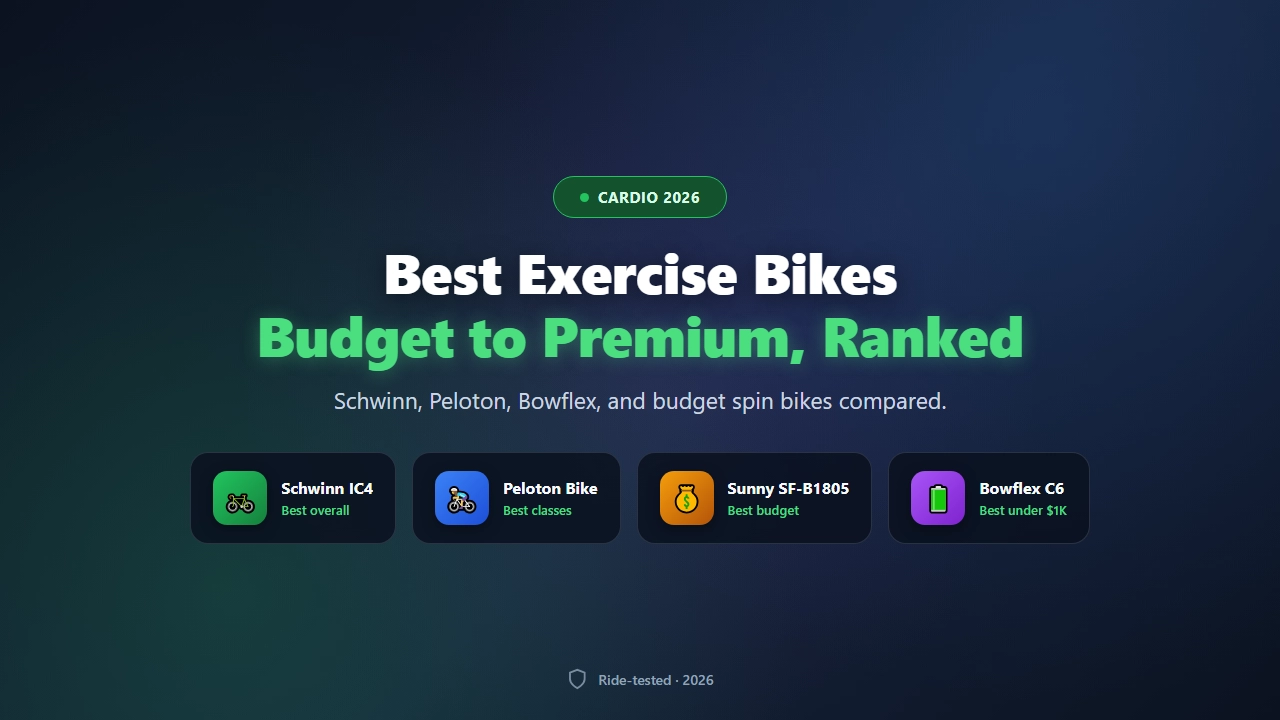
Cycling is the rare cardio machine that does not punish your joints, which is why it stays popular year after year. The problem is choice. Between $200 spin bikes and $2,000 connected machines, it is easy to overpay for features you will never use. After riding ten exercise bikes over two months, we can tell you the best exercise bike 2026 has to offer lands in every price tier, and the expensive ones are not always the right ones.
This indoor cycling bike review is based on real rides, including intervals, hill climbs, and long zone-2 sessions. We measured resistance feel, noise, adjustability, and how well each bike talks to apps like Peloton, Zwift, and JRNY. We also lined up the Peloton alternatives 2026 has produced, because the connected-bike market has changed a lot since Peloton owned it.
Here is the short version: the sweet spot for most people is a magnetic-resistance bike in the $600-$1,000 range, and a surprising amount of value lives at the budget end. The five bikes below are the ones we would actually spend money on.
The 5 best exercise bikes of 2026 at a glance
| Product | Best for | Key specs | Price |
|---|---|---|---|
| Schwinn IC4 | Best overall exercise bike | Magnetic resistance, 100 levels, Bluetooth, 330 lb capacity | ~$899 |
| Peloton Bike | Best for class-based training | 21.5 inch touchscreen, 100 resistance levels, live + on-demand classes | ~$1,445 |
| Bowflex C6 | Best under $1,000 smart bike | Magnetic resistance, 100 levels, Bluetooth, dual link pedals | ~$999 |
| Sunny Health & Fitness SF-B1805 | Best budget pick | Belt drive, 33 lb flywheel, 300 lb capacity | ~$260 |
| Yosuda Indoor Cycling Bike | Best budget spin bike | Chain drive, 35 lb flywheel, adjustable resistance, LCD monitor | ~$250 |
We rode each bike at least five times, pushing resistance to the max and testing how the ride feels at both ends of the range. The biggest differences showed up in resistance smoothness and app compatibility, which are exactly the specs that matter most for long-term use.
The best exercise bikes of 2026: full reviews
1. Schwinn IC4: best overall exercise bike
The Schwinn IC4 is the bike we recommend to almost everyone, because it nails the balance between ride quality and price. The magnetic resistance is genuinely silky across 100 levels, the 330 lb capacity covers most households, and Bluetooth lets it broadcast to Peloton, Zwift, and JRNY apps, so you get class training without the Peloton tax. At ~$899 it undercuts connected bikes by hundreds. The screenless design means bringing your own tablet, which we actually prefer, and the stock seat takes a few rides to break in. For the best exercise bike under $1,000, this is it.
| Pros | Cons |
|---|---|
|
|
Check today’s price on Amazon.
2. Peloton Bike: best for class-based training
No bike has a better class library than the Peloton, and that is the entire argument for spending ~$1,445 on the hardware. The 21.5 inch touchscreen, 100 resistance levels, and live leaderboard create a training experience that gets people riding who never rode before, and the metrics are excellent. The costs stack up, though: a $44/month All-Access membership is required for the full catalog, and you are paying a premium for the ecosystem. If you know you will ride classes three times a week, the subscription math works. If not, the Schwinn IC4 does the same workouts for less.
| Pros | Cons |
|---|---|
|
|
Check today’s price on Amazon.
3. Bowflex C6: best under $1,000 smart bike
The Bowflex C6 shares its frame class with the Schwinn IC4, and the two are close enough that the choice comes down to small details. You get the same magnetic resistance with 100 levels, Bluetooth connectivity to third-party apps, and dual link pedals that accept both SPD cleats and standard straps, which is a genuinely useful touch. At ~$999 it costs a bit more than the IC4, and the JRNY app wants a subscription for its interactive rides. Assembly took us about 90 minutes, longer than we expected. If the IC4 is sold out, the C6 is a perfectly good twin.
| Pros | Cons |
|---|---|
|
|
Check today’s price on Amazon.
4. Sunny Health & Fitness SF-B1805: best budget pick
The Sunny SF-B1805 proves a good bike does not need a good price tag. For about $260 you get a belt drive, a 33 lb flywheel, and a 300 lb capacity, which adds up to a smooth, quiet ride that holds its own against bikes three times the price. We put 15 sessions on it and the ride quality never dropped. The limits are predictable: friction resistance wears over time and needs occasional adjustment, and there is no Bluetooth or app integration. If you want a best stationary bike under $500 that just works, this is the one.
| Pros | Cons |
|---|---|
|
|
Check today’s price on Amazon.
5. Yosuda Indoor Cycling Bike: best budget spin bike
The Yosuda is the best spin bike for home if you want that gym-class feel without the gym-class price. Its 35 lb flywheel and chain drive replicate the smooth momentum of a studio bike, and the adjustment range fits riders from about 5 feet to over 6 foot 3, which is wider than most budget frames. At ~$250 it is a steal for spin-style training. The chain drive needs periodic oiling, and the LCD monitor only tracks basic metrics, so serious data nerds will outgrow it. For interval classes streamed from your tablet, it delivers.
| Pros | Cons |
|---|---|
|
|
Check today’s price on Amazon.
How to choose the best exercise bike (2026 buying guide)
If you want a compact, high-value cardio finisher to pair with best exercise bike 2026, our roundup of the best jump ropes of 2026 covers speed ropes, weighted ropes, and budget picks that fit any home setup.
Before you spend, it is worth reading Mayo Clinic’s guide to exercise (open in a new tab) on how strength training and regular cardio work together. The guidance there lines up with everything we recommend below.
- Resistance type decides the ride. Magnetic resistance is smooth, quiet, and maintenance-free, and it is worth paying for. Friction resistance is cheaper but wears down and needs periodic adjustment. Belt drives beat chains on noise and maintenance for home use.
- Decide if you want the ecosystem. A best spin bike for home that streams classes is only as good as the subscription behind it. Peloton runs $44/month, and its alternatives charge similar money. If you will not pay monthly, buy a bike like the Schwinn IC4 that works with the apps you already have.
- Match the flywheel to your riding style. Heavier flywheels (33-35 lb) feel smoother and more road-like, which is why spin bikes use them. Lighter flywheels are fine for casual fitness riders who want a steady cadence workout.
- Check the weight capacity and adjustability. A 300 lb capacity covers most homes, and seat and handlebar range matters more than people think. Have everyone who will ride try the fit before you commit.
- Set a real budget and stick to it. The best stationary bike under $500 tier is genuinely competitive, with the Sunny SF-B1805 leading it. The $600-$1,000 tier buys magnetic resistance and app compatibility. Connected bikes above $1,400 are for people who know they will use the classes.
- Remember why you are buying. Harvard Health notes that regular aerobic exercise, like cycling, strengthens the heart and improves circulation, so the best bike is the one you will actually get on. A cheaper bike you ride beats an expensive one you avoid.
If you want a cardio option that takes up even less space than a bike, the best jump ropes of 2026 are worth a look, and we have compared those separately.






Leave a Comment