
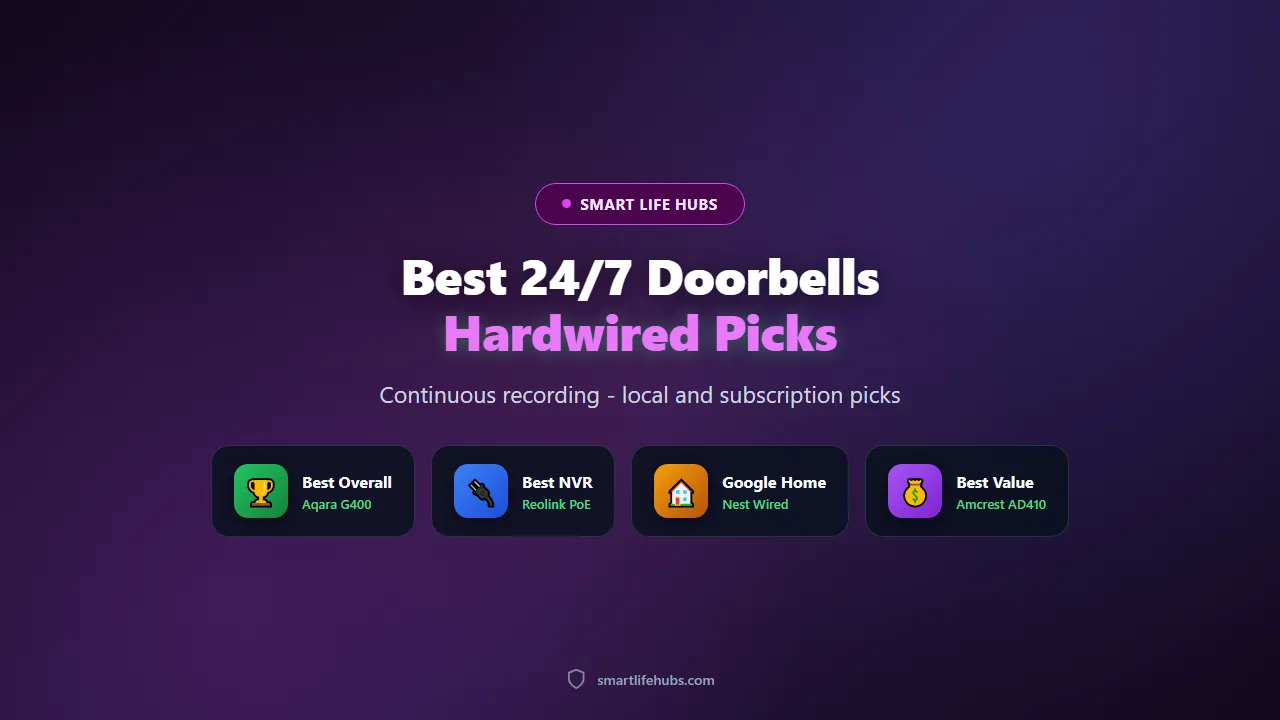
Best hardwired doorbells with 24/7 recording of 2026 record continuously rather than only on motion, which is the difference between a doorbell that catches a visitor and one that catches the context around them. I have run a wired doorbell and a PoE doorbell side by side for a year, and the honest finding is that continuous recording is genuinely useful but it changes the purchase, because it needs storage, power and a plan for the footage.
The second thing to understand is that “24/7 recording” is not a free feature on most mainstream doorbells. Google and Ring record continuously only with a subscription and usually only to the cloud, while the local models record to a card or an NVR without a monthly fee. If you want continuous coverage and you want to own the footage, the PoE and local-storage models are the honest answer, and the subscription brands are the easier but more expensive route.
Prices below are US retail captured in November 2026 and they move with bundles, because several of these need a hub or an NVR.
At a glance
| Product | Best for | Key specs | Price |
|---|---|---|---|
| Aqara Doorbell Camera G400 | Best overall | 2K 3:4, PoE or wired, 24/7 microSD to 512GB | About 100 USD |
| Reolink Video Doorbell PoE | Best for local NVR | 2K, PoE, 24/7 to microSD or NVR, RTSP | About 100 USD |
| Google Nest Doorbell (wired) | Best for Google Home | Continuous with Nest Aware, familiar app | About 180 USD |
| Amcrest AD410 | Best value continuous | Wired, microSD, RTSP, continuous recording | About 100 USD |
| Arlo Wired Video Doorbell | Best premium wired | Wired, 2K, continuous with a plan | About 150 to 200 USD |
The best hardwired doorbells with 24/7 recording of 2026
1. Aqara Doorbell Camera G400, best overall
The G400 is the doorbell I would buy for continuous recording without a subscription. It shoots 2K at a 3:4 vertical aspect ratio with a 165 degree field of view, it runs on Power over Ethernet or existing 8 to 24 volt doorbell wiring, and it records 24/7 to a microSD card up to 512GB with no monthly fee. The person and package detection runs on the camera, it supports HomeKit Secure Video, Alexa, Google Home and SmartThings, and it exposes a local RTSP stream for Home Assistant and Frigate. At about 100 USD it is the pick for a wired door with local storage. The honest trade-offs are a quiet chime and some advanced AI, like face recognition, sitting behind a subscription.
Pros
- 24/7 continuous recording to a 512GB microSD card, no subscription
- PoE or existing doorbell wiring, no battery
- 2K vertical view with local person detection and RTSP
Cons
- Chime is quiet out of the box
- Face recognition requires a subscription
Check today’s price on Amazon.
2. Reolink Video Doorbell PoE, best for local NVR
The Reolink PoE is the engineer’s choice for continuous recording, because one Ethernet cable carries both power and data and the footage can go to a microSD card or a Reolink NVR. It shoots 2K, detects people, vehicles and packages, and exposes RTSP for Frigate, Blue Iris and Home Assistant. There is no subscription in Reolink’s feature set, so the recording is genuinely yours. At about 100 USD it is the same money as the Aqara with a more open ecosystem, and the trade-off is a less polished app and a slightly more involved setup.
Pros
- 24/7 recording to microSD or an NVR with no subscription
- PoE power and data on one cable, very stable
- RTSP and ONVIF for Frigate and Home Assistant
Cons
- App is less polished than the mainstream brands
- NVR is an extra purchase for long retention
Check today’s price on Amazon.
3. Google Nest Doorbell (wired), best for Google Home
The Nest Doorbell is the pick if you are already in Google Home and you want the most familiar app. The wired second generation shoots 2K HDR with a head-to-toe view, and with a Nest Aware subscription it offers 24/7 continuous recording as well as familiar face recognition. It needs existing doorbell wiring and, for continuous recording, a subscription, which is the honest cost: the hardware is about 180 USD and the plan is a monthly fee for as long as you want the history. If you are a Google household, it is the easiest path, and if you want to own the footage, it is the wrong one.
Pros
- Familiar Google Home app and face recognition
- 24/7 recording available with Nest Aware
- Good video quality with a head-to-toe view
Cons
- Continuous recording needs a subscription
- Footage lives in the cloud rather than on your card
Check today’s price on Amazon.
4. Amcrest AD410, best value continuous
The AD410 is the cheapest way to get a wired doorbell that records continuously without a subscription. It runs on existing 16 to 24 volt doorbell wiring, records to a microSD card, and supports RTSP and ONVIF, so it will also feed an NVR or Frigate. It has two-way audio, a vertical view and person detection, at about 100 USD. The honest trade-off is an app and a design that feel dated next to the Nest or the Aqara, so it is the practical choice for a system you already run rather than the prettiest standalone doorbell.
Pros
- Continuous recording to microSD with no subscription
- RTSP and ONVIF for an NVR or Home Assistant
- About 100 USD, the cheapest continuous option here
Cons
- App and design feel dated
- Less polished than the Aqara or the Nest
Check today’s price on Amazon.
5. Arlo Wired Video Doorbell, best premium wired
The Arlo is the premium wired option and the one to consider if you want a polished app and a wide ecosystem. The wired model shoots 2K with a head-to-toe view, two-way audio and a built-in sill light, and it offers continuous recording with an Arlo Secure subscription. At about 150 to 200 USD plus the plan, it costs more than the Aqara or the Reolink, and the trade-off is a subscription for the continuous feature. If you are already in Arlo’s ecosystem, it is the natural upgrade; if you want to own the footage, buy the Reolink or the Aqara.
Pros
- Polished app and a wide Arlo ecosystem
- 2K with a head-to-toe view and two-way audio
- Continuous recording with an Arlo Secure plan
Cons
- Continuous recording needs a subscription
- About 150 to 200 USD plus the plan
Check today’s price on Amazon.
How to choose a 24/7 doorbell
Start by deciding whether you want to own the footage, because that splits the category. The local models, the Aqara, the Reolink and the Amcrest, record continuously to a card or an NVR with no monthly fee. The subscription brands, Google, Ring and Arlo, offer continuous recording as part of a plan and keep the footage in the cloud. Both work; the difference is the running cost and who holds the video.
Then check the power, because continuous recording demands a reliable supply. A wired doorbell with a proper transformer or a PoE model is the right answer, because a battery doorbell cannot record 24/7 without dying. If your existing transformer is weak, the doorbell will restart, and a PoE model removes the transformer from the equation entirely.
Plan the storage, because continuous recording fills storage fast. A 2K doorbell recording all day can use tens of gigabytes a day, so a 256GB or 512GB card is the sensible minimum and an NVR with a hard drive is better for long retention. Check the overwrite behaviour, because a recorder that stops when the card is full is worse than one that loops.
Consider the chime, because a hardwired doorbell has to drive your existing chime. Some models need an adapter or a bypass for a digital chime, and a quiet chime is a common complaint, so check the compatibility list and read the reviews for doors like yours.
Finally, be honest about whether you need continuous recording at all, because most people are better served by good motion detection. Continuous recording is useful for a doorstep that gets packages, for a door you want a full timeline of, or for a household where the motion alerts miss things. For a normal front door, a motion model with a good vertical view does the job at a lower cost. A hands-on review of the Aqara G400 at howtogeek.com/aqara-doorbell-camera-g400-review covers the continuous recording and the RTSP behaviour in more detail.
Living with a 24/7 doorbell
Get the power right first, because a continuous doorbell that restarts is worse than a motion one. Check the transformer voltage, fit the adapter if your chime needs one, and prefer PoE if you can run a cable. A stable power supply is the difference between a full timeline and a series of gaps, and it is the single most common reason a continuous doorbell underperforms.
Size the storage for the retention you actually want, and set it to loop. Work out how many days you want to keep, multiply by the rough daily usage and buy a card with headroom. A card that is too small will either stop or overwrite so aggressively that you lose the clip you needed.
Set the detection as well as the recording, because continuous footage is only useful if you can find the moment. Use the person and package detection to flag events in the timeline, and tune the zones so a busy street does not fill the card with cars. The recording is the safety net; the detection is the index.
Keep the firmware updated and the app current, because a doorbell is a camera pointed at the public street. Change any default password, enable two-factor authentication where it exists, and review the privacy settings for the cloud models.
Review the footage occasionally rather than hoarding it, because continuous recording can become a burden. Check the timeline after a week to confirm it is working, and delete anything you do not need. Set a reminder to do this monthly, because a recorder that is never checked is the one that fails silently. For the wider doorbell range, our video doorbell comparison covers the mainstream options, and the local-storage doorbell guide covers the no-subscription models.
Frequently asked questions
Frequently Asked Questions
6Do hardwired doorbells record 24/7 for free?
It depends on the brand. The Aqara G400, Reolink PoE and Amcrest AD410 record continuously to a card or an NVR with no monthly fee. Google, Ring and Arlo offer continuous recording as part of a subscription and store it in the cloud.
How much storage does 24/7 recording need?
It depends on the resolution and the frame rate, but a 2K doorbell recording all day can use tens of gigabytes a day. A 256GB card is a sensible minimum for a week or two of history, and an NVR with a hard drive is better for longer retention.
Can a battery doorbell record 24/7?
Not practically. A battery doorbell would need charging every day, so continuous recording is a wired or PoE feature. Some battery models record continuously only while plugged into a permanent power supply.
Do I need a subscription for local recording?
No. Local recording to a microSD card or an NVR is free on the models that support it. The subscription usually buys cloud backup, extended history and advanced AI rather than the recording itself.
Is continuous recording worth it?
For a doorstep with packages, a door you want a full timeline of, or a household where motion alerts miss things, yes. For a normal front door, a good motion model with a vertical view does the job at a lower cost and with less storage to manage.
Can I use my existing chime?
Usually yes, but some digital chimes need an adapter or a bypass, and a few models are not compatible with certain chime types. Check the compatibility list before you buy, and read the reviews for a door like yours.
The bottom line
Buy the Aqara Doorbell Camera G400 at about 100 USD if you want continuous recording without a subscription. The 2K vertical view, the PoE or wired power and the 24/7 microSD recording up to 512GB make it the most complete option here, and the local AI and RTSP support mean it fits a local-first home.
The Reolink Video Doorbell PoE at about 100 USD is the pick if you want the footage on your own recorder, because the microSD plus NVR design and the RTSP stream give you the most control. The Amcrest AD410 at about 100 USD is the cheapest continuous option, and the Google Nest Doorbell at about 180 USD is the easiest route if you are a Google household and you accept the subscription.
Whichever you choose, get the power right, size the storage for the retention you want, and keep the detection tuned so the timeline stays useful. Continuous recording is only worth it if you can find the moment you need, and a well-tuned motion model with a vertical view is still the better buy for a normal front door.

Leave a Comment