
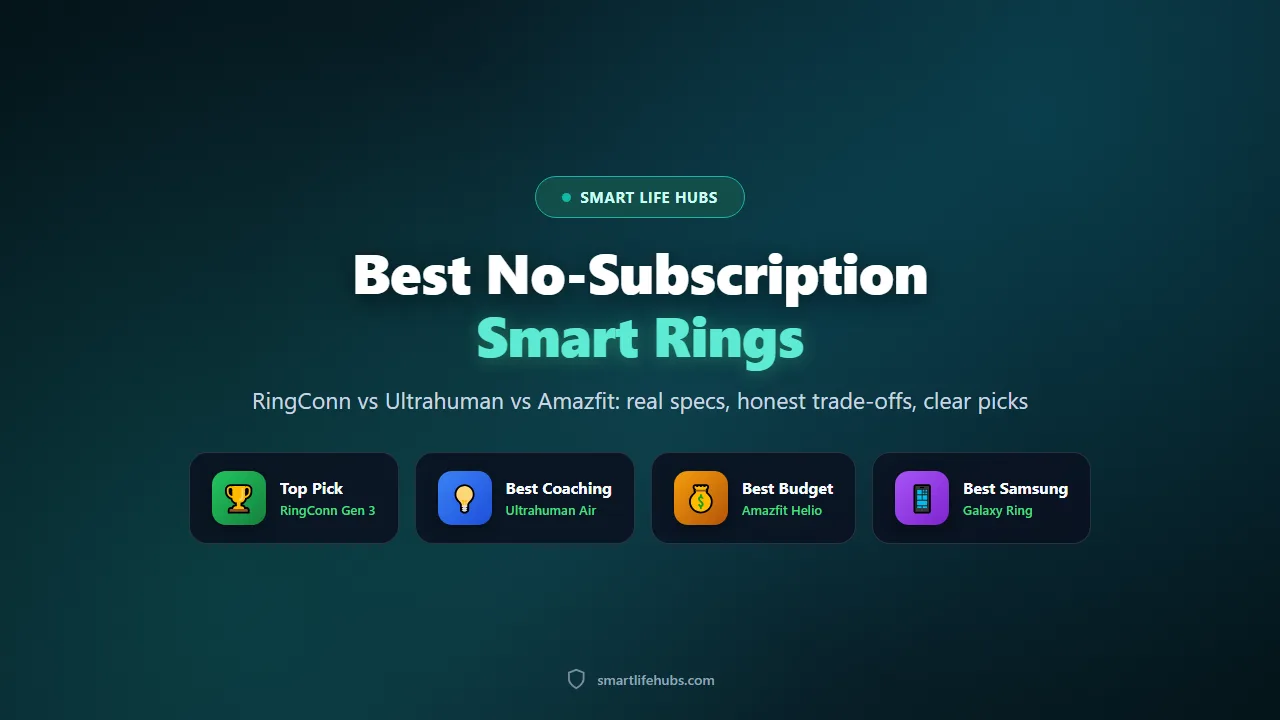
The best no subscription smart rings of 2026 give you sleep staging, heart rate variability, blood oxygen, and skin temperature without a monthly bill eating into your data. I compared five rings that charge you once and then stay out of your wallet, and the short version is this: buy the RingConn Gen 3 if you want the longest battery and the most complete sensor package, buy the Ultrahuman Ring Air if you want proactive coaching that tells you when to drink coffee, and buy the Amazfit Helio Ring if $199 is your ceiling.
Here is why the subscription question matters more than the spec sheet. An Oura Ring 5 costs $399 up front plus $5.99 a month. Over three years that is $615. A RingConn Gen 3 costs $349 and stays $349. The gap is $266, which is enough to buy a second ring for your partner. Every ring on this list tracks the same core metrics. The difference is what happens after you unbox it: does the app keep working for free, or does it start asking for your card?
I looked at manufacturer specs, published reviews from PCMag, Trusted Reviews, and Tom’s Guide, and long-term owner reports across Reddit and Amazon. Where a number is a claim rather than a measurement, I say so. Prices are typical US street prices as of November 2026 and fluctuate a little, but the ranking holds.
At a glance
| Product | Best for | Key specs | Price | 3-year cost |
|---|---|---|---|---|
| RingConn Gen 3 | Best overall: battery + sensors | Titanium, 14-day battery, IP68/10ATM, vibration alerts, vascular trends | $349 | $349 |
| Ultrahuman Ring Air | Best coaching: circadian + caffeine | Titanium, 4-6 day battery, 100m water, 2.4g, circadian rhythm guidance | $349 | $349 |
| Amazfit Helio Ring | Best budget: under $200 | Titanium, 4-7 day battery, 10ATM, EDA stress sensor, 3 sizes only | $199 | $199 |
| Samsung Galaxy Ring | Best for Samsung phone owners | Titanium, 7-day battery, 10ATM/IP68, Energy Score, charging case | $299 | $299 |
| Circular Ring Slim | Slimmest: 2.2mm fashion ring | Stainless steel, 3-5 day battery, 5ATM, temperature sensor, 2g | $320 | $320 |
The best no-subscription smart rings of 2026
1. RingConn Gen 3, best overall
The Gen 3 is the ring I would buy with my own money. It lasts 11 to 14 days on a charge with vibration alerts off, and 10 to 12 days with them on, which means you charge it roughly once every two weeks instead of every few days. The included wireless charging case holds over 150 days of backup power, so a month-long trip needs no wall socket. It tracks sleep stages, HRV, blood oxygen, skin temperature, stress, and steps, and the new Vascular Trend feature adds blood pressure pattern insights that no other ring in this price range offers. The sleep apnea pattern detection carried over from Gen 2 and works without a subscription. At 2.3mm thick and 2.5 to 3.5 grams depending on size, it is barely noticeable on your finger. The trade-off is automatic activity detection: it is spotty compared to Oura, so you will occasionally need to manually log a workout. The app is functional but not as polished as Ultrahuman’s or Oura’s.
- Pros: 14-day battery with charging case; vascular health and sleep apnea insights free; IP68 and 10ATM water rating
- Cons: Automatic workout detection is unreliable; app UX lags behind Oura and Ultrahuman
Check today’s price on Amazon.
2. Ultrahuman Ring Air, best coaching
The Ring Air is the lightest ring here at 2.4 grams, and it is the only one that tells you when to stop drinking coffee. The circadian rhythm feature suggests your optimal caffeine window based on your sleep data, and the Movement Index nudges you to break up sedentary time. That proactive coaching is genuinely useful in a way that a passive readiness score is not. It tracks sleep, HRV, SpO2, skin temperature, stress, and over 100 workout modes, and it syncs with Apple Health and Google Health Connect. The battery is the weak point: 4 to 6 days in Turbo Mode, up to 8 in Chill Mode, which means you are charging it twice a week. The optional Ultrahuman Max subscription ($99.99/year) unlocks deeper PowerPlug insights, but the core experience is complete without it. At $349 with five finishes at the same price, there is no gold-tier upsell like Oura’s $499 finish.
- Pros: Lightest at 2.4g; circadian and caffeine coaching no other ring offers; Apple Health and Google Health Connect sync
- Cons: 4-6 day battery means frequent charging; optional Max subscription for deeper insights
Check today’s price on Amazon.
3. Amazfit Helio Ring, best budget
Amazfit cut the Helio Ring from $299 to $199 in 2026 and made all software free for life, including the Zepp Aura Premium tier that used to cost extra. At that price it is the cheapest established-brand smart ring with no subscription, and it still tracks sleep stages, HRV, blood oxygen, skin temperature, stress, and readiness. The unusual sensor here is EDA (electrodermal activity), which measures skin conductance for a more nuanced stress picture than HRV alone. Battery runs 4 days at typical polling and up to 7 if you reduce heart rate sampling. The catch is sizing: the Helio only comes in sizes 8, 10, and 12. If your finger is not one of those three, this ring does not exist for you. The Zepp app is functional but less polished than Oura’s or Ultrahuman’s, and sleep-stage detection is less validated in independent comparisons. If you already own an Amazfit watch, the data merges into one profile rather than competing, which is a genuine ecosystem advantage.
- Pros: $199 with all features free for life; EDA stress sensor unique at this price; merges with Amazfit watch data
- Cons: Only 3 sizes (8, 10, 12); sleep staging less validated than premium rings
Check today’s price on Amazon.
4. Samsung Galaxy Ring, best for Samsung owners
If your phone is a Samsung Galaxy, this is the ring that fits your life with zero friction. The Energy Score folds into Samsung Health alongside your Galaxy Watch data, the double-pinch gesture dismisses alarms and triggers your camera, and Find My Ring locates it if you take it off at the gym. Battery is a genuine 7 days in testing, and the included charging case holds about 1.5 extra charges, extending total time off the wall to roughly 17 days. It is the lightest premium ring at 2.3 grams for the smallest size. The price dropped from $399 to $299 on Samsung’s US site in late 2026, making it the cheapest major-brand ring with no subscription. The limitation is hard: no iPhone support, and several features (Energy Score insights, Double Pinch, Find My Ring) only work on Samsung Galaxy phones. If you carry an iPhone or a non-Samsung Android, look elsewhere. Samsung also announced an FDA-cleared sleep apnea feature for fall 2026, which would make it the only ring with regulatory clearance for that metric.
- Pros: 7-day battery with charging case; direct Galaxy Watch integration; $299 with no subscription
- Cons: Android-only, best features locked to Samsung phones; no iPhone support at all
Check today’s price on Amazon.
5. Circular Ring Slim, slimmest design
The Circular Ring Slim is 2.2mm thick and weighs about 2 grams, which makes it the slimmest smart ring you can buy. It genuinely looks like a fashion ring rather than a health tracker, and it comes in gold, silver, and rose gold finishes that read as jewellery. It tracks sleep stages, heart rate, HRV, SpO2, and skin temperature, and the Kira Score gives you a daily health summary. No subscription, all features unlocked at purchase. The problems are real: multiple independent reviews from TechRadar, Wareable, and Trusted Reviews flag tracking accuracy as below the Oura and Ultrahuman tier, the exterior scratches easily, and the claimed 5-8 day battery typically delivers 3-5 days in owner reports. Water resistance is only 5ATM (50 metres), so it handles showers and swimming but not diving. At about $320 it is not cheap for what you get, and the RingConn Gen 2 Air at $199 offers better tracking for less money. Buy the Circular only if the slim form factor is your absolute priority and you accept the accuracy trade-off.
- Pros: Slimmest at 2.2mm and lightest at 2g; jewellery-grade finishes; temperature sensor at this price
- Cons: Tracking accuracy below premium tier per multiple reviews; scratches easily; only 5ATM water rating
Check today’s price on Amazon.
How to choose a no-subscription smart ring
Battery life decides whether you actually wear it. A ring you charge every 3 days becomes a ring you forget to put back on. The RingConn Gen 3 at 14 days and the Samsung Galaxy Ring at 7 days are the ones you will keep on your finger through a two-week vacation. The Ultrahuman at 4-6 days and the Circular at 3-5 days require a charging habit. If you travel often or simply hate plugging things in, battery is the first filter. For independent battery testing methodology, PCMag’s smart ring reviews document real-world drain under standardized settings.
Sensors determine what you can actually track. Every ring here measures heart rate, HRV, and sleep. The differences are at the edges: RingConn adds vascular trends and sleep apnea patterns, Ultrahuman adds circadian rhythm and caffeine windows, Amazfit adds EDA for stress, and Samsung adds snore detection. If you care about blood pressure patterns, only RingConn offers that. If you want to optimize your caffeine timing, only Ultrahuman does. Match the sensor to the question you are actually trying to answer about your health.
App ecosystem is the lock-in you cannot see. The Samsung Galaxy Ring only works on Android, and its best features need a Samsung phone. The Amazfit Helio merges with Amazfit watches in the Zepp app. The Ultrahuman syncs with Apple Health and Google Health Connect. The RingConn works on both iOS and Android with no ecosystem dependency. If you plan to switch phones in the next two years, avoid the Samsung. If you already own an Amazfit watch, the Helio is the natural companion. If you want your data in Apple Health, Ultrahuman and RingConn both deliver.
Sizing is the silent dealbreaker. The Amazfit Helio only comes in three sizes. If your finger is a 9 or an 11, you cannot buy it. Every other ring here offers a free sizing kit, and you should always order one before committing. Ring sizes for smart rings differ slightly from jewellery sizes because the sensor bump adds internal volume. A ring that is too loose will rotate and give bad readings; too tight and it restricts blood flow, which also corrupts the data. Order the kit, wear the sizer for 24 hours, and confirm before you buy.
Water rating determines where you can wear it. The RingConn, Samsung, and Amazfit are all 10ATM (100 metres), which covers swimming, snorkeling, and showering without removal. The Ultrahuman is rated to 100 metres for up to 12 hours. The Circular is only 5ATM (50 metres), which handles pools and showers but not sustained submersion. If you swim daily or surf, stick to 10ATM. If you only shower with it, any rating here is fine. For more on how water resistance ratings translate to real-world use, our fitness tracker guide covers the same IP and ATM standards across wearables.
Frequently asked questions
Frequently Asked Questions
6What is the best smart ring with no subscription in 2026?
The RingConn Gen 3 at $349. It has the longest battery (up to 14 days), the most complete sensor package including vascular trends and sleep apnea patterns, a wireless charging case with 150 days of backup power, and every feature is free forever with no optional paid tier.
Is the Oura Ring worth the subscription compared to these?
Oura has the most validated sleep staging and the most polished app, and its automatic activity detection is the best in the category. But over three years you pay $615 versus $349 for a RingConn or Ultrahuman. If you value app polish and sleep-staging accuracy above all else and do not mind the recurring cost, Oura earns it. If you want the same core data without a monthly bill, every ring on this list delivers it.
Do no-subscription smart rings track the same things as Oura?
Yes, for the core metrics: sleep stages, heart rate, HRV, blood oxygen, skin temperature, stress, and activity. The differences are in extras. RingConn adds vascular trends. Ultrahuman adds circadian and caffeine coaching. Amazfit adds EDA stress sensing. Samsung adds snore detection and Energy Score. Oura’s advantage is in the depth and validation of its sleep algorithm, not in the raw sensor list.
Can I use a no-subscription smart ring with an iPhone?
Yes, except for the Samsung Galaxy Ring, which is Android-only. The RingConn Gen 3, Ultrahuman Ring Air, Amazfit Helio Ring, and Circular Ring Slim all work on iOS. Ultrahuman and RingConn also sync with Apple Health, so your ring data appears alongside your other health metrics in one place.
How accurate are smart rings compared to chest straps?
For resting heart rate and overnight HRV, smart rings are within 1-2 bpm of a Polar H10 chest strap in published comparisons. For active exercise heart rate, rings are less reliable because motion artifact and finger blood flow changes during intense effort. If you need precise training-zone data during workouts, a chest strap or armband is still the better tool. Rings excel at passive, all-day and overnight tracking where you are not moving violently.
What happens to my data if the company shuts down?
This is the real risk of any connected device. RingConn stores up to 10 days of data on the ring itself, so you can export even without the app. Ultrahuman syncs to Apple Health and Google Health Connect, which means your data lives in your phone’s health store independently. Samsung data lives in Samsung Health. The safest approach is to export your data regularly and sync to a platform you control, rather than relying solely on the manufacturer’s cloud.
The bottom line
Buy the RingConn Gen 3 if you want the best no-subscription smart ring overall: 14-day battery, vascular health insights, sleep apnea patterns, and a charging case that makes it the lowest-maintenance ring you can own. Buy the Ultrahuman Ring Air if you want proactive coaching that changes your behavior, not just reports your data, and you do not mind charging twice a week. Buy the Amazfit Helio Ring if $199 is your budget and your finger is a size 8, 10, or 12. Buy the Samsung Galaxy Ring if you carry a Samsung phone and want the tightest ecosystem integration with zero subscription. Skip the Circular Ring Slim unless the 2.2mm form factor is non-negotiable, because the accuracy trade-off is real and documented. If you want to pair your ring with a broader health tracking setup, our smart scale roundup covers the body-composition side that rings cannot measure. Which ring ended up on your finger? Tell us in the comments.

Leave a Comment