
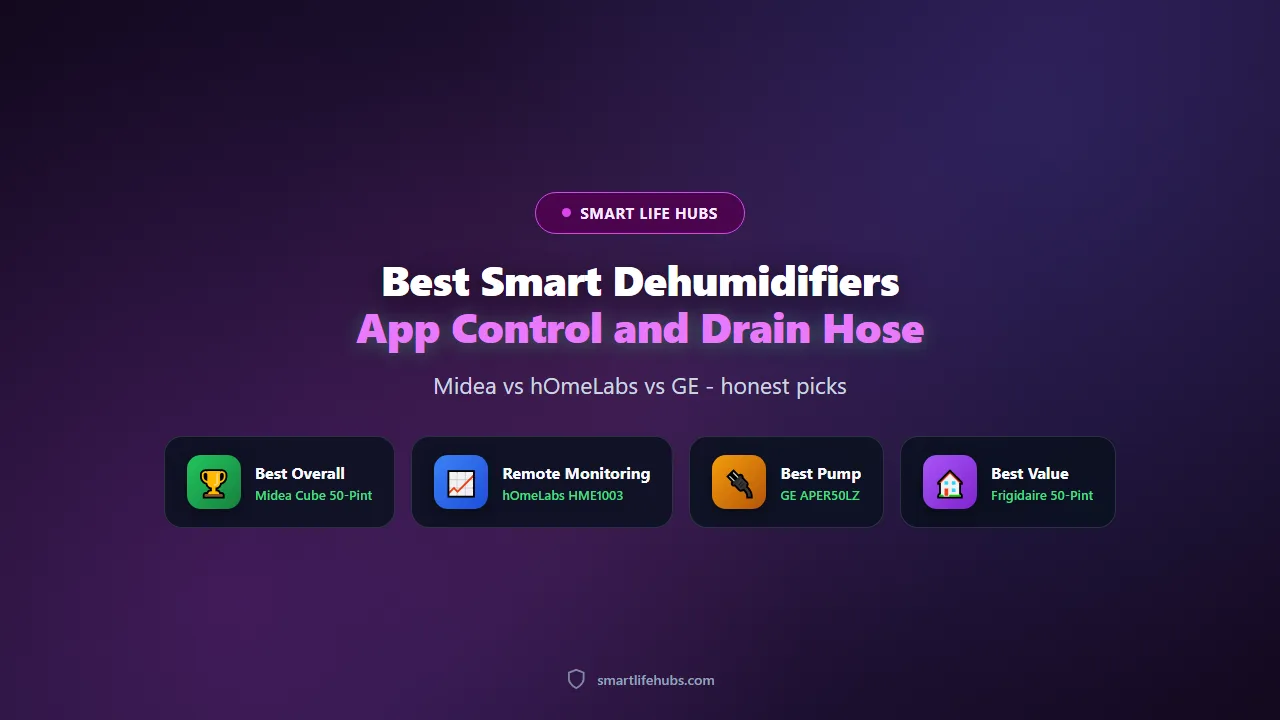
Best smart dehumidifiers of 2026 pull water from the air, report the humidity to an app and drain either into a tank or continuously through a hose, and the category has matured enough that the app is genuinely useful rather than a gimmick. I have used a smart dehumidifier in a damp basement for a winter and followed the category closely, and the honest finding is that the drain hose and the pump matter more than the app, because a dehumidifier you do not have to empty is a dehumidifier you will actually run.
The second thing to understand is that a smart dehumidifier is not a different kind of machine, it is a normal dehumidifier with a Wi-Fi radio. The app adds scheduling, remote on and off, a humidity reading and alerts, and it is genuinely useful for a basement you do not visit daily. The trade-off is that the app features usually depend on the cloud, so a lost internet connection can take away the smart features while the machine keeps working on its built-in controls.
Prices below are US retail captured in November 2026 and they move with capacity and sales.
At a glance
| Product | Best for | Key specs | Price |
|---|---|---|---|
| Midea Cube 50-Pint | Best overall | App and voice, built-in pump, gravity hose, 50-pint class | About 300 to 400 USD |
| hOmeLabs HME1003 50-Pint | Best for whole-house monitoring | App with live humidity, built-in pump, 50-pint class | About 350 to 450 USD |
| GE APER50LZ 50-Pint | Best pump-first | Smart Dry, built-in pump, 16-foot hose | About 350 to 450 USD |
| Honeywell TP30AWKN | Best for medium rooms | 30-pint, Wi-Fi, Alexa, dual drainage | About 250 to 350 USD |
| Frigidaire FHDD5034Y1 | Best value | 50-pint, digital humidistat, gravity hose | About 250 to 350 USD |
The best smart dehumidifiers of 2026
1. Midea Cube 50-Pint, best overall
The Cube is the smart dehumidifier most buyers should buy, because it combines a mature app, a large tank and a built-in pump in a compact body. The Midea SmartHome app shows the live humidity, sets the target, schedules the run time and works with Alexa and Google, and the Cube has a 16.5 pint tank that lifts out from the base rather than a bucket you spill. It has a built-in pump for continuous drainage, a gravity hose outlet, a washable filter and auto defrost, and the 50-pint class covers a large basement or an open floor plan. At about 300 to 400 dollars it is the best balance of price and features. The honest trade-off is that the pump hose needs a sink, a window or a floor drain, and the app requires the cloud.
Pros
- App and voice control with live humidity and scheduling
- Built-in pump plus a gravity hose outlet
- Lift-out tank and a washable filter
Cons
- Pump hose needs a sink, window or drain
- App features depend on the cloud
Check today’s price on Amazon.
2. hOmeLabs HME1003 50-Pint, best for whole-house monitoring
The HME1003 is the pick if you want to watch the humidity remotely from anywhere. Its app shows the live humidity, lets you set the target percentage, and has a built-in pump for continuous drainage, so you can put it in a basement and check it from the sofa. It is a 50-pint class unit with a digital humidistat, auto shutoff and a washable filter, and it covers an open floor plan or several rooms. At about 350 to 450 dollars it costs a little more than the Midea and the app is less polished, so it is the pick for the monitoring and the pump rather than the app experience.
Pros
- App shows live humidity and lets you set the target
- Built-in pump for continuous drainage
- 50-pint class for open plans and basements
Cons
- About 350 to 450 USD, a little more than the Midea
- App is less polished than Midea’s
Check today’s price on Amazon.
3. GE APER50LZ 50-Pint, best pump-first
The GE is the pick if drainage is your main problem, because the built-in pump can push water up to 16 feet vertically through the included hose, which a gravity drain cannot do. It removes up to 50 pints a day, it has a Smart Dry feature that adjusts the fan to the room humidity, a 15-pint bucket with auto shutoff and an included remote and timer. It is not the app-first choice, because the smart features are more limited than the Midea’s, but for a damp basement where the only drain is a sink or a high window, the pump is the feature that matters. At about 350 to 450 dollars it is the practical choice when you need to move water uphill.
Pros
- Built-in pump pushes water up to 16 feet vertically
- 50-pint capacity with Smart Dry and a 15-pint bucket
- Included hose, remote and 24-hour timer
Cons
- Less app depth than the Midea or hOmeLabs
- Pump hose still needs a sink, window or drain
Check today’s price on Amazon.
4. Honeywell TP30AWKN, best for medium rooms
The Honeywell is the pick for a medium room rather than a whole basement. It is a 30-pint unit for spaces up to about 1,000 square feet, with a reliable Wi-Fi connection, an app and Alexa control, and dual drainage with a tank or a hose. It has a washable filter, auto defrost and a digital humidistat, and it is quiet enough for a living space. At about 250 to 350 dollars it is cheaper than the 50-pint models, and the trade-off is the capacity, so it is the right size for a flat, a bedroom or a small basement rather than a large damp space.
Pros
- About 250 to 350 USD for a 30-pint unit
- Reliable Wi-Fi with an app and Alexa
- Dual drainage and a washable filter
Cons
- 30-pint capacity suits a medium room
- App is functional rather than rich
Check today’s price on Amazon.
5. Frigidaire FHDD5034Y1, best value
The Frigidaire is the honest budget option. It removes up to 50 pints a day under the current DOE test, it has a digital humidistat with a settable target, a gravity hose outlet and a bucket, and it costs about 250 to 350 dollars. It does not have the app depth of the Midea or the pump of the GE, so it is the pick if you want capacity and a settable humidity level without paying for the smart extras, and you are happy to empty the tank or run a gravity hose. The honest trade-off is the lack of app control, which is the point of this roundup, so it is here as the value fallback rather than a smart recommendation.
Pros
- About 250 to 350 USD for a 50-pint unit
- Digital humidistat with a settable target
- Gravity hose outlet and a bucket
Cons
- No app control, which is the category requirement
- No built-in pump
Check today’s price on Amazon.
How to choose the best smart dehumidifier
Start with the drainage, because that decides how often you will interact with the machine. A gravity hose works only if you have a floor drain lower than the unit, while a built-in pump can push water to a sink or out a window, which is the difference between a machine you forget about and one you empty daily. If your only drain is above the unit, buy the pump model.
Then check the capacity, because the pint rating is not the whole story. A 50-pint unit is for a large, damp basement; a 30-pint unit suits a flat or a bedroom; and an oversized unit in a small room will short-cycle and use more energy. Match the capacity to the space and the dampness rather than buying the biggest number.
Check the tank size and the emptying method, because a large capacity with a tiny tank is a machine you empty often. A lift-out tank is easier than a bucket, and an auto shutoff when the tank is full is essential. If you can run continuous drainage, the tank matters less, but it is still the backup.
Decide how much you need the app, because the smart features are usually cloud-dependent. If you want to check the humidity from work, set a schedule and get an alert when the tank is full, the app is worth it. If you only want the machine to hold a humidity level, the built-in humidistat does the job without a subscription or a cloud connection.
Finally, be honest about the source of the damp, because a dehumidifier manages moisture rather than fixing a leak. If the damp comes from a failed damp-proof course, a gutter or a condensation problem, the dehumidifier will run forever and the problem will stay. Fix the source first, then size the machine. A detailed 2026 comparison at onesmartcrib.com/best-smart-dehumidifiers covers the app and drainage differences of the current models.
Living with a smart dehumidifier
Place it centrally in the damp space, away from walls and furniture, because a dehumidifier needs airflow to work. Give it a few inches of clearance on all sides, keep the intake and the outlet clear, and close the door and the windows of the room so it is not fighting the whole house.
Set the target humidity rather than running it flat out, because a basement at 50 percent is comfortable and dry, and a lower target runs the machine longer for little gain. Set 45 to 50 percent for a basement, 40 to 45 for a living space, and let the humidistat do the work.
Run the continuous drain if you can, because a tank you forget is a machine that stops. Fit the hose securely, check for kinks, and make sure the outlet is lower than the unit for gravity or within the pump’s lift for a pump model. Test the drainage with a full tank before you leave it unattended.
Clean the filter monthly and wipe the tank, because a dusty filter reduces the airflow and a damp tank can grow mould. A washable filter is the norm, so rinse it and let it dry fully before you refit it, and empty and rinse the tank occasionally even if you drain continuously.
Use the app alerts to catch problems early, because a full tank or a failed pump is easier to fix before the room goes damp. Set an alert for the tank, an alert for a humidity level that stays high, and check the app after a heavy rain. For the wider category, our basement dehumidifier guide covers the non-smart options, and the smart air purifier guide covers the units that handle the other half of the problem.
Frequently asked questions
Frequently Asked Questions
6What humidity level should I set?
Set 45 to 50 percent for a basement and 40 to 45 percent for a living space. Below 30 percent the air is dry enough to irritate skin and sinuses, and above 60 percent you risk condensation and mould, so the 40 to 50 band is the comfortable and safe target.
Do I need the app on a dehumidifier?
No. The built-in humidistat holds the humidity level without any app. The app is useful for checking the room remotely, scheduling runs and getting an alert when the tank is full, but it is a convenience rather than a requirement.
What is the difference between a gravity drain and a pump?
A gravity drain relies on the water flowing downhill through a hose to a floor drain. A built-in pump pushes the water up to a sink or out a window, which is essential if your only drain is above the unit.
How often do I need to empty the tank?
It depends on the dampness and the tank size. A 50-pint unit with a 15-pint tank in a very damp basement may fill in a day or two, which is why continuous drainage is the better setup. Use the auto shutoff and the app alert so a full tank does not stop the machine unnoticed.
Can a dehumidifier replace an air purifier?
No. A dehumidifier manages moisture and does nothing for dust, pollen or odours. An air purifier manages particles and does nothing for damp. A house with both problems needs both machines.
Why does my dehumidifier stop in cold weather?
Most compressor dehumidifiers auto-defrost when the coils ice up in a cold room, and some are inefficient below about 15 degrees Celsius. If your basement is cold, look for a model with a good auto-defrost or a desiccant unit, and do not expect a warm-room performance in a cold space.
The bottom line
Buy the Midea Cube 50-Pint at about 300 to 400 dollars if you want the best all-round smart dehumidifier. The mature app, the lift-out tank, the built-in pump and the 50-pint capacity make it the easiest machine to live with, and the price is fair for the features.
The hOmeLabs HME1003 at about 350 to 450 dollars is the pick if you want to monitor the humidity remotely, and the GE APER50LZ at about 350 to 450 dollars is the one if you need to pump water up to a sink or out a window. The Honeywell TP30AWKN at about 250 to 350 dollars is the right size for a medium room, and the Frigidaire FHDD5034Y1 at about 250 to 350 dollars is the value fallback if you do not need the app.
Whichever you choose, sort the drainage first, set a target humidity rather than running it flat out, and clean the filter monthly. A smart dehumidifier earns its keep only if it runs continuously, and a machine you never empty is the one that actually does the job.






Leave a Comment