
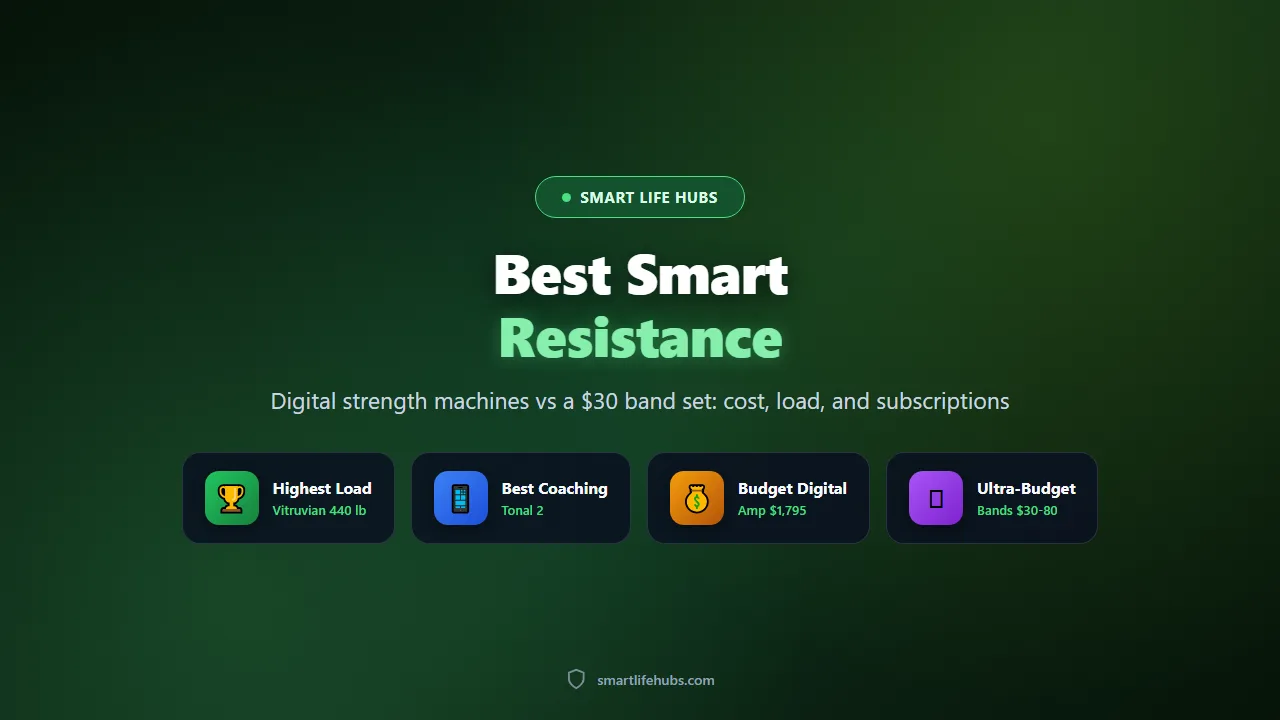
Smart resistance is a confusing label, because the products people mean by it are not elastic bands at all. Tonal, Vitruvian and Speediance are digital strength machines that use motorised resistance, while a genuine smart resistance band set is still a niche product. So this category is really three things: premium digital machines, budget elastic bands with an app, and a great deal of marketing that blurs the two.
Prices run from about $30 for a band set with a door anchor to about $3,000 to $3,750 for a digital machine before any subscription. The Vitruvian Trainer+ at about $3,000 offers the highest resistance and the smallest footprint, the Tonal 2 at about $2,995 to $3,295 is the most polished, and a $30 to $80 band set covers most cable exercises for a fraction of the price.
I pulled Trail and Kale’s honest Tonal alternatives comparison, Keersa’s smart resistance guide, Digital Gym’s wall-mounted gym guide and Heavy Lift Vault’s Vitruvian review. Where a figure is a claim rather than a measurement, I say so. Prices are US street prices as of November 2026 and they move heavily on sale.
At a glance
| Product | Best for | Key specs | Price |
|---|---|---|---|
| Vitruvian Trainer+ | Best high load | Up to 440 lb digital resistance, floor platform, no installation | About $3,000 |
| Tonal 2 | Best coaching | Up to 250 lb, wall mounted, large touchscreen, form tracking | About $2,995 to $3,295 plus $49 to $59.95 a month |
| Speediance Gym Monster 2 | Best long-term value | 220 to 260 lb, free basic mode, wall mounted | From about $3,749 |
| Amp | Best budget digital | 100 lb, wall mounted, app coaching | About $1,795 plus $23 a month |
| Band set with door anchor | Best ultra-budget | 5 to 150 lb stacked elastic resistance, handles and anchor | About $30 to $80 |
The best smart resistance options of 2026
1. Vitruvian Trainer+, best high load
The Vitruvian Trainer+ costs about $3,000 and it is the machine for a serious lifter who wants compact digital resistance. It delivers up to 440 pounds, stores in about 3.5 square feet, sits on the floor with no installation and works with handles connected to a motorised system in the base. Trail and Kale calls it in a category of its own for resistance, and Heavy Lift Vault notes it delivers nearly double the resistance of Tonal for roughly a thousand dollars less.
The trade-offs are the limited movement library and the app. Trail and Kale notes the Vitruvian is limited in the number of movements it can do compared with Tonal, Speediance and OxeFit, and there is no screen, so you pair it with your own device. Heavy Lift Vault also reports some owners seeing motor or software failures after one to two years, so long-term reliability is unproven.
- Pros: About $3,000; up to 440 lb; 3.5 square feet; no installation; no mandatory fee
- Cons: Fewer exercises; app-based only; long-term reliability unproven
Check today’s price on Amazon.
2. Tonal 2, best coaching
The Tonal 2 costs about $2,995 to $3,295 plus $49 to $59.95 a month and it is the most polished digital gym. It mounts to the wall, includes a large touchscreen, tracks your form with motion sensors and delivers up to 250 pounds of adaptive resistance, with more than 200 exercises listed. Digital Gym puts the three-year total at about $4,759 and notes it is very limited without the subscription.
The trade-offs are the price, the mandatory fee and the installation. Trail and Kale lists installation at $295 to $550 on top of the hardware, and Heavy Lift Vault calculates that over five years the membership adds more than two thousand dollars. Buy it if you want the smoothest guided experience and you are committed to the monthly cost.
- Pros: Up to 250 lb; form tracking; deep content library; polished app
- Cons: $49 to $59.95 a month; installation extra; very limited without the sub
Check today’s price on Amazon.
3. Speediance Gym Monster 2, best long-term value
The Speediance Gym Monster 2 costs from about $3,749 and it is the challenger that undercuts the subscription model. It offers 220 to 260 pounds of resistance, a 21.5 inch touchscreen and a free basic manual mode, and Trail and Kale calls it the best freestanding value challenger. Digital Gym lists the three-year total at about $2,483 with a $19 monthly subscription, though the hardware price there is lower at about $1,799.
The trade-offs are the screen and the brand maturity, and the conflicting prices between sources suggest the range changes with bundles. Check the current package before you compare, because a bundle with an included membership changes the arithmetic completely.
- Pros: 220 to 260 lb; free basic mode; works without a full subscription
- Cons: Higher sticker price; pricing varies by bundle; smaller content library than Tonal
Check today’s price on Amazon.
4. Amp, best budget digital
Amp costs about $1,795 plus $23 a month and it is the cheapest way into a wall-mounted digital machine, with 100 pounds of resistance and app coaching. Trail and Kale lists it as the budget-conscious wall-mount option, provided the 100 pound ceiling works for your training level.
The trade-off is the ceiling. At 100 pounds it suits general fitness and most home users but not an experienced lifter, and the resistance is the whole product. If you are already pressing heavy dumbbells, look at Vitruvian or Tonal.
- Pros: About $1,795; $23 a month; wall mounted; cheapest digital route
- Cons: 100 lb ceiling; limited for advanced lifters; subscription for full features
Check today’s price on Amazon.
5. Band set with door anchor, best ultra-budget
A resistance band set with handles and a door anchor costs about $30 to $80 and Digital Gym argues it replicates most cable machine exercises, with resistance from 5 to 150 pounds when you stack bands. Bands have a different resistance curve than cables because they get harder at full extension, but for general fitness, muscle building and rehabilitation they are remarkably effective.
The trade-offs are the feel, the durability and the lack of data. Bands snap, the resistance curve is uneven, and there is nothing to track. For under $80 though, this is the best value in the entire category, and it is the honest recommendation for most people.
- Pros: About $30 to $80; portable; no subscription; covers most cable exercises
- Cons: Uneven resistance curve; bands wear and snap; no tracking or coaching
Check today’s price on Amazon.
Living with a digital gym or a band set
The first thing you learn is that the machine is the easy part and the routine is the hard part. A digital gym with a library of 200 movements still needs you to show up, and the subscription is only worth it if the coaching is what gets you there. If you know your own programme, the machine’s content is a bonus rather than the reason.
The second is that a wall-mounted machine changes the room. It becomes a fixture, which is good for the habit and bad for flexibility, and it needs a wall that can take the load plus clearance for pressing and pulling. A floor platform like the Vitruvian can be moved, which matters in a rented flat.
The third is noise and neighbours. Motorised resistance is quiet compared with iron, but the machine hums and the plates or cables still make some sound. Bands are silent, which is a genuine advantage in a thin-walled flat.
The fourth is that bands wear out. A snapped band at full extension stings and can injure, so inspect them for tears and replace them on schedule rather than waiting. Cheap bands are consumables, and the budget should allow for it.
Finally, think about what happens if you stop paying. A machine that becomes a paperweight without a subscription is a risk, and one that still works in manual mode is a safer purchase. Read the fine print before you commit, because the subscription is the part that is hardest to escape later.
The honest bottom line is that most people do not need a three thousand dollar machine to get stronger at home, and the bands plus a plan will take them most of the way there for the price of a single month of coaching on one of the premium machines, which is the comparison worth making before you spend any money at all on new kit for the home.
How to choose smart resistance
First decide if you want a machine or bands. Digital machines cost $1,795 to $3,749 and give you smooth, measurable, app-guided resistance. Bands cost under $80 and give you elastic resistance that is portable and good enough for most goals. The gap in price is enormous and the gap in results is much smaller than the marketing suggests.
Do the three-year arithmetic. Tonal’s membership adds more than $2,000 over five years and the machine is very limited without it. Digital Gym puts Tonal’s three-year total at about $4,759 and Vitruvian’s at about $4,194. Always compare the total cost of ownership, not the sticker.
Check the resistance ceiling against your level. A 100 pound ceiling suits general fitness, 200 to 260 suits most home lifters, and 440 is for serious strength athletes. Buying above your level buys nothing, and buying below it means replacing the machine.
Think about space and installation. Wall-mounted machines need a wall and often professional installation at $150 to $550. The Vitruvian is floor-based and stores in 3.5 square feet, which is the argument for it in a rented flat.
Check whether it works without the subscription. Tonal is very limited without its fee, Speediance has a free basic mode and Vitruvian includes its features. If you might cancel, buy a machine that still works.
Be sceptical of the band comparison. Elastic bands and motorised resistance are different tools, and no band set will match a digital machine for smoothness or data. The honest comparison is bands against bands and machines against machines.
Consider iron first. Heavy Lift Vault makes the point that if you have a garage and a budget, iron still wins on durability and cost, and Digital Gym suggests a wall-mounted cable pulley with weight plates at $80 to $150 gives 80 percent of the functionality at 5 percent of the price.
Think about the rest of the kit. Our adjustable dumbbell roundup covers the simpler route to strength, and our fitness tracker roundup covers tracking the sessions.
Frequently asked questions
Frequently Asked Questions
6Are Tonal and Vitruvian resistance bands?
No. Both are digital strength machines that use motorised resistance rather than elastic bands. Tonal is wall mounted with a screen, and Vitruvian is a floor platform with handles.
Which is better, Tonal or Vitruvian?
It depends on the priority. Vitruvian offers up to 440 pounds, a 3.5 square foot footprint and no installation for about $3,000. Tonal offers up to 250 pounds, a touchscreen, form tracking and a deeper content library for about $2,995 to $3,295 plus $49 to $59.95 a month.
Are smart resistance machines worth the money?
If you will train four or more times a week and want guided programming, yes, because the coaching is what keeps the habit. If you follow your own programme, a $30 to $80 band set or a $80 to $150 cable pulley with plates does most of the job.
What is the cheapest way to get cable machine exercises at home?
A resistance band set with handles and a door anchor at $30 to $80, or a wall-mounted cable pulley with weight plates at $80 to $150, which Digital Gym estimates gives 80 percent of the functionality at 5 percent of the price.
Do these machines require a subscription?
Tonal effectively does, at $49 to $59.95 a month, and is very limited without it. Speediance has a free basic mode, Vitruvian includes its features, and Amp charges $23 a month for full coaching.
Can I store a digital gym in a small flat?
The Vitruvian Trainer+ is the most compact at about 3.5 square feet and needs no installation, and Tonal folds flat against a wall. Wall-mounted machines still need a suitable wall and clearance.
The bottom line
Buy the Vitruvian Trainer+ if you want the highest resistance in the smallest footprint: about $3,000, up to 440 pounds, floor based and no installation. Buy the Tonal 2 at about $2,995 to $3,295 if you want the most polished coaching and a screen, and accept the $49 to $59.95 monthly fee. Buy the Speediance Gym Monster 2 from about $3,749 if you want a free basic mode, the Amp at about $1,795 if 100 pounds is enough, and a $30 to $80 band set with a door anchor if the budget is the point. Trail and Kale’s Tonal alternatives comparison reached the same conclusion on the Vitruvian as the strength-first option. The honest summary is that these are motorised strength machines rather than smart bands, the subscriptions decide the real cost, and a $30 band set will get most people most of the way there. Which matters more to you, the data or the money? Tell us in the comments.





Leave a Comment