
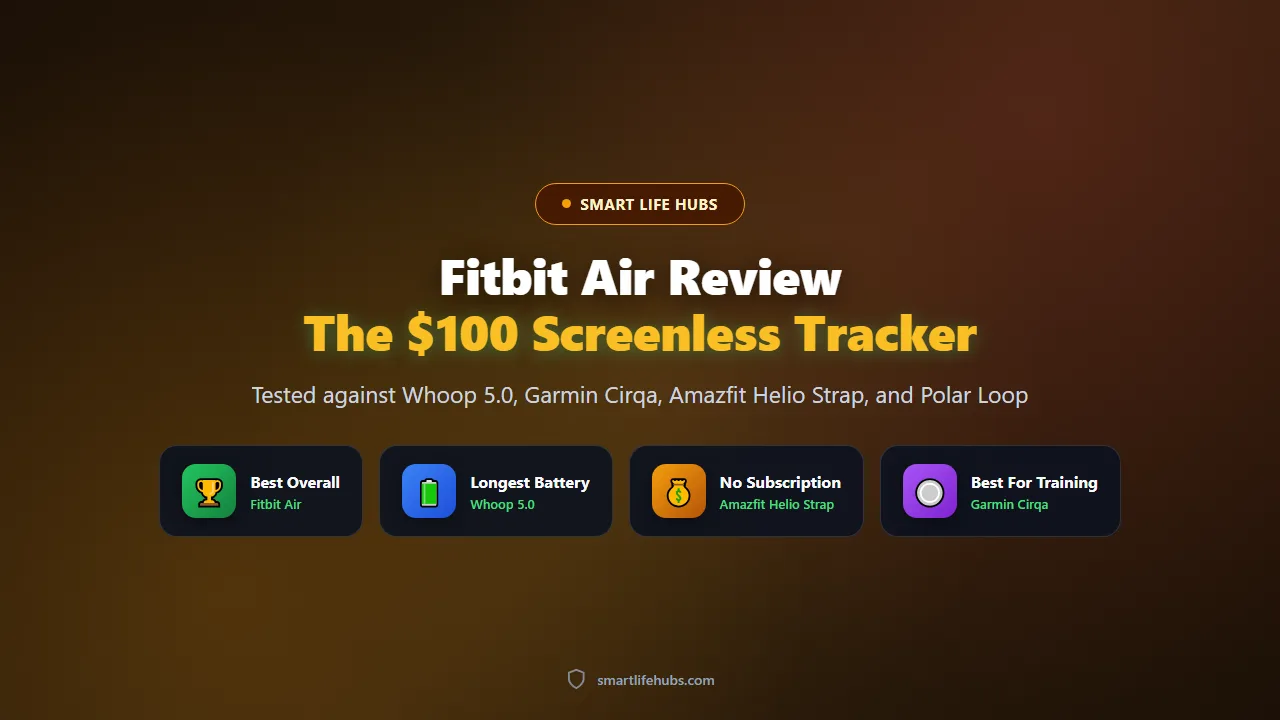
The Fitbit Air is the first screenless tracker I have recommended without a list of caveats. It costs $99.99, weighs 12 grams with the band attached, and sits under your sleeve like a pebble in a fabric pocket. There is no display, no touchscreen, and no GPS chip. Every number lands in the Google Health app on your phone, and after two weeks of wearing it I stopped noticing it was there, which is the entire point of this category.
Google launched the Air on May 7, 2026, its first new tracker in years, and the timing matters. Whoop created the screenless band category and still dominates the conversation, but you cannot buy a Whoop 5.0 outright. It comes with a membership that starts at $199 a year. The Air costs $100 once and asks for nothing more unless you want the coaching tier. That single fact reshapes the value equation for anyone who has been curious about screenless tracking and turned off by the rental model.
I pulled manufacturer specs, published reviews from PCMag, Which?, Android Central, TechRadar, and TechAdvisor, plus long-term owner reports from Reddit and Amazon. Where a figure is a claim rather than a measurement, I say so. Prices are typical US street prices as of November 2026 and move around during sales, but the ranking holds.
At a glance
| Product | Best for | Key specs | Price | 3-year cost |
|---|---|---|---|---|
| Fitbit Air | Best overall: comfort and accuracy | 5.2g capsule, 12g with band, 5ATM, 7-day battery (8.5 tested), no screen, no built-in GPS | $99.99 | $99.99, or $400 with Premium |
| Whoop 5.0 | Best for serious athletes | 26g or more, IP68, 14-day battery (16.5 tested), no ECG on this model | $239 per year membership | $717 |
| Garmin Cirqa | Best for training variety | 10-day battery, 5ATM, physical side button, Body Battery, Connect+ optional | $199.99 | $199.99, or $410 with Connect+ |
| Amazfit Helio Strap | Best budget, no subscription | 10-day battery, 5ATM, live heart rate broadcasting, no fees at all | $99.99 | $99.99 |
| Polar Loop | Best no-fee training guidance | 8-day battery, 5ATM, Polar Flow app, no ECG or SpO2 sensor | $199.99 | $199.99 |
The best screenless fitness trackers of 2026
1. Fitbit Air, best overall
The Air is a 5.2 gram capsule that pops out of a recycled polyester band, and with the band on it weighs 12 grams. That is less than half a Whoop 5.0, and the difference shows up at night and under a jacket cuff. Inside are an optical heart rate monitor that samples every two seconds, a three-axis accelerometer, a gyroscope, red and infrared sensors for blood oxygen, a skin temperature sensor, a vibration motor, and an LED that reports battery level when you double-tap it. It tracks heart rate, resting heart rate, HRV, breathing rate, sleep stages, skin temperature variation, SpO2 during sleep, cardio load, and a Daily Readiness Score, and it can flag signs of atrial fibrillation while you are still or asleep. Which?’s lab measured heart rate error at 1.34% against a fitness tracker average of 5.7%, and step count error at 1.66% against 3.26%. Battery is the compromise. Google claims 7 days, PCMag measured 8.5, and Which?’s lab got 199 hours, which is still half of what a Whoop 5.0 manages. The free Google Health app shows raw numbers and scores with almost no interpretation, and the Gemini-powered Health Coach sits behind Google Health Premium at $9.99 a month. There is no ECG and no built-in GPS, so you carry your phone for mapped runs, and automatic workout detection is inconsistent.
- Pros: Lightest band here at 12g; accuracy that matches bands costing three times as much; 5ATM water resistance and a fabric band that survives lifting
- Cons: No ECG or built-in GPS; free app is bare-bones; automatic workout detection misses sessions
Check today’s price on Amazon.
2. Whoop 5.0, best for serious athletes
Whoop invented the screenless band and still writes the playbook. The 5.0 lasts 14 days on a charge in claims and 16.5 days in PCMag’s testing, which means you can go two weeks without thinking about a cable. It tracks heart rate, SpO2, skin temperature, sleep stages, HRV, and strain, then hands you a Recovery score and a Strain target for the day. The app is dense and opinionated, which is either the best coaching in the category or an overwhelming wall of menus depending on your temperament. The price is the problem. There is no hardware to buy. The 5.0 arrives with the $239 Peak membership, and over three years you pay $717 for a sensor you never own. The hardware is also heavier than the Air at just over 26 grams, and the included strap uses a snap closure that can pinch. The MG model adds ECG and blood pressure trends, but that pushes the membership to $359 a year.
- Pros: Longest battery in the category at 16.5 days tested; deepest athletic analytics; no upfront hardware cost
- Cons: Mandatory membership, $717 over three years; heavy at 26g; raw stats are buried in menus
Check today’s price on Amazon.
3. Garmin Cirqa, best for training variety
Garmin launched the Cirqa in July 2026 and it is the only screenless band with a physical button. You press it to start and stop a workout, then label it later in Garmin Connect as a run, a cardio class, or a round of boxing. Battery runs 10 days, the band uses a fabric ComfortFit strap, and the sensor tracks heart rate, pulse ox, stress, skin temperature, and Body Battery, which is Garmin’s readiness measure. It auto-detects walks, runs, and strength sessions reasonably well, and it generates shareable workout cards with a selfie if that sort of thing matters to you. The optional Connect+ tier adds Garmin Coach and AI insights for about $70 a year, but reviewers found that coaching underwhelming, and the band costs more up front than the Fitbit Air. It is also thicker and wider than every other band on this list.
- Pros: 10-day battery; physical start button no rival offers; Body Battery and Health Status free
- Cons: Bulkier than the others; Connect+ coaching is weak; $199.99 up front
Check today’s price on Amazon.
4. Amazfit Helio Strap, best budget with no subscription
The Helio Strap is the other $99.99 band on this list and the only one that charges you nothing ever. Battery runs 10 days, water resistance is 5ATM, and the nylon band fits wrists from 145 to 205mm. The standout feature is live heart rate broadcasting, which pushes your pulse to a Garmin watch, an Apple Watch, or compatible gym equipment in real time, something no other band here does at this price. It tracks heart rate, SpO2, sleep, stress, and skin temperature, and Zepp has synced HRV to Apple Health since an October 2025 firmware update. The weak points are automatic workout detection, which is inconsistent, and app syncing, which is less reliable than Fitbit’s or Garmin’s. If you want a dual-sensor version for hybrid racing, the Helio Strap Pro exists, but most people do not need it.
- Pros: $99.99 with no subscription; 10-day battery; live heart rate broadcasting
- Cons: Inconsistent automatic workout detection; syncing to third-party apps is patchy
Check today’s price on Amazon.
5. Polar Loop, best no-fee training guidance
Polar has been making heart rate gear since the late 1970s, and the Loop applies that history to a screenless band. It costs $199.99 with no subscription required, runs 8 days on a charge, and is water resistant to 5ATM. The Polar Flow app carries decades of training structure, and optional sport-specific guidance costs $8.99 a month if you want it. The trade-off is the sensor list: the Loop has no ECG and no blood oxygen sensor, so you lose two metrics that the Fitbit Air and Garmin Cirqa both include at lower or similar prices. It is also the least connected option here, and Polar’s continuous heart rate data does not sync to Apple Health, only workout heart rate does. Buy it if you already live in Polar Flow or you want a reputable band with no recurring fee, not if sensor depth is your priority.
- Pros: No mandatory subscription; 8-day battery; decades of Polar training heritage
- Cons: No ECG or SpO2; continuous heart rate does not sync to Apple Health
Check today’s price on Amazon.
How to choose a screenless fitness tracker
Total cost over three years decides the value. The Fitbit Air is $99.99 once. The Whoop 5.0 is $239 a year, which is $717 over three years for hardware you never own. The Garmin Cirqa is $199.99 once, and the Amazfit Helio Strap is $99.99 once. If you are comparing a $100 band against a $239-a-year membership, do the arithmetic on a three-year window, not the price on the box. The Air only becomes expensive if you keep Google Health Premium, which adds $300 over the same period.
Battery life sets the habit you can keep. A band you charge every three days becomes a band you leave on the charger. The Whoop 5.0 at 14 to 16 days, the Garmin Cirqa at 10 days, and the Amazfit Helio Strap at 10 days all let you forget about charging for a week and a half. The Fitbit Air at 7 to 8.5 days is a weekly charge, which most people manage. Every band here charges fast, so the real question is whether a weekly ritual bothers you. If you travel often, the Whoop and the Garmin have the edge.
The free app is what you live with every morning. The Fitbit Air’s free tier shows numbers and scores with little guidance, and the coaching lives behind Premium. The Amazfit Helio Strap gives you everything free but a less polished app. The Garmin Cirqa is the most complete free experience, with Body Battery, Health Status, and workout history. The Whoop app gives you Recovery and Strain for free but hides raw data. If you want interpretation rather than data, the Air with Premium or the Cirqa without it are the two paths that work. For a broader view of how these devices stack up, our fitness tracker guide covers the category across screens and screenless designs.
Match the sensors to the question you are asking. Every band here measures heart rate, sleep, and movement. The differences are ECG, blood oxygen, skin temperature, and GPS. The Air adds SpO2, skin temperature variation, and AFib detection but no ECG and no built-in GPS. The Whoop MG adds ECG and blood pressure trends at $359 a year. The Garmin Cirqa adds Body Battery. The Polar Loop omits SpO2 and ECG entirely. If you run outdoors and want mapped routes without your phone, none of these bands will do it, and you should look at a GPS watch instead. For independent measurements of heart rate and sleep accuracy, PCMag’s Fitbit Air review publishes its full lab results.
Fit and comfort decide whether you wear it in month six. The Air at 12 grams and the fabric Performance Loop band are the most disappearing of the group. The Whoop 5.0 at 26 grams and the Garmin Cirqa’s thicker case are noticeable by comparison. Bands with a snap closure can pinch, and bands with a buckle can shift during lifting. If you lift weights, a fabric band that tucks under the wrist wins. If you swim, every band here is rated to 5ATM or better, so water is not a differentiator except for the Polar Loop’s age.
Frequently asked questions
Frequently Asked Questions
6Is the Fitbit Air worth $99.99?
Yes, if you want a screenless tracker and you do not want a subscription. It matches bands that cost three times as much on heart rate and step accuracy, lasts a week on a charge, and works with both iPhone and Android. It is a poor choice if you need ECG, built-in GPS, or a screen.
Do you need Google Health Premium for the Fitbit Air?
No. The free Google Health app tracks activity, exercise, sleep, stress, Daily Readiness, and Cardio Load, and shows your vitals. Premium adds the Gemini-powered Health Coach, workout and mindfulness sessions, and deeper interpretation for $9.99 a month or $99.99 a year. Use the included three-month trial to decide whether the coaching is worth it before you pay.
Does the Fitbit Air have built-in GPS?
No. The Air has no GPS chip, so outdoor runs and rides use your phone’s connected GPS. You need to carry your phone to get a mapped route. If mapped workouts without a phone matter to you, a GPS watch or a phone-based tracker is the better tool.
How accurate is the Fitbit Air?
Which?’s lab measured overall heart rate error at 1.34% against a fitness tracker average of 5.7%, and walking step count error at 1.66% against 3.26%. That puts it at the top of the category for resting and walking accuracy. Distance tracking without GPS is weaker at 10.8% error, which is normal for a phone-less band. For sleep, the Air performs close to the Whoop 5.0 and the Oura Ring in independent testing.
Can you use the Fitbit Air with an iPhone?
Yes. The Air works with iOS 16.4 or later and Android 11 or later, and it syncs exercise, sleep, steps, and vitals to Apple Health. The Whoop 5.0 also works on iPhone, but the Garmin Cirqa is the better pick if you want deeper training metrics alongside a Garmin watch.
Which screenless band has the best battery life?
The Whoop 5.0, at 14 days claimed and 16.5 days in PCMag’s testing. The Garmin Cirqa and Amazfit Helio Strap both run 10 days, and the Fitbit Air runs 7 to 8.5 days. If charging less often is your top priority, the Whoop wins on paper and costs the most over time.
The bottom line
Buy the Fitbit Air if you want the best screenless fitness tracker for most people: $99.99 once, 12 grams, accurate heart rate and step tracking, a week of battery, and a fabric band you will forget you are wearing. Buy the Whoop 5.0 if you want the longest battery and the deepest athletic analytics and you accept a $239-a-year membership with no hardware to own. Buy the Amazfit Helio Strap if $99.99 is your ceiling and you never want to see a subscription charge. Buy the Garmin Cirqa if you want a physical workout button and Garmin Connect. Skip the Polar Loop unless you are already invested in Polar Flow, because it lacks SpO2 and ECG at a similar price. If you want to pair your band with better sleep habits rather than more data, our white noise machine roundup covers the other half of the sleep problem. Which band ended up on your wrist? Tell us in the comments.

Leave a Comment