
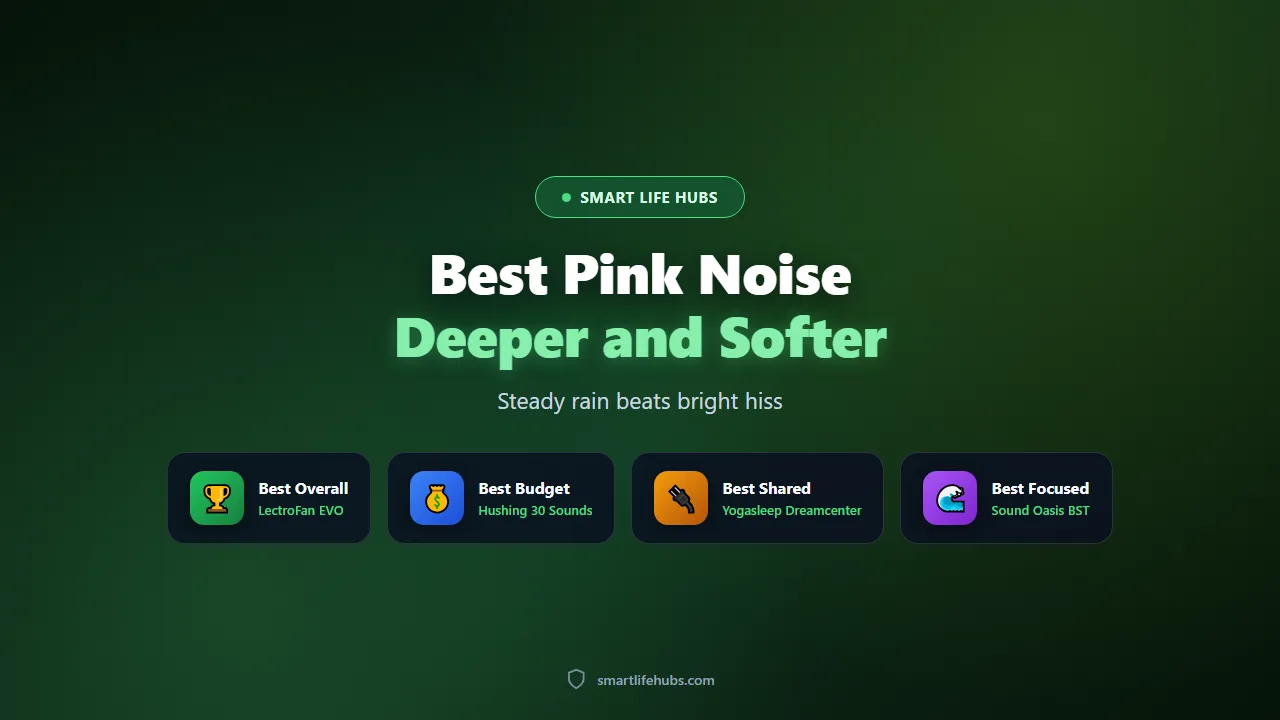
Best pink noise machines of 2026 are the ones that produce a steady, softer sound than white noise, and the honest finding after comparing them is that pink noise is mostly a comfort choice rather than a proven sleep enhancer. It has more energy at the lower frequencies, which reads as steady rain rather than bright hiss, and many people find it easier to sleep next to. The research that made it famous used timed pulses in a lab, not an all-night machine.
The second thing to understand is the difference between the three colours, because the choice is about what you are covering and what you can tolerate. White noise has equal energy at every frequency and sounds bright, pink noise is softer and fuller, and brown noise is a deep rumble. Many listeners find white too harsh and brown too heavy, which is why pink is often the compromise.
Prices below are US retail captured in November 2026 and they move with sales.
At a glance
| Product | Best for | Key specs | Price |
|---|---|---|---|
| LectroFan EVO | Best overall | 22 non-looping sounds incl. pink, 10 fan tones | About 50 to 70 USD |
| Hushing Brown Noise Machine | Best budget pink | 30 non-looping sounds incl. pink, night light | About 20 to 30 USD |
| Yogasleep Dreamcenter | Best shared room | 26 sounds incl. pink, headphone jack | About 30 to 40 USD |
| Hatch Restore 3 | Best smart | App library, sunrise alarm, subscription | About 170 USD |
| Sound Oasis BST-80-20 | Best pink-focused | Pink and white noise, Bluetooth | About 40 to 60 USD |
The best pink noise machines of 2026
1. LectroFan EVO, best overall
The EVO is the pick because it generates its pink noise rather than replaying a recording, so there is no loop seam to notice, and it gives you 22 sounds including white, pink and brown plus 10 fan tones, with precise volume control and a timer. It costs about 50 to 70 dollars, and the honest trade-offs are a sound that can be bright at the higher volumes, a plastic body and a night light that some people find intrusive, so it is the pick for someone who wants to try several colours without buying three machines.
Pros
- Non-looping pink, white and brown noise generated on the spot
- 22 sounds with precise volume and a timer
- About 50 to 70 dollars
Cons
- Bright at higher volumes
- Plastic body and an intrusive night light
Check today’s price on Amazon.
2. Hushing Brown Noise Machine, best budget pink
The Hushing is the pick if you want pink noise for the least money, because it offers 30 non-looping sounds with white, pink and brown all named on the listing, plus an amber night light, at about 20 to 30 dollars. The honest trade-offs are a speaker that is adequate rather than good, a build that is plasticky, and an app-free design that some will see as a plus and others as a lack of control, so it is the pick for a first try.
Pros
- 30 non-looping sounds including pink, no app needed
- About 20 to 30 USD, the cheapest here
- Amber night light included
Cons
- Basic speaker and plastic build
- No app or schedule
Check today’s price on Amazon.
3. Yogasleep Dreamcenter, best shared room
The Dreamcenter is the pick if only one person in the bed wants the noise, because it offers 26 sounds including pink and white, a full-colour light ring and, most usefully, a headphone jack so the sound can go to one person without inflicting it on the other. It costs about 30 to 40 dollars, and the honest trade-offs are a light ring that is too bright for some bedrooms, a sound that is recorded rather than generated, and a body that is larger than a travel machine, so it is the pick for a shared bed.
Pros
- Headphone jack so one person can have the noise
- 26 sounds including pink and white
- About 30 to 40 dollars
Cons
- Recorded sounds can loop
- Light ring may be too bright
Check today’s price on Amazon.
4. Hatch Restore 3, best smart
The Restore 3 is the pick if you want the pink noise inside a full bedtime routine, because its app library includes pink noise alongside a sunrise alarm, a wind-down and a schedule, at about 170 dollars. The honest trade-offs are a price well above a plain machine, a subscription for the full library, and a device that needs Wi-Fi and an app, so it is the pick for someone replacing an alarm clock as well as a sound machine.
Pros
- Pink noise inside a sunrise alarm and wind-down routine
- App control with scheduled sessions
- About 170 dollars
Cons
- Subscription for the full library
- Needs Wi-Fi and the app
Check today’s price on Amazon.
5. Sound Oasis BST-80-20, best pink-focused
The BST-80-20 is the pick if you want a machine built around pink noise, because it is marketed specifically for pink and white noise and adds Bluetooth so you can stream your own sound, at about 40 to 60 dollars. The honest trade-offs are a smaller sound library than the LectroFan, a body that is more utilitarian, and a brand that is less well known than the big names, so it is the pick for someone who wants pink noise first and extras second.
Pros
- Built around pink and white noise with Bluetooth streaming
- About 40 to 60 dollars
- Good for a specific pink-noise user
Cons
- Smaller sound library than the LectroFan
- Utilitarian design
Check today’s price on Amazon.
How to choose a pink noise machine
Start with the colour, because that is the whole decision. If white noise sounds like an untuned radio and bothers you, pink is the softer choice and brown is the deepest. If you are covering voices or a snore, pink keeps more mid and high frequency, while brown is better against traffic rumble and a neighbour’s bass. Buy for the sound you can tolerate all night.
Then check whether the sound is generated or recorded, because a recorded pink-noise loop will have a seam that you will notice after an hour. A machine that generates the noise, or a real fan, is the better buy for all-night use, and a cheap recorded machine is fine for travel or a short nap.
Check the volume range and the control, because pink noise needs to sit below the level you notice. Look for a fine-grained volume control and a timer, and avoid a machine with only three settings, which will jump from too quiet to too loud. A calibrated dial is easier to set in the dark than a button you cannot see.
Think about the extras and the partner, because a night light, an app and a headphone jack each solve a different problem. A headphone jack is the feature that makes a machine usable in a shared bed, a timer suits someone who wants it off after they fall asleep, and an app suits a schedule. If only one person wants the noise, buy the jack.
Finally, be honest about the evidence, because the famous pink noise studies used short, timed pulses during deep sleep in a lab, not eight hours of continuous playback. A 2021 review rated the evidence for continuous noise as a sleep aid as very low, so treat the machine as a comfort and masking tool rather than a treatment, and judge it by whether the street or the snore stops waking you rather than by a tracker score. Heft and Hush’s 2026 comparison at heftandhush.com/sound-machines/pink-and-brown-noise covers the sound colours, the machines and the research.
Living with a pink noise machine
Choosing the colour and the level
Pink noise sits between white and brown, so if you have tried white and found it too bright, pink is the first alternative to test. It keeps enough mid and high frequency to soften voices and a snore, while the extra low end makes it feel less like static. Brown is the next step down if the room has traffic rumble or a neighbour’s bass, and a machine that offers all three lets you settle the question in one purchase rather than guessing.
The level is the other half, and pink noise is easy to set too loud because it is pleasant rather than harsh. Aim for a steady floor that you stop noticing within a few minutes, and use the timer if you only need it to fall asleep, since a lower volume for a shorter period is gentler on the ears and on a partner, and easier to keep consistent.
Set the sound below the level you notice, because the point of pink noise is a steady floor rather than a dominant sound. Start low, leave it for a week, and only increase if a specific noise is still getting through. A machine you are aware of is one that is too loud, and pink noise at a high volume can be as disturbing as white.
Keep the sound the same from night to night, because your brain learns to ignore a steady sound and changing it every few nights resets that process. Pick one track or one colour, set it, and leave it, since variety is for the daytime and consistency is for the night.
Use the headphone jack or a sleep headband if you share the bed, because a partner who does not want the noise will otherwise switch the machine off. A machine with a jack lets you have the sound at a low level without imposing it, and a headband is the most comfortable option for a side sleeper.
Clean the machine and keep the speaker clear, because a dusty grille will rasp and ruin the smooth sound that pink noise is chosen for. Wipe the machine monthly, keep it out of the airflow of a heater, and check that the volume dial has not worked loose, since a drifting dial will change the level overnight.
Pair it with the conditions that actually decide sleep, because the machine masks noise while the light, the temperature and the bedtime decide whether you sleep. Keep the room dark and cool, the caffeine early and the bedtime consistent, and treat the pink noise as the layer that covers the street rather than the reason you sleep.
For the wider sleep range, our Hatch Restore 3 review covers the smart option, and the sleep techniques guide covers the routine around it.
Frequently asked questions
Frequently Asked Questions
6What is the difference between white, pink and brown noise?
White noise has equal energy at every frequency and sounds like bright static. Pink noise has more energy at the lower frequencies and sounds like steady rain or distant surf. Brown noise is weighted further into the bass and sounds like a deep rumble, better against traffic.
Does pink noise improve deep sleep?
The well-known studies used short, precisely timed pulses of pink noise during slow-wave sleep in a laboratory, which no consumer machine replicates. Continuous all-night pink noise has mixed and limited evidence, so it is best treated as a comfort and masking tool.
Is pink noise better than white noise?
Neither is universally better. Pink is softer and often more comfortable for sleeping, while white is brighter and better at masking speech. Choose the one you can ignore all night at a low volume.
How loud should pink noise be?
As low as it can be while still covering the noise you want to mask. Start below the obvious level and increase until the background is steady, because a sound you notice is a sound that is too loud.
Can I use a phone app instead of a machine?
Yes, and it is cheaper, but a phone app will usually loop a recording and will compete with notifications and battery. A dedicated machine or a real fan is the better option for all-night use.
Who should not use a pink noise machine?
Anyone whose tinnitus is worsened by background sound, and anyone who finds the sound more alerting than soothing. If the machine disturbs a partner, use a headphone jack or a sleep headband instead.
The bottom line
Buy the LectroFan EVO at about 50 to 70 dollars if you want the best overall pink noise machine, because the sound is generated rather than looped and you can try white, pink and brown from one device.
Buy the Hushing at about 20 to 30 dollars for pink noise on a budget, the Yogasleep Dreamcenter at about 30 to 40 dollars if you share the bed and need the headphone jack, the Hatch Restore 3 at about 170 dollars if you want the routine, and the Sound Oasis BST-80-20 at about 40 to 60 dollars if pink noise is the priority.
The honest point is that pink noise is a comfort and masking choice rather than a proven sleep enhancer, so buy the machine that produces the softest sound you can ignore, set it low and use it alongside a dark, cool, consistent bedtime.



Leave a Comment