
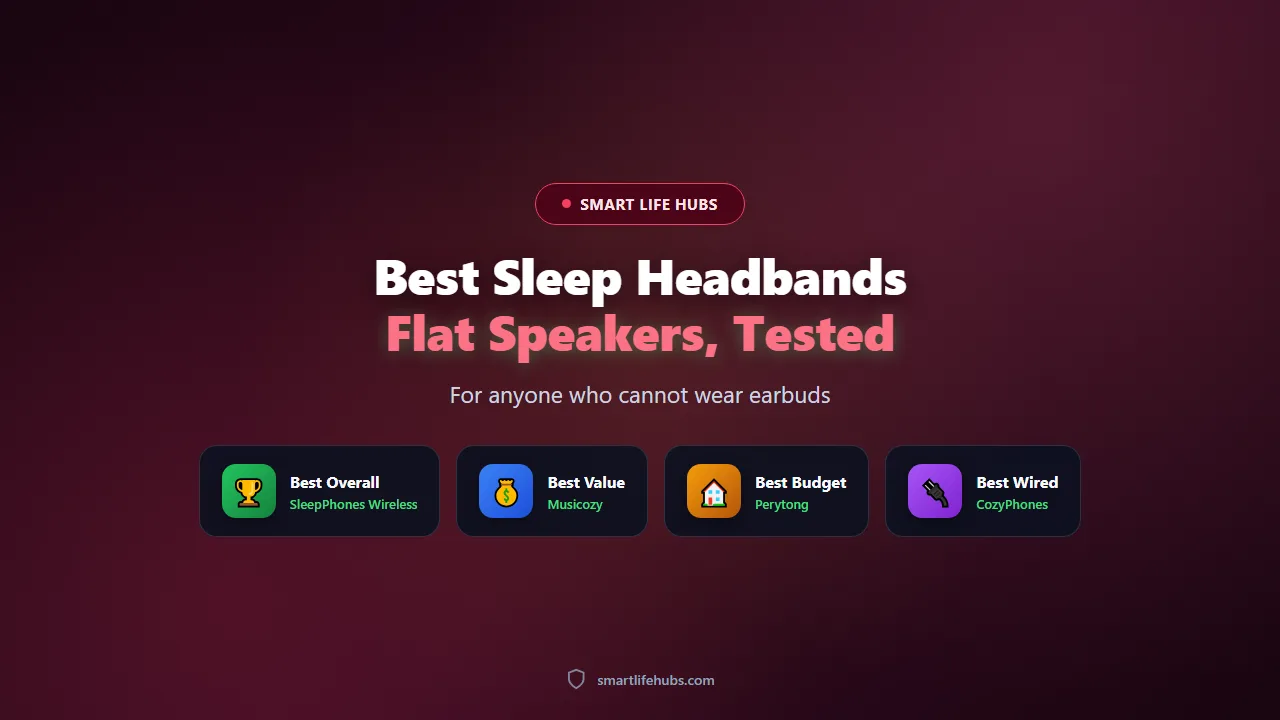
Best sleep headbands of 2026 are the flat-speaker headbands that let you listen to audio without anything in your ears, and the honest finding after wearing them for a month is that they are the answer for anyone who cannot tolerate earbuds or earplugs. The AcousticSheep SleepPhones is the original and the most comfortable, while the budget headbands are a reasonable way to try the idea for a fraction of the price.
The second thing to understand is that a sleep headband is a headphone rather than a mask or a white-noise machine. It plays your own audio, so the sound library is your phone’s, and it does not block noise unless you play it loudly. If you want to mask a snore, a headband will only help at a volume that may disturb you, and earplugs or a white-noise machine may be the better tool.
Prices below are US retail captured in November 2026 and they move with sales.
At a glance
| Product | Best for | Key specs | Price |
|---|---|---|---|
| AcousticSheep SleepPhones Wireless | Best overall | Flat speakers, Bluetooth, 24h battery, washable | About 90 to 110 USD |
| Musicozy Sleep Headphones | Best value | Bluetooth 5.4, thin speakers, mask combo | About 20 to 30 USD |
| Perytong Sleep Headphones | Best budget | Bluetooth, thin band, USB-C | About 15 to 20 USD |
| CozyPhones Sleep Headphones | Best wired | Wired 3.5 mm, no battery, washable | About 20 to 25 USD |
| Soundcore Sleep A30 | Best earbud alternative | In-ear, ANC, snore masking, 8h | About 150 USD |
The best sleep headbands of 2026
1. AcousticSheep SleepPhones Wireless, best overall
The SleepPhones are the pick because they are the original and the most considered design. The flat, felt-covered speakers sit inside a soft, machine-washable band, they come in several sizes and fabrics so you can find a fit, and the Bluetooth module and drivers remove for washing. The battery lasts about 24 hours and it costs about 90 to 110 dollars. The honest trade-offs are a price several times a budget headband, speakers that can shift in the night, and a passive design with no noise blocking, so it is the pick for someone who will use it every night and cannot tolerate earbuds.
Pros
- Flat speakers in a soft, machine-washable band
- Multiple sizes and fabrics, 24-hour battery
- About 90 to 110 dollars
Cons
- Pricier than the budget headbands
- Speakers can shift and it blocks no noise
Check today’s price on Amazon.
2. Musicozy Sleep Headphones, best value
The Musicozy is the pick if you want the headband idea for the least sensible money, because it offers Bluetooth 5.4, ultra-thin stereo speakers and a stretchy band that doubles as an eye mask, with an 8 to 10 hour battery, at about 20 to 30 dollars. The honest trade-offs are speakers that are uncomfortable to lie on for long periods, a blinking light that some people find annoying, a battery beep that is loud when it runs low, and a build that is thinner than the SleepPhones, so it is the pick for quiet bedtime audio rather than noise masking.
Pros
- Bluetooth 5.4 with ultra-thin speakers and a mask combo
- About 20 to 30 USD, the cheapest decent headband
- 8 to 10 hour battery
Cons
- Speakers can press and the light blinks
- Thinner build than the SleepPhones
Check today’s price on Amazon.
3. Perytong Sleep Headphones, best budget
The Perytong is the pick if you want the simplest cheap headband, because it is a thin Bluetooth band with a USB-C charge at about 15 to 20 dollars. The honest trade-offs are audio that is adequate for speech rather than music, a band that is thinner and less comfortable than the Musicozy, and a battery that is shorter, so it is the pick for a first try or a travel bag.
Pros
- About 15 to 20 USD, the cheapest here
- Thin band that is easy to pack
- USB-C charging
Cons
- Basic audio and a thinner band
- Shorter battery than the pricier options
Check today’s price on Amazon.
4. CozyPhones Sleep Headphones, best wired
The CozyPhones are the pick if you want no battery at all, because they are a wired headband with a 3.5 mm plug and flat speakers in a washable band, at about 20 to 25 dollars. The honest trade-offs are a cable that can pull in the night, a need for a headphone jack or a dongle on a modern phone, and no wireless convenience, so it is the pick for a child’s room or a phone with a jack.
Pros
- No battery and no charging
- Washable band with flat speakers
- About 20 to 25 dollars
Cons
- Wired, so the cable can pull
- Needs a headphone jack or a dongle
Check today’s price on Amazon.
5. Soundcore Sleep A30, best earbud alternative
The A30 is the pick if you want to mask noise as well as play audio, because it is an in-ear sleep earbud with active noise cancelling, a snore-masking mode and a case that extends the battery, at about 150 dollars. The honest trade-offs are a price at the top of the range, a battery that is shorter than a headband, and an in-ear design that some people cannot tolerate, so it is the pick for someone who wants the masking rather than the headband form.
Pros
- Active noise cancelling with a snore-masking mode
- Bluetooth streaming and a charging case
- About 150 dollars
Cons
- About 150 USD, the priciest here
- In-ear, so not for anyone who dislikes earbuds
Check today’s price on Amazon.
How to choose a sleep headband
Start with the ear, because the headband exists for people who cannot tolerate earbuds or earplugs. If you can wear earbuds, a sleep earbud will mask more noise for less money. If you cannot, a headband is the most comfortable way to listen in bed, and the choice then comes down to the build quality and the battery.
Then check the speaker and the fit, because a headband that shifts in the night will wake you. Look for removable, washable speakers, a band in the right size and fabric, and a design that keeps the speaker over the ear when you turn your head. A side sleeper needs a thin speaker that will not press, and a back sleeper has more freedom.
Check the battery and the charging, because a headband used every night should last at least a full night and preferably two. A 24-hour battery means charging every other day, while an 8-hour battery needs charging daily. Check the charging port and whether the band can be used while it charges, since a wired-only headband is limiting with modern phones.
Think about the audio and the noise, because a headband plays your own sound and blocks very little. If you want to mask a snore or a street, a headband will need a higher volume than you would like, and earplugs or a white-noise machine may be the better tool. If you want audiobooks, podcasts or your own sleep playlist, a headband is ideal.
Finally, be honest about the washing, because a headband sits on your face and collects skin oil and pillow residue. A removable, machine-washable band is worth paying for, and a sealed unit that can only be wiped will become unpleasant within a season. Wirecutter’s 2026 testing at nytimes.com/wirecutter/reviews/best-sleep-headphones covers the fit, the audio and the washability, and it is a useful check on whether the price is worth it before you spend above the budget.
Living with a sleep headband
Fit, speakers and the first nights
Fit is everything with a headband, because the speakers have to sit over the ear canal and stay there while you move. Try the band on sitting up, then lying on your side and on your back, and check that the speakers do not slide towards the forehead or the neck. A band that is too loose will migrate, and one that is too tight will give you a headache by the second night, so take the time to find the middle setting.
The first nights with a headband feel odd, because there is a thin pad pressing on the ear and the audio is coming from a different place than earbuds. Give it three or four nights before you judge the comfort, and adjust the band rather than concluding it does not fit, since most problems are solved by moving it a centimetre up or back rather than by choosing a different model.
Position the speakers over your ears before you settle, because a headband that starts in the wrong place will shift as you move. Slide the band so the speakers sit directly over the ear canal, then turn your head on the pillow to check that they stay put. A headband that moves in the first hour will move all night.
Set a sleep timer on the audio, because playing all night is unnecessary and will flatten the battery. Use the player’s sleep timer or a short playlist so the sound stops after you have dropped off, and keep the volume low enough that you would hear an alarm or a smoke alarm through it.
Wash the band regularly and remove the speakers first, because the band is the part that touches the skin and the hair. Follow the brand’s instructions, dry it fully before you refit the speakers, and wipe the speaker covers with a damp cloth rather than submerging them.
Charge it where you will remember, because a headband that is flat in the morning is one you will stop using. Keep the cable by the bed or charge it in the afternoon rather than at bedtime, and if the battery has become short, replace it or accept a charging routine.
Use it alongside the other sleep conditions, because the headband delivers the audio while the room, the light and the bedtime decide whether you sleep. Keep the room dark, the temperature cool and the bedtime consistent, and use the headband for the content rather than as a substitute for the routine, since a podcast will not fix a room that is bright and warm.
For the wider sleep range, our sleep earbud guide covers the in-ear alternative, and the sleep mask guide covers the light side.
One more decision worth making before you buy is whether the headband will replace a pillow speaker or a phone on the nightstand, because a pillow speaker is cheaper and will not move, but it is a flat pad that crinkles and a headband is a pad that can be worn while you read. If you only listen in bed, the headband wins; if you fall asleep with the phone on the pillow, the pillow speaker is enough.
Frequently asked questions
Frequently Asked Questions
6Are sleep headbands comfortable for side sleepers?
A thin, flat-speaker headband is comfortable for most side sleepers, because the speakers sit over the ear rather than inside it. A thick speaker or a hard module can press on the pillow, so look for a slim design and check that the speakers stay in place when you turn your head.
Do sleep headbands block noise?
Not by themselves. They play your own audio, so they mask noise only if you play it loudly enough, and they have no active noise cancelling. For blocking a snore or a street, earplugs or a white-noise machine are more effective.
Can I wash a sleep headband?
Most have a removable, machine-washable band and speakers that must come out first. Check the instructions, dry the band fully before refitting the speakers, and wipe the speaker covers rather than submerging them.
How long does the battery last?
A good headband lasts a full night and often longer, with 24 hours on the SleepPhones and 8 to 10 hours on the budget bands. Check the charge port and whether it can be used while charging, since a wired-only model needs a headphone jack.
Are sleep headbands worth it?
For someone who cannot tolerate earbuds and listens to audio in bed, yes. If you can wear earbuds, a sleep earbud masks more noise for less money, so the headband earns its price through comfort rather than performance.
Can I use a sleep headband with a phone that has no headphone jack?
Yes, if the headband is Bluetooth. A wired headband needs a USB-C or Lightning dongle, so check the connector before you buy, and prefer Bluetooth if your phone has no jack.
The bottom line
Buy the AcousticSheep SleepPhones Wireless at about 90 to 110 dollars if you want the best sleep headband, because the flat speakers, the size range and the washable band make it the one that will still be comfortable in a year.
Buy the Musicozy at about 20 to 30 dollars for the best value, the Perytong at about 15 to 20 dollars for the budget, the CozyPhones at about 20 to 25 dollars if you want no battery, and the Soundcore Sleep A30 at about 150 dollars if you want noise masking rather than a headband.
The honest point is that a headband is the comfort choice for people who cannot wear earbuds, not a noise-blocking device. Buy it for your own audio, wash the band regularly and use earplugs or a white-noise machine for the snore.



Leave a Comment