
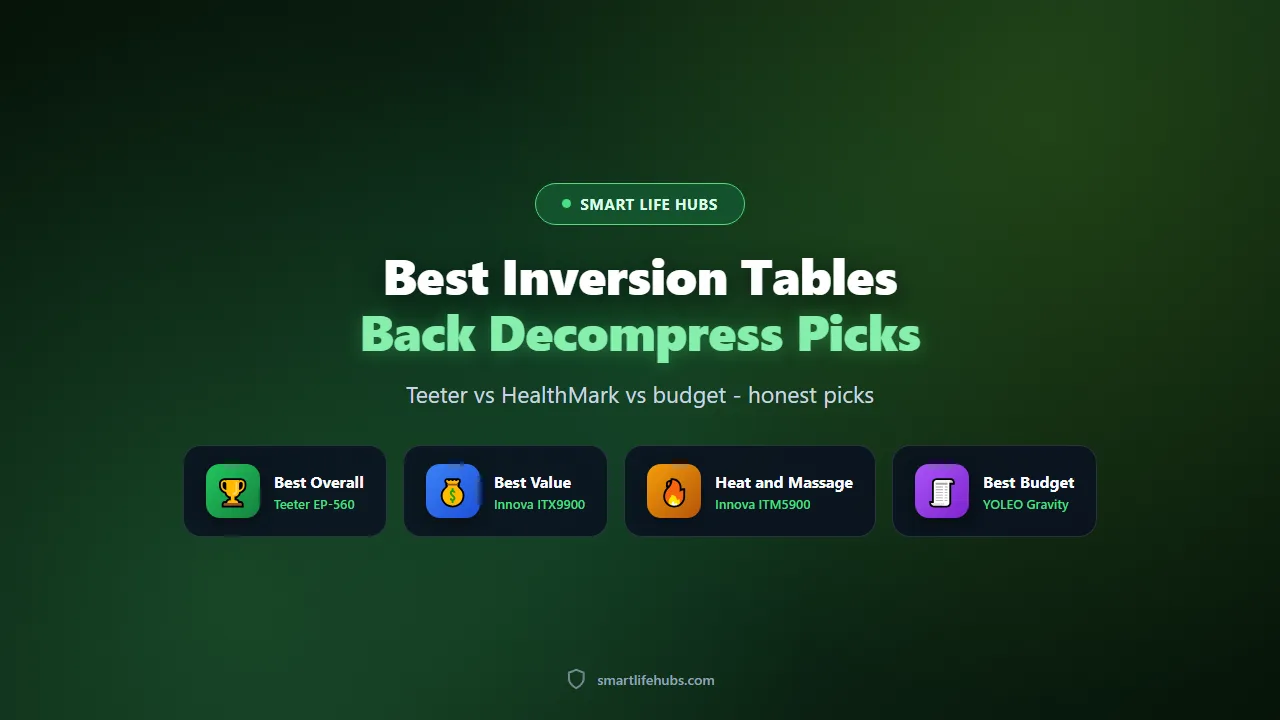
Best inversion tables of 2026 hold your ankles, let you tilt backward, and use gravity to stretch the spine in the opposite direction from how you spend your day. I have used an inversion table three times a week for about a year on a stiff lower back, and the honest finding is that it feels good and leaves you looser for a few hours, while the research on inversion for back pain is limited and mixed. This is comfort hardware, not a treatment.
The second thing worth knowing before you buy is that inversion is not for everyone. Tilting head-down raises pressure in the head and the eyes, so anyone with glaucoma, retinal problems, uncontrolled high blood pressure, a history of stroke or a heart condition should talk to a doctor before using one. The same applies during pregnancy. A table is also a large, heavy piece of equipment, and the entry and exit are where cheap models frustrate people, because you have to bend forward to reach the ankle lock while your back is the thing you are trying to avoid bending.
Prices below are US retail captured in November 2026 and they move with sales. What separates the tables is the ankle system, the backrest and the frame certification, not the number of accessories in the box.
At a glance
| Product | Best for | Key specs | Price |
|---|---|---|---|
| Teeter EP-560 Ltd. | Best overall | 300 lb capacity, FDA-registered 510(k), UL certified, ComforTrak bed | About $299 to $350 |
| Innova ITX9900 | Best value | 300 lb capacity, air lumbar bladder, adjustable headrest, six-angle pin | About $160 to $170 |
| Innova ITM5900 | Best with heat and massage | 300 lb capacity, heat and massage pad, six-angle pin, adjustable headrest | About $200 to $210 |
| Health Gear ITM5500 | Best comfort features | 300 lb capacity, memory foam backrest, removable heat and massage pad | About $200 |
| YOLEO Gravity Heavy Duty | Best budget | 300 lb capacity, steel frame, foam ankle holders, tether angle control | About $133 to $150 |
The best inversion tables of 2026
1. Teeter EP-560 Ltd., best overall
Teeter is the only brand whose tables are registered with the FDA as a 510(k) medical device, indicated for back pain, muscle tension and spasm, herniated disc, sciatica, degenerative disc disease, spinal stenosis, spinal curvature from tight muscles and facet syndrome, and it is UL safety certified at a 300 pound rating. The EP-560 uses a ComforTrak bed that flexes and slides for a deeper stretch, a tether strap for angle control, and an Ergo-Embrace ankle system with a soft foam liner and wrap-around design. It folds for storage and includes a free app with guided programs. It is heavy at about sixty-five pounds, and at two hundred and ninety-nine to three hundred and fifty dollars it is the most expensive pick here.
Pros
- FDA-registered and UL safety certified, the only table with that status
- Flexible bed gives a deeper stretch than a rigid board
- Comfortable wrap-around ankle system and a five-year warranty
Cons
- The most expensive pick, at about three hundred dollars
- Heavy and bulky, so it stays in one room
Check today’s price on Amazon.
2. Innova ITX9900, best value
The ITX9900 is the pick if you want most of the useful features for about a hundred and sixty to a hundred and seventy dollars. It has a 300 pound capacity, an air lumbar bladder you can inflate to put support exactly where your back needs it, an adjustable headrest, and a six-position pin system that lets you set the inversion angle. The True Balance adjustment helps taller and shorter users find a comfortable fit. It is not certified like the Teeter and the backrest is a padded foam board rather than a flexible bed, but for the price it is the best balance of features and cost in this roundup.
Pros
- About a hundred and sixty dollars, a third of the Teeter price
- Air lumbar bladder lets you tune the support to your back
- Adjustable headrest and a six-position angle pin
Cons
- Foam backrest does not flex, so the stretch feels less natural
- Ankle system is foam rollers rather than a wrap-around cup
Check today’s price on Amazon.
3. Innova ITM5900, best with heat and massage
The ITM5900 is the same frame as the Innova line with a heat and massage pad added to the backrest, and it is the pick if you like warmth while you stretch. The 300 pound capacity and six-angle pin system are the same, and the pad adds a massage vibration plus heat for the lower back during the session. At about two hundred to two hundred and ten dollars it costs more than the ITX9900 for the pad, and the pad is a separate piece that can be removed if you decide you do not use it.
Pros
- Heat and massage built into the backrest
- Six-angle pin system and a 300 pound capacity
- Pad is removable, so the table still works without it
Cons
- Costs about forty dollars more than the ITX9900 for the pad
- Massage motors add weight and one more thing to fail
Check today’s price on Amazon.
4. Health Gear ITM5500, best comfort features
The ITM5500 is the pick for someone who wants the most padded, most cushioned session. It has a 300 pound capacity, a four-inch-thick padded racing-style backrest with memory foam, and a removable heat and massage pad, plus dual-roller ankle supports with an extended easy-reach lever so you do not have to fold forward to lock in. It folds for storage. At about two hundred dollars it competes with the Innova ITM5900, and the extra padding is the reason to pick it.
Pros
- Four-inch memory foam backrest is the plushest here
- Extended-reach ankle lever reduces bending at entry
- Removable heat and massage pad
Cons
- Heavier and less compact when folded than the Innova
- No certification to match the Teeter
Check today’s price on Amazon.
5. YOLEO Gravity Heavy Duty, best budget
YOLEO is the cheapest table worth considering. It has a steel tube frame, a 300 pound capacity, a memory foam backrest with a headrest, foam-cushioned ankle holders, and a tether strap that caps the tilt angle so you can start shallow. It folds for storage and costs about a hundred and thirty-three to a hundred and fifty dollars. The trade-offs are a simpler ankle system, a shorter warranty and less refinement in the rotation, and the budget build is exactly where the cheaper tables feel wobbly.
Pros
- About a hundred and thirty-three dollars, the lowest price here
- 300 pound capacity and a memory foam backrest
- Tether strap lets you cap the angle and start gently
Cons
- Rotation is less smooth and the frame feels lighter
- Ankle holders are basic foam rollers
Check today’s price on Amazon.
How to choose the best inversion table
Check your own health before you shop, because inversion is a real contraindication for some people. Tilting head-down raises pressure in the head and the eyes, so glaucoma, retinal detachment, uncontrolled hypertension, a history of stroke, heart disease and pregnancy all need a clinician’s sign-off first. If you have any of those, a gentle back stretcher or a foam roller is the safer route.
Then look at the ankle system, because that is what you interact with every session and where the cheap tables fail. A wrap-around cup with a foam liner, as on the Teeter, holds the ankle securely and is comfortable for a full session. Foam rollers are adequate but can feel tight on wider ankles, and a spring-pin closure is fiddlier than a lever. If you have a bad back, an extended-reach handle matters a great deal, because bending forward to lock your ankles is the one movement you are trying to avoid.
Capacity and height range are the specs that get ignored. Most tables are rated to 300 pounds, which covers most adults, but a few budget models are rated to 250, and a couple of heavy-duty models go to 350 or 600. Check the height range too, because a table that fits 4 feet 8 inches to 6 feet 6 inches covers almost everyone, and a shorter range will not suit a tall user.
Backrest design decides how natural the stretch feels. A flexible bed that slides and flexes, like the Teeter ComforTrak or the FitSpine FlexTech, lets the spine decompress as you tilt, which is why those tables feel better than a rigid foam board. A rigid board still works, it just gives a different, more static stretch.
Finally, check the certification and the warranty. Teeter is the only brand registered with the FDA as a 510(k) medical device and UL safety certified, and it carries a five-year warranty. Most budget tables carry a one-year warranty and no third-party safety certification, which is worth knowing on a device that holds your full bodyweight upside down. A safety-first 2026 buyer’s guide at trustedhealthgear.com/reviews/best-inversion-table walks through the frame, ankle and certification questions in more detail.
Living with an inversion table
Start shallow and short. Set the tether to the first preset, usually about twenty degrees, and invert for one to two minutes the first few times. Most people want to go full inversion immediately and end up with a headache or a sore back the next day. Build toward forty-five to sixty degrees over a couple of weeks, and keep sessions to five to ten minutes.
Use the ankle lock correctly. Sit on the table, slide your feet into the holders, and lock them snugly with the lever before you tilt. The holders should feel secure rather than crushing, and you should be able to slide a finger between the foam and your ankle. If your feet tingle or go numb during a session, your ankles are too tight.
Move slowly on the way back up. The return is where people feel lightheaded, so come up in stages, pausing at about thirty degrees for a few seconds before you sit fully upright. Never bounce at the bottom of the tilt, and never try inverted exercises on a budget table.
Give it time and keep it consistent. Inversion feels good in the moment and the benefit is cumulative for most people, so three sessions a week for a month is a fair trial. If you feel worse after a week, stop. Increased pain, dizziness or a headache that lingers are signs that inversion is not for your back.
Pair it with the work that actually treats the problem. Inversion decompresses and stretches, which helps symptoms, but it does not strengthen the muscles that hold your spine. A daily routine of gentle core and hip work, plus the mobility you can do on a foam roller, will do more over a month than the table alone. If a cushion at your desk is what keeps the curve in your lower back through the day, our guide to the best lumbar support cushions covers the picks worth the money. And if your pain comes with numbness, tingling down a leg or weakness, that is a reason to be assessed rather than a reason to invert more.
Frequently asked questions
Frequently Asked Questions
6Do inversion tables actually relieve back pain?
The research is limited and mixed. Some people get real short-term relief from gentle traction and stretching, and many clinicians use it as an adjunct. It is comfort hardware rather than a treatment, and it should not replace assessment or exercise for a persistent problem.
How long should I invert for?
Start with one to two minutes at a shallow angle and build toward five to ten minutes at forty-five to sixty degrees. Longer is not better, and most people feel best with short, regular sessions rather than long occasional ones.
Who should not use an inversion table?
Anyone with glaucoma or retinal problems, uncontrolled high blood pressure, a history of stroke, heart disease, or who is pregnant should get medical advice first. Inversion raises pressure in the head and eyes, and those conditions make that risky.
Are cheap inversion tables safe?
A budget table from a known brand is generally safe if you stay within the weight and height limits and assemble it correctly. The trade-offs are a lighter frame, a less smooth rotation and a shorter warranty, and the very cheapest models can feel unstable at full inversion.
What is the difference between a rigid and a flexible backrest?
A rigid foam board holds you in a fixed curve and gives a static stretch. A flexible bed that slides and flexes, as on the Teeter, lets the spine decompress as you tilt, which most people find more comfortable and more effective.
Can I do exercises while inverted?
Some tables, including the Teeter, are rated for inverted exercises and have a secure lockout. It is not something to try on a budget table, and it is not the reason most people buy one. Gentle stretching while inverted is fine once you are comfortable at the angle.
The bottom line
Buy the Teeter EP-560 Ltd. if you want the best-built and safest table here and you have the budget. It is the only inversion table registered with the FDA as a 510(k) device and UL safety certified, the flexible bed gives a deeper and more comfortable stretch, and the five-year warranty is the longest in the category. At about three hundred dollars it is a serious purchase.
The Innova ITX9900 at a hundred and sixty to a hundred and seventy dollars is the pick for most people, because the air lumbar bladder and the adjustable headrest cover the important features at a third of the price. If you want heat while you stretch, the Innova ITM5900 at about two hundred dollars is the one, and the YOLEO at a hundred and thirty-three dollars is the budget choice.
Before you buy any of them, check your own health. Inversion raises pressure in the head and eyes, and it is a genuine contraindication for several common conditions. If you are cleared, start at twenty degrees for two minutes, build slowly, and pair the table with the core and mobility work that actually addresses the cause.


Leave a Comment