
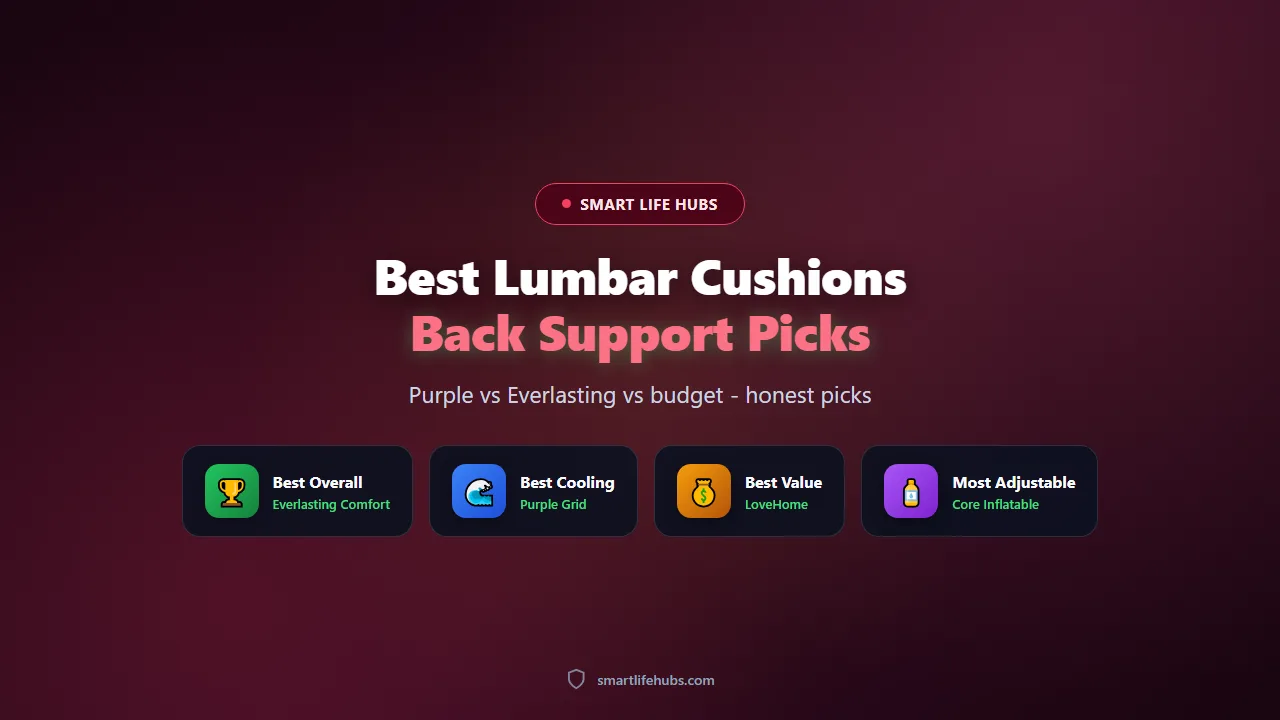
Best lumbar support cushions of 2026 all do one job, which is filling the gap between your lower back and the chair so the natural curve of the spine does not collapse into a slump. I have used a memory foam cushion at a desk for three years and tried the gel grid and the inflatable versions alongside it, and the honest finding is that the plain memory foam cushion is the one most people should buy, because it is supportive enough to matter and soft enough to sit on for eight hours.
The second thing to know is that a cushion is not a fix for a bad chair. If the seat is too deep, too low or shaped wrong, a cushion can only partly compensate, and the money is better spent on the chair. A cushion helps most when the chair is basically fine but has a flat or weakly supported back, which is the situation most office and car seats leave you in. It also helps when you are tall, because a chair back that suits an average-height person often leaves a gap at your lumbar curve.
Prices below are US retail captured in November 2026 and they move with sales. What actually separates the cushions is the foam density, the strap system and the cover, not the number of features in the listing.
At a glance
| Product | Best for | Key specs | Price |
|---|---|---|---|
| Everlasting Comfort Lumbar Pillow | Best overall | Contoured memory foam, two straps with extenders, mesh cover, fits to 32 inch chairs | About $27 to $40 |
| Purple Back Cushion | Best cooling | Hyper-elastic GelFlex grid, open air channels, single strap | About $79 |
| LoveHome Memory Foam | Best value | High-resilience memory foam, 3D mesh cover, two straps with extenders | About $28 |
| Cushion Lab Ergonomic Lumbar | Best premium | Extra-dense memory foam, non-slip strap, contoured profile | About $69 |
| Core Products Deluxe Inflatable | Best adjustable | Inflatable chamber, webbing strap, firmness you set yourself | About $55 |
The best lumbar support cushions of 2026
1. Everlasting Comfort Lumbar Pillow, best overall
This is the cushion most people should buy first, and the owner numbers are the reason. It is a contoured slab of heat-responsive memory foam that softens slightly to your back over a few minutes, held on with two adjustable straps and extensions that reach chairs up to about 32 inches wide. The two-strap system is the quiet reason it works where cheaper cushions slide down, because it anchors the top and the bottom so the support stays parked at the lumbar curve instead of migrating to the seat by lunchtime. The mesh cover is removable and washable, there is a lifetime replacement guarantee, and it costs twenty-seven to forty dollars.
Pros
- Two straps with extenders anchor it at the right height
- Contoured foam suits most body sizes and chair types
- Removable mesh cover and a lifetime replacement guarantee
Cons
- Wirecutter found it softer than consistently supportive in its 2026 retest
- Straps can be too long for smaller chairs, so they flap
Check today’s price on Amazon.
2. Purple Back Cushion, best cooling
Purple uses the same hyper-elastic GelFlex grid as its mattresses and seat cushions, an open lattice of air channels that does not trap body heat the way a solid foam block does. It attaches with a single adjustable strap and suits people who find foam too warm, or who sit in a car for long stretches. The honest trade-off is support: Wirecutter tested it in 2026 and found the grid fun and breathable but not substantial enough to beat a firmer, cheaper option. At about seventy-nine dollars it is the most expensive pick here.
Pros
- Open grid stays cool through long sits and hot cars
- Flexible and lightweight, with a low-profile look
- Good for people who find memory foam claustrophobic
Cons
- Less firm support than the memory foam cushions
- About seventy-nine dollars, the priciest option in this list
Check today’s price on Amazon.
3. LoveHome Memory Foam, best value
LoveHome does about ninety percent of the job for two-thirds of the price. It is a high-resilience memory foam block in a breathable 3D mesh cover, with adjustable straps and extenders that the brand markets as a three-way fixation system, which is functionally two straps plus reach extenders. With well over twenty-five thousand reviews at a high average, it is one of the most trusted cheap picks in the category. It is a plain rectangular-ish cushion rather than a shaped one, so it suits people who want a simple lift rather than a pronounced contour.
Pros
- About twenty-eight dollars with tens of thousands of reviews
- Breathable mesh cover and adjustable straps with extenders
- Firm enough to hold the curve without feeling hard
Cons
- Less contoured than the Everlasting Comfort or Cushion Lab
- Cover fits tightly and can be awkward to remove for washing
Check today’s price on Amazon.
4. Cushion Lab Ergonomic Lumbar, best premium
Cushion Lab is the pick if you want a firmer, more deliberately shaped cushion and you are willing to pay for it. It uses extra-dense memory foam in a contoured profile that puts more pressure at the lumbar curve and less at the surrounding tissue, with a non-slip strap to hold it in place. At about sixty-nine dollars it sits between the budget picks and the Purple, and the extra density is the reason to choose it, because a firmer cushion keeps its shape through a long day while a soft one flattens by mid-afternoon.
Pros
- Extra-dense foam holds its shape through long sits
- Contoured profile targets the curve rather than the whole back
- Non-slip strap and a well-finished cover
Cons
- About sixty-nine dollars, more than twice the budget picks
- Firm feel is too hard for some people on the first day
Check today’s price on Amazon.
5. Core Products Deluxe Inflatable, best adjustable
The inflatable cushion is the odd one out and the one to buy if you cannot find a foam shape that suits you. You set the firmness yourself with a small chamber and a webbing strap holds it in place. That adjustability is the whole product: a person who finds every foam cushion either too soft or too hard can dial in exactly the support they want, and the cushion packs flat for travel. At about fifty-five dollars it is not cheap for an inflatable, and it requires occasional re-inflation, but for a specific fit problem it is the most flexible option here.
Pros
- Firmness is set by you rather than fixed at the factory
- Packs flat, so it travels well
- Useful when foam shapes never quite fit
Cons
- Needs re-inflation and can feel unstable if under-filled
- No contour, so it is a lift rather than a shaped support
Check today’s price on Amazon.
How to choose the best lumbar support cushion
Start with your chair, because the cushion has to fit it. Measure the width of the backrest and check the strap reach, since several cushions top out around 32 inches and a large executive chair can exceed that. Check the seat depth too: if your chair is too deep, a cushion makes the effective depth shorter, which is usually helpful, but if it is already shallow, a thick cushion will push you forward and leave your feet dangling.
Then decide how firm you want the support. A soft memory foam cushion feels comfortable immediately and suits short sits and car journeys. A firmer, denser cushion holds the curve through a full workday and is the better choice for eight hours at a desk, at the cost of feeling hard for the first day or two. If you have a disc problem or a specific diagnosis, ask your clinician what level of support they want you using rather than guessing.
Check the strap system, because a cushion that slides is worse than no cushion. Two straps with extenders, as on the Everlasting Comfort and the LoveHome, anchor the top and the bottom and stay put. A single strap is simpler but lets the cushion rotate and drift. In a car, a non-slip base matters as much as the strap, because the cushion shifts every time you get in and out.
Cover and breathability matter more than the spec sheet suggests. A mesh or 3D-mesh cover stays cooler than solid memory foam against your back, and a removable, machine-washable cover means the cushion will be cleaned rather than replaced. If you run hot, the gel grid is the pick; if you do not, the mesh-covered foam cushions are fine.
Finally, be honest about the limits. A cushion improves comfort and helps you hold a better position, but it does not correct posture on its own and it does not replace a chair that fits. A careful 2026 retest at nytimes.com/wirecutter/reviews/best-lumbar-support-pillow tested the leading cushions and found that the former top picks were softer than they expected and that a less expensive, sturdier option won, which is a good reminder that the most-reviewed cushion is not automatically the most supportive.
Living with a lumbar cushion
Position it at the belt line, not the ribs. The cushion should sit where the natural inward curve of your lower back is, roughly level with your navel or belt buckle, and it should feel like it is filling a gap rather than pushing you forward. If it pushes your chest out or forces you upright, it is too high or too thick.
Give it a week before you judge it. A firm cushion feels wrong for the first two or three days because your back is used to slumping, and most people abandon a good cushion during that window. Sit with it for an hour at a time at first, then extend to a morning, and see how your back feels after a full afternoon rather than in the first ten minutes.
Adjust your chair to work with the cushion, not against it. Raise or lower the seat so your hips are at or slightly above knee level, move the backrest so the cushion meets your curve, and keep the armrests at a height where your shoulders stay down. A cushion plus a badly set chair is still a badly set chair.
Keep it clean and check the straps. A weekly wipe of the cover and a monthly wash of a removable one prevents the build-up of skin oil, and the straps should be checked every few months because a stretched strap is what lets the cushion drift to the seat. Replace the cushion when the foam stops springing back or develops a permanent dip.
Use the cushion as part of a routine, not as the whole solution. It holds you in a better position, but the muscles that keep you there have to be trained. Pair it with the posture work that stops the slump, and our guide to the best posture correctors covers the trainers that catch you before the cushion has to. For the lower body, a standing desk mat changes the picture more than any cushion when most of your day is on your feet.
Frequently asked questions
Frequently Asked Questions
6Do lumbar support cushions actually work?
They work as a comfort and positioning aid, filling the gap at the lower back so the spine holds its natural curve instead of collapsing. They do not fix posture or treat a back problem, and a cushion cannot compensate for a chair that is the wrong size or shape.
Where should a lumbar cushion sit?
At the belt line, over the natural inward curve of the lower back, not up at the ribs and not down on the seat. It should feel like it is filling a gap, and it should not push your chest out or force you upright.
How firm should a lumbar cushion be?
Firm enough to hold its shape through a long sit. A soft cushion feels nicer for ten minutes and flattens by lunchtime, so for a full workday a denser foam is the better choice, even if it feels hard for the first couple of days.
Can I use a lumbar cushion in a car?
Yes, and it helps most on long drives, because car seats are usually flat and slightly reclined. Choose one with a non-slip base and a strap that will not slip, and keep it at the belt line rather than under the thighs.
Are expensive lumbar cushions worth it?
Sometimes. A firmer, denser cushion holds its shape longer and is worth the money for all-day desk use, and a gel grid is worth it if you run hot. For short sits and travel, a thirty-dollar memory foam cushion does the job.
Who should be careful using a lumbar cushion?
Anyone with a recent back injury, a diagnosed spinal condition, or pain that comes with numbness, tingling or weakness should get advice before using one, because a cushion changes your position and can aggravate some conditions.
The bottom line
Buy the Everlasting Comfort Lumbar Pillow unless you have a specific reason not to. The contoured memory foam suits most backs, the two-strap system with extenders keeps it at the right height where cheaper cushions slide, the mesh cover breathes, and it costs twenty-seven to forty dollars with a lifetime replacement guarantee.
The upgrades are specific. The Purple Back Cushion at about seventy-nine dollars is the pick if you run hot or sit in a car for hours, because the open grid does not trap heat. The Cushion Lab at about sixty-nine dollars is the one if you want a firmer cushion that holds its shape through a full day. And the LoveHome at about twenty-eight dollars is the best value here, doing most of the job for two-thirds of the price.
Position it at your belt line, give it a week, and adjust the chair to work with it. A cushion holds you in a better position, but it cannot do the work for you, so pair it with the posture and core work that keeps you there once the cushion comes off.





Leave a Comment