
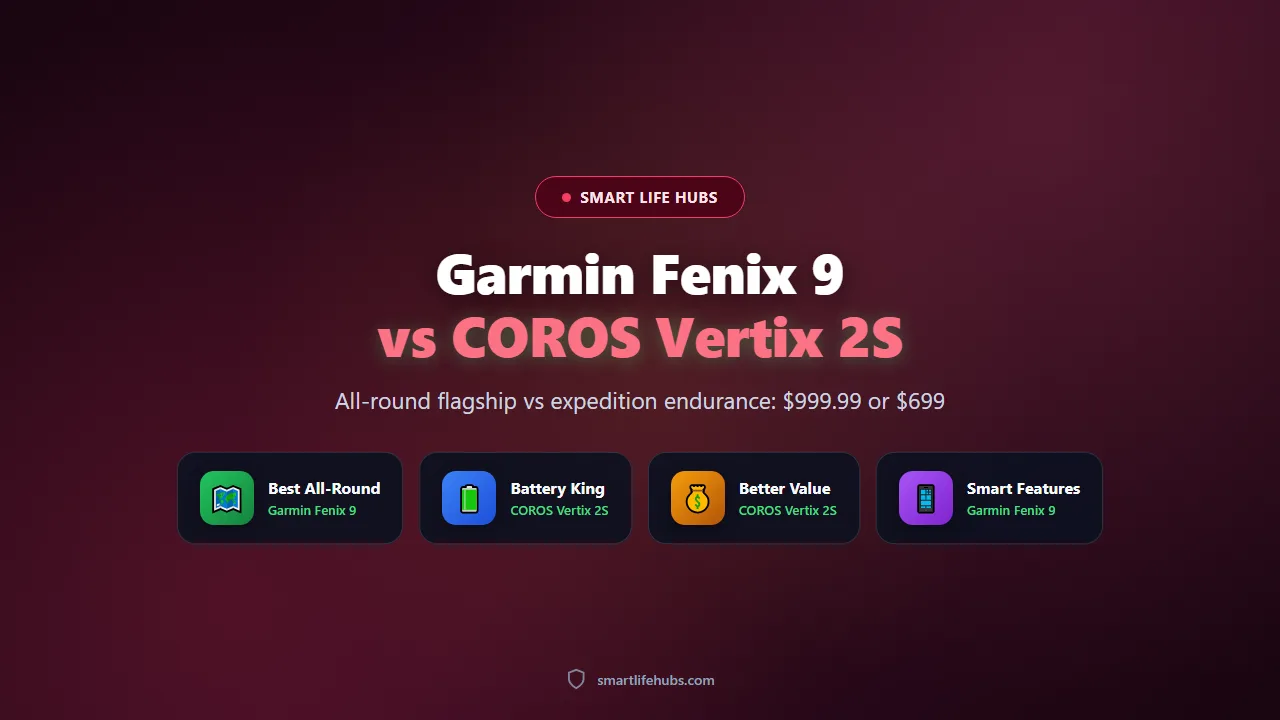
The Garmin Fenix 9 and the COROS Vertix 2S are the two watches that treat a week in the mountains as a normal weekend. The Fenix 9 starts at $999.99 with an AMOLED display, multi-band GPS, 64GB of storage, and a battery that runs 10 to 29 days depending on case size. The Vertix 2S costs $699, swaps the AMOLED panel for a transflective memory-in-pixel screen, and trades the smart features for endurance, with 36 days of daily use and 118 hours of GPS. One is the better all-round watch. The other is the better watch for being far from a wall socket.
The comparison is about priorities more than price. The Fenix 9 wants to be the only watch you own, with maps, music, payments, training readiness, and a huge app store. The Vertix 2S wants to record your expedition accurately and never ask for a charge, and it accepts a smaller feature set to do that. Neither approach is wrong, and the right one depends on how far you go and how much you care about apps.
I compared manufacturer specifications, Runner’s World’s COROS testing, Outdoor Gear Lab’s watch reviews, and owner reports from the Garmin and COROS communities. Where a figure is a claim rather than a measurement, I say so. Prices are US street prices as of November 2026.
At a glance
| Criteria | Garmin Fenix 9 | COROS Vertix 2S |
|---|---|---|
| Price | From $999.99, up to $1,299.99 Pro Solar inReach | $699 |
| Display | AMOLED, sapphire, up to 3,000 nits | 1.4in transflective memory-in-pixel, sapphire |
| Case | Titanium bezel over polymer, 43 to 51mm | Titanium bezel, 10ATM |
| Battery (daily) | 10 days (43mm), 16 (47mm), 29 (51mm) | Up to 36 days |
| GPS battery | 49 hours (43mm) to 54 hours (51mm) | Up to 118 hours |
| Storage | 64GB for maps and music | No music storage |
| Navigation | Full maps, route planning, Connect IQ apps | Offline topographic maps, track following |
| Training metrics | Readiness, HRV status, load, stamina zones | Training load, fatigue, recovery |
| Best for | All-round multisport and navigation | Expeditions and ultra-endurance events |
Garmin Fenix 9 vs COROS Vertix 2S: how they compare
Price and positioning
The Vertix 2S is $699, which is $300 less than the entry Fenix 9 and $600 less than the Pro Solar inReach. COROS is selling endurance hardware at a price that undercuts the flagship it is trying to displace, and it has done that consistently since the first Vertix. The Fenix 9 costs more because it does more: maps, music, payments, an app store, and a training ecosystem that has accumulated for years. If you want one watch for daily life and occasional adventure, the Garmin justifies its price. If you want a watch that exists to keep recording, the COROS is the rational buy.
Display and legibility
The Fenix 9 has the better screen in most conditions. Its AMOLED panel with sapphire glass reaches up to 3,000 nits on the Pro model, so maps, metrics, and notifications are crisp and bright in direct sun. The Vertix 2S uses a transflective memory-in-pixel display, which is not as vivid and has no backlit colour, but it is always visible without waking the watch and it sips power. In bright alpine sun the COROS is genuinely readable and arguably easier on the eyes over a long day. At night and in the dark, the Garmin is far better. If you navigate by screen often, the Fenix 9 wins. If you glance at your wrist twice a day in the mountains, the Vertix 2S is good enough and costs you almost no battery.
Battery life
This is the COROS argument, and it is strong. The Vertix 2S is rated at 36 days of daily use and 118 hours of GPS, and Runner’s World measured a one-hour dual-frequency run draining just 2 percent, which suggests a month of training on a single charge. The Fenix 9 runs 10 days on the 43 millimetre case, 16 on the 47, and 29 on the 51, with 49 to 54 hours of GPS. So the COROS matches the largest Fenix 9 for daily use and more than doubles its GPS endurance. For a multi-day race, a long trek, or a simple hatred of charging, the Vertix 2S is the better tool. Note that the Fenix 9’s 29-day figure belongs to the 51 millimetre case, which is the heaviest and largest option. Runner’s World’s COROS watch guide reached similar conclusions in its own testing.
GPS accuracy and navigation
Both watches use dual-frequency GNSS across multiple satellite systems, and both track accurately in testing, including in tree cover and steep terrain. The difference is what happens after the track. The Fenix 9 carries full-colour maps, route planning, a perspective map view, and Connect IQ navigation apps, so you can plot a route, follow turn-by-turn prompts, and reroute on the fly. The Vertix 2S has offline topographic maps, track following, waypoints, and breadcrumb navigation, which covers most backcountry travel but is less detailed and less interactive. If navigation is how you use the watch, Garmin is clearly ahead. If you follow known routes and want to mark points along the way, COROS is fine.
Training metrics and ecosystem
The Fenix 9 is the better training computer. It reports training readiness, HRV status, acute and chronic load, recovery time, stamina zones, and a stamina curve, and it adds Body Battery for daily energy. The Vertix 2S reports training load, fatigue, recovery, and training effect, and its EvoLab tools are solid for endurance athletes, but the library is smaller and the coaching less detailed. Both sync to Strava and third-party platforms. If you coach yourself from data, the Garmin is the better instrument. If you mostly want to know whether you are fresh or fatigued, the COROS answers that question.
Sleep, health sensors, and daily metrics
Both watches track sleep, resting heart rate, blood oxygen, and stress, and both will report a recovery number in the morning. The Fenix 9 adds HRV status, Body Battery, and a sleep score with coaching, and its readiness metric combines sleep, stress, and training load into one number you can act on. The Vertix 2S tracks sleep stages and reports recovery and fatigue through EvoLab, and its numbers are reliable for endurance training, but the presentation is sparser and the coaching is thinner. Neither watch has an ECG. If sleep quality and daily readiness drive your decisions, the Fenix 9 explains itself better. If you want a simple fresh-or-fatigued answer before a long run, the COROS is enough.
Durability, weight, and daily wear
Both watches are built for abuse. The Fenix 9 is rated to 10ATM with a dive rating to 40 metres and leakproof buttons, and the Pro models add solar charging and inReach satellite messaging. The Vertix 2S is rated to 10ATM with a titanium bezel, sapphire glass, and an operating range from minus 30 to 50 degrees Celsius, which is the better specification for cold expeditions. Weight is the trade-off: the Vertix 2S weighs 70 grams on a nylon band and 87 grams on silicone, while the Fenix 9 ranges from 45 to 77 grams depending on case and band. The COROS is bulky and can catch on tight jacket cuffs, which owners mention often. If you want the lighter watch, the smaller Fenix cases win.
Smart features and daily use
The Fenix 9 is the more complete daily watch, with Garmin Pay, music storage for up to 7,000 songs, notifications, and a broad app store. The Vertix 2S has notifications and basic smartwatch functions but no music storage and no contactless payments, and its notification handling is clumsier than Garmin’s. If you want one device that handles your phone calls, music, and payments on a run, the Garmin is the only choice here. If the watch is a training instrument you check rather than a companion you talk to, the COROS costs less and asks for less attention.
Which one should you buy
Buy the Garmin Fenix 9 if you want one watch for everything. It has the better screen, full maps, music, payments, the deepest training metrics, and the biggest app ecosystem. It costs $999.99 and up, and it suits athletes who want navigation and daily smart features alongside their training data.
Buy the COROS Vertix 2S if you want the best battery and the least fuss. At $699 it runs 36 days of daily use and 118 hours of GPS, tracks accurately with dual-frequency GNSS, and covers offline maps and breadcrumb navigation. It suits ultra runners, expedition athletes, and anyone who spends multiple days away from a charger and does not need music or payments on the wrist.
Neither is right if you want the cheapest reliable GPS watch. The COROS PACE 4 at $249 and the Amazfit Balance Ultra at $599.99 both cover daily training and maps for less. The premium here buys expedition battery life, metal build, and navigation depth, and you should only pay for what you will actually use.
Ask what the watch is for on a Tuesday. Both of these are adventure watches, but most days are not adventures. If the watch will sit on your wrist through a working week and come out for a weekend run, the Fenix 9’s screen, notifications, music, and payments earn their keep. If it will live in a drawer until the next expedition, you are paying for smart features you never use, and the COROS is the better value.
Think about how you will charge it. If you travel for a week at a time, the Vertix 2S is the better fit. If you charge your watch on the nightstand every few days, the Fenix 9’s battery advantage disappears and its better screen and maps become the deciding factors.
Do the ecosystem math before you switch. Both watches sync to Strava and third-party platforms, so leaving either one is not a data problem. The cost is the coaching history and the app ecosystem. If you already use Connect IQ apps or Garmin’s readiness metrics, the Fenix 9 is the easier upgrade. If you are starting fresh, the Vertix 2S is the cheaper way into expedition-grade tracking. For a broader look at the category, our fitness tracker guide covers all price bands, and our full Garmin Fenix 9 review goes deeper on the Garmin.
Care, charging, and real-world use
Charge habits decide the battery story. The Vertix 2S is the easier watch to live with because it asks for a charge roughly once a month, while the Fenix 9 asks every one to three weeks depending on the case and how much GPS you log. If you already charge your phone nightly, the Fenix 9 fits that rhythm and the battery gap narrows. If you travel for a week at a time, the COROS removes the charger from your packing list entirely.
Protect the glass and the bezel. Both watches use sapphire, which resists scratches but not hard knocks against rock, a climbing buckle, or a pack strap. The titanium bezels on both are tougher than aluminium, and owners who climb or work outdoors should still avoid using the watch as a hand tool. A soft pouch in a pack is enough for normal travel.
Common mistakes when switching systems. The first is expecting the Vertix 2S to behave like a smartwatch; it will not store music or take payments, and the notification handling is basic. The second is assuming the Fenix 9 matches the COROS on a week-long expedition; at 49 to 54 hours of GPS it needs a charge mid-trip on the longest efforts. The third is ignoring the size. The 51 millimetre Fenix 9 is the one with the 29-day battery, and it is also the heaviest option at 77 grams, so try the 47 millimetre if you want a balance.
Who should skip both. If you run three times a week on roads and mostly want pace, heart rate, and sleep, neither watch is the value. The $249 COROS PACE 4 or the $599.99 Amazfit Balance Ultra covers that training for less. These two watches earn their cost when the route is long, remote, or measured in days rather than kilometres.
Frequently asked questions
Frequently Asked Questions
6Is the Garmin Fenix 9 better than the COROS Vertix 2S?
Better all-round watch, yes. Better expedition watch, no. The Fenix 9 has a brighter AMOLED screen, full maps, music, payments, and deeper training metrics. The Vertix 2S lasts 36 days daily and 118 hours of GPS against 10 to 29 days and 49 to 54 hours, and it costs $300 less.
How long does the COROS Vertix 2S battery last?
COROS rates it at up to 36 days of daily use and 118 hours of full GPS. Runner’s World measured a one-hour dual-frequency run draining about 2 percent, which works out to roughly a month of training on a charge. Cold weather and constant GPS use reduce those figures.
Does the COROS Vertix 2S have maps?
Yes, offline topographic maps with track following, waypoints, and breadcrumb navigation. It lacks the full-colour, turn-by-turn mapping and third-party navigation apps that the Fenix 9 offers, so it is better for following a route than for planning one on the wrist.
Which has better GPS accuracy, Garmin or COROS?
They are close. Both use dual-frequency GNSS across multiple satellite systems, and both track accurately in testing, including in tree cover and steep terrain. Garmin adds SatIQ to pick the mode automatically and has a larger mapping ecosystem, which matters more for navigation than for raw track accuracy.
Is the COROS Vertix 2S too big?
It is bulky. It weighs 70 grams on a nylon band and 87 grams on silicone, and owners report that the case height catches on tight jacket cuffs. If you have a small wrist or want an all-day watch, the smaller Fenix 9 cases at 45 to 50 grams are the more comfortable option.
Can either watch take calls or store music?
The Fenix 9 can store up to 7,000 songs and supports notifications and Garmin Pay. The Vertix 2S has notifications but no music storage and no contactless payments. If those features matter on a run, the Garmin is the only one here that offers them.
The bottom line
Buy the Garmin Fenix 9 if you want the better screen, full maps, music, payments, and the deepest training ecosystem, and you accept charging every one to three weeks. Buy the COROS Vertix 2S if you want 36 days of daily use, 118 hours of GPS, and a $699 price, and you can live without music and payments on your wrist. For a week-long expedition the COROS is the easier watch to own. For everything else, the Fenix 9 is still the more complete tool. Which one would you take on a long mountain route? Tell us in the comments.




Leave a Comment