
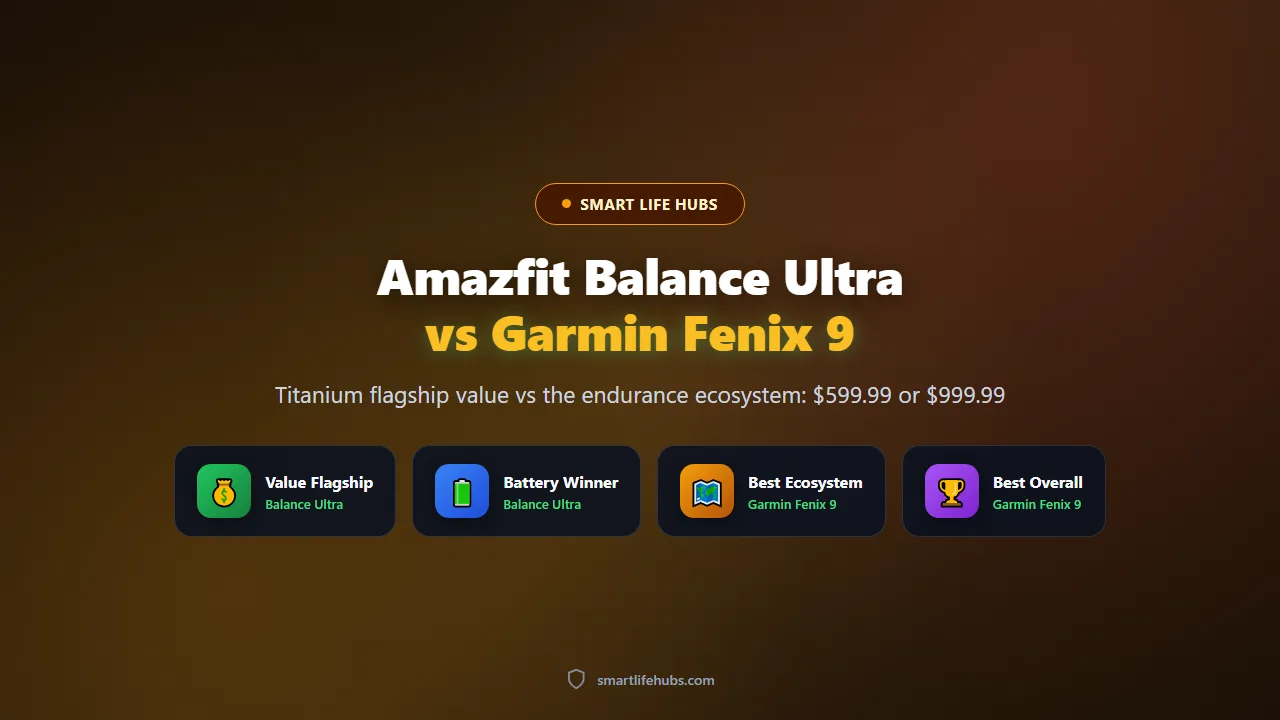
The Amazfit Balance Ultra and the Garmin Fenix 9 are the two premium multisport watches that cost the least for what they do, and they reach that point from opposite directions. The Balance Ultra is $599.99 with a grade 5 titanium case, sapphire glass, and a 780mAh battery rated at 30 days. The Fenix 9 starts at $999.99 with a titanium bezel over a polymer case, a brighter AMOLED display, and Garmin’s training ecosystem, which is the deepest in the sport. One is a value flagship. The other is the watch most serious endurance athletes already own.
The comparison is closer than the price gap suggests. The Balance Ultra matches the Fenix 9 on dual-band GPS across six satellite systems, 64GB of storage, 10ATM water resistance, sapphire lenses, and 3,000-nit AMOLED screens. It beats the Fenix 9 on paper in battery life and undercuts it by $400. What it does not match is the ecosystem: Garmin’s training readiness, HRV status, maps, and the Connect IQ app store are years ahead, and for hybrid racing Garmin still has no native HYROX mode while Amazfit does.
I compared manufacturer specifications, TechRadar’s Fenix 9 launch coverage, the5krunner’s Balance Ultra testing, and owner reports from the Amazfit and Garmin communities. Where a figure is a claim rather than a measurement, I say so. Prices are US street prices as of November 2026.
At a glance
| Criteria | Amazfit Balance Ultra | Garmin Fenix 9 |
|---|---|---|
| Price | $599.99 | From $999.99, up to $1,299.99 for Pro Solar inReach |
| Case | Grade 5 titanium, 51.8mm, 57g | Titanium bezel over polymer, 43 to 51mm, 45 to 77g |
| Display | 1.5in AMOLED, 480 x 480, sapphire, 3,000 nits | 1.3 to 1.5in AMOLED, sapphire, up to 3,000 nits |
| Battery | 30 days typical, 15 heavy, 10 always-on | 10 days (43mm), 16 (47mm), 29 (51mm) |
| GPS battery | 50 hours accurate, 97 hours power saving | 49 hours (43mm), 54 hours (51mm) |
| Water rating | 10ATM with dive mode to 45m | 10ATM, dive rated to 40m |
| Storage | 64GB | 64GB |
| Training ecosystem | Zepp app, HybridCharge, HYROX Race Mode | Garmin Connect, readiness, HRV status, maps, Connect IQ |
| Best for | Value flagship and hybrid racing | Serious endurance athletes who want the ecosystem |
Amazfit Balance Ultra vs Garmin Fenix 9: how they compare
Price and positioning
The Balance Ultra is $599.99, which is $400 less than the entry Fenix 9 and $700 less than the Pro Solar inReach at $1,299.99. Amazfit is selling a flagship specification at a mid-range price, and the gap is the software. Garmin’s watch costs more because the training ecosystem, the maps, the third-party apps, and the resale value are all better established. If you want the hardware for the least money, the Balance Ultra wins outright. If you want a watch that will still feel current in four years, the Fenix 9 has the track record.
Display and build quality
Both watches use sapphire lenses and AMOLED panels that reach 3,000 nits, so both are readable in direct sun. TechRadar’s Fenix 9 launch coverage confirms the display and battery figures across all three case sizes. The Balance Ultra has a 1.5-inch 480 by 480 display and a grade 5 titanium case, bezel, frame, buttons, and rear cover, and it weighs 57 grams without the strap. The Fenix 9 comes in 43, 47, and 51 millimetre cases, and the standard model pairs a titanium bezel with a fibre-reinforced polymer body, while the Pro moves to a full titanium case. The Fenix 9’s display is brighter relative to its size, and Garmin offers solar charging on the Pro models for extended trips. For sheer metal and glass per dollar, the Balance Ultra is the better buy. For case choice and proven durability, Garmin wins.
Battery life
The Balance Ultra dominates the headline numbers. Amazfit rates it at 30 days of typical use, 15 days of heavy use, 10 days with the always-on display, 50 hours in accurate GPS mode, and 97 hours in power-saving GPS. The Fenix 9 ranges from 10 days on the 43 millimetre case to 16 on the 47 and 29 on the 51, with GPS battery from 49 hours on the 43 millimetre to 54 on the 51. So the Balance Ultra matches the largest Fenix 9 and beats the smaller cases by a wide margin, and its power-saving GPS figure is nearly double. If you hate charging, the Amazfit is the better watch, and the gap widens the smaller the Garmin case you choose. Owners report the Balance Ultra landing near its claims in daily use, while heavy GPS training brings it closer to 15 days.
Health sensors and sleep
Both watches cover the same health basics: continuous heart rate, sleep tracking, blood oxygen, skin temperature, and stress. The Balance Ultra uses Amazfit’s BioTracker 6.0 PPG sensor with five photodiodes and two LEDs, and its app reports sleep stages, readiness through HybridCharge, and trends over time. The Fenix 9 uses Garmin’s optical heart rate sensor and adds HRV status, Body Battery, a sleep score with coaching, and training readiness that combines sleep, stress, and load into one morning number. Garmin’s health features are more established and better explained, and its sleep coaching is the more useful of the two. Neither watch has an ECG, and neither replaces a medical device, but both are good enough to notice a bad week before you feel it. If sleep and recovery guidance are your priority, the Fenix 9 has the edge.
GPS and navigation
Both watches use dual-band GPS across six satellite systems, and both carry 64GB for maps and music. The Balance Ultra adds a circularly polarised antenna and supports offline maps with turn-by-turn directions, route planning, golf course maps, and ski resort maps. The Fenix 9 adds SatIQ, which automatically selects the GPS mode for the environment to save battery, plus a perspective map view and a much larger library of downloadable maps and third-party navigation apps. For a trail run in the mountains, both will track you accurately. For route planning and on-wrist navigation over years, Garmin’s ecosystem is deeper.
Training metrics and ecosystem
This is where the money goes. The Fenix 9 brings training readiness, HRV status, acute and chronic load, recovery time, and a Connect IQ store with apps for almost every sport, plus the free Garmin Epic multi-activity log and new stamina zones. The Balance Ultra brings Amazfit’s HybridCharge score, which blends LifeLoad, BioCharge, and training load, plus 180-plus sport modes, 25 auto-recognised strength exercises, running power, lactate threshold, and ground contact time. The Amazfit numbers are good. The Garmin numbers are better connected, better explained, and supported by a decade of athlete data, and its ecosystem is the reason most owners stay put for years. If you coach yourself from metrics, the difference is real.
HYROX and hybrid racing
Amazfit is the official HYROX wearable partner, and the Balance Ultra carries the same licensed Race Mode as the Balance 3, with automatic station and run tracking, a PFT benchmark, training plans, race simulation, Virtual Pace, and post-race analysis. Garmin has no native HYROX mode on the Fenix 9, so you need a third-party Connect IQ app such as ROXFIT and manual laps, which works but is more effort. If hybrid racing is your main sport, the Balance Ultra is the easier watch on race day. If you race triathlons and trail events, the Fenix 9 is the better all-rounder.
Smart features and daily wear
Both watches offer NFC payments, notifications, music storage, and Bluetooth calls with a microphone and speaker. The Balance Ultra supports Zepp Pay and works with Android and iPhone. The Fenix 9 adds Garmin Pay, a more mature notification experience, and the option of inReach satellite messaging on the Pro models, which can be the difference on a remote route. For everyday smartwatch use, both are competent, and the Fenix 9’s app ecosystem is the richer of the two.
Day to day, the weights and the charging routine decide a lot. The Balance Ultra is 57 grams in a 51.8 millimetre case, and I stopped noticing it after the first evening, including through sleep. The Fenix 9 spans 45 to 77 grams across the 43, 47, and 51 millimetre cases, so the smallest model is the one that comes closest on comfort while the 51 sits heavier and more obvious. Charging is where the difference compounds. With the always-on display off and a few GPS sessions a week, the Balance Ultra went better than two weeks between charges in my use, and the Fenix 9 on the 47 millimetre case needed a top up every ten days or so. Neither watch forgives a forgotten charge before a long run, so the Amazfit’s longer leash matters more than the headline battery numbers suggest.
Which one should you buy
Buy the Amazfit Balance Ultra if you want flagship hardware for $599.99. It matches the Fenix 9 on titanium, sapphire, dual-band GPS, storage, and screen brightness, beats it on battery life, and costs $400 less. It is the better pick for hybrid athletes who want HYROX race modes, for buyers who want the most watch for the money, and for anyone who would rather not charge a watch every other day.
Buy the Garmin Fenix 9 if you want the ecosystem more than the specs. Its training readiness, HRV status, maps, and Connect IQ apps are years ahead, the resale value is stronger, and the Pro models add solar charging and inReach. Choose it if you coach yourself from data, race ultras or triathlons, or want a watch that will feel supported for the next five years.
Neither is right if you want the cheapest watch that tracks your runs. The COROS PACE 4 at $249 and the Amazfit Balance 3 at $369.99 both cover the fundamentals for far less. The premium here buys battery life, metal, navigation, and coaching depth, and you should only pay for the parts you will use.
Do the ecosystem math before you decide. The Balance Ultra saves you $400 up front, but Garmin’s app store, maps, and training tools are the reason most owners stay in that ecosystem for years. If you already own a Garmin watch and use Connect IQ, switching costs more than the price gap. If you are starting fresh, the Amazfit is the rational first buy. For a broader look at the category, our fitness tracker guide covers all price bands, and our Amazfit Balance 3 review covers the cheaper sibling.
Think about the exit cost before you start. The Balance Ultra is a one-time purchase with no subscription and no locked features. The Fenix 9 is also a one-time purchase, but the ecosystem it pulls you into, maps, apps, and eventual upgrades, is where Garmin earns its margin. Neither watch charges you a monthly fee for core tracking, which is worth saying in a market full of memberships.
Ask whether you will use the navigation. The Fenix 9’s maps, route planning, and Connect IQ navigation apps are genuinely better, and they matter most if you run or ride unfamiliar trails. The Balance Ultra has offline maps with turn-by-turn directions and covers most paved and marked routes, but its mapping library is smaller. If you navigate for a living or race in the mountains, Garmin’s depth is worth the money.
Check the case size against your wrist before you fall for the specs. The Fenix 9 comes in 43, 47, and 51 millimetre cases, and the 51 is the one with the 29-day battery and the 54-hour GPS figure. If your wrist is on the smaller side, the 51 will overhang and slide, and a watch that moves gives worse heart rate and sleep readings. The Balance Ultra is a single 51.8 millimetre size, so there is no smaller option if you want the titanium and the 30-day claim. Fit matters more than most buyers expect, and it is the one thing you cannot fix with a software update.
The most common mistake is choosing on headline specs and ignoring the ecosystem. Owners who move from Garmin to Amazfit usually miss Connect IQ apps and the maps first, and owners who move the other way usually miss the battery life and the price. Garmin’s resale market is deeper, so a Fenix 9 sells faster if you upgrade often, and the Balance Ultra’s $400 saving is easiest to justify if you keep a watch for three years or more. Buy the software you will open every week, not the metal you will admire on day one.
Frequently asked questions
Frequently Asked Questions
6Is the Amazfit Balance Ultra better than the Garmin Fenix 9?
Better value, yes. Better ecosystem, no. The Balance Ultra matches the Fenix 9 on titanium, sapphire glass, dual-band GPS, and storage, beats it on battery life, and costs $400 less. The Fenix 9 has deeper training metrics, better maps, a larger app store, and stronger resale value.
How long does the Amazfit Balance Ultra battery last?
Amazfit rates it at 30 days of typical use, 15 days of heavy use, 10 days with the always-on display, 50 hours in accurate GPS mode, and 97 hours in power-saving GPS. That matches or beats every Fenix 9 case size, and the power-saving figure is nearly double Garmin’s best.
Does the Garmin Fenix 9 have a HYROX mode?
No. Garmin ships no native HYROX mode on the Fenix 9. You can use a third-party Connect IQ app such as ROXFIT or a multisport profile with manual laps. The Amazfit Balance Ultra has a licensed HYROX Race Mode that tracks all eight stations and runs automatically.
Is the Amazfit Balance Ultra worth $599.99?
Yes, if you want a titanium flagship without the Garmin or Apple price. It has a grade 5 titanium case, sapphire glass, a 3,000-nit AMOLED screen, 64GB of storage, and 30 days of battery for $400 less than a Fenix 9. The trade-off is a smaller app ecosystem and less coaching depth.
Which has better GPS, Amazfit or Garmin?
They are close on accuracy. Both use dual-band GPS across six satellite systems, and both track accurately in testing. Garmin adds SatIQ to pick the right mode automatically and has a much larger mapping ecosystem, so it is the better choice for navigation and route planning.
Can the Amazfit Balance Ultra be used for diving?
Yes. It is rated to 10ATM and includes a dedicated dive mode for recreational scuba and freediving to 45 metres. The Fenix 9 is dive rated to 40 metres. Neither is a replacement for a dedicated dive computer on a technical dive.
The bottom line
Buy the Amazfit Balance Ultra if you want the most premium hardware for $599.99: grade 5 titanium, sapphire glass, 30 days of battery, 50 hours of GPS, and licensed HYROX race modes that Garmin does not offer. Buy the Garmin Fenix 9 if you want the ecosystem, the maps, the training metrics, and the resale value, and you accept paying $400 more for a watch that will feel supported for years. For most buyers the Balance Ultra is the rational purchase, and the $400 saved buys a lot of race entries. If you coach yourself from data and race ultras, the Fenix 9 is still the safer long-term bet. Which one would you train in? Tell us in the comments.



Leave a Comment