

Pelvic floor incontinence is relieved by strengthening the pelvic floor muscles through a type of exercise known as Kegel exercises. The bladder, bowel, and uterus are supported by a group of muscles known as the pelvic floor muscles.
An important role in sexual function is also played by them. It can be done by anyone, regardless of age or gender.
Urinary incontinence, fecal incontinence, or pelvic organ prolapse are particularly helped by them. Sexual function in both men and women can also be enhanced by it.
In this comprehensive guide, we will discuss kegel exercises and their benefits for both men and women. These exercises offer a practical solution for improving pelvic floor health.
For women looking to strengthen their pelvic muscles, it is a highly effective option.
It also works better for men. Anyone can benefit from performing Kegels regularly.
Pelvic floor muscles support the bladder, uterus, and rectum and play an important role in controlling urine and feces.
It can help improve bladder control, reduce the risk of pelvic organ prolapse, and increase sexual function. The inability to control your bowels and bladder may cause a weak pelvic floor.
If you understand how to perform Kegels, you can do them anywhere at any time. While waiting in a long line for something or in the privacy of your own place. It is very easy to perform it as your own process.
There are a lot of benefits for both men and women from performing it perfectly.
Definition and history of Kegel exercises
These exercises have been given the name of Dr. Arnold Kegel and were developed in the 1940s to assist women with urinary and other pelvic floor issues after childbirth.
Kegels involve squeezing and releasing the pelvic floor muscles supporting the bladder, uterus, and rectum. Also, pelvic organ prolapse can be prevented by it, as it improves sexual function.
Over time, it has become a popular and effective way to support pelvic floor health. Kegels are now recommended for both men and women of all ages.
It is important to a lot of people’s health and wellness routines because of its long history and proven benefits.
Today, it is recommended for both women and men to improve bladder and bowel control, as well as sexual function.
Now it is a very popular exercise to strengthen the pelvic floor muscles for improving sexual function and blood flow.
What is Kegel Exercise?
Pelvic floor exercises are also known as Kegels which are designed to strengthen the muscles of the pelvic floor.
These muscles are very important for improving bladder, uterus, and rectum performance and play a key role in controlling urine and feces.
The muscles in the bottom part of the body can become less strong as time goes on because of things like having a baby, getting older, and having an operation.
This can cause problems like not being able to control when you go to the toilet, organs in your pelvis moving down, and having less desire or ability to have sex. It can help improve these problems and provide several health benefits.
To perform it, you need to first discover the pelvic floor muscles.
You can do this by stopping the flow of urine mid-stream or by inserting a finger into the vagina or rectum and tensing the muscles around it.
Once you have identified the muscles, you can perform these exercises by contracting and relaxing the pelvic floor muscles. It is recommended to perform Kegels regularly, aiming for three sets of 10 repetitions per day.
You can perform these exercises while sitting, lying down, or standing. As you become stronger, you can gradually increase the length of time you hold the contraction, up to 10 seconds.
It is also important to avoid tightening the muscles in the abdomen, thighs, and buttocks while performing Kegels.
Why do Kegel exercises?
Performing it regularly, men and women can benefit from it. It is very important to maintain healthy pelvic floor muscles and reduce the risk of associated issues.
These painless exercises can help make your pelvic floor muscles stronger. This can lower the chances of having accidents with pee and feces. It can also provide support to organs like the bladder and uterus in your lower belly.
Additionally, they can help improve sexual performance and pleasure. By doing some easy movements a few times each day, anyone can benefit from these exercises.
To perform Kegel exercises:
- Locate the pelvic floor muscles: To locate the pelvic floor muscles, try stopping the flow of urine midstream. The muscles used to do this are the pelvic floor muscles.
- Isolate the muscles: Sit or lie down and focus on tightening the pelvic floor muscles. Hold the contraction for 5–10 seconds, and then relax for 5–10 seconds. Repeat this 10 times.
- Gradually increase the length of contraction: As you become stronger, you can gradually increase the length of time you hold the contraction, up to 10 seconds.
- Incorporate it into daily activities: It can be performed anywhere, at any time. Incorporating them into your daily routine, such as while sitting at a desk, can help you remember to do them regularly.
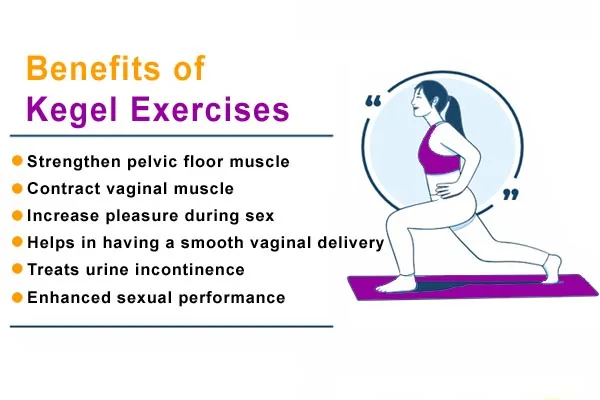
Benefits of Kegels
It is a pelvic floor muscle exercise that involves contracting and relaxing the muscles that support the bladder, uterus, and rectum.
Here are some of the key benefits of Kegel exercises:
Improved bladder control
This can help make the muscles in your lower stomach stronger. These muscles control your bladder, and by strengthening them, you can reduce the chances of accidentally peeing.
This is really helpful for women who have had babies because being pregnant and giving birth can make these muscles weaker.
Better bowel control
In addition to improving bladder control, Kegels can also help with bowel control. You may regain control over your bowel movements and prevent unintentional leaks by strengthening your pelvic floor muscles.
Increased sexual satisfaction
These exercises can improve sexual function in both men and women. For women, stronger pelvic floor muscles can lead to more intense orgasms and better vaginal lubrication. For men, Kegels can improve erections and increase the intensity of orgasms.
Reduced risk of prolapse
Pelvic organ prolapse occurs when the pelvic organs (bladder, uterus, or rectum) drop into the vagina due to weakened pelvic floor muscles. It can help strengthen these muscles and lower your chance of prolapse.
Improved recovery after childbirth
Women who do Kegels during and after pregnancy may experience a faster recovery after giving birth. These exercises can help prevent urinary incontinence and pelvic organ prolapse, which are common issues after childbirth.
Easier labor and delivery
Strong pelvic floor muscles can also make labor and delivery easier by improving the support of the uterus and helping with pushing during delivery.
Enhanced prostate health
In men, these exercises can help improve the strength and endurance of the pelvic floor muscles that support the prostate gland.
This can help with prostate health and potentially reduce the risk of prostate issues such as benign prostatic hyperplasia (BPH) and prostatitis.
It has several potential benefits for both men and women:
Enhanced confidence
Improving pelvic floor blood flow can enhance your confidence level.
Improved bladder control
You can be helped to control your bladder better and have your chances of having accidents lowered. Incontinence is a common problem, especially in women who have had babies, and doing Kegel exercises can help to make the muscles that hold up the bladder stronger and stop leaks.
Reduced risk of pelvic organ prolapse
The pelvic floor muscles can be made stronger by performing these exercises which lowers the chances of pelvic organ prolapse which is when organs in the pelvic area sag from their usual place.
Enhanced sexual function
Sexual function and pleasure can be improved for both men and women. Blood flow can be improved to the pelvic region by performing these exercises which also increase sensation and enhance sexual arousal by supporting the muscles of the pelvic floor.
Postpartum recovery
Recovery can be helped to speed up, and the risk of pelvic floor issues can be reduced for women who have given birth through these exercises. Pregnancy and childbirth can weaken the pelvic floor muscles, and Kegels can help rebuild strength and prevent problems such as incontinence and pelvic organ prolapse.
Eased constipation
Constipation can also be relieved by Kegels through the improvement of the function of the rectum muscles. Bowel movements can be improved, and the risk of constipation can be reduced, by strengthening the muscles that control the rectum.
Improved posture
Improved posture can also be achieved by maintaining the muscles of the lower back and pelvis. Better support for the lower back and improved posture can be provided by strong pelvic floor muscles, reducing the risk of back pain and other related problems.
It’s crucial to keep in mind that when doing it, the muscles in the buttocks, thighs, and abdomen should all be relaxed. It is also important to perform Kegels correctly to achieve the benefits.
Incorrectly performed exercises can actually weaken the pelvic floor muscles, so it is best to get proper instructions from a doctor or physical therapist.
Guidance on the best techniques for strengthening the pelvic muscles can also be provided by them, and the frequency and duration of the exercises can be determined with their help.
How to do Kegel exercise?
It is easy to do and can be done anywhere, anytime. Here’s how:
Find the right muscles
To do Kegels, you need to identify the pelvic floor muscles. To do this, try to stop the flow of urine when you’re going to the bathroom. The muscles you use to do this are your pelvic floor muscles.
Contract the muscles
Once you’ve identified the right muscles, contract them for 5–10 seconds. Make sure you’re only contracting the pelvic floor muscles and not your abdominal or thigh muscles.
Relax the muscles
After holding the contraction for 5–10 seconds, release and relax the muscles for the same amount of time.
Repeat
Repeat the exercise 10-15 times, three times a day.
Kegel Exercises Benefit Sexually
Also known as pelvic floor exercises, they are often associated with improving bladder and bowel control. However, a significant impact on sexual function and satisfaction for both men and women can also be achieved by Kegels.
It was invented to strengthen the muscles of the pelvic floor, which support the bladder, uterus, and rectum.
To perform Kegels, you contract the muscles used to stop the flow of urine midstream.
Hold the contraction for a few seconds, then release the contraction. Repeat this cycle 10 to 15 times, several times a day.
It can be done anywhere and at any time, without anyone knowing that you’re doing it. It’s easy to incorporate into your daily practice to gain numerous benefits.
Kegels for Women to Empowering the Pelvic Health
It is commonly referred to as pelvic floor exercises which are an essential component of women’s health regimens. The muscles in your pelvic area are strengthened by performing these exercises. Keeping your bladder, uterus, and rectum strengthened is very important for these muscles.
It can be used to prevent and cure a variety of pelvic disorders, including mishaps with urination, organ dislodgement, and difficulties during sexual activity.
The Importance of Strong Pelvic Floor Muscles
The overall well-being of women is crucially affected by having strong pelvic floor muscles. Bladder and bowel control are not only aided by these muscles but also provide support to essential organs.
Additionally, enhanced sexual function is contributed to by strong pelvic floor muscles, leading to increased pleasure and satisfaction during intimate moments.
Addressing Common Pelvic Health Issues
These exercises can be used to effectively treat urinary incontinence, a problem that is common among women.
The pelvic floor muscles, when strengthened, allow control over the bladder to be regained by women, reducing the embarrassment and discomfort associated with involuntary urine leakage.
Additionally, consistent exercises can help reduce the symptoms of pelvic organ prolapse, a disease in which organs such as the bladder or uterus move from their usual locations.
These exercises help lift and support the pelvic organs, preventing them from descending and causing discomfort.
The Right Technique for Performing it
Performing it correctly is essential to achieving the desired results. To begin, identify the pelvic floor muscles by attempting to stop the flow of urine midstream.
Once located, avoid engaging the abdominal, buttock, or thigh muscles during the exercise. The pelvic floor muscles should be contracted, and the contraction should be held for five seconds.
Performing ten repetitions of these contractions, three times a day, can significantly strengthen the pelvic floor muscles over time.
You should aim to perform ten repetitions of these contractions, holding each contraction for five seconds. The pelvic floor muscles will be strengthened effectively when this routine is practiced three times a day.
Incorporating Kegel Tools and Devices
It can be complemented by the use of tools and devices specifically designed to enhance pelvic floor muscle training.
Kegel balls are weighted balls that are put into the vagina. In order to keep the balls in place, the pelvic floor muscles must contract.
These balls provide more resistance, which intensifies the workout and produces results more quickly. Pelvic floor workouts can be improved with the use of Kegel balls.
Improving pelvic muscle strength and control can be achieved by using Kegel balls as part of your exercise routine.
Incorporating Kegel Tools and Devices
The full benefits of the exercises are reaped when consistency is key. Significant improvements in pelvic health over time can be witnessed by incorporating these exercises into your daily routine.
Remember that, like any other muscle group, the pelvic floor muscles require regular workouts to maintain their strength and functionality.
Optimal results are achieved when consistency with these exercises is maintained. Women’s pelvic health is promoted by it, which is a powerful tool.
Exercising and making the muscles in the pelvic area stronger enables women to regain control of their bodies, have better control over their urine, avoid problems with their pelvic organs moving out of place, and experience improved sexual function.
You can use simple exercises like Kegel balls or basic contractions to make positive changes in women’s lives if you do them every day. Let the power of it be embraced, and let your pelvic health be taken care of today.
For women, a positive impact on sexual function can be achieved by Kegels, as the strength and tone of the pelvic floor muscles are improved.
Benefits of Kegel Exercises for Women
Better control and increased pleasure during sex can be achieved by strong pelvic floor muscles.
Improved vaginal tone
The pelvic floor muscles form the foundation of the vagina, and when they’re toned, they can improve vaginal tone and elasticity, which can lead to more enjoyable sexual experiences.
Increased sensitivity
It can help increase the sensitivity of the clitoris and surrounding areas by improving blood flow to the pelvic region.
Reduced pain
Women with weak pelvic floor muscles may experience pain during sexual activity. Strengthening these muscles can reduce pain and discomfort during intercourse.
Enhanced orgasm
When the pelvic floor muscles are strong, they can lead to more intense and pleasurable orgasms. The ability to contract these muscles can also lead to more frequent and multiple orgasms.
Kegel Exercise During Pregnancy
The pelvic floor muscles can be excellently strengthened, especially during pregnancy. The uterus, bladder, and rectum are supported by the pelvic floor muscles, and they can weaken due to pregnancy and childbirth.
The muscles around the anus, vagina, and urethra are involved in squeezing and releasing, and urinary incontinence and pelvic organ prolapse can be prevented during and after pregnancy. These exercises are safe to perform throughout pregnancy and can be done anywhere and at any time.
Being consulted with a healthcare provider before starting a new exercise program is always recommended, but a healthy pregnancy and postpartum recovery are supported by Kegels which is a simple and effective way.
Kegel Exercises for Men to Improve Performance
The health benefits offered to women by these exercises have become more widely known, but were you aware that men can also benefit from the same exercises.
Kegel exercises for men can help strengthen the pelvic floor muscles, which can lead to improved urinary incontinence and erectile functioning. Sexual performance can be enhanced, and it has been verified that the risk of getting prostate cancer is reduced.
If done regularly, Kegels can be a great way for your pelvic health to be taken better care of. If you want to stop accidental peeing or improve your sexual life, you should do these exercises as part of your regular workouts.
Kegel Exercise Benefits for Men
Strengthening of pelvic floor muscles isn’t limited to women. It can also benefit men.
In reality, doing Kegels exercises can be really helpful for men who have trouble finishing too quickly or getting and keeping erections.
Improved erectile function
Strong pelvic floor muscles can help men achieve and maintain erections by improving the blood flow to the penis.
Increased ejaculatory control
Kegels can help men gain more control over when they ejaculate, reducing the likelihood of premature ejaculation.
Enhanced orgasm
Just like with women, strong pelvic floor muscles can lead to more intense and pleasurable orgasms for men.
Improved bladder control
Men who suffer from urinary incontinence, which can be especially common in older men, can be helped by Kegels.
How to Perform Kegel exercises?
To perform these exercises, first, locate your pelvic floor muscles by stopping the flow of urine midstream. Once you’ve identified the muscles, you can perform Kegels anywhere and at any time.
Start by contracting the muscles and holding for a few seconds, then release.
Repeat the cycle 10 to 15 times, several times a day. Over time, you can gradually increase the length and frequency of your Kegels.
Some people find it useful to do these exercises while they are watching TV during commercial breaks when they are traveling or while they are sitting at their desks at work.
An easy and effective way to improve sexual function and satisfaction for both men and women is offered by Kegels.
Pain during sexual activity can be decreased, sensitivity can be raised, and orgasm can be enhanced by strengthening the pelvic floor muscles.
A more fulfilling sexual life and improved overall pelvic health can be achieved by incorporating it into your daily routine.
Tips for Success
An effective way to strengthen your pelvic floor muscles and improve your bladder and bowel control, sexual function, and overall pelvic health can be gained through Kegels.
However, like any exercise, seeing the best results with Kegels is important to approach with the right mindset and techniques.
Here are some possible tips for success:
Be patient
It can take several weeks of regular Kegels to see improvement in bladder or bowel control or sexual function.
Don’t overdo it
Like any exercise, it’s important not to overdo it with Kegels. Start with a few repetitions and gradually work your way up to more.
Start slowly
Don’t try to do too much too soon. Start with just a few repetitions of these exercises each day and gradually work your way up to more. Overdoing it can lead to muscle fatigue or soreness, and may even make the issue worse.
Make it a habit
To see the full benefits of Kegels, it’s important to make them a part of your daily routine.
Be consistent
To see the best results, it’s important to make these exercises a consistent part of your daily routine. Try to do them at the same time each day, such as when you first wake up, after a meal, and before bed.
Stay focused
When doing Kegels, make sure you’re only contracting the pelvic floor muscles and not any other muscles. Avoid holding your breath or clenching your stomach or buttock muscles.
Use different positions
Kegels can be done in a variety of positions, such as sitting, standing, or lying down. Different positions can be experimented with to find the one that works best for you.
Get professional advice
If you’re having difficulty with these exercises or have concerns about your pelvic health, consider seeking advice from a healthcare provider or physical therapist who specializes in pelvic health.
Mix it up
Kegels don’t have to be boring. Try doing them while watching TV or listening to music. You can also try adding variations, such as holding the contraction for longer or doing quick contractions.
Don’t give up
It can take several weeks or even months of consistent Kegels to see the full benefits. Don’t get discouraged if you don’t see immediate results. Keep at it, and you will eventually see improvements in your pelvic health.
Get guidance
If you’re unsure if you’re doing Kegels correctly or if you have any concerns about pelvic floor health, talk to an expert.
10+ Kegel Exercises to Improve Sexual Life and Health
A great way to improve sexual and overall health is offered by these exercises, also known as pelvic floor exercises. The pelvic floor muscles which support the bladder, uterus, and rectum, are strengthened by them.
Urinary incontinence, pelvic organ prolapses, and sexual dysfunction can be caused by weak pelvic floor muscles.
Basic Kegels
The basic Kegels involve squeezing and releasing the pelvic floor muscles. To do this exercise, the muscles around the anus, vagina, and urethra should be comfortably sat on and tightened.
Hold for 3–5 seconds, then relax for 5 seconds. Repeat 10–15 times.
The benefits of basic Kegels for sexual health are numerous. Erection quality for men can be improved by regular exercises that increase blood flow to the penis and strengthen the muscles that control ejaculation.
For women, it can enhance vaginal tone and improve lubrication, leading to increased sexual pleasure and a reduced risk of pelvic organ prolapse.
In addition, both men and women can experience increased orgasm intensity and improved bladder control as a result of regularly performing Kegels.
So, if you’re looking to improve your sexual health and function, the basic Kegels should be started with, and more advanced variations should be worked up to.
Bridge Kegels
Bridge kegels involve tightening the pelvic floor muscles while doing a bridge exercise. Performing this exercise Lay on the floor with your back down, bend your knees, and keep your feet flat. Lift your hips off the floor, squeezing your glutes and pelvic floor muscles.
Hold for a few seconds, then release and lower your hips back down. Repeat 10 times. Vaginal tightness can be improved, and sexual pleasure can be enhanced for women by the bridge Kegels.
The bridge pose helps stretch and strengthen the lower part of your body and helps blood flow better in the pelvic floor area. You may feel more turned on and have more powerful feelings of pleasure when you have an orgasm.
In addition, the bridge Kegels can help prevent or reduce symptoms of pelvic organ prolapse, a condition that occurs when the pelvic organs (such as the uterus or bladder) drop down into the vaginal canal.
Your risk of prolapse can be decreased, and these organs can be better supported by strengthening your pelvic floor muscles.
Squat Kegels
Squat kegels involve tightening the pelvic floor muscles while doing a squat. To do this exercise, the following steps are taken:
- Stand with your feet apart at the same distance as your shoulders.
- Lower yourself down as if you were sitting on a chair.
As you squat, tighten your pelvic floor muscles. Hold for a few seconds, then release and stand back up. Repeat 10 times.
Doing exercises called squat Kegels can give you many advantages for your sexual health. Improving bladder control can be done by making the muscles that hold up the bladder and urethra stronger.
Urinary incontinence or leakage during activities such as exercise or sneezing can be especially beneficial for women to experience.
In addition, the risk of pelvic organ prolapse can be reduced by strengthening the pelvic floor muscles and supporting the organs in the pelvic region through the use of squat Kegels.
Using a squatting motion activates the muscles in the lower body, like the glutes and quads. The pelvis can be helped to be made more stable.
Split Kegel
The muscles responsible for controlling ejaculation in men are targeted by a variation called the split Kegels.
Sit on the floor with your legs straight out in front of you. Spread your legs apart as far as you comfortably can. Tighten your pelvic floor muscles as you imagine drawing your testicles up towards your body.
Hold the contraction for a count of 5 seconds, then release and relax. Repeat the exercise 10 times, 3 times a day.
The split Kegels can help improve ejaculation control in men by strengthening the muscles that contract during orgasm.
Practicing this exercise regularly, they better control their ejaculation, and increased sexual stamina can be discovered in men.
In addition, the splits can also help increase sexual pleasure for both partners.
Men can obtain longer-lasting and more powerful orgasms by strengthening their pelvic floor muscles, while women may experience increased vaginal tightness and more pleasurable sensations during sexual activity.
Diamond Kegels
The muscles at the base of the pelvic floor are targeted by the variation called the diamond Kegels. Sit down on the floor and have your feet touch each other with your knees out to the sides.
Place your hands on your inner thighs and use your thumbs to apply pressure to the muscles at the base of the pelvic floor. Tighten your pelvic floor muscles as you imagine drawing your testicles up towards your body.
Hold the contraction for a count of 5 seconds, then release and relax. Repeat the exercise 10 times, 3 times a day.
A number of benefits for women, including increased vaginal tightness and improved bladder control, can be provided by Diamond Kegels.
This exercise can make the muscles at the bottom of the pelvic floor stronger. The muscles that help hold up the uterus, bladder, and rectum get stronger which lowers the chance of organs drooping and makes the pelvic area healthier.
Additionally, sexual function can be improved by the Diamond Kegels which increase vaginal tightness and sensation during intercourse.
When women make their pelvic floor muscles stronger, they may have a better feeling during sex and have stronger and more frequent orgasms.
Reverse Kegel Exercise
Reverse Kegels involve relaxing the pelvic floor muscles. Instructions for performing this exercise, sit comfortably and relax your pelvic floor muscles as much as possible.
Please wait for a few moments, then tighten the muscles and hold for a few seconds. Repeat 10 times. Ejaculation control and sexual pleasure for men can be improved and enhanced by training the muscles that relax the pelvic floor through the use of reverse Kegels.
More control over ejaculation and delayed orgasm, leading to more satisfying sexual experiences for both partners, can be achieved by men with the help of this.
In addition, the reverse Kegels can also help men achieve and maintain erections by improving blood flow to the penis. Men may benefit from enhanced erectile function and greater blood flow by relaxing the pelvic floor muscles.
As with other Kegels, it’s important to focus on proper form and avoid tensing other muscles in the body, such as the abs or glutes, during the exercise.
If you’re new to these exercises, start with the basic Kegel and work your way up to more advanced variations like the reverse Kegel as you build strength and control.
Long-Hold Kegels
Long-hold Kegels involve holding the squeeze for a longer period of time. To do this exercise, tighten the pelvic floor muscles and hold for 10 seconds. Release for 10 seconds and repeat 10 times.
Short-Hold Kegels
Short-hold Kegels involve squeezing and releasing the pelvic floor muscles quickly. To do this exercise, tighten and release the muscles quickly for 10 seconds. Repeat 10 times.
Elevator Kegels
Elevator kegels involve tightening the pelvic floor muscles gradually as if you were taking an elevator up a building.
To do this exercise, start by squeezing the muscles around the anus, then gradually squeeze the muscles around the vagina and urethra. Hold for a few seconds, then release in reverse order. Repeat 10 times.
Side-lying Kegels
Side-lying Kegels involve tightening the pelvic floor muscles while lying on your side. To do this exercise, lie on your side with your legs bent at a 90-degree angle. Tighten your pelvic floor muscles, hold for a few seconds, then release. Repeat 10 times on each side.
Super Kegels
Super Kegels involve tightening the pelvic floor muscles while standing. To do this exercise, stand with your feet shoulder-width apart and tighten your pelvic floor muscles. Hold for a few seconds, then release. Repeat 10 times.
Combination Kegels
Combination Kegels involves combining different exercises. To do this exercise, choose two or more Kegels and perform them in sequence.
For example, you could do 10 basic kegels, followed by 10 long-hold kegels and 10 short-hold Kegels.
Kegel Exercises PDF: A complete how-to guide.
In the final analysis, having these exercises done is a straightforward and helpful way to make your pelvic floor muscles stronger.
Kegels can prevent issues such as urine leakage, organs in the pelvis falling out of place, and a reduced incidence of sexual dysfunction.
Doing Kegels regularly can give you a lot of health benefits and help you feel better in your pelvic area.






Leave a Comment