
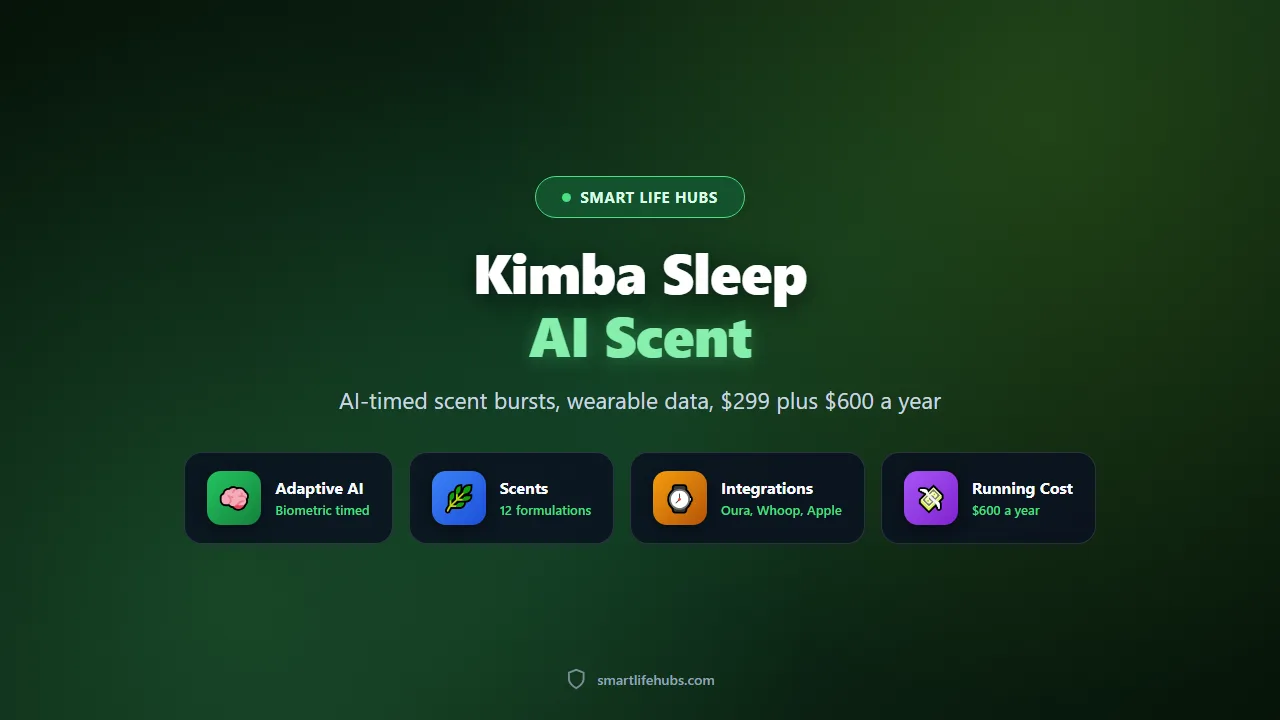
Kimba is an AI-powered bedside sleep system that releases short bursts of scent during the night in response to what it reads from your body. It is not a diffuser, not a white noise machine, and not a humidifier. It is a $299 pre-order device with a $299 every six months membership, and it began taking orders in 2026 with shipping scheduled for early 2027. It connects to Apple Watch, Oura, Whoop, Fitbit, and Garmin, and it also has its own sensors for movement, breathing, light, and snoring.
The concept comes from neurobiologist Dr. Anat Arzi, and the company says the system is designed to intervene without waking you. Rather than filling the room with scent on a timer, Kimba reads biometric and ambient signals and releases a brief pulse when it detects a pattern it is meant to support, such as a shift toward lighter sleep or irregular breathing. It holds three scent capsules at a time, draws from 12 water-based, plant-derived formulations, and adjusts capsule recommendations quarterly.
A note on this review. Kimba is a pre-order product and had not shipped to customers at the time of writing, so this is a specification and evidence assessment, not a hands-on test. I pulled the company’s published details, CNET’s and Wareable’s coverage, and the early clinical data. Where a figure is a claim rather than a measurement, I say so.
At a glance
| Spec | Detail |
|---|---|
| Price | $299 pre-order, including six months of membership |
| Running cost | $299 every six months, about $600 a year |
| Availability | Pre-order, shipping scheduled for early 2027 |
| Sensors | Movement, breathing, light, snoring, ambient conditions |
| Wearable links | Apple Watch, Oura, Whoop, Fitbit, Garmin |
| Scent system | Three capsules, 12 formulations, replaced about every three months |
| Size | About 7 by 4.8 by 4.4 inches |
| Evidence | Early trial of 50 participants, company-reported |
How it works
You place the unit beside your bed and complete a sleep assessment in the app. From then on, Kimba combines its own sensors with data from a connected wearable, reading heart rate variability, sleep stages, movement, and breathing through the night. When the system detects a pattern it is designed to support, it selects a scent and releases a short burst rather than running continuously, which is the main difference from a conventional diffuser.
The hardware holds three scent capsules, and the company says each formulation is water-based and plant-derived, with options aimed at sleep onset, grounding, and sleep continuity. Soft Blue uses Roman chamomile, Golden Grove uses sandalwood, and Lemon Calm uses lemon balm. Capsules are replaced about every three months and are part of the membership. The unit needs no cleaning, and Kimba says its microphones use edge processing so conversations are not recorded, with a cloud architecture aligned to HIPAA guidelines.
The practical question is whether you want a device that needs a subscription to function. Without the membership, you do not get the scent deliveries, the app, or the quarterly refills, and the hardware is largely pointless. That is the same model as Pura and Aera, but at a much higher running cost, and it is the single biggest factor in deciding whether Kimba makes sense for you.
What the sensors watch
Kimba’s case rests on the idea that scent should be timed rather than constant. Its own sensors watch movement, breathing, light, and snoring, and a connected wearable adds heart rate variability and sleep stages. The device then decides when a short burst is more useful than a steady plume, which is the main difference from a diffuser on a timer. Without a wearable the unit still runs from its own sensors, but the picture is thinner and the timing decisions are less informed.
What a capsule is and how long it lasts
The scent system is a consumable business as much as a hardware one. The unit holds three capsules, each one a water-based formulation, and the company draws from 12 options aimed at sleep onset, grounding, and sleep continuity. Capsules are replaced about every three months rather than refilled, and the replacements arrive through the membership, so the renewal fee buys both the hardware’s input and the physical refills.
Setup, privacy, and daily use
Setup is meant to be simple. You place the unit beside the bed, plug it in, and pair it with the app, which walks you through a sleep assessment. From there the device runs on its own, reading its sensors and any connected wearable, and you only interact with it when the app suggests a capsule change or a new formulation. Because the scent is released in short bursts rather than continuously, the room should not smell strongly, and the capsules are replaced about every three months rather than refilled.
The privacy question is worth taking seriously, because the unit has microphones in a bedroom. Kimba says it uses edge processing to isolate sleep-relevant signals such as snoring without recording conversations, and that its cloud architecture aligns with HIPAA guidelines. Those are company statements rather than independent audits, so if privacy matters to you, ask for the specifics before you buy. The device also needs Wi-Fi and a phone for setup, and it is another thing on the nightstand in a market already full of them.
The daily experience is the part no specification can convey. Some people find scent genuinely helps them settle, and a short burst timed to the onset of light sleep is a plausible way to use it. Others find any smell in the bedroom distracting, and a device that puffs scent at 3am can wake a light sleeper rather than help them. There is no way to know which group you are in without trying it, which is the strongest argument for testing a cheap diffuser first.
The privacy questions worth asking
Kimba says it uses edge processing to isolate sleep-relevant signals such as snoring without recording conversations, and that its cloud architecture aligns with HIPAA guidelines. Those are company statements rather than independent audits. Before pre-ordering, ask what is processed on the device, what is sent to the cloud, how long it is kept, and whether you can delete it. Ask whether snore audio ever leaves the unit and who at the company can access the data. If the answers are vague, treat the privacy claim as unproven, because the microphones will be in the bedroom even when the scent is off.
The alternatives at a glance
A conventional smart diffuser such as the Pura 4 costs $49.99 and takes your own oils, with no required subscription. It will not time scent to your sleep stages, but it will tell you whether scent at night helps you at all. A white noise machine costs $30 to $60 and addresses a different problem, masking disturbance rather than promoting relaxation. A wearable you already own gives you sleep tracking for no extra cost. None of these is as clever as Kimba, and none requires $600 a year.
The comparison that should worry Kimba is the fixed-schedule diffuser. If a $50 device with lavender oil produces the same subjective result, the adaptive AI is not worth the subscription, and that is the test most buyers should run before committing.
The evidence
Kimba says its technology has been clinically studied and references a 2025 to 2026 study involving 50 participants, which the company says showed improvements in sleep quality and next-day cognitive performance. CNET and Wareable covered the launch and repeated the company’s claims. What is missing is an independent, peer-reviewed publication of that study, and a 50-participant company-run trial is not the same as a large controlled trial.
The underlying science is not fringe. Aromatherapy has clinical support for relaxation and sleep, and lavender in particular has been studied for sleep onset. What is less established is the adaptive part: whether reading live biometrics and timing scent bursts produces better outcomes than a fixed schedule. That specific claim rests on Kimba’s own data at this point. The honest read is that the scent component is plausible and the personalization is unproven.
How strong is the 50-person trial?
A 50-person study can be a useful signal, but the details matter more than the headline. The Kimba trial is company-run and company-reported, and no peer-reviewed paper had been published at the time of writing. What would make the claim stronger is an independent lab, a control group using a scent-free or fixed-schedule comparison, follow-up beyond a single night, and results published in a journal rather than a launch release. Until then, the timing claim should be treated as a company result rather than a settled one.
The cost, honestly
The pre-order price is $299 and includes the device and six months of membership. After that, the membership is $299 every six months, which works out to about $600 a year or roughly $50 a month. That is the most expensive sleep gadget running cost in this roundup by a wide margin, and it compares badly with a $50 smart diffuser that needs no subscription at all.
The comparison that matters is with other sleep interventions. A good mattress, a consistent schedule, and limiting alcohol and screens cost little and have far stronger evidence. A CPAP or a cognitive behavioural therapy programme costs money and treats a medical problem. Kimba sits in an awkward middle: it is a wellness product with a subscription, and the evidence does not yet justify the price. If you want scent at night, a $50 diffuser and a bottle of lavender oil will tell you whether the idea works for you before you commit to $600 a year.
The three-year cost of ownership
The pre-order price is $299 and includes six months of membership. After that the membership is $299 every six months, so the first year costs $299 in total and the second and third years cost $598 each. Over three years you pay the device plus five renewals, $1794 in total, or about $598 a year. That is the number to compare with a $50 diffuser, and it makes the subscription the real product rather than an add-on. If the hardware lasts three years, the device itself is a minority of what you spend.
Who Kimba suits and who should skip it
Who it suits
Kimba is a reasonable experiment for a specific buyer: someone who already sleeps with a wearable, likes scent at night, and is comfortable with a subscription that costs more than the hardware. It suits a person who wants the routine handled and does not mind a device listening for snoring, and it suits someone who has tried a basic diffuser and found the idea useful, because adaptive timing is the feature they would be paying for.
Who should skip it
Skip it if you do not wear a tracker, because the main input is missing. Skip it if you are sensitive to smell or share a bed with someone who is. Skip it if you want sleep data, because Kimba depends on a wearable for sleep stages. And skip the pre-order if the refund terms are not clear, because a product that has not shipped should be bought with an obvious exit.
Should you pre-order Kimba?
Wait for independent reviews. Kimba had not shipped at the time of writing, so no one outside the company has tested a production unit over weeks. Pre-ordering a sleep device on a company-run 50-person study is a leap of faith, and the refund terms for pre-orders should be checked before you pay.
Do the arithmetic on the subscription. At $600 a year, three years of membership costs more than the device. Decide whether you would pay $50 a month for a scent system, because that is the real commitment.
Check whether you already have the data. Kimba works best with a connected wearable, and its value depends on the quality of that data. If you do not already wear a tracker, you are paying for a system whose main input is missing.
Consider the simpler alternatives first. A conventional diffuser with lavender, a white noise machine, and a consistent bedtime address most of the same goals for under $100. Our sleep gadget roundup covers them, and our smart aromatherapy guide covers diffusers that take your own oils.
Be clear about what it is not. Kimba makes no medical claim and is not a treatment for sleep apnoea or insomnia. If you snore heavily, wake unrefreshed, or suspect a sleep disorder, see a doctor rather than buying a scent device.
Frequently asked questions
Frequently Asked Questions
6How much does Kimba cost?
The pre-order price is $299 including six months of membership. After that, membership is $299 every six months, about $600 a year, which covers scent capsule deliveries, the app, and personalized recommendations.
Is Kimba available now?
No. It opened for pre-order in 2026 with shipping scheduled for early 2027. Check the current shipping date before ordering, because launch timing has shifted before.
Does Kimba produce white noise or cool mist?
No. Kimba releases short bursts of water-based scent. It is not a white noise machine and not a humidifier, despite some coverage describing it as a diffuser.
Which wearables work with Kimba?
Apple Watch, Oura, Whoop, Fitbit, and Garmin. It also works without a wearable using its own sensors for movement, breathing, light, and snoring.
Is there clinical evidence for Kimba?
The company references a 2025 to 2026 study of 50 participants showing improved sleep quality and next-day cognitive performance. It is company-reported and not yet independently published.
Is Kimba worth $600 a year?
Not on the current evidence. The scent component is plausible and the adaptive timing is unproven, and $600 a year is a steep running cost for a wellness device. Try a conventional diffuser first.
The bottom line
Kimba is an interesting idea with a weak evidence base and an expensive subscription. It reads your biometrics and releases timed scent bursts to support sleep, it integrates with the major wearables, and it needs no cleaning. The problems are that it is not shipping yet, the only study is a 50-person company-run trial, and the membership costs $600 a year, which is more than the device. Buy it only if you have tried scent at night and know it helps you, and wait for independent reviews before you pre-order. For most people, a $50 diffuser and a consistent bedtime deliver most of the benefit for a fraction of the cost. Have you tried scent for sleep? Tell us in the comments.

Leave a Comment