
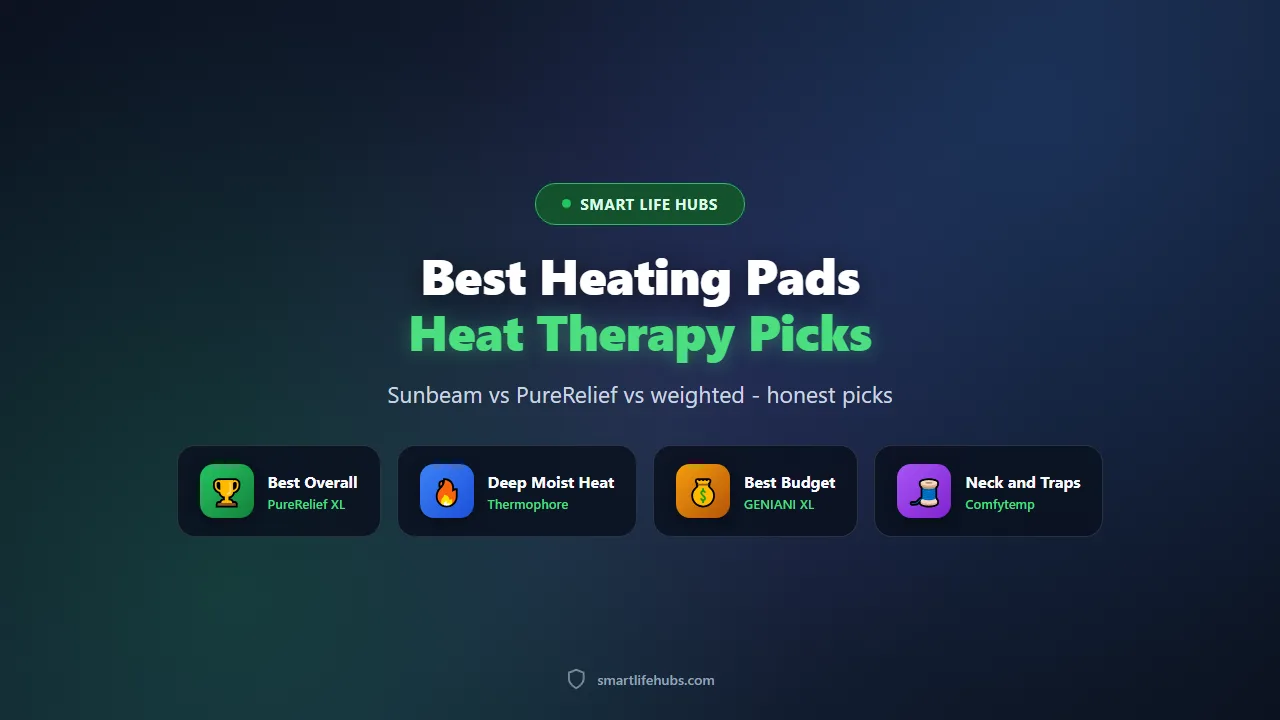
Best heating pads of 2026 do a dull job extremely well, which is warming a sore muscle or a stiff lower back for twenty minutes and letting the blood flow do the rest. I have used a heating pad most evenings for three winters on a desk-tight back, and the honest finding is that the mid-priced pads beat the expensive ones on the only metric that matters, how hot they actually get and how long they stay there, while the cheap pads usually fail on both.
The second thing to get straight is dry versus moist heat. Most pads on this list are dry electric pads, and that is what most people want. A few, like the Thermophore, use a moist heat design that drives warmth deeper and runs hotter than anything else here. A microwaveable pad is a different product again, cheap and pleasant but gone cold in twenty minutes. If your pain is deep and stubborn, moist heat is worth the extra money. If you want a warm back while you read, a dry pad is the better buy.
Prices below are US retail captured in November 2026 and they move hard with sales, sometimes by a third. What does not move is the two-hour auto shut-off, which every pad here has and which is the safety feature you should never buy around.
At a glance
| Product | Best for | Key specs | Price |
|---|---|---|---|
| Pure Enrichment PureRelief XL | Best overall | 12 by 24 inch, six heat settings, microplush, two-hour shut-off | About $30 to $38 |
| Sunbeam Premium XpressHeat King | Best fast heat-up | King size, warmth in about 30 seconds, six settings, moist option | About $50 to $62 |
| Thermophore MaxHEAT Moist | Best deep moist heat | 14 by 27 inch, three settings to 165 degrees, 25-minute timer | About $66 to $80 |
| Comfytemp Weighted Neck and Shoulder | Best weighted pick | 2.6 lb contoured collar, nine heat settings, eleven timers | About $30 to $45 |
| GENIANI XL | Best budget | Extra large, six settings, two-hour shut-off, two-year warranty | About $30 |
The best heating pads of 2026
1. Pure Enrichment PureRelief XL, best overall
The PureRelief XL is the pad to buy unless you have a specific reason not to. The 12 by 24 inch surface covers an adult lower back in one application, there are six heat settings, it warms in about thirty seconds, and the microplush cover is soft enough to sit directly against skin. It shuts off after two hours, carries a UL safety certification and a five-year warranty, and it has been a pick in Wirecutter’s guide for years. At thirty to thirty-eight dollars it costs less than the pads it beats. The only real criticism is that the controller is plain, and the cover texture can feel crinkly to some testers.
Pros
- Covers a full lower back and warms in about thirty seconds
- Six settings, UL certified, five-year warranty
- About thirty dollars on sale, cheaper than most rivals
Cons
- Controller and plug design feel less refined than the price suggests
- Moist heat requires a separate attachment rather than built in
Check today’s price on Amazon.
2. Sunbeam Premium XpressHeat King, best fast heat-up
Sunbeam is the brand with the widest footprint in this category, and the XpressHeat King is the model that justifies it. It is a king-size pad that reaches warmth in roughly thirty seconds, has six settings, offers a moist heat option, and carries a five-year warranty. The trade-off, noted by Wirecutter in its 2026 update, is that it does not get quite as hot as the Pure Enrichment pads and the cover is less plush, so it is the pick for someone who wants a large, fast, dependable pad rather than the softest one. At about fifty to sixty-two dollars it sits above the PureRelief on price.
Pros
- King-size coverage and warmth in about thirty seconds
- Six settings with a moist heat option
- Five-year warranty and a widely available brand
Cons
- Does not get as hot as the top Pure Enrichment pads
- Cover and controller feel cheaper than the price implies
Check today’s price on Amazon.
3. Thermophore MaxHEAT Moist, best deep moist heat
Thermophore is the clinical oddity in this list, and for a specific kind of pain it is the best pad here. It uses a moist heat design that drives warmth deeper than a dry electric pad, runs to about 165 degrees across three settings, and is the pad physical therapy clinics have used for years. The catch is a twenty-five minute auto shut-off, which is short, and a price of sixty-six to eighty dollars. If you have a deep, stubborn ache that a normal pad barely touches, this is the upgrade. If you just want warmth while you watch television, it is more than you need.
Pros
- Moist heat penetrates deeper than dry electric pads
- Runs hotter than anything else in this roundup
- Two-year warranty and a long clinical track record
Cons
- Twenty-five minute auto shut-off is short for a long session
- About sixty-six to eighty dollars, the most expensive pick here
Check today’s price on Amazon.
4. Comfytemp Weighted Neck and Shoulder, best weighted pick
This is a different product from the flat pads, and it earns its place because neck and shoulder tension is the one job a flat pad does badly. It is a 2.6 pound contoured collar that drapes over the traps and stays put while you sit upright, with nine heat settings and eleven timers. The weight is the point: it gives mild compression while the heat works, and it does not slide off the way a pad draped over a shoulder does. At thirty to forty-five dollars it is the pick for desk workers with tight upper traps, and it is not a substitute for a back pad.
Pros
- Weighted collar stays in place on the traps while you work
- Nine heat settings and eleven timer options
- No mechanism to aim, nothing to hold against the neck
Cons
- Contoured shape only suits neck and shoulders
- Runs small for some body types and is bulky under a jacket
Check today’s price on Amazon.
5. GENIANI XL, best budget
GENIANI is the sensible cheap pad. Extra large, six heat settings, a two-hour auto shut-off, a machine-washable cover and a two-year warranty that extends to three if you register, at about thirty dollars. It is the pad to buy for a guest room, a kitchen standing spot or a second location, and it is the one I would hand to someone who is not sure they will use a heating pad at all. The build is lighter than the Pure Enrichment and it does not feel as plush, but the core function is there and the warranty is longer than the price suggests.
Pros
- About thirty dollars for an extra-large pad
- Two-year warranty extending to three on registration
- Machine-washable cover and six heat settings
Cons
- Cover feels thinner than the Pure Enrichment microplush
- Heat-up is slower and the top setting is less intense
Check today’s price on Amazon.
How to choose the best heating pad
Start with the area you are treating. A flat 12 by 24 inch pad covers a lower back or an abdomen, which is what most people need. A contoured weighted collar is for the neck and traps and will not lie flat on a back. A wrap with a strap is for a knee, a shoulder or a hip that moves. Buying the wrong shape is the most common mistake here, and it is the reason a perfectly good pad ends up in a drawer.
Then decide dry or moist. Dry pads are cheaper, simpler and fine for most muscle soreness. Moist heat, as in the Thermophore, reaches deeper and is worth the money for a deep joint or a chronic ache. Microwaveable pads are a third category, pleasant and cheap but cold in under half an hour, so they suit a short session rather than a long one.
Check the auto shut-off before anything else. Two hours is the standard and a good safety net. A twenty-five minute timer, as on the Thermophore, is shorter and means you restart the pad during a long session. Never buy a pad without an automatic shut-off, and never sleep on one even if it has one, because sustained pressure and heat on the same patch of skin can cause a burn you do not feel at the time.
Look at the cover and the controller, because those are what you touch every session. Microplush feels better against skin than flannel or vinyl. A backlit controller matters if you use the pad in bed. A washable cover matters if you use it daily, because a pad that cannot be cleaned will be discarded long before it fails. A cord of seven feet or more keeps you from sitting awkwardly near the outlet.
Finally, calibrate your expectations against the evidence. Heat is a well-supported comfort measure for muscle stiffness and some types of pain, but it is temporary relief rather than a fix. A careful 2026 ranking of the category at americanrankinginstitute.org/rankings/wellness/heating-pads screens models on documented heat settings, warranty terms and safety certification rather than review counts, which is a better way to compare than trusting a star average.
Living with a heating pad
Use a barrier for the first session. Even a pad with a plush cover can feel too hot directly on bare skin at the top setting, so start at a middle setting over a thin layer of clothing and move up only if it feels comfortable. The goal is a warm, pleasant sensation, never a pink or reddened patch of skin.
Time your sessions rather than leaving the pad on all evening. Twenty minutes on, twenty minutes off is the standard advice for muscle pain, and two hours is the hard ceiling most pads enforce themselves. Longer continuous heat does not help more and raises the risk of a low-grade burn, especially in people with reduced sensation from diabetes or a nerve problem.
Placement matters less than you would think for a large pad, but more than you would think for a small one. For a lower back, centre the pad over the painful area and lie on it or lean back against it so your body weight keeps contact. For a neck, a weighted collar beats a flat pad because it stays in place. For a joint, wrap it rather than drape it, so the heat reaches the sides as well as the front.
Clean the cover on a schedule rather than when it looks dirty. Skin oil and sweat break down the fabric and the heating elements over months, so a weekly wipe of the controller and a monthly wash of a removable cover extends the life of the pad. Check the cord and plug for fraying every few months, and replace the pad if the heat becomes uneven or one corner stops warming.
Use heat as part of a routine, not as the whole routine. Heat loosens tissue and feels good, but the stiffness usually comes from loading, posture or a weak area nearby. Pair twenty minutes of heat with the mobility and strengthening work that addresses the cause, and the pad becomes a tool you reach for rather than a crutch. If pain is new, severe, or comes with numbness, weakness or a loss of bladder or bowel control, stop self-treating and get it checked. For sore legs after a long session, our guide to the best heated compression boots covers the tools that combine warmth with a squeeze. For a stiff back that nothing seems to reach, a massage ball worked into the tissue beside the spine is the pairing that actually loosens things up.
Frequently asked questions
Frequently Asked Questions
6How hot should a heating pad get?
Hot enough that you feel clear warmth without discomfort, and never hot enough to redden the skin. Most pads top out between 110 and 140 degrees Fahrenheit, and the Thermophore moist pads run to about 165 degrees. If a setting makes you flinch, drop down one level.
Can I sleep with a heating pad on?
No. Falling asleep with a pad running raises the risk of a burn because you cannot feel when the skin has had enough, and pressure from your body weight makes it worse. Use the auto shut-off as a backstop, not as permission, and set a timer if you tend to doze off.
What is the difference between dry and moist heat?
Dry heat warms the surface and is what most electric pads deliver. Moist heat transfers warmth deeper into the tissue and is usually hotter, which is why clinical moist pads like the Thermophore are used for deep aches. Moist heat generally requires a specific pad design or a damp cover.
How long does a heating pad last?
A good pad lasts three to five years with regular use, and some brands warranty the heating element for five years. The cover usually wears out first, and the controller is the most common point of failure. Replace the pad when the heat turns uneven or slow.
Can I use a heating pad on an injury or a recent strain?
Use cold in the first forty-eight hours after a fresh injury, because heat increases blood flow and can worsen swelling. After that window, gentle heat is usually helpful for stiffness. If you are unsure which phase you are in, ask a clinician before applying heat.
Are heating pads safe for older adults?
They can be, but older skin is thinner and sensation is often reduced, so a lower setting and a barrier layer are important. Choose a pad with a reliable auto shut-off, avoid sleeping on it, and check the skin afterwards. Anyone with diabetes-related neuropathy should get advice before regular use.
The bottom line
Buy the Pure Enrichment PureRelief XL unless you have a specific reason not to. It covers a lower back, warms in about thirty seconds, has six settings, carries a five-year warranty, and costs thirty to thirty-eight dollars on sale, which is less than the pads it beats.
The upgrades are worth it for specific cases. The Thermophore MaxHEAT at about sixty-six dollars is the pick for a deep, stubborn ache that a normal pad barely touches, and the short timer is the trade. The Comfytemp weighted collar at thirty to forty-five dollars is the one for tight traps, because it stays where you put it. And the GENIANI XL at about thirty dollars is the best budget pad here, with a warranty that outlasts its price.
Whatever you choose, use it for twenty minutes at a time, never sleep on it, and pair it with the movement that addresses the cause. Heat is one of the cheapest and safest comfort tools in a home, and it works best as a regular habit rather than an emergency response.


Leave a Comment