
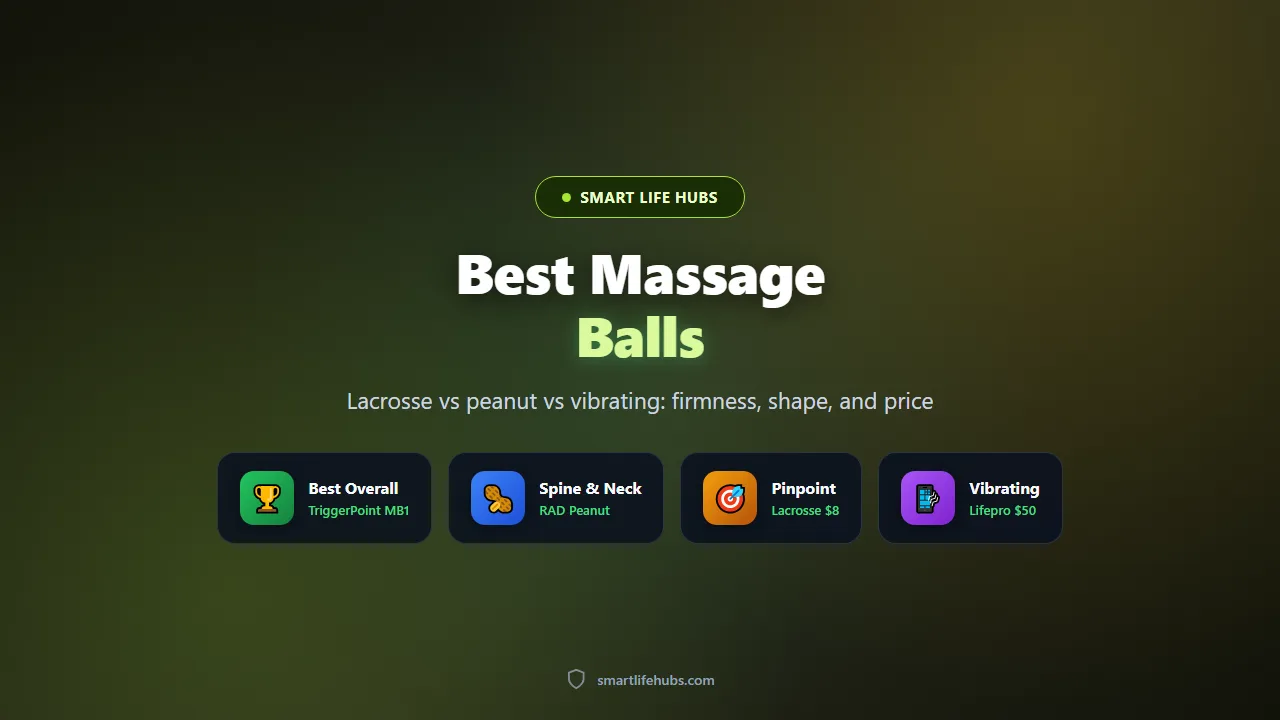
A massage ball is the cheapest recovery tool that actually works. It is a small firm ball you use with your own body weight to press into a tight spot, and it costs between about $6 and $110 depending on whether you want plain rubber or a motor. The category splits into single balls for pinpoint work, peanut shapes for the muscles beside the spine, spiky balls for hands and feet, and vibrating balls for people who want the pressure without the effort.
The honest summary is that a $7.99 pair of lacrosse balls does the core job, and the rest is convenience. The TriggerPoint MB1 at about $20 is the best all-round single ball, a peanut ball is essential if you want to work your back safely, and a vibrating ball at about $50 is a luxury rather than a necessity.
I pulled Home Gym Verdict’s ranked massage ball guide, Trusted Health Gear’s scored comparison, Rep and Recovery’s four honest picks, Home Court Athlete’s 2026 home gym guide and StrongRanked’s category breakdown. Where a figure is a claim rather than a measurement, I say so. Prices are US street prices as of November 2026.
At a glance
| Product | Best for | Key specs | Price |
|---|---|---|---|
| TriggerPoint MB1 | Best overall | 2.6 inch textured EVA foam, firm but forgiving, no motor | About $20 |
| RAD Roller Stiff | Best for spine and neck | Peanut shape straddles the vertebrae, firm rubber | About $25 to $34 |
| Kieba Lacrosse Balls (set of 2) | Best value | 2.5 inch firm rubber, pinpoint pressure, two balls | About $8 |
| Lifepro Agility 4-Speed | Best vibrating | 3.7 inch silicone and ABS, four speeds, USB-C, auto shutoff | About $50 |
| Due North Foot Rubz | Best for hands and feet | 1.9 inch spiky rubber, small and aggressive | About $6 |
The best massage balls of 2026
1. TriggerPoint MB1, best overall
The TriggerPoint MB1 costs about $20 and it is the ball most people should buy first. It is a 2.6 inch textured EVA foam ball with a firm feel that Home Gym Verdict says is hard enough to dig into glutes, feet and lats without being so hard it bruises on first use, and Trusted Health Gear scores it 7.9 out of 10 as the best larger, softer ball. The textured surface grips the floor and skin rather than skating off, and the multi-density foam spreads pressure more evenly than a hard rubber ball.
The trade-off is firmness. If you want the deepest possible pressure on a dense knot, a lacrosse ball will dig harder, and the foam ball can feel too soft once you are used to it. It is the safer first purchase rather than the last.
- Pros: About $20; textured grip; multi-density foam; firm without being brutal
- Cons: Less pinpoint than a hard ball; foam wears over years of heavy use
Check today’s price on Amazon.
2. RAD Roller Stiff, best for spine and neck
The RAD Roller Stiff costs about $25 to $34 and it is the peanut shape that solves the problem a single ball cannot: working the muscles beside the spine without pressing on the vertebrae. The central channel runs along either side of the spinous processes so the load goes into the muscle, and Home Gym Verdict recommends it specifically for anyone who wants to work directly on the spine or neck.
The trade-off is versatility. A peanut ball does not roll in all directions, so it is less useful for broad sweeping work on large muscles, and ModelRec notes the shape limits it compared with a round ball. Buy it as a second ball for the back rather than your only one.
- Pros: About $25 to $34; straddles the spine safely; firm rubber; compact
- Cons: Single plane of motion; not for large muscle groups; less versatile
Check today’s price on Amazon.
3. Kieba Lacrosse Balls, best value
The Kieba Massage Lacrosse Balls cost about $8 for a set of two and they are the cheapest serious option. They are 2.5 inch firm rubber balls, and ModelRec names them the editor’s choice because they deliver the deepest, most reliable pressure for the lowest cost, while Trusted Health Gear scores them 8.6 out of 10 as the best overall and best value.
The trade-offs are the hardness and the grip. A lacrosse ball is unforgiving on a sensitive spot, so you need to start with light pressure, and the smooth rubber can slide on a hard floor unless you use it against a wall or with a mat.
- Pros: About $8 for two; firmest pinpoint pressure; durable; tiny
- Cons: Very hard on sensitive areas; can slide on smooth floors; no texture
Check today’s price on Amazon.
4. Lifepro Agility 4-Speed, best vibrating
The Lifepro Agility 4-Speed Vibrating Massage Ball costs about $50 and it is the only powered option worth considering at the budget end. It is 3.7 inches across, made from silicone and ABS, offers four vibration levels, charges over USB-C and shuts itself off, and Home Court Athlete notes the auto shutoff removes the need to switch it off after every use.
The trade-offs are the session limits and the weight cap. Home Court Athlete lists a maximum of 10 minutes of use at a time, a 220 pound maximum user weight and no exposure to liquids, and Trusted Health Gear scores it 8.3 out of 10 while noting that a $8 lacrosse ball delivers the core benefit. The vibration is pleasant rather than transformative.
- Pros: About $50; four speeds; USB-C; auto shutoff; grippy silicone
- Cons: 10 minute session cap; 220 lb user limit; motor adds bulk and cost
Check today’s price on Amazon.
5. Due North Foot Rubz, best for hands and feet
The Due North Foot Rubz costs about $6 and it is the small spiky ball for the arches, palms and feet. Home Court Athlete describes it as a small spiked ball for hands and feet, and at 1.9 inches it is small enough to target a specific spot on the sole of the foot without the broad pressure of a larger ball.
The trade-offs are that the spikes are aggressive and the ball is too small for large muscles. It is a specialist tool for the feet and hands rather than an all-rounder, and it is the cheapest item here by a distance.
- Pros: About $6; 1.9 inch spiky surface; targets arches and palms; very cheap
- Cons: Too small for large muscles; spikes can be intense; single purpose
Check today’s price on Amazon.
Which ball for which muscle
The glutes are the most common target and the easiest to work. Sit on the floor with your knees bent, put the ball under one cheek and lean your weight onto it, then roll slowly across the whole muscle. A single ball is ideal here because you want pinpoint pressure on the knot.
The upper back and shoulder blades need a wall or the floor. Stand with the ball between your shoulder blade and the wall, bend your knees to move up and down, and pause on tender spots. A peanut ball is better if you want to work the strips of muscle either side of the spine, and a foam ball is kinder on the first attempt.
The feet are where the small spiky ball earns its place. Stand and roll the arch over it, starting lightly and adding weight as it settles, and use it on a hard floor where the spikes can bite. For the calves and hamstrings a larger ball on the floor works well, with the other leg stacked on top for extra pressure.
The hips and hip flexors are awkward and worth the effort. Lie face down with the ball under the front of the hip and move slowly, or use a lacrosse ball against a wall for the side of the hip. These are the spots that produce referred tightness down the leg, so work them gently.
Finally, the neck is the one area to approach with caution. Use a peanut ball and let the channel sit over the spine, keep the pressure light, and stop if you feel dizzy or get tingling in the arms.
Living with a massage ball
The first thing you learn is that a ball only works if it is where you will use it. A ball in a drawer is worthless, and one by the sofa or under the desk gets used, which is why the cheapest option often wins: it is easy to leave out.
The second is that the floor is the hardest surface and the wall is the most controllable. On the floor you use your body weight and can press hard, against a wall you control the angle and the pressure with your hands, and on a chair you can work the glutes with fine control.
The third is duration. A tender spot needs 30 to 60 seconds of steady pressure, not thirty seconds of scrubbing. Most people move too fast and wonder why nothing changes.
The fourth is knowing when to stop. A ball that produces sharp pain, numbness or tingling is being used on the wrong spot, and you should stop rather than push through. Dull ache is the target; shooting pain is a warning.
The fifth is that the ball is a supplement, not a fix. It helps with the feeling of tightness and can support mobility work, but it will not correct a movement problem or treat an injury, and persistent pain belongs with a physiotherapist.
The short version is that the cheapest ball you will leave out beats the clever one in the drawer, so buy the shape that fits the spot and put it where you will see it.
How to choose a massage ball
Start with single or peanut. A single ball is the most precise for the centre of a muscle such as a glute knot, calf or shoulder blade. A peanut ball straddles the spine and is the safe way to work the back and neck. Most people end up wanting both.
Match the firmness to your tolerance. A lacrosse ball is the firmest and cheapest, a foam ball like the TriggerPoint MB1 spreads the pressure and is gentler, and a spiky ball is the most aggressive on small areas. If you are new to this, start softer.
Consider the surface. Textured or grooved surfaces grip the floor and the skin, which matters when you are pressing hard. Smooth rubber slides, so use it against a wall or on a mat.
Check the size. A 1.9 inch ball targets a foot arch, a 2.5 inch ball is the all-round size, and a 3.7 inch ball spreads pressure over a larger area. Size changes the pressure more than firmness does, because a smaller contact area concentrates your body weight.
Decide whether vibration is worth it. A vibrating ball costs ten to twenty times a rubber one and adds comfort rather than capability. If you dislike the discomfort of deep pressure, it may be worth it; if you tolerate it, it is not.
Check the limits on powered balls. Vibrating models often carry session caps, user weight limits and liquid restrictions. Read them before buying, because a 220 pound limit rules out some users entirely.
Think about where you will keep it. A ball that lives by the sofa gets used, and one in a cupboard does not. Cheap enough to leave out is a real feature.
Think about the rest of the kit. Our vibrating foam roller guide covers the larger version of the same idea, and our fitness tracker roundup covers the training that creates the tightness.
Frequently asked questions
Frequently Asked Questions
6What is the best massage ball?
The TriggerPoint MB1 at about $20 for most people, because its textured foam is firm enough for glutes, feet and lats without bruising. The Kieba lacrosse balls at about $8 for the firmest pinpoint pressure, and a peanut ball if you want to work your back.
Are vibrating massage balls worth it?
They add comfort rather than capability. Trusted Health Gear scores the Lifepro at 8.3 out of 10 but notes a $8 lacrosse ball delivers the core benefit, so the motor is a luxury for people who dislike deep pressure.
What is the difference between a lacrosse ball and a peanut ball?
A lacrosse ball is a single round ball for pinpoint pressure on one muscle. A peanut ball has two lobes and a central channel that straddles the spine, so you can work the muscles beside the vertebrae without pressing on bone.
Can a massage ball help with back pain?
It can ease the feeling of tightness in the muscles beside the spine, and the peanut shape is designed for exactly that. It is not a treatment for back pain, and persistent or radiating pain should be assessed by a professional.
How long should I use a massage ball?
Thirty to 60 seconds on a tender spot, and two to three minutes per muscle group. More than five minutes on one place can irritate the tissue.
What should I not roll?
Avoid the lower back, the side of the neck and any joint, and be cautious with the IT band, which responds poorly to direct pressure. Stop if you feel sharp pain, numbness or tingling.
The bottom line
Buy the TriggerPoint MB1 if you want the best all-round ball: about $20, textured foam, firm without being brutal. Buy the RAD Roller Stiff at about $25 to $34 if you want to work your back and neck safely, the Kieba lacrosse balls at about $8 for the firmest pinpoint pressure, the Lifepro Agility at about $50 if you want vibration, and the Due North Foot Rubz at about $6 for hands and feet. Home Gym Verdict’s ranked massage ball guide reached the same conclusion on the TriggerPoint MB1 as the best for most home gyms. The honest summary is that the $8 lacrosse ball does the core job, the peanut shape is the one genuinely different tool, and vibration is a luxury. Which spot are you actually trying to reach? Tell us in the comments.


Leave a Comment