
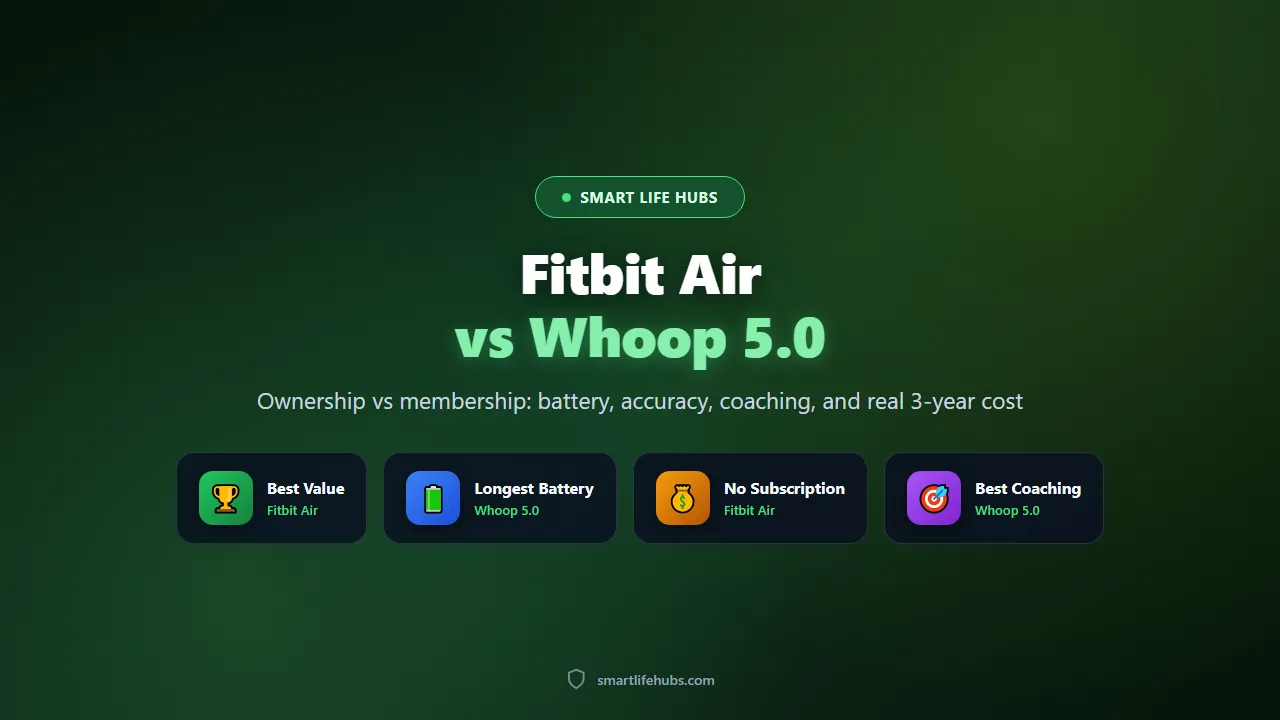
The Fitbit Air and the Whoop 5.0 are the two screenless bands most people actually compare, and they reach the same goal from opposite directions. The Air costs $99.99 once and asks for nothing more. The Whoop 5.0 has no price tag because you cannot buy it; it arrives with a membership that starts at $239 a year. Both track heart rate, sleep, and recovery around the clock. The real question is whether Whoop’s deeper analytics justify renting a sensor for three years while Fitbit sells you one for the price of a decent pair of running shoes.
Whoop created this category and still defines it. Fitbit is the biggest name in fitness tracking and the Air is its first screenless device, launched in May 2026. The two products take different bets. Fitbit bets that most people want a light band, a week of battery, and a fair price. Whoop bets that serious trainees want strain and recovery guidance bad enough to pay annually forever. Both bets are reasonable, and the right answer depends on how you actually train.
I compared manufacturer specifications, PCMag’s and Tom’s Guide’s published measurements, Which?’s lab results for the Air, and long-term owner reports from Reddit and the Whoop community. Where a number is a claim rather than a measurement, I say so. Prices are US street prices as of November 2026.
At a glance
| Criteria | Fitbit Air | Whoop 5.0 |
|---|---|---|
| Price | $99.99 once | No hardware sale; $239 per year membership (Peak) |
| Subscription | Optional, Google Health Premium $9.99 per month | Required; One $199, Peak $239, Life $359 per year |
| Battery | 7 days claimed, 8.5 days tested | 14 days claimed, 16.5 days tested |
| Weight | 5.2g capsule, 12g with band | 26.5g without strap |
| Water resistance | 50 metres (5ATM) | IP68 |
| Sensors | Heart rate, SpO2, skin temperature, accelerometer, gyroscope | Heart rate, SpO2, skin temperature, accelerometer, gyroscope |
| ECG | No | No on the 5.0; the MG model adds it |
| Built-in GPS | No, connected GPS only | No |
| App | Google Health | Whoop app |
| Best for | Most people, first-time tracker buyers | Serious trainees who want coaching depth |
Fitbit Air vs Whoop 5.0: how they compare
Price and ownership
The Air is $99.99 and it is yours. The Whoop 5.0 is not for sale. The Peak membership that includes it costs $239 a year, and over three years you pay $717 for hardware you never own and cannot resell. Cancel and the sensor stops working. The Air keeps working with the free Google Health app even if you never pay another dollar, and you can sell it or give it away. This is the single biggest difference between the two products, and no amount of coaching quality changes it. If you stop training for six months, the Air becomes a $100 paperweight in a drawer. The Whoop becomes a $239 annual reminder in your bank statement.
Battery and charging
Whoop wins on paper and in testing. The 5.0 runs 14 days on a charge by claim and lasted 16.5 days in PCMag’s testing, which means two weeks of tracking without a cable. The Air runs 7 days by claim, 8.5 days in the same testing, and 199 hours in Which?’s lab. Both charge quickly. The Air reaches roughly 60% in 15 minutes and a full charge in about 90 minutes, and a 5-minute top-up buys a day of use. Whoop’s charging is more convenient on the MG model, which supports a wireless power pack that clips on while you wear it. On the 5.0 you remove the sensor to charge. For most people the practical difference is charging once a week versus once every two weeks, and PCMag’s Whoop 5.0 review documents the same 16.5-day result under standardized testing.
Accuracy and sensors
Both bands carry the same core sensor set: optical heart rate, SpO2, skin temperature, accelerometer, and gyroscope. Neither the Air nor the 5.0 has an ECG, and neither has built-in GPS, so both need your phone for mapped outdoor workouts. Which?’s lab measured the Air’s overall heart rate error at 1.34% against a fitness tracker average of 5.7%, and walking step count error at 1.66% against 3.26%. Whoop’s own accuracy has been consistently strong in independent testing, and one reviewer’s side-by-side workouts put the two within about a beat of each other. For resting heart rate, sleep stages, and HRV, the two are close enough that the choice comes down to interpretation, not measurement. Where they differ is in the extras: the Air can flag signs of atrial fibrillation and reads blood oxygen during sleep, while the Whoop 5.0 does not offer ECG, which is reserved for the $359 MG tier. For a closer look at how these devices stack up on accuracy, our fitness tracker accuracy guide covers the testing methods.
Sleep tracking and readiness
Sleep is where both bands spend most of their battery, and both handle it well. The Air tracks sleep stages, breathing rate, SpO2, and skin temperature variation, then gives you a sleep score and a Daily Readiness Score that combines last night’s sleep with the day before’s effort. Whoop tracks sleep stages, respiratory rate, and HRV, then gives you a Recovery percentage and a Sleep Performance score. Long-term owners put the two close on total sleep time, with the Air sometimes scoring light sleep differently from Whoop. Where Whoop pulls ahead is the morning report. It tells you whether to push hard, take it easy, or rest, and it adjusts that advice based on the previous day’s strain. The Air gives you a readiness number too, but the free app explains it in less detail. If sleep is your main reason for buying, both work, and the difference is how much hand-holding you want at seven in the morning. In practice most owners look at the score, glance at the breakdown once a week, and ignore the rest, so the fancier report earns its keep only if you act on it.
App and coaching
This is where the money goes. The free Google Health app gives you heart rate, sleep stages, a Daily Readiness Score, Cardio Load, and stress, with almost no guidance attached. Google Health Premium for $9.99 a month adds a Gemini-powered Health Coach that builds fitness plans, answers questions about your data, logs meals by photo or voice, and suggests workouts around an injury. Whoop’s app gives you Recovery, Strain, and Sleep scores for free, plus a journal, a coach, and a dense library of metrics. Reviewers consistently describe Whoop’s recommendations as strong and its raw data as buried. If you want interpretation, Whoop is the better coach out of the box and the Air is the better coach once you pay for Premium. For a broader view of the category, our fitness tracker roundup covers both screenless and screen designs.
Comfort and wear
The Air is 12 grams with the fabric band on, less than half the Whoop 5.0’s 26.5 grams, and it disappears under a cuff or during sleep. The Whoop strap uses a snap closure that some owners say pinches, and the sensor is chunky enough that you notice it when dressing up. Whoop sells a wide range of mounts, including clothing and wrist options, which softens the complaint. If you lift weights, the Air’s fabric band tucks out of the way better than a rigid sensor. Both are comfortable enough for 24-hour wear, and both survived swimming in testing, though the Air’s 50-metre rating is the more useful spec for pool and open water.
Daily use, alarms, and durability
Neither band shows notifications, which is the point of the category. The Air has a vibration motor for silent alarms and a small LED that reports battery level when you double-tap the sensor. The Whoop 5.0 has haptic feedback for alarms and alerts. Both store several days of data onboard, so a long weekend without your phone is fine. The Air ships with a recycled polyester band and a Velcro closure, and Fitbit sells a tougher Active Band plus a dressier option from $34.99. Whoop’s included strap is harder to adjust and can pinch when you snap it closed, though the company sells clothing mounts and a wide range of bands separately. Owners who move the sensor to a bicep or waist mount report better comfort for lifting and sleeping. The Air has no equivalent mount, but its low weight means most people forget it is there. For lifting, the Air’s fabric band tucks under the wrist better. For formal wear, both are visible, and the Air is the less obvious of the two.
Which one should you buy
Setup, app pairing, and daily use
Both bands need a phone for setup and both take about 15 to 20 minutes. The Air pairs through the Google Health app, and if you are on Android it can also write to Health Connect, while on an iPhone it shares exercise, sleep, steps, and vitals with Apple Health. The Whoop 5.0 pairs through the Whoop app and asks for a few baseline days before its recovery numbers settle, so the first week of advice is less reliable. Wear either band a finger-width above the wrist bone for the cleanest heart rate signal, and tighten it one notch for workouts. Neither band shows notifications, so if you are used to reading messages on your wrist, expect to check your phone more often. Both store several days of data, so a weekend away from the phone does not lose anything.
Care, cleaning, and long-term durability
Both bands sweat, and both need a rinse. Wash the Air’s fabric band by hand with mild soap and let it air dry, and wipe the sensor capsule with a damp cloth, keeping the charging contacts dry. The Whoop strap is similar, and its snap closure should be opened and closed gently because the clip is the part owners report breaking. Neither band has a user-replaceable battery, so plan on a two-to-three-year life before capacity drops enough to notice. Rinse after swimming, because residue on the sensor window causes patchy heart rate readings. If you wear the band for sleep and showers, clean it weekly rather than monthly.
Common mistakes buyers make
The most common mistake with the Air is never trying Google Health Premium, so the band stays a dashboard with no guidance, then wondering why the data feels pointless. The opposite mistake is paying for Premium without using the coach, which turns $9.99 a month into a subscription you forgot. With Whoop, the mistake is signing up for the Life tier when Peak gives you everything you will read, or staying on Peak after three months of ignoring the strain advice. A third mistake is wearing either band too loose at night, which degrades sleep staging and HRV. A fourth is comparing a single day’s recovery score instead of the weekly trend, since both apps are designed around trends. A fifth is expecting either band to replace a GPS watch, because both lean on your phone.
Who should skip both
Skip both if you want on-wrist notifications, maps, or apps, since neither has a screen. Skip both if you need built-in GPS or an ECG, because the Air and the 5.0 lack both and the Whoop MG is the tier that adds ECG. Skip both if you want the cheapest possible tracker, since a basic band with a screen costs less than the Air. Skip the Air if you want structured daily coaching and will not pay for Premium. Skip the Whoop if you train casually, take long breaks, or dislike recurring bills, because the membership punishes interruption. And skip both if you already wear a watch you like, since a screenless band worn beside a watch is a lot of hardware for one wrist.
Buy the Fitbit Air if you want to own your tracker. At $99.99 it is the best value in the category, and the free app covers the basics well enough for a first tracker. It suits walkers, gym-goers, and anyone who wants sleep and heart rate data without a monthly bill. Add Google Health Premium only if you find yourself wanting a coach rather than a dashboard.
Buy the Whoop 5.0 if you train seriously and want guidance. The 16.5-day battery, the strain and recovery model, and the depth of the app make it the better tool for structured training, and the membership includes hardware upgrades over time. Only do it if you will actually use the coaching, because three years of membership costs more than a good GPS watch.
Consider neither if you need GPS or ECG. Both bands rely on your phone for mapped routes, and neither the Air nor the 5.0 has an ECG. If those two features matter, a GPS watch or the Whoop MG at $359 a year is the better fit.
Do the three-year math before you decide. The Air with Premium is $400 over three years. The Whoop 5.0 at Peak is $717. The Air without Premium is $100. That gap is the whole decision in one line.
Think about the exit cost before you start. The Air is a one-time purchase you can walk away from at any point. The Whoop membership renews, and the sensor is useless without it. If your budget or motivation is unpredictable, the Air’s worst case is $100. The Whoop’s worst case is $239 a year for as long as you keep paying.
Skip both if you want a screen or a smartwatch experience. Neither band will read your messages, show a map, or run apps. If you want notifications on your wrist, an entry-level smartwatch costs about the same as the Air and does far more. The screenless category trades all of that for battery life and comfort, and that trade is only worth it if you actually want fewer screens.
Frequently asked questions
Frequently Asked Questions
5Is the Fitbit Air better than the Whoop 5.0?
Better value, yes. Better coaching, no. The Air costs $99.99 once and matches the Whoop on heart rate and sleep accuracy, but Whoop’s app gives you more structured guidance for training. If you want a coach, Whoop wins. If you want a tracker you own, the Air wins.
Can you buy a Whoop 5.0 without a membership?
No. Whoop does not sell the 5.0 as hardware. The Peak membership at $239 a year includes the device, and the cheaper One tier at $199 includes the older Whoop 4.0. The top Life tier at $359 includes the MG with ECG and blood pressure trends.
Which has better battery life, the Fitbit Air or the Whoop 5.0?
The Whoop 5.0. It runs 14 days on a charge by claim and 16.5 days in PCMag’s testing, against 7 days claimed and 8.5 days tested for the Air. Both charge fast enough that the difference is a weekly ritual versus a biweekly one.
Does the Fitbit Air work with the Whoop app?
No. The Air syncs only to Google Health, which can write exercise, sleep, steps, and vitals to Apple Health and, on Android, HRV to Health Connect. Whoop data stays in the Whoop app unless you use its approved integrations.
Is the Whoop 5.0 worth $239 a year?
Only if you use the coaching. The hardware is good and the battery is the best in the category, but you can buy a Fitbit Air for $100 and get similar heart rate and sleep accuracy. Pay for Whoop if the strain and recovery guidance changes how you train, not for the sensor itself.
The bottom line
Buy the Fitbit Air if you want the better deal and a tracker you own: $99.99, 12 grams, accurate heart rate and sleep, and a free app that covers the essentials. Buy the Whoop 5.0 if you want the best coaching and the longest battery and you will genuinely use the strain and recovery guidance, accepting $717 over three years for a sensor you never own. For most people the Air is the smarter purchase, and the money left over buys running shoes that will do more for your fitness than any band. If you want a third option that costs the same as the Air with no subscription at all, the Amazfit Helio Strap at $99.99 is worth a look. Which one are you leaning toward? Tell us in the comments.

Leave a Comment