
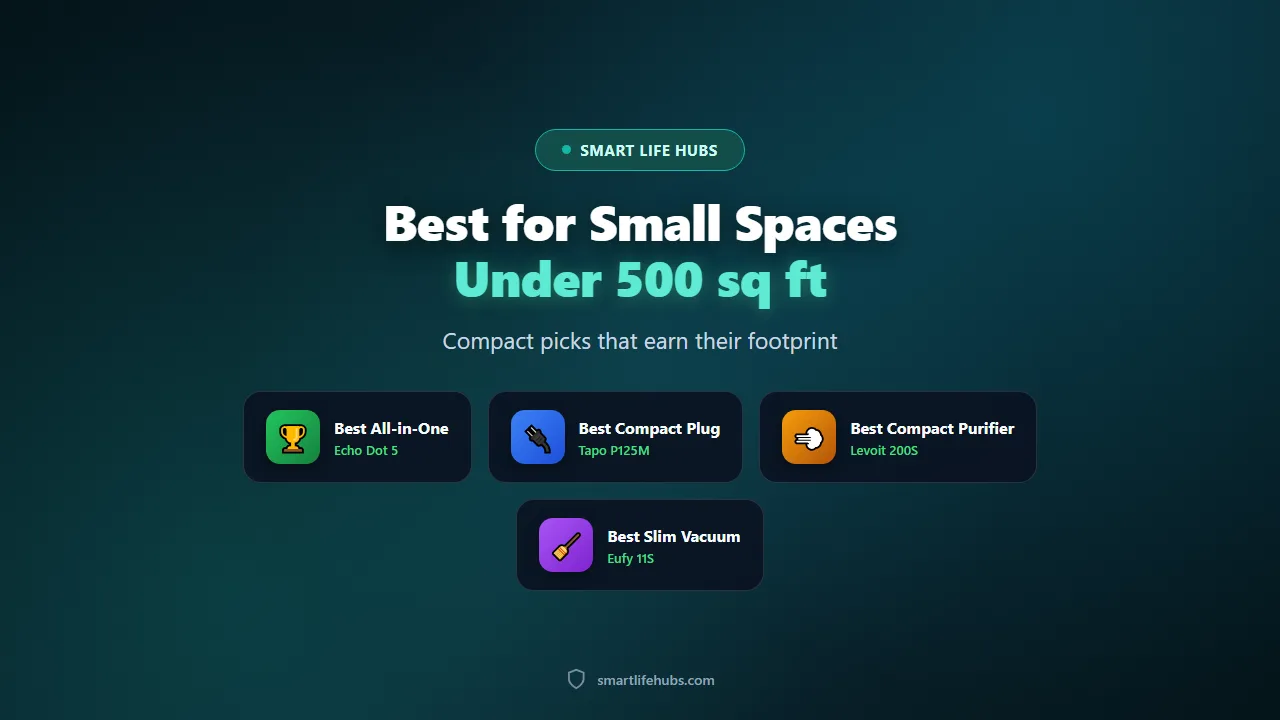
Best smart home devices for small spaces of 2026 are the ones that do two or three jobs at once and do not block the second socket, the only shelf or the walkway, and the honest finding after fitting out a 400 square foot studio is that six well-chosen devices beat twenty. A small space punishes clutter, so every gadget has to earn its footprint, and the devices that survive are the compact speaker, the compact plug, the compact purifier and the compact camera.
The second thing to understand is that a small space has a different air problem from a big one. One person breathing in a closed 400 square foot room can push carbon dioxide from 400 to over 1,200 parts per million in an evening, which is enough to make you groggy, and the same volume of air means cooking smells, humidity and particulates concentrate faster. An air quality monitor and a compact purifier earn their place in a studio in a way they do not in a house.
Prices below are US retail captured in November 2026 and they move with sales.
At a glance
| Product | Best for | Key specs | Price |
|---|---|---|---|
| Amazon Echo Dot (5th Gen) | Best all-in-one | Voice, routines, temperature sensor, compact | About 40 to 50 USD |
| TP-Link Tapo P125M | Best compact plug | Matter, energy monitoring, does not block the next socket | About 12 to 20 USD |
| Levoit Core 200S | Best compact purifier | HEPA, about the size of a large coffee can, quiet | About 90 USD |
| eufy Indoor Cam C220 | Best compact camera | 2K, local storage, freestanding | About 35 USD |
| Eufy RoboVac 11S | Best slim robot vacuum | 2.85 inches high, slides under furniture | About 150 USD |
The best smart home devices for small spaces
1. Amazon Echo Dot (5th Gen), best all-in-one
The Echo Dot is the pick because it is the one device that replaces a speaker, a voice assistant, a hub and a temperature sensor in a body the size of an orange, and in a studio that consolidation is worth more than raw sound quality. It runs Alexa routines, it can act as a Matter controller, it has a temperature sensor you can use for automations, and it costs about 40 to 50 dollars. The honest trade-offs are a sound that is fine for speech and background music rather than for a film, an Alexa-first ecosystem, and a device that is always listening for the wake word, so it is the pick for a small flat where one gadget must do several jobs.
Pros
- About 40 to 50 USD in a very small body
- Voice, routines, Matter controller and a temperature sensor
- Replaces a speaker, a hub and a timer
Cons
- Sound is fine rather than good
- Alexa-first, with an always-on microphone
Check today’s price on Amazon.
2. TP-Link Tapo P125M, best compact plug
The P125M is the pick because the shape matters more than the specification in a studio. It is a compact plug that does not block the second socket in a duplex outlet, it works with Matter across Alexa, Google and Apple Home, it monitors energy and it costs about 12 to 20 dollars. The honest trade-offs are a plastic body, no dimming and an app that is functional rather than lovely, so it is the pick for the lamp, the fan, the coffee maker and the heater you want to schedule.
Pros
- About 12 to 20 USD, the cheapest useful automation
- Compact enough to leave the second outlet free
- Matter support and energy monitoring with no hub
Cons
- No dimming and a plastic body
- App is functional rather than polished
Check today’s price on Amazon.
3. Levoit Core 200S, best compact purifier
The Core 200S is the pick because a small room needs a small purifier and this one is about the size of a large coffee can, so it sits on a nightstand or a shelf instead of taking the floor. It has a HEPA filter, three speeds, app and voice control, and it covers a small room for about 90 dollars. The honest trade-offs are a filter you must buy forever, a top air speed that is modest, and a design that is plain, so it is the pick for a studio or a bedroom rather than an open-plan living room.
Pros
- About 90 USD and small enough for a nightstand
- HEPA filtration with three speeds
- App and voice control
Cons
- Replacement filters are an ongoing cost
- Top speed is modest for a large room
Check today’s price on Amazon.
4. eufy Indoor Cam C220, best compact camera
The C220 is the pick if you want to see the door or the room from anywhere without a big camera on the shelf. It shoots 2K, it stores locally so there is no subscription, it stands on its own or mounts with a small screw, and it costs about 35 dollars. The honest trade-offs are a 2.4GHz-only connection, a need for a power cable, and an eufy app rather than a fully open platform, so it is the pick for a budget camera on a shelf.
Pros
- About 35 USD, the cheapest useful camera
- 2K with local storage and no subscription
- Small enough to sit on a shelf
Cons
- 2.4GHz Wi-Fi only and needs a power cable
- Works best inside the eufy app
Check today’s price on Amazon.
5. Eufy RoboVac 11S, best slim robot vacuum
The 11S is the pick if you want a robot vacuum that actually fits a studio, because at 2.85 inches high it slides under a bed or a sofa that a thicker robot cannot reach, and in a small flat that is the difference between a robot that cleans and one that is stuck in the doorway. It has a slim body, a quiet motor and boost mode, and it costs about 150 dollars. The honest trade-offs are no mapping or room selection, a smaller dustbin and a design that is a few generations old, so it is the pick for a small area rather than a whole house.
Pros
- 2.85 inches high, so it fits under low furniture
- About 150 USD with boost mode
- Quiet for a robot vacuum
Cons
- No mapping or room selection
- Smaller dustbin and an older design
Check today’s price on Amazon.
How to choose for a small space
Start with the footprint, because in a studio the space a device occupies is the real price. A compact plug that blocks the second socket is not compact, and a purifier the size of a bin is not for a small room. Measure the shelf, the socket and the floor area before you buy, and prefer the device that does two jobs over two devices that do one.
Then check the air, because a small room’s air turns over fast and the CO2 can climb while you sleep. An air quality monitor with a CO2 reading, a compact purifier and a fan or a vent that you can automate will do more for how the room feels than any lighting upgrade, and the whole stack costs less than a single designer lamp.
Check the connectivity, because a small flat often has one router and a lot of devices competing for it. Matter devices are the simplest, Thread bulbs reduce the Wi-Fi load, and a mesh node in the right place is often the difference between a system that works and one that drops out when the microwave runs.
Think about the noise, because a device you hear in a small room is a device you will turn off. A loud purifier, a buzzy plug or a robot vacuum in a studio is far more intrusive than the same device in a house with a door to close, so check the decibel figures and prefer the quiet model even if it costs a little more.
Finally, be honest about how many devices you will actually manage, because a small space rewards a simple system. One speaker, two plugs, a bulb or two, a purifier and a camera is a complete studio, and a shelf of gadgets you check in five apps is a burden rather than an upgrade. CleverHomeClub’s 2026 small-apartment guide at cleverhomeclub.com/smart-home-small-apartment covers the compact picks and the air quality numbers.
Living with a small-space smart home
Layout and cables
Plan the sockets before you buy, because a studio often has one double outlet per wall and a smart plug that blocks the second socket is a daily annoyance. Count the devices you want to plug in, measure the space behind the furniture, and put the plugs that stay permanently on a short extension lead so the wall socket stays usable for the vacuum.
Use the vertical space, because floor area is the one thing a small flat does not have. A shelf for the speaker, a wall mount for the camera and a hook for the robot vacuum’s dock keep the floor clear, and a clear floor makes a small room feel larger than any gadget makes it feel smarter.
Use vertical space and stick to the edges, because a studio has no room for a device in the middle of the floor. Put the purifier on a shelf or a nightstand, mount the camera high on a wall or a shelf, and keep the plugs at the back of the socket so the cables fall behind the furniture rather than across the walkway.
Choose a single app where you can, because five apps for six devices is the fast route to a system you ignore. Pick one assistant, put the plugs, bulbs and purifier in it, and use the camera’s own app only for the camera. A single dashboard in a small flat is the difference between a smart home and a chore.
Set the automations once and then leave them, because a small space benefits from a routine more than a big one. Set the purifier to auto, the lights to a warm evening level, the robot vacuum to run when you are out and the speaker to read the weather in the morning, and let the flat run itself rather than reaching for the phone.
Watch the air quality and act on it, because a CO2 reading above 1,000 parts per million is the signal to open a window, and a humidity reading above 60 percent is the signal for the dehumidifier. Put the monitor where you sit rather than on a shelf you never look at, and check it once a day.
Clear the floors and the shelves regularly, because a small space fills up fast and a gadget bought for convenience becomes clutter within a season. If a device has not been used in a month, unplug it, and if you are moving, sell or give away what you did not use. For the wider setup, our apartment space-saving guide covers the picks, and the small space desk guide covers the workspace.
Frequently asked questions
Frequently Asked Questions
6What is the best single device for a small flat?
A compact smart speaker. It replaces a speaker, a voice assistant, a timer and sometimes a hub and a temperature sensor, so it is the one device that consolidates the most functions into the smallest footprint.
Why does a small room need an air purifier?
Because the air volume is small, so CO2, cooking smells and particulates concentrate faster. One person in a closed 400 square foot room can push CO2 from 400 to over 1,200 parts per million in an evening, which is enough to affect how you feel.
Do smart plugs block the second socket?
Some do and some do not. A compact plug like the Tapo P125M is designed to leave the second outlet free, which matters in a room with only a few sockets, so check the dimensions before you buy.
Is a robot vacuum worth it in a studio?
Yes, if it is slim enough to get under the furniture. A small flat has less floor to clean, so a robot vacuum that runs daily keeps it tidy with no effort, and a 2.85 inch model will reach the dust a thicker one cannot.
Do I need a mesh router in a small flat?
Usually not, because the distances are short, but a studio with thick walls or a router in a cupboard can still have dead spots. A single mesh node in the right place is cheaper and simpler than moving the router.
How many smart devices is too many for a small space?
If you need more than one app to run the room, you probably have too many. Six devices in one ecosystem is a complete small flat, and every device after that has to justify the shelf space and the attention it demands.
The bottom line
Buy the Amazon Echo Dot at about 40 to 50 dollars as the single most useful device in a small flat, because it consolidates a speaker, a voice assistant, a Matter controller and a temperature sensor into a body that fits on a shelf.
Buy the TP-Link Tapo P125M at about 12 to 20 dollars for automation that does not block the second socket, the Levoit Core 200S at about 90 dollars for compact air cleaning, the eufy Indoor Cam C220 at about 35 dollars for a budget camera and the Eufy RoboVac 11S at about 150 dollars for a vacuum that fits under low furniture.
The principle that matters is that every device must earn its footprint. In a small space, the compact plug, the slim vacuum and the small purifier are worth more than the flagship versions, because the flagship is designed for a room you do not have.

Leave a Comment