
A vibrating foam roller is a normal roller with a motor inside that buzzes while you roll, and the claim is that the vibration reduces the discomfort of deep pressure so you can work harder and recover faster. The honest evidence is more modest: vibration adds a small improvement in range of motion over a standard roller, and the reviews that looked at jump performance and strength found effects close to zero.
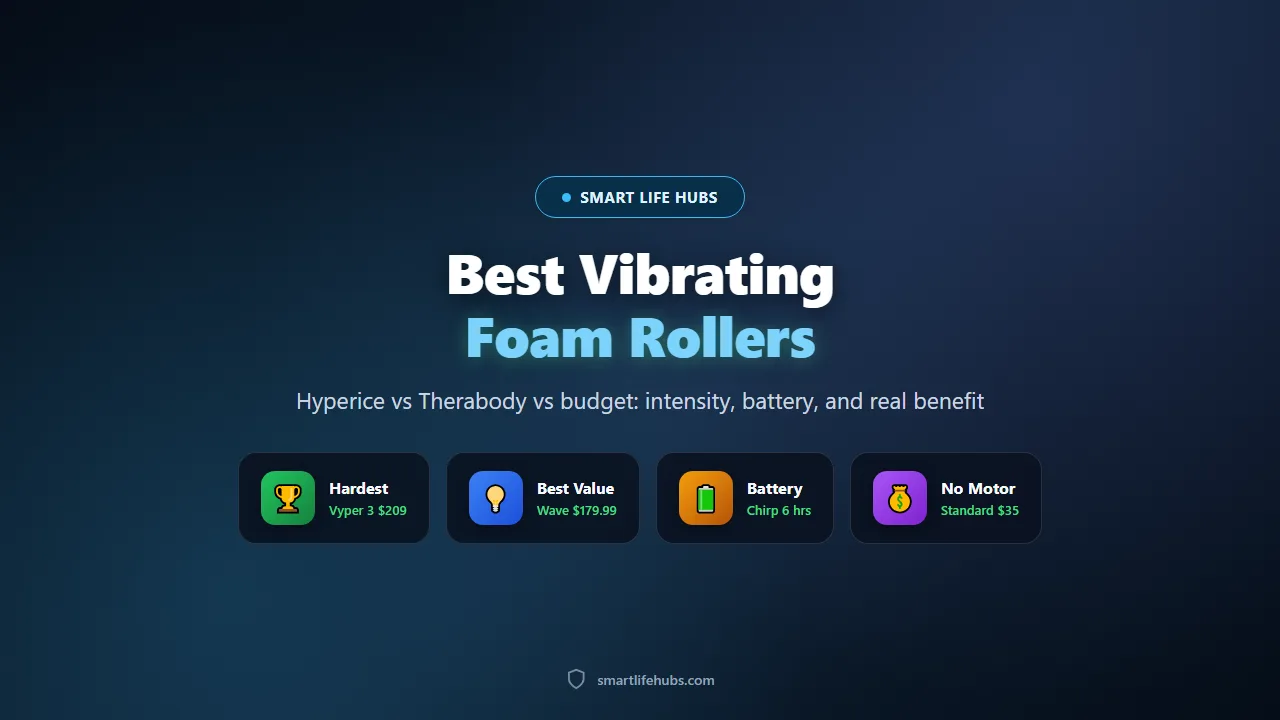
Prices run from about $35 for a plain roller to about $230 for a powered one. The Hyperice Vyper 3 at $209 is the most intense and the best for deep tissue work, the Therabody Wave Roller at $179.99 is the best value with five speeds and app guidance, the Chirp RPM at $229.99 has the longest battery, and a $35 standard roller does most of the job.
I pulled Verywell Fit’s tested vibrating roller guide, MK Library’s spec-by-spec comparison, TalkGyms’ 2026 review, Runner’s Picks’ foam roller roundup and PNEUX’s price and battery table. Where a figure is a claim rather than a measurement, I say so. Prices are US street prices as of November 2026.
At a glance
| Product | Best for | Key specs | Price |
|---|---|---|---|
| Hyperice Vyper 3 | Best overall | 3 speeds at 1,600 to 3,200 RPM, 2 hour battery, 3 lb, 13 inch | $209, about $159 on sale |
| Therabody Wave Roller | Best value | 5 speeds, 3 hour battery, Bluetooth app routines, 3.3 lb | $179.99, about $150 on sale |
| Chirp RPM | Best battery | 5 speeds, 6 hour battery, 44 powered nodes, hands-free stand | $229.99 |
| RENPHO R3 | Best budget | 4 speeds, USB-C, rechargeable, quieter than expected | About $50 |
| Standard foam roller | Best without vibration | No motor, no battery, no app, works forever | About $35 |
The best vibrating foam rollers of 2026
1. Hyperice Vyper 3, best overall
The Hyperice Vyper 3 costs $209 and it is the roller that hits hardest. It offers three speeds at 1,600, 2,600 and 3,200 RPM driven by a 34 watt high-torque motor, weighs 3 pounds and measures 13 inches, with a contoured hourglass shape that cradles the spine. TalkGyms rates it 4.7 out of 5 and found the three speeds genuinely distinct rather than blending together, with the battery lasting a full week of daily 10 minute sessions. Verywell Fit gives it 4.6 out of 5 and credits the ridged design with reaching deep knots.
The trade-offs are the battery, the speeds and the material. MK Library lists the 2 hour battery as the weakest specification and notes that three speeds look limited next to the five offered by both competitors. It is also polypropylene rather than foam, so the surface feels different from a traditional roller.
- Pros: $209; hardest vibration; distinct speeds; hourglass contour; 3 pound travel weight
- Cons: 2 hour battery; only 3 speeds; polypropylene shell is not foam
Check today’s price on Amazon.
2. Therabody Wave Roller, best value
The Therabody Wave Roller costs $179.99 and it wins on the specification for the money. It offers five speeds, a 3 hour battery, Bluetooth app control with guided routines and a 12 inch hypo-allergenic EVA high-density foam body with silicone wave grooves. MK Library calculates it undercuts the Vyper 3 by $29 while offering more speeds and longer battery life, and TalkGyms rates it 4.6 out of 5, finding the guided sessions genuinely useful for tight IT bands and upper back tension.
The trade-offs are the softer foam and the app dependency. MK Library notes Therabody’s own specifications describe the Wave’s foam as softer than the Vyper’s, so it is a gentler option for people who dislike aggressive pressure, and TalkGyms’ testing found the top speed milder than the Hyperice.
- Pros: $179.99; 5 speeds; 3 hour battery; app-guided routines; softer foam
- Cons: Gentler than the Vyper; app needed for full control; foam is softer
Check today’s price on Amazon.
3. Chirp RPM, best battery
The Chirp RPM costs $229.99 and it is the roller that does not need charging often, with a 6 hour battery and 5 reversible speeds. It uses 44 powered nodes in a rolling-pin design with handles, comes with a hands-free stand for your feet and weighs 3.68 pounds, or 4.86 with the stand. MK Library lists it as the option with the longest battery life and a stall force of 60 pounds.
The trade-offs are the price, the length at 19.9 inches and the lack of app connectivity. If you want guided routines, the Therabody is the better choice; if you want a long battery and a different rolling geometry, the Chirp is interesting.
- Pros: $229.99; 6 hour battery; 5 speeds; 44 nodes; hands-free foot stand
- Cons: Most expensive here; 19.9 inch length; no app
Check today’s price on Amazon.
4. RENPHO R3, best budget
The RENPHO R3 costs about $50 and it is the roller to buy if you are not sure you will use vibration. TalkGyms rates it 4.3 out of 5 as the best budget option, noting the motor is quieter than expected, the foam holds its shape after regular quad and IT band work and it charges over USB-C. It offers four speeds, which is more settings than the Hyperice for a fifth of the price.
The trade-offs are the lower intensity and the build quality. The vibration is milder than the premium models, the battery needs charging more often, and it is a budget product rather than a long-term tool.
- Pros: About $50; 4 speeds; USB-C; quiet motor; holds its shape
- Cons: Mild vibration; shorter battery; budget build
Check today’s price on Amazon.
5. Standard foam roller, best without vibration
A standard foam roller such as the TriggerPoint GRID at about $35 has no motor, no battery and no app, and MK Library’s reading of the evidence suggests a $25 to $35 standard roller gets you 80 to 90 percent of the documented benefit. The vibration adds a small range-of-motion gain, but the reviews that looked at jump performance and strength found effects near zero, which makes the motor a convenience rather than a necessity.
The trade-offs are the absence of vibration, which means more discomfort at the same pressure, and the fact that you supply all the pressure yourself. If you are disciplined and on a budget, this is the honest recommendation.
- Pros: About $35; no battery; durable; 80 to 90 percent of the benefit
- Cons: No vibration; more discomfort; no app or guidance
Check today’s price on Amazon.
Rolling technique that actually helps
The first rule is slow. Rolling a muscle quickly back and forth is the mistake almost everyone makes, because the tissue barely has time to respond. Aim for roughly an inch per second, and when you find a tender spot, hold the pressure on it for 30 to 60 seconds rather than scrubbing over it.
The second is to avoid the areas you should not roll. Skip the lower back, the side of the neck and any joint, and be cautious around the IT band, which is a thick band of fascia rather than a muscle and does not respond well to direct pressure. Roll the quad and hip flexor above it instead.
The third is breathing. People hold their breath when a spot hurts, which raises tension and makes the discomfort worse. Slow exhales through the tender area help the muscle let go, and that is where the range-of-motion gain comes from.
Finally, two to three minutes per muscle group is enough. More than five minutes on one spot can irritate the tissue, and rolling daily is more useful than a long session once a week.
Living with a vibrating roller
The first thing you learn is that the vibration mostly buys you tolerance. Rolling a sore quad without vibration is uncomfortable enough that people stop early, and the buzz lets you stay on the spot longer, which is where the small range-of-motion gain comes from. It is a comfort feature more than a treatment.
The second is that the battery becomes a chore. A roller with a two hour battery used daily needs charging every other day, and several budget models are worse. If you will use it daily, buy the model with the longest battery rather than the most speeds.
The third is noise. A vibrating motor on a hollow shell is audible in a quiet room, and cheaper models are louder. If you roll while watching television, you will notice.
The fourth is that the motor adds weight and changes the feel. A 3 pound powered roller is harder to control than a 1 pound foam one, and the rigid shell can feel harsher on the spine than a soft roller. Many people keep both.
The fifth is that you still have to do the work. A vibrating roller will not roll for you, and the people who benefit most are the ones who use it for two to three minutes per muscle group after training rather than owning it.
The short version is that the motor buys comfort, not results, and the cheaper roller plus the discipline to use it is the better buy for most people who are not treating a specific problem.
How to choose a vibrating foam roller
Decide whether you need vibration at all. The evidence supports a small range-of-motion gain and little else, and a $35 standard roller delivers most of the benefit. If you dislike the discomfort of deep pressure, vibration is worth it; if you tolerate rolling well, it is not.
Check the battery in hours, not sessions. A two hour battery used daily needs charging constantly, while a six hour battery lasts a week. Check the warranty on the battery and electronics, because PNEUX found the most common complaints were about battery and charging.
Look at the intensity range, not the number of speeds. Because you add pressure with your body weight, a gentle first mode matters more than a fierce top one. TalkGyms found some budget rollers mild at top speed, which makes the range the useful number.
Consider the surface and shape. A contoured hourglass shape suits the spine and calves, a smooth cylinder suits the quads and hamstrings, and a textured surface grips better but can be harsh. Pick for the muscles you will roll most.
Check the weight and length for travel. A 3 pound 13 inch roller fits in a gym bag, and a 3.68 pound 19.9 inch roller with a stand does not. If you travel, weight and packed size matter more than the extra features.
Think about the app. Therabody’s guided routines are genuinely useful if you do not know what to roll, and Hyperice and Chirp work without one. If you want structure, the app is worth paying for.
Do not expect performance gains. The reviews that looked at jump performance and strength found effects near zero, so treat a vibrating roller as a recovery comfort tool rather than a way to get stronger or faster.
Think about the rest of the kit. Our recovery slides roundup covers what to wear afterwards, and our fitness tracker roundup covers measuring the training that creates the soreness.
Frequently asked questions
Frequently Asked Questions
6Do vibrating foam rollers actually work?
They add a small improvement in range of motion over a standard roller, with a meta-analysis reporting a standardized mean difference of about 0.53. Reviews looking at jump performance and strength found effects close to zero, so the benefit is modest and mostly about comfort during rolling.
Which vibrating foam roller is best?
The Hyperice Vyper 3 at $209 for the hardest vibration and deep tissue work, the Therabody Wave Roller at $179.99 for the best value with five speeds and app guidance, and the RENPHO R3 at about $50 on a budget.
How long does a vibrating roller battery last?
From about 2 hours on the Hyperice Vyper 3 to 3 hours on the Therabody Wave Roller and 6 hours on the Chirp RPM. Budget models typically need charging every few sessions.
Are vibrating foam rollers worth the money?
If you dislike the discomfort of deep pressure and will roll daily, yes, because the vibration lets you work longer on a sore spot. If you tolerate rolling well, a $35 standard roller delivers 80 to 90 percent of the benefit.
Can you use a vibrating roller on your back?
Yes, but use a contoured roller such as the Vyper 3, which is shaped to cradle the spine, and avoid pressing directly on the lower back with a hard motorised shell.
What speed should I use?
Start on the lowest setting for one to two minutes per muscle and increase only if it feels comfortable. Because you add pressure with your body weight, a gentle first mode matters more than a high top speed.
The bottom line
Buy the Hyperice Vyper 3 if you want the hardest vibration and deep tissue work: $209, three distinct speeds, a contoured shell and a 3 pound travel weight. Buy the Therabody Wave Roller at $179.99 if you want the best value with five speeds, a 3 hour battery and app-guided routines. Buy the Chirp RPM at $229.99 if battery life matters most, the RENPHO R3 at about $50 if you are testing the idea, and a $35 standard roller if you want to skip the motor entirely. Verywell Fit’s tested vibrating foam roller guide reached the same conclusion on the Vyper 3 as the best investment. The honest summary is that vibration buys comfort and a small range-of-motion gain, the battery is the spec that decides daily use, and a plain roller still does most of the job. Would you use it enough to justify the motor? Tell us in the comments.




Leave a Comment