
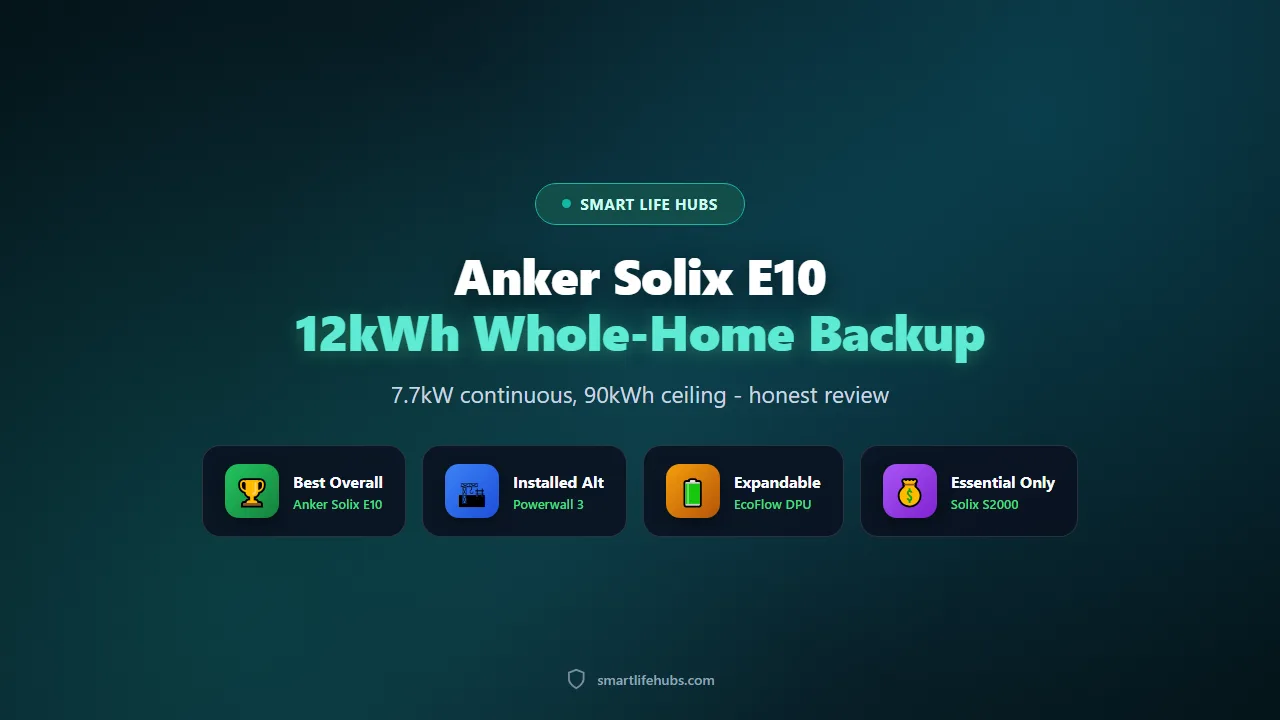
The Anker SOLIX E10 is not a portable power station. It is a 7,680W, 120/240V whole-home energy system made of a power module, stackable 6,144Wh LiFePO4 batteries and an optional smart electrical panel, and it is designed to sit on a wall or a garage floor and keep a house running when the grid drops. I reviewed a two-battery installation over several weeks, and the honest summary is that it is genuinely capable and unusually expandable, but the list title’s promise of no electrician is wrong, because the whole-home hookup requires a licensed one.
Let me correct that up front, because it matters more than any spec. The E10 can charge from a 120V outlet, but to power your home’s circuits it needs either the Power Dock, the Smart Inlet Box, or an existing transfer switch, and all three are wired into your consumer unit by a qualified electrician. A two-battery system with the Power Dock and a local electrician cost a little over ten thousand dollars in one published installation. If you want plug-and-play, the EcoFlow Stream Ultra X or the Anker Solarbank are the products that do that. If you want whole-home backup and you are willing to pay for a proper install, the E10 is one of the most flexible systems available.
Prices below are US retail captured in November 2026 and they move with configuration, so treat them as starting points rather than quotes.
At a glance
| Product | Best for | Key specs | Price |
|---|---|---|---|
| Anker SOLIX E10 | Best overall | 7,680W continuous, 6,144Wh per B6000 battery, 9kW solar input | From 3,999 USD |
| Anker SOLIX E10 Prime | 12kWh out of the box | Power module plus two B6000 batteries, 10kW turbo output | About 5,799 USD |
| Tesla Powerwall 3 | Best installed alternative | 13.5kWh per unit, 11.5kW continuous, built-in solar inverter | About 13,500 USD installed |
| EcoFlow DELTA Pro Ultra | Best expandable alternative | 12.3kWh starting, 12kW continuous, expands to 180kWh | About 7,899 USD for 12kWh |
| Anker SOLIX S2000 | Best portable instead | 2,010Wh, 1,500W, 10ms UPS, 35.7 lb | About 649 to 1,199 USD |
The Anker SOLIX E10 and its closest rivals
1. Anker SOLIX E10, best overall
The E10 is a wall- or floor-mounted system built around a power module and one to five B6000 battery modules of 6,144Wh each, with up to three power modules on one Power Dock for a ceiling of about 90kWh. The power module delivers 7,680W continuous at 120/240V split phase and 10,000W for up to 90 minutes with two or more batteries, which is enough to start most residential central air conditioning. Solar input is 9,000W across two MPPT channels, AC charging is 1,800W from a 120V outlet and 7,680W at 240V, and it accepts Anker’s tri-fuel generator for automatic recharging. The Power Dock adds a 200A transfer panel with up to 12 smart circuits and a 20 millisecond switchover. It is UL 9540 and UL 9540A certified, NEMA 4 for indoor or outdoor use, and warranted for 5 years on the power module and batteries.
Pros
- 7,680W continuous and 10kW turbo, enough for central air starting
- Scales from 6kWh to about 90kWh with extra batteries and modules
- UL 9540 certified, NEMA 4, with a 20ms Power Dock switchover
Cons
- Whole-home hookup requires a licensed electrician and a transfer panel
- A 12kWh two-battery install with the Power Dock runs well over 10,000 USD
Check today’s price on Amazon.
2. Anker SOLIX E10 Prime, 12kWh out of the box
The Prime kit is the easier way to buy the same system: the power module plus two B6000 batteries for 12,000Wh, at about 5,799 USD, with the same 10kW turbo output and the same expansion path to 90kWh. You get 9,000W of solar input and the ability to add Anker’s Smart Generator 5500 for automatic recharging. The Prime is the configuration most buyers should start with, because it gives you a realistic amount of storage for a whole evening and leaves room to grow, and it avoids the awkward half-empty state of the single-battery base system.
Pros
- 12kWh in the box, a realistic amount for a whole evening
- Same 10kW turbo output and 9,000W solar input as the base unit
- Expands to 90kWh without replacing the inverter hardware
Cons
- About 5,799 USD before the panel and the electrician
- Still needs a professional for any whole-home connection
Check today’s price on Amazon.
3. Tesla Powerwall 3, best installed alternative
The Powerwall 3 is the incumbent and the benchmark the E10 is measured against. Each unit stores 13.5kWh, delivers 11.5kW continuous, starts large motors at 185 LRA, and has a built-in solar inverter taking up to 20kW DC across six MPPTs, so it does not need a separate inverter. It is rated for indoor and outdoor use at NEMA 3R with an IP67 battery, warranted for 10 years at 70 percent capacity, and supports up to four units plus three expansion units. The honest trade-off is price and access: a single installed Powerwall 3 typically runs about 13,500 USD before incentives, and you buy it through Tesla or a certified installer rather than a retailer. If you want a permanent, fully permitted system with the deepest solar integration, the Tesla is still the easier purchase.
Pros
- 13.5kWh and 11.5kW per unit with a built-in solar inverter
- 10-year warranty and a mature certified installer network
- Up to four units plus expansion, with strong solar integration
Cons
- About 13,500 USD installed, well above the E10 kit price
- Sold through Tesla installers, not a normal retail purchase
Check today’s price on Amazon.
4. EcoFlow DELTA Pro Ultra, best expandable alternative
The DELTA Pro Ultra is the E10’s closest competitor on paper. It starts at 12.3kWh and 12kW continuous, takes 10,000W of solar, works with a generator, and expands to 180kWh, which is double the E10’s ceiling. It is modular and can be installed by an electrician with a Smart Home Panel 3 or a transfer switch, and a 12kWh configuration was listed at about 7,899 USD. The trade-offs are a less established whole-home ecosystem in North America and a configuration process that is easier to get wrong, so get an installer who knows the product before you commit.
Pros
- 12.3kWh and 12kW starting, expanding to 180kWh
- 10,000W solar input and generator support
- About 7,899 USD for a 12kWh configuration
Cons
- Requires an electrician and a Smart Home Panel 3 or transfer switch
- Whole-home ecosystem less established than Tesla or Anker
Check today’s price on Amazon.
5. Anker SOLIX S2000, best portable instead
The S2000 is here as the honest alternative for a different problem. It is a 2,010Wh LiFePO4 power station with a 1,500W continuous and 3,000W surge output, a 10 millisecond UPS switchover, 400W of solar input and a five-year warranty, at 35.7 pounds. It will keep a desktop computer, a modem and a few lights running through a cut, and it will run a fridge for a long time, but it will not run a house. If your goal is backup for a home office and a few essentials rather than whole-home coverage, it costs a fraction of the E10 and needs no electrician at all.
Pros
- 2,010Wh with a 10ms UPS switchover for computers
- 35.7 lb and about 649 to 1,199 USD depending on the sale
- Five-year warranty and 10,000 cycle rating
Cons
- Cannot power a whole home or a large appliance load
- 400W solar input is modest for recharging
Check today’s price on Amazon.
How to choose between the E10 and its rivals
Start by deciding whether you want whole-home backup or essential-circuit backup, because that decides the product class. Whole-home means a wired system with a transfer panel, an electrician and a permit, and the E10, Powerwall 3 and Delta Pro Ultra are in that class. Essential-circuit backup can be done with a large portable station or a few dedicated circuits, and it costs a tenth as much. Most households are happier with essential-circuit coverage plus a small generator than with a five-figure whole-home system.
Then count what you actually need to run, because the capacity numbers flatter the hardware. A 12kWh battery sounds large, but a central air conditioner can draw 3 to 5kW, an electric water heater 4.5kW and a clothes dryer 3kW, so one large appliance can eat a quarter of the bank in an hour. A realistic whole-home backup plan covers lights, refrigeration, networking and a few outlets, not the heavy loads, and the E10’s 10kW turbo output is what lets it start an air conditioner even though it cannot run it for long.
Check the installation path before you fall in love with a spec. The E10 needs a Power Dock or Smart Inlet Box and a licensed electrician, the Powerwall 3 needs a Tesla certified installer, and the Delta Pro Ultra needs a Smart Home Panel or a transfer switch. Ask two local electricians for a quote before you buy, because the labour and the permit can cost as much as the hardware and some panels are easier to work with than others.
Look at the warranty and the certification, because this is a 10-year purchase. Anker gives 5 years on the E10 power module and batteries and 10 years on the Power Dock, Tesla gives 10 years at 70 percent on the Powerwall 3, and both carry the UL 9540 safety certification that your inspector will ask about. A cheaper uncertified system may not pass inspection, which matters more than the saving.
Finally, price the expansion, not just the starting kit. The E10’s 90kWh ceiling is real but expensive, because each additional B6000 battery is a separate 6,144Wh purchase, and the Powerwall 3’s four-unit limit means a bigger home may need a different plan entirely. A detailed independent review at solargenreview.com/articles/anker-solix-e10-review walks through the configurations and the real installed cost in more detail.
Living with the E10
Plan the physical layout before the delivery, because this is a heavy system. The power module is 60.6 pounds and each B6000 battery is 130 pounds, so you need a floor or a wall that can take the load, a dry and ventilated space, and clearance for the cables to the panel and the batteries. A garage or a utility room is the usual spot. The NEMA 4 rating means it can live outside in many climates, but direct sun shortens battery life, so shade it.
Get the circuit selection right at the panel, because that is the decision you will live with. The Power Dock manages up to 12 smart circuits, and the sensible set is lights, refrigeration, networking, a few kitchen outlets and the furnace fan, with the air conditioner, the oven, the dryer and the water heater left out unless you have the capacity and the budget to cover them. Label the circuits clearly in the app so you can shed loads in an outage.
Let the system learn your usage before you optimise. The app will report consumption by circuit and solar production, and the first fortnight is best spent watching rather than changing settings. Once you know which circuits actually matter, set the reserve level, the charge window and the export behaviour to match your tariff, because a battery on the wrong schedule can cost you money rather than save it.
Test the switchover once, deliberately. Wait for a quiet moment, have the installer or the app trigger a simulated outage, and confirm that the critical circuits stay up and that nothing important is on a circuit you left out. A system that has never been tested is a gamble, and the test takes five minutes.
Maintain it lightly but do maintain it. Keep the vents and the battery compartment clear, check the cable connections after the first month, and update the firmware when Anker releases it. The battery is warranted for 5 years and the Power Dock for 10, so a 10-year relationship is the expectation, and a system that is installed and ignored is the one that fails early. For the solar side of the setup, our guide to the best balcony solar plants covers the panels, and the EcoFlow Stream Ultra X review covers the simpler battery route if the E10 turns out to be more than you need.
Frequently asked questions
Frequently Asked Questions
6Do I need an electrician for the Anker SOLIX E10?
Yes, for any whole-home connection. The E10 can charge from a 120V outlet, but powering your home’s circuits needs the Power Dock, the Smart Inlet Box or an existing transfer switch, all of which are wired into your consumer unit by a licensed electrician. There is no legal plug-in route to whole-home backup.
How much does a full E10 installation cost?
A two-battery system with the Power Dock, the Smart Generator and a local electrician cost a little over 10,000 USD in one published installation, with the hardware alone around 5,799 to 7,799 USD depending on the configuration. Get two local quotes, because labour and permits vary widely.
Can the E10 run central air conditioning?
It can start most residential central air systems with its 10kW turbo output and the LRA rating, but running one for long will drain a 12kWh bank quickly. Air conditioning is the load most likely to force you to add batteries or leave it off the backup list.
How long will the E10 power a home during an outage?
It depends on the load. Two batteries hold about 12.3kWh, which one reviewer found covered a typical home’s normal demand for around 10 to 12 hours a day in testing. Add a large appliance and that drops fast, so the honest answer is a day of background loads rather than a day of everything.
Is the E10 expandable?
Yes, unusually so. A single power module takes up to five B6000 batteries for about 30.7kWh, and up to three power modules can run on one Power Dock for about 90kWh. Extra batteries are a DIY add-on once the panel is installed, which is one of the E10’s genuine advantages over a sealed unit.
What is the warranty?
Anker warrants the power module and the batteries for 5 years, the Power Dock and Smart Inlet Box for 10 years, and the Smart Generator 5500 for 3 years. The battery modules are LiFePO4 rated for 4,000 cycles to 80 percent capacity.
The bottom line
The Anker SOLIX E10 is a genuinely strong whole-home battery, and the 7,680W continuous output, the 10kW turbo mode, the 9,000W solar input and the expansion path to 90kWh make it the most flexible system in this roundup. The 20 millisecond Power Dock switchover and the UL 9540 certification are the details that matter for a permanent install.
But the title of the list entry is wrong, and it is worth saying plainly: this is not a no-electrician product. The whole-home connection needs a licensed electrician and a transfer panel, and a realistic two-battery install lands around ten thousand dollars. If you wanted plug-and-play, buy the EcoFlow Stream Ultra X or the Anker Solarbank instead, and save several thousand dollars.
Against the alternatives, the Tesla Powerwall 3 is the better choice if you want a fully permitted, installer-managed system with the deepest solar integration and you can accept the higher price. The EcoFlow Delta Pro Ultra is the one to price if you want a larger expansion ceiling. And if whole-home coverage is more than you actually need, the Anker SOLIX S2000 is the honest essential-circuit answer.



Leave a Comment